The rapid rise of generative AI is reshaping digital content production and driving Adobe’s transformation from a traditional software provider to an AI-driven creative infrastructure platform. As demand grows for intelligent marketing, automated content generation, and digital office solutions, Adobe’s technology strategy is influencing not only the design sector but also expanding into advertising, media, e-commerce, and enterprise services.
From its corporate history, core business ecosystem, and AI innovation to the competitive landscape, Adobe’s business model is undergoing a pivotal upgrade. Understanding how Adobe integrates software subscriptions, artificial intelligence, and enterprise services is essential for analyzing the long-term growth prospects and potential risks behind ADBE stock.
What Is Adobe (ADBE)? Company Background and Development

Founded in 1982 and headquartered in California, Adobe is one of the world’s most influential digital content software companies. The company first entered the technology market with the PostScript page description language, which revolutionized desktop publishing and became a foundation for modern digital printing.
In 1987, Adobe introduced Illustrator, followed by Photoshop in 1990. With its robust image editing capabilities, Photoshop became the global standard for designers, photographers, and advertisers, establishing Adobe as a leader in digital creative software.
As the internet and digital media evolved in the 21st century, Adobe shifted from single software licensing to a cloud subscription model. Around 2013, Adobe launched Creative Cloud, integrating Photoshop, Illustrator, Premiere Pro, and other products into the cloud, offering ongoing updates and services through membership subscriptions.
This strategic shift transformed Adobe’s revenue structure. Compared to traditional one-time software sales, the subscription model increased revenue stability and user retention, enabling sustained investment in R&D.
Recently, Adobe has expanded its enterprise digital experience business through acquisitions like Magento and Marketo, strengthening its position in e-commerce, marketing automation, and enterprise customer management.
Today, Adobe’s comprehensive software ecosystem includes creative software, digital documents, and enterprise digital experience.
Adobe’s Core Business Segments
Adobe’s primary businesses are divided into three core segments:
Creative Cloud: Digital Content Creation Ecosystem
Creative Cloud is Adobe’s largest business segment and the cornerstone of its brand influence.
The platform includes:
- Photoshop: Image editing and AI-powered image generation
- Illustrator: Vector design
- Premiere Pro: Video editing
- After Effects: Motion graphics and visual effects
- Lightroom: Photography management and processing
- InDesign: Publishing design
Creative Cloud serves individual creators, design agencies, film studios, advertising firms, and enterprise design teams.
With the rise of short videos, social media, e-commerce content, and digital advertising, global demand for visual content is surging. Adobe leverages professional tools, cloud collaboration, and AI-assisted features to boost creator productivity and strengthen its user ecosystem.
Document Cloud: Digital Document and Office Ecosystem
Document Cloud centers on PDF and electronic signature services, with Acrobat as its flagship product.
As businesses digitize their operations, PDF has become the global standard for document exchange. Adobe provides:
- PDF creation and editing
- File management
- Electronic signatures
- Automated document processing
Generative AI integration further enhances Document Cloud’s value. AI can summarize lengthy documents, extract key information, and generate content summaries, reducing information processing costs for enterprises.
Experience Cloud is Adobe’s key offering for large enterprise clients.
The platform delivers:
- Customer data management
- Digital advertising analytics
- Content management
- Personalized marketing
- User experience optimization
In the digital economy, competition increasingly hinges on user data and precision marketing. Adobe Experience Cloud combines data analytics, content management, and marketing tools to help businesses improve customer conversion rates.
Unlike standalone software tools, Experience Cloud functions as enterprise digital infrastructure, offering higher customer value and long-term renewal potential.
Building a Business Ecosystem: Creative Cloud, Document Cloud, and Experience Cloud
Adobe’s competitive edge lies in the synergy among its three cloud platforms—not just individual software products.
Creative Cloud powers content creation, Document Cloud facilitates content circulation and office collaboration, and Experience Cloud drives content distribution and business conversion.
For example, a company might use Photoshop for marketing materials, Acrobat for document management, and Experience Cloud to analyze user feedback and optimize marketing strategies.
This closed-loop capability enables Adobe to evolve from a “design software provider” to a platform company covering the entire content lifecycle.
Adobe’s subscription-based model encourages users to adopt the full ecosystem long-term rather than single products. For professionals, learning curves, workflow integration, and file compatibility create significant barriers to switching.
These factors help Adobe maintain its competitive advantage over time.
Generative AI: Driving Adobe Product Innovation
Generative AI is transforming digital content creation and is a strategic focus for Adobe’s future growth. Traditionally, designers and creators relied on specialized skills to perform repetitive tasks—like adjusting images, generating assets, editing video clips, and refining marketing copy. Generative AI, with natural language processing and automation, lowers the barrier to content production and enhances creative efficiency.
Adobe’s AI strategy is not simply about adding features—it’s about deeply integrating AI into creative workflows, making it a core capability of Creative Cloud, Document Cloud, and Experience Cloud.
In Creative Cloud, AI enables:
- Automatic generation of image elements
- Intelligent expansion of image boundaries
- Automated style adjustments
- Rapid design draft creation
- Streamlined video editing workflows
For professionals, AI is a productivity enhancer—not a replacement. Designers can focus on creative decisions, branding, and artistic direction, while spending less time on repetitive tasks.
In the enterprise market, AI expands Adobe’s value proposition. Marketing teams can use AI to quickly generate ad materials, personalized content, and customer communications, boosting digital marketing efficiency.
Adobe is also integrating AI with its data ecosystem. By analyzing user behavior, content performance, and market feedback, AI helps businesses develop targeted marketing strategies, supporting the entire chain from content creation to business conversion.
Adobe Firefly: Transforming Content Creation Workflows
Adobe Firefly is Adobe’s generative AI model system and a flagship product in AI content generation.
Unlike generic AI image tools, Adobe Firefly is tailored for commercial creative scenarios. Through managed training data, copyright protection, and deep integration with Creative Cloud, Adobe aims to offer enterprise users a secure and reliable AI creative environment.
Firefly is being incorporated into core products like Photoshop and Illustrator, including:
Generative Fill
Generative Fill is a key AI feature in Photoshop, allowing users to add, remove, or modify image content via text prompts.
For example, users can instruct: “add a city background,” “change the sky,” or “remove a person,” and AI will automatically adjust the image while preserving its style. This streamlines complex edits into simple commands.
Text to Image
Firefly enables users to generate visual assets from text descriptions, facilitating rapid concept design, marketing imagery, and creative drafts.
For advertising, e-commerce, and social media teams, this shortens content production cycles significantly.
AI Video and Multimodal Creation
As generative AI advances, Adobe is exploring video generation, audio processing, and multimodal content creation. In the future, creators may generate complete video segments, animations, or branded content from text prompts or simple assets.
This evolution further elevates Adobe’s role in the digital creative industry.
Adobe’s Competitive Advantages in Digital Marketing, Design, and Enterprise Services
Adobe’s core strengths stem from brand equity, ecosystem integration, and enterprise service capabilities. The company has a long-standing presence in professional creative fields. Photoshop, Illustrator, and Premiere Pro are industry standards in design, film, and advertising. Many professionals, educational institutions, and enterprises have built workflows around Adobe tools, fostering strong user loyalty.
Adobe offers a comprehensive software ecosystem. Unlike single-tool providers, Adobe covers the full chain from creative production to commercial application:
- Creatives produce content with Creative Cloud
- Enterprises manage information via Document Cloud
- Marketing teams leverage Experience Cloud for analytics and conversion
This ecosystem connectivity sets Adobe apart from traditional design software companies.
Adobe is highly competitive in the enterprise space. Large organizations value software vendors for data security, reliability, enterprise support, and system integration. Adobe’s extensive experience serving global enterprise clients underpins its business credibility.
Adobe vs Canva, Microsoft, and Salesforce

With the rise of AI-powered content creation, Adobe faces competition from multiple fronts.
Adobe vs Canva
Canva is one of the fastest-growing design platforms, known for its ease of use and low learning curve.
Canva targets non-professional users, offering template-based design to lower barriers, making it ideal for:
- Small business marketing
- Social media content
- Basic design needs
Adobe, by contrast, is focused on professional creators and enterprise markets.
The positioning is clear:
Canva emphasizes fast design and mass adoption;
Adobe emphasizes professional capability, complex creation, and enterprise-grade workflows.
Both companies are lowering design barriers with AI, but Adobe’s professional tool ecosystem remains a distinct advantage.
Adobe vs Microsoft
Microsoft’s AI strategy centers on office productivity, such as Microsoft 365, Copilot, and enterprise tools.
Microsoft’s strengths include:
- Large enterprise user base
- Mature office software ecosystem
- Robust cloud infrastructure
Adobe focuses on content creation, digital experience, and marketing.
While not direct competitors, the companies overlap in AI enterprise applications.
Adobe vs Salesforce
Salesforce is a leader in CRM and customer data management.
Salesforce addresses:
- Customer relationship management
- Sales automation
- Enterprise data analytics
Adobe Experience Cloud focuses on digital experience, content management, and marketing optimization.
As AI marketing evolves, the two may increasingly compete in enterprise intelligent services.
Key Risks for ADBE Investors
While Adobe’s business foundation is strong, investing in ADBE stock requires awareness of several risk factors.
AI Competition May Reshape the Software Industry
Generative AI lowers content creation barriers and introduces new competitors. If AI-native creative tools advance rapidly, reliance on traditional professional software may decline.
Adobe must continually demonstrate that its AI products deliver efficiency and new business value.
Creative Software Market Growth May Slow
Adobe Creative Cloud already serves a mature user base. Future growth relies on:
- New user acquisition
- Enterprise client upgrades
- AI-driven value-added services
If digital content industry growth falls short, Adobe’s revenue expansion may slow.
Intensified Enterprise Software Competition
Adobe Experience Cloud faces competition from CRM, marketing automation, and cloud computing providers.
As enterprise digitalization deepens, clients may favor more comprehensive platform solutions.
AI Costs and Commercialization Challenges
Training and operating large AI models require substantial computing resources.
Adobe must balance AI investment, pricing, and user adoption. If AI feature costs are high and users are unwilling to pay, profitability may suffer.
Adobe’s Future Growth and Long-Term Potential
Adobe’s growth opportunities are rooted in AI-powered creation, enterprise digitalization, and the expanding content economy.
- AI will be a major growth driver for Adobe’s ecosystem. Historically, Adobe relied on subscription growth; going forward, AI features, advanced services, and enterprise solutions may boost per-user value. AI creative tools could become new premium offerings.
- Demand for digital content continues to rise. With the growth of short videos, e-commerce, gaming, virtual content, and brand marketing, businesses and individuals increasingly require high-quality digital assets. Adobe, as a foundational industry provider, stands to benefit.
- The enterprise digital experience market has enduring potential. Businesses depend on data analytics, personalized marketing, and automation to enhance competitiveness. Experience Cloud could be a key growth driver.
Long term, Adobe’s core competitiveness is evolving from “software tools” to “AI-powered content production and business ecosystem.”
Investing in Adobe (ADBE) via Gate Stock Trading
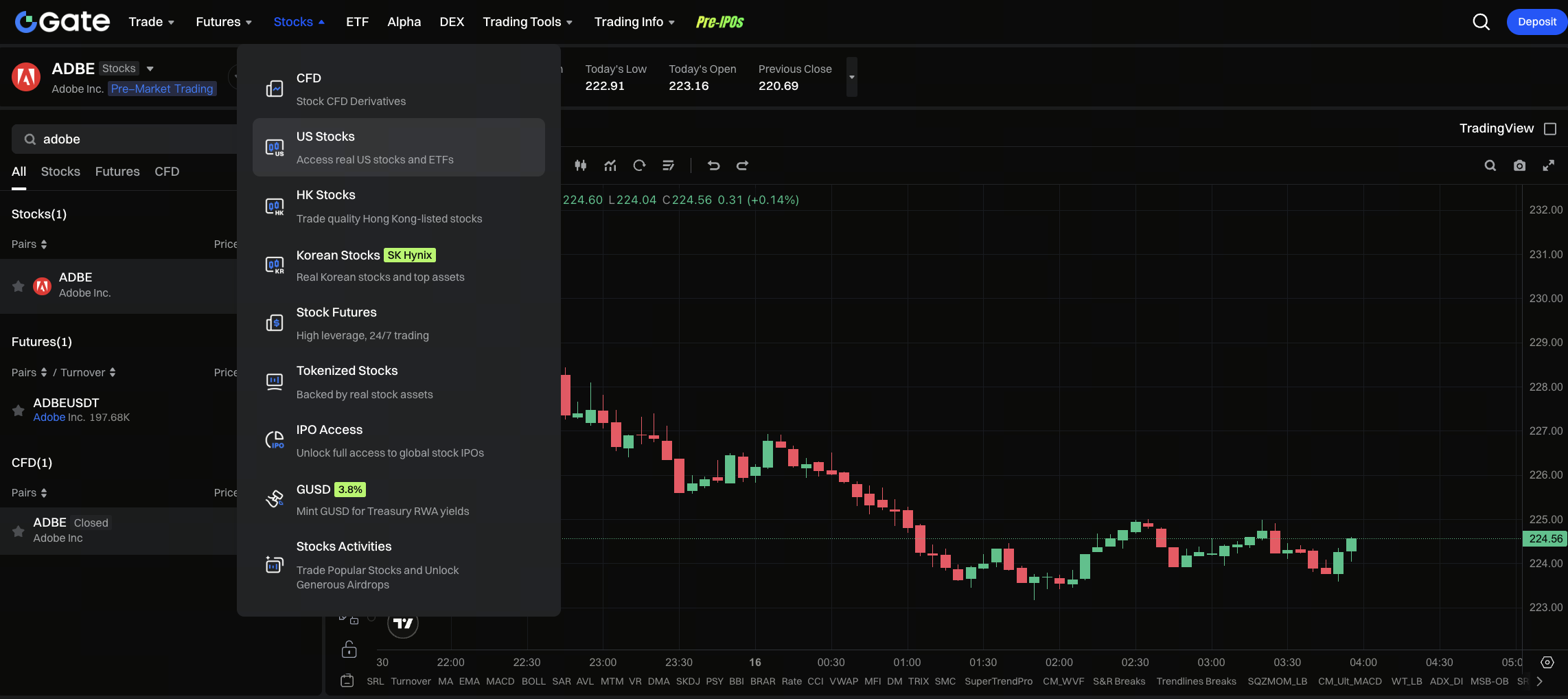
For investors seeking exposure to global tech companies, Adobe (ADBE) stock offers opportunities in digital creative software, enterprise SaaS, and AI-driven applications. As global interest in US technology firms grows, convenient and efficient trading channels are essential for asset allocation.
Gate Stock Trading provides access to major global markets, supporting US stocks, ETFs, and Hong Kong stocks. Users can manage global assets through a unified account and trade with USDT, simplifying cross-market fund conversion.
Gate Stock Trading covers over 11,000 stock assets, including 10,000+ US stocks and ETFs, and 1,000+ Hong Kong stocks, spanning the New York Stock Exchange (NYSE), Nasdaq, NYSE Arca, NYSE American, and BATS. Investors interested in Adobe, Microsoft, NVIDIA, and other tech giants can directly participate in their market performance via Gate Stock Trading.
The platform also supports fractional share trading, with a minimum of 0.01 shares, enabling flexible participation in high-value stocks. For example, when large tech companies like Adobe have high share prices, fractional shares lower entry barriers, allowing more users to diversify according to their financial plans.
With the long-term trends in AI, cloud computing, and the digital economy, tech companies like Adobe remain a focal point for global capital markets. Gate Stock Trading empowers investors to efficiently allocate global quality assets and adjust portfolios in response to market changes.
Summary
Adobe (ADBE) is a global tech leader that began with digital creative software and has built a comprehensive ecosystem spanning content creation, document management, and enterprise digital experience through Creative Cloud, Document Cloud, and Experience Cloud.
With generative AI advancing rapidly, Adobe is upgrading its products through Adobe Firefly, AI-assisted design, and intelligent marketing tools. Rather than simply offering AI generation tools, Adobe focuses on integrating AI into established software workflows and building a commercial ecosystem that addresses copyright, security, and enterprise needs.
Adobe’s ability to maintain industry leadership will depend on the pace of AI deployment, enterprise market competitiveness, and adaptability to new content creation trends.
For ADBE investors, Adobe continues to offer strong brand equity and ecosystem advantages, but must also monitor risks from AI competition, shifting market growth, and intensified enterprise software competition.
FAQs
What is Adobe (ADBE)?
Adobe (ADBE) is a global leading software company specializing in digital creativity, electronic documents, and enterprise digital experience. Its flagship products include Photoshop, Illustrator, Premiere Pro, Acrobat, and Experience Cloud.
What are Adobe’s main sources of revenue?
Adobe’s primary revenue comes from subscription services, including Creative Cloud, Document Cloud, and Experience Cloud. Creative Cloud is the largest segment.
What is Adobe Firefly?
Adobe Firefly is a generative AI model system developed by Adobe for image generation, design assistance, and content creation, integrated into products like Photoshop and Illustrator.
Will AI replace Adobe?
In the near term, AI is more likely to enhance Adobe’s products than to fully replace professional creative software. Adobe’s strengths include a mature software ecosystem, professional user base, and enterprise client network.
Is ADBE stock worth long-term attention?
Adobe offers stable subscription revenue, strong brand influence, and opportunities for AI-driven transformation. However, investors should remain mindful of risks from AI competition, changes in enterprise software markets, and growth rate fluctuations. Investment decisions should reflect individual risk tolerance and market context.