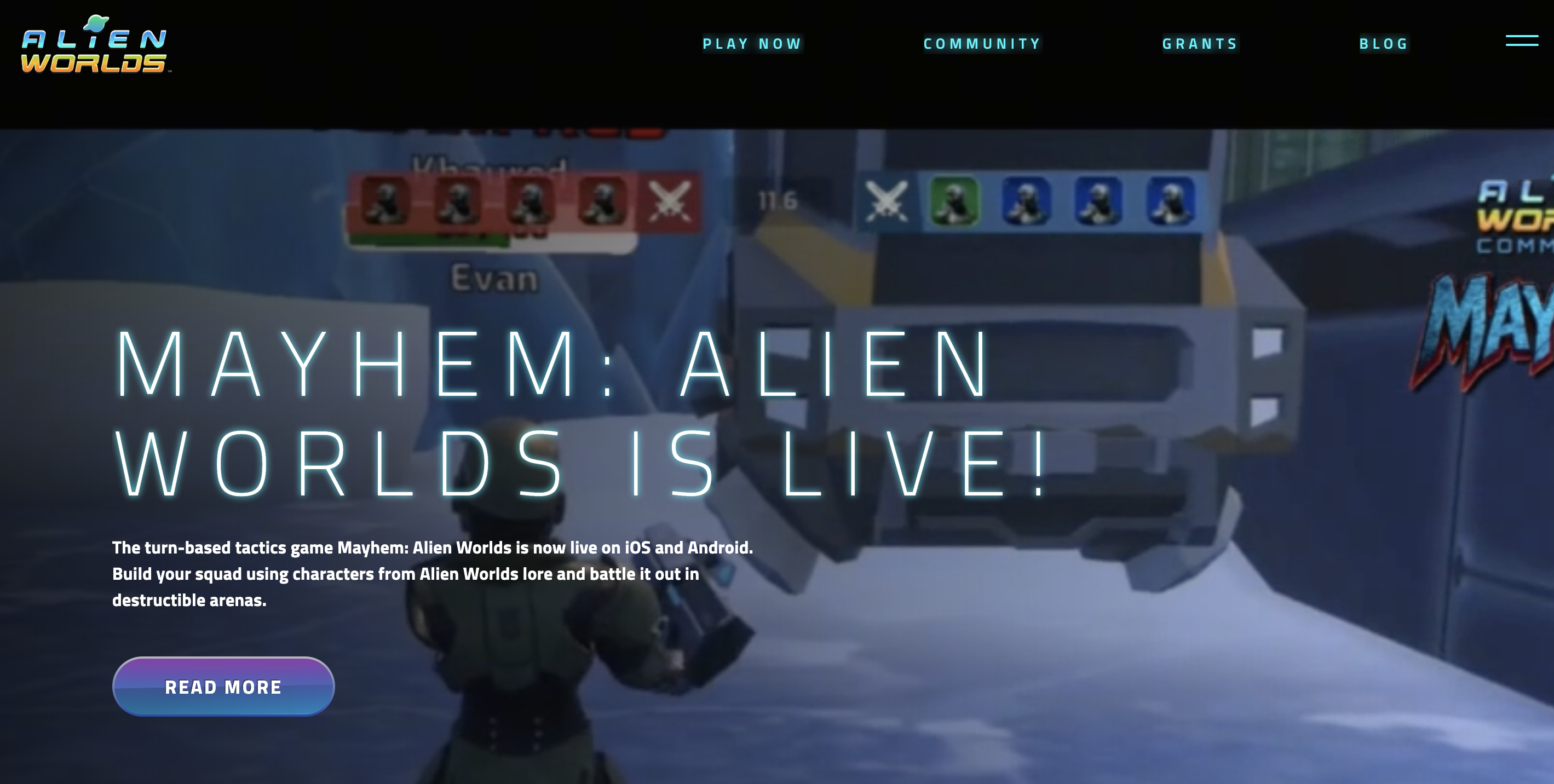
Alien Worlds (TLM) is a decentralized metaverse game ecosystem built on the blockchain. Its core mechanisms center on virtual planet exploration, NFT asset interactions, and a DAO governance structure, while the native token Trilium (TLM) serves as both the value carrier and incentive tool for the entire economic system. The project aims to redefine traditional gaming by leveraging on-chain mechanisms to overhaul asset ownership and yield distribution, shifting players from "content consumers" to "participants and governors of the virtual economy."
From a technological and industrial evolution standpoint, Alien Worlds’ significance goes beyond the game itself: it directly maps in-game actions to on-chain economic activity, automating asset ownership and revenue distribution through NFTs and tokens. This model breaks the traditional centralized gaming paradigm where developers hold absolute control over virtual assets and economies, empowering users to truly own their assets and participate in rule-making and governance. As Web3 and the Metaverse continue to converge, such on-chain economic experiments are becoming a foundational pillar of the GameFi sector.
From a macro perspective, Alien Worlds represents an early form of a "programmable virtual economy system." Its triad of NFT assets, token incentives, and DAO governance offers a verifiable operational model for decentralized gaming economies and serves as a key reference framework for subsequent GameFi and Metaverse projects.
Alien Worlds (TLM) Project Background and Development History
Alien Worlds was originally developed by Dacoco GmbH and officially launched around 2020, aiming to build a fully player-governed decentralized Metaverse ecosystem. Initially deployed on the WAX blockchain, it later expanded to BNB Chain and Ethereum, enhancing cross-chain asset liquidity and user reach.
The game features a virtual universe of six major planets, each managed by an independent Planet DAO. Players participate in governance by holding NFTs or staking TLM, influencing resource allocation, reward mechanisms, and the development direction of each planet. This design turns traditional game "server rules" into on-chain governance structures, making the rules themselves a participatory and competitive element.
During the peak of the GameFi craze, Alien Worlds was one of the most active Metaverse projects by on-chain users. Its "Mining + DAO + NFT" model became a benchmark early chain-game economic framework and influenced the design logic of numerous subsequent GameFi projects.
TLM Tokenomics and Ecological Incentive Mechanism
Trilium (TLM) is the core token of the Alien Worlds ecosystem, serving multiple functions including value exchange, governance voting, and reward distribution. It is the fundamental driver of the entire economic system.
TLM is issued through three primary sources: first, planet mining rewards — players earn base income by mining on different planets; second, mission and battle system rewards — players earn additional TLM by completing specific on-chain or in-game tasks; third, Planet DAO governance rewards — to incentivize user participation in governance.
For inflation control, TLM uses a dynamic release model that balances output speed with ecosystem consumption. Additionally, the system creates token burning pathways through NFT consumption, upgrade mechanisms, and governance lock-ups, mitigating unidirectional inflationary pressure.
In terms of incentive structure, player income depends not only on time invested but also on NFT rarity and hashrate weight. This creates an "asset-driven income" characteristic where users with higher-quality NFTs achieve greater earning efficiency.
How Alien Worlds Builds a Play-to-Earn Metaverse Game
Alien Worlds’ Play-to-Earn model is not just "click to mine and earn"; it is an on-chain economic cycle built through multiple layered mechanisms.
Players first choose a planet to mine, each with different resource output rates and governance rules. Mining consumes time and actions to earn TLM rewards, and players can use NFT tools to boost efficiency.
Beyond basic mining, the system introduces Missions and Battles, allowing players to earn extra rewards through more complex interactions. This diversifies income sources and deepens user engagement.
At its core, this Play-to-Earn model creates a closed loop of "action → income → reinvestment," enabling players to upgrade NFTs with their earnings and amplify future earning potential — a positive feedback cycle.
How Planet DAO, NFTs, and Trilium (TLM) Work
Planet DAO is the governance backbone of Alien Worlds. Each planet has its own DAO managing resource allocation, reward rules, and ecological direction. Players vote by staking TLM or holding governance NFTs, influencing planetary decisions.
NFTs serve multiple roles: tool NFTs, avatar NFTs, and land NFTs. Land NFTs are especially critical, directly impacting planet resource output and providing ongoing income to holders. Tool NFTs boost mining efficiency and mission rewards, while avatar NFTs affect performance in battle.
TLM acts as the value medium connecting all modules — used for governance voting weight, NFT trading, and reward distribution — forming a complete closed-loop economic structure.
Core Gameplay and Economic System Analysis of Alien Worlds
Mining is the primary income source — players select a planet, equip NFT tools, and earn TLM. Missions offer additional earning paths tied to resource exploration or on-chain activities. Battles introduce a competitive element with a high-risk, high-reward structure.
Economically, Alien Worlds uses "resource scarcity + NFT weight + DAO regulation" to create dynamic balance, fostering competition between planets and preventing resource concentration on any single one.
Alien Worlds’ Application in the GameFi and Metaverse Ecosystem
In the GameFi ecosystem, Alien Worlds is considered a pivotal early experiment in chain-game economic models, with its mechanisms widely referenced in later Play-to-Earn projects. For the Metaverse, it attempts to build an interplanetary economy where NFT assets can circulate across virtual spaces, enhancing composability.
Its DAO governance structure also provides a valuable experimental foundation for virtual world governance, enabling the community to directly shape economic system rules.
How Alien Worlds Differs from The Sandbox, Axie Infinity, and Pixels
Compared to The Sandbox, Alien Worlds leans more toward automated economic simulation rather than user-created worlds — its focus is resource allocation and economic modeling, not content creation. Versus Axie Infinity, Alien Worlds emphasizes DAO governance and a multi-planet structure, while Axie is driven by combat and pet breeding.
Compared to Pixels, Alien Worlds belongs to an earlier generation of chain games with more complex mechanics but a more basic user experience, prioritizing the economic system over graphics and interactivity.
What Risks Should Be Considered When Investing in TLM Tokens
TLM investment risks center on several factors. First, high token inflation pressure — the long-term release mechanism may weigh on price. Second, user activity is highly volatile, as GameFi projects often rely on cyclical excitement. Third, complex game mechanics may hinder new user retention. Finally, overall market sentiment toward GameFi is prone to sharp cyclical swings.
Thus, TLM is a high-volatility asset whose price performance closely tracks industry cycles rather than behaving as a stable store of value.
Future Development Direction and Market Potential of Alien Worlds
Alien Worlds’ future development is likely to focus on three areas. First, multi-chain ecosystem expansion to enhance asset liquidity via cross-chain interoperability. Second, DAO governance optimization for more efficient and transparent planetary management. Third, NFT functionality upgrades to improve composability and extensibility.
From an industry perspective, as Web3 gaming infrastructure matures, Alien Worlds could evolve from an early-stage experimental project into a more stable on-chain economic model, potentially gaining ground in the next GameFi cycle.
Conclusion
Alien Worlds (TLM) stands as an important early pioneer in Web3 Metaverse gaming, integrating NFTs, DAO, and tokenomics into a complete on-chain virtual economy. While its user experience and economic model still have room for improvement, its experimental significance and structural innovation in GameFi history remain undeniable, offering a valuable reference for future chain games and Metaverse projects.
FAQs
Q1: Is Alien Worlds still operational?
Yes, the project is still active, though overall activity has declined from its early peak.
Q2: What is the primary use of TLM?
It is used for governance voting, NFT transaction payments, and game reward distribution.
Q3: Is Alien Worlds a Metaverse or a chain game?
It is a hybrid, leaning more toward an on-chain economic simulation Metaverse game.
Q4: Can you earn money from Alien Worlds?
Yes, but earnings are highly dependent on market conditions and ecosystem activity.
Q5: What is the long-term outlook for Alien Worlds?
It depends on the GameFi industry cycle and how well the project optimizes its mechanisms.
Author: Max
Disclaimer
* The information is not intended to be and does not constitute financial advice or any other recommendation of any sort offered or endorsed by Gate.
* This article may not be reproduced, transmitted or copied without referencing Gate. Contravention is an infringement of Copyright Act and may be subject to legal action.
Solana faces both opportunities and challenges in its development. Recently, severe network congestion has led to a high transaction failure rate and increased fees. Consequently, some have suggested using Layer 2 and appchain technologies to address this issue. This article explores the feasibility of this strategy.
Sui is a PoS L1 blockchain with a novel architecture whose object-centric model enables parallelization of transactions through verifier level scaling. In this research paper the unique features of the Sui blockchain will be introduced, the economic prospects of SUI tokens will be presented, and it will be explained how investors can learn about which dApps are driving the use of the chain through the Sui application campaign.
This article introduces the technical principles, framework, and applications of Zero-Knowledge (ZK) technology, covering aspects from privacy, identity (ID), decentralized exchanges (DEX), to oracles.
Tronscan is a blockchain explorer that goes beyond the basics, offering wallet management, token tracking, smart contract insights, and governance participation. By 2025, it has evolved with enhanced security features, expanded analytics, cross-chain integration, and improved mobile experience. The platform now includes advanced biometric authentication, real-time transaction monitoring, and a comprehensive DeFi dashboard. Developers benefit from AI-powered smart contract analysis and improved testing environments, while users enjoy a unified multi-chain portfolio view and gesture-based navigation on mobile devices.