As mobile internet, cloud computing, the Internet of Things, and artificial intelligence continue to develop, global data traffic keeps rising, making telecom infrastructure increasingly important. Rather than directly participating in telecom operations, American Tower plays the role of an “infrastructure provider,” building and managing communication sites that give operators stable, long term resources for network coverage.
In today’s digital economy, communication towers have become critical infrastructure, much like highways, power grids, and data centers. With a site network spanning many countries and regions, American Tower has become one of the most important infrastructure companies in the global telecom value chain.
What Is AMT (American Tower)?
American Tower Corporation was founded in 1995 and is headquartered in Boston, Massachusetts. It is one of the world’s largest independent communication tower operators. The company trades under the ticker symbol AMT and operates as a real estate investment trust (REIT).
Unlike traditional real estate companies, American Tower’s main assets are not residential or commercial properties, but communication towers, wireless base stations, rooftop sites, and related digital infrastructure. These assets form a crucial part of modern wireless communication networks, providing mobile operators with the physical space needed to deploy network equipment.
American Tower’s core business logic does not depend on charging for communication services. Instead, it is built on infrastructure leasing. Operators lease space on towers to install telecom equipment, enabling network coverage and signal transmission, while American Tower earns revenue through long term lease contracts.
This model gives American Tower the stability of infrastructure assets while allowing it to benefit from growing demand driven by the continued expansion of the global mobile communications industry.
American Tower’s Development History and Market Position
American Tower initially served mainly the domestic wireless communications market in the United States. As the global mobile communications industry grew rapidly, the company gradually built an infrastructure network across multiple countries through asset acquisitions and international expansion.
After the industry entered the 4G era, widespread smartphone adoption drove a sharp increase in data traffic, and operators needed to build more base stations to improve network capacity. American Tower expanded its asset base quickly by riding this trend and gradually became a major player in the global communication tower industry.
In recent years, the company has further expanded into Latin America, Europe, Africa, and Asia. This international presence has not only given American Tower more growth opportunities, but also reduced the impact of volatility in any single market.
Today, American Tower has become an important platform connecting telecom operators, internet services, and digital infrastructure. Its market position is closer to that of a global telecom infrastructure operator than simply a traditional REIT.
How American Tower’s Communication Tower Business Works
American Tower’s core business is communication tower leasing. After building or acquiring communication towers, the company leases tower space to mobile operators for the installation of wireless equipment.
The most important feature of the communication tower industry is its shared infrastructure model. A single tower can usually host equipment from multiple operators, which means one asset can generate several streams of rental income at the same time. When a second or third operator joins the same site, the additional cost is relatively limited, while revenue can increase significantly.
This is known as the Multi-Tenant Model. The multi-tenant structure gives communication towers strong operating leverage and is an important source of American Tower’s profitability.
Compared with constantly building new network facilities, operators usually prefer to lease existing infrastructure. This approach can reduce capital expenditure, improve network deployment efficiency, and help tower operators build economies of scale.
Modern mobile communication networks are built through the combined efforts of operators, equipment manufacturers, and infrastructure providers. American Tower sits at the foundational infrastructure layer of this ecosystem.
Wireless operators need communication towers to deploy antennas and wireless equipment, allowing mobile networks to provide coverage. Whether users are browsing the web on a phone, watching videos, or making online payments, the signal transmission capabilities provided by communication sites are working behind the scenes.
American Tower helps operators reduce construction costs and improve network coverage efficiency by providing site resources. Since tower construction requires land resources, approval processes, and long term operating capabilities, the industry has relatively high barriers to entry.
This infrastructure nature makes American Tower one of the key supporting forces behind the global digital economy. Its role is similar to that of Equinix in the data center industry or pipeline operators in the energy sector.
Why 5G Network Construction Is Driving Growth in Tower Demand
Compared with 4G, 5G technology offers higher data transmission speeds and lower network latency, but it also requires a denser network coverage structure.
Because of the characteristics of 5G spectrum, operators need to deploy more wireless sites to achieve broad coverage. This means demand for communication towers is unlikely to decline. Instead, it may continue to grow as networks are upgraded.
Beyond traditional mobile communication services, the development of autonomous driving, industrial internet, smart cities, and IoT devices also depends on support from 5G infrastructure. The higher the demand for data transmission, the greater the need for network capacity and coverage density.
For American Tower, 5G construction is not a one time opportunity, but an important industry trend that supports long term infrastructure upgrades. This is also one of the key reasons the market continues to pay close attention to the communication tower industry.
American Tower’s Data Center and Digital Infrastructure Strategy
As the digital economy develops, the scope of communication infrastructure has gradually expanded from traditional towers to data centers, edge computing, and cloud connectivity services.
In recent years, American Tower has begun building out data center and digital infrastructure businesses in hopes of further diversifying its revenue sources. Compared with communication towers, data centers are responsible for data storage and computing functions. Together, the two form the infrastructure foundation that keeps the modern internet running.
The development of edge computing also creates new opportunities for American Tower. More applications now require low latency data processing, which means computing resources need to be deployed closer to end users.
By combining communication sites with digital infrastructure resources, American Tower is gradually transforming from a pure tower operator into an integrated digital infrastructure platform.
How American Tower Differs From Crown Castle and SBA Communications
American Tower, Crown Castle, and SBA Communications are often regarded as the most representative companies in the U.S. communication tower industry.
| Company |
Core Features |
Main Markets |
| AMT |
Broadest global footprint |
Multiple countries worldwide |
| Crown Castle |
Highly concentrated in the U.S. market |
United States |
| SBA Communications |
Smaller tower asset base |
Mainly the Americas |
American Tower’s defining feature is its international footprint. The company owns telecom infrastructure assets in multiple countries, allowing it to benefit from growth in mobile communications markets around the world.
Crown Castle, by contrast, is more focused on the U.S. market and has a strong presence in fiber networks and small cells. SBA Communications is relatively smaller in scale, but it is also focused on telecom infrastructure operations.
All three companies use similar leasing models, but their market coverage and growth strategies differ clearly.
What Are American Tower’s Main Use Cases?
American Tower’s infrastructure is widely used across mobile communications, internet access, enterprise networks, the Internet of Things, and other fields.
The most common use case is mobile phone communication networks. When users make calls, send messages, or use mobile data, communication signals usually need to be transmitted through base stations and towers.
Enterprise private networks, industrial automation, and smart city projects also rely on telecom infrastructure support. As the number of connected devices continues to rise, communication sites are becoming even more important.
In addition, the development of 5G networks, edge computing, and artificial intelligence applications is creating more digital service scenarios, making communication infrastructure a key foundational asset in the digital economy era.
How to Buy AMT (American Tower) Stock
AMT is the ticker symbol for American Tower Corporation, which is listed and traded on the New York Stock Exchange (NYSE). Traditionally, investors can buy AMT stock through securities accounts that support U.S. stock trading, allowing them to participate in the development of the global telecom infrastructure industry.
Because American Tower is a representative company in the REIT sector, its operating performance is closely tied to mobile communications development, data traffic growth, and digital infrastructure investment. As a result, it has attracted attention from many investors focused on the infrastructure space.
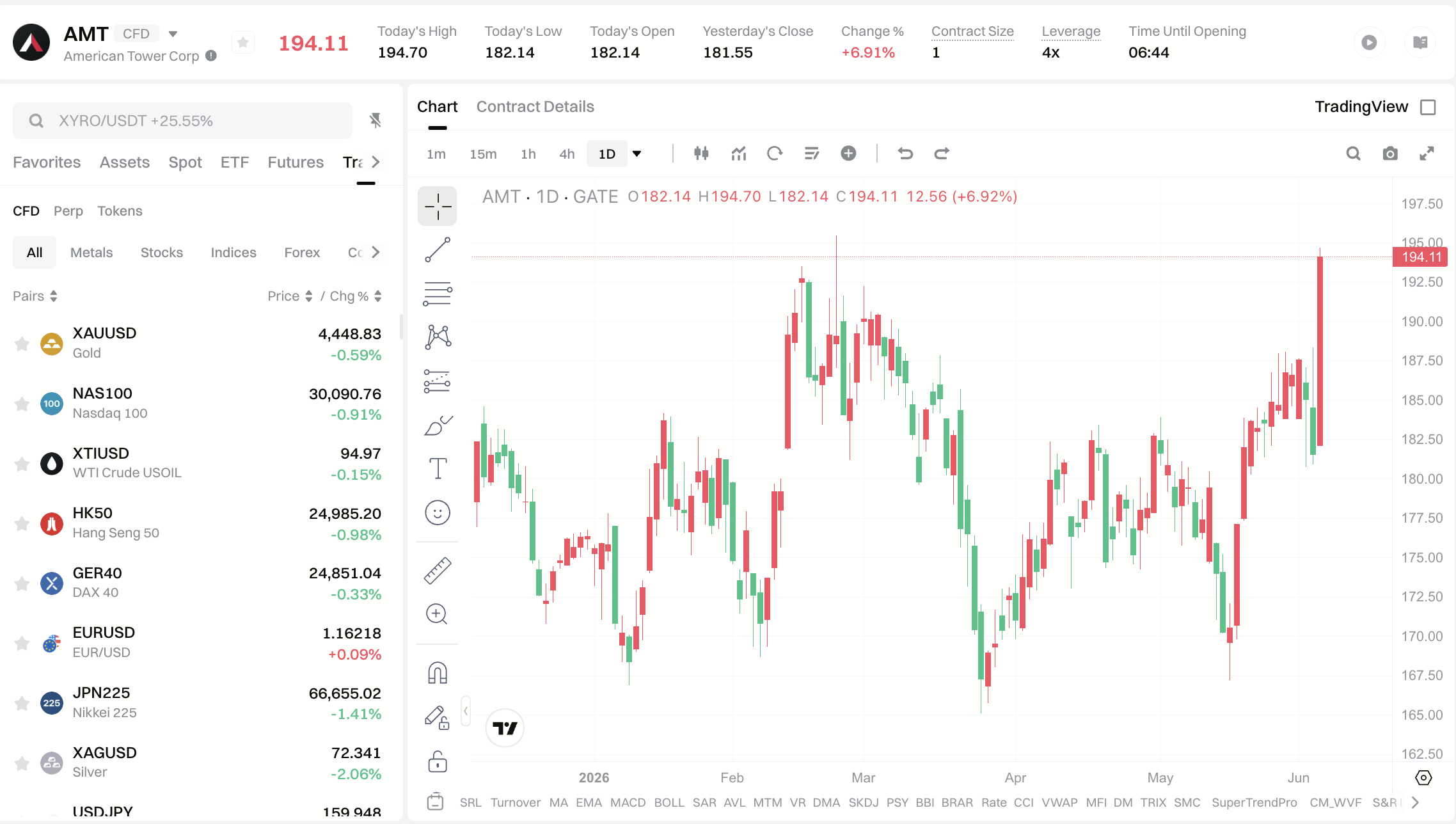
As digital asset markets and traditional financial markets gradually converge, more trading tools linked to the price movements of U.S. stocks and infrastructure assets have appeared in the market. For example, some platforms offer CFD products linked to related stock prices, allowing users to participate in market movements through price changes without directly holding the underlying shares.
Gate TradFi is continuing to expand its coverage of traditional financial assets, allowing users to monitor digital assets, U.S. stocks, ETFs, indices, and commodity markets within the same account environment. Some markets also offer Gate CFD products, providing more options for cross market asset management and price monitoring.
Regardless of how they participate in the market, investors should fully understand the product structure, trading rules, and regulatory requirements in their region.
American Tower’s Strengths and Limitations
American Tower’s greatest strength comes from its infrastructure attributes. Communication towers are costly to build, approval cycles are long, and suitable locations are clearly scarce in many areas, which makes the industry’s competitive landscape relatively stable.
The multi-tenant model can improve the profitability of individual assets, while long term lease contracts also make revenue relatively predictable. As global data traffic continues to grow, demand for telecom infrastructure still has long term support.
However, American Tower also faces certain challenges. Changes in telecom operators’ capital expenditure may affect short term demand, while shifts in the interest rate environment may influence the valuation performance of the REIT sector. In addition, regulatory environments and exchange rate fluctuations across different national markets can also affect the company’s international business.
As a result, American Tower combines the stable characteristics of the infrastructure industry with the complexity that comes from global operations.
Conclusion
American Tower is one of the world’s largest telecom infrastructure operators. Its core business is built on communication tower leasing, multi-tenant operations, and digital infrastructure development. As 5G network construction, mobile data traffic growth, and the continued expansion of the digital economy move forward, telecom infrastructure is becoming increasingly important. With its global asset footprint and long term leasing model, American Tower has become a key infrastructure provider in the global wireless communications ecosystem.
FAQs
What Kind of Company Is American Tower?
American Tower is a telecom infrastructure REIT that mainly provides site leasing services to wireless operators by owning and operating communication towers.
How Does AMT Make Money?
AMT primarily earns revenue from communication tower leasing. When multiple operators share the same tower, the asset’s profitability can improve.
Is American Tower a Real Estate Company?
American Tower operates under a REIT structure, but its core assets are communication towers and digital infrastructure rather than traditional commercial real estate.
Why Is 5G Beneficial for AMT?
5G networks require denser infrastructure deployment, which may drive demand for communication sites and increase demand for tower leasing.
What Is the Difference Between AMT and Crown Castle?
American Tower has a broader international business footprint, while Crown Castle is more focused on the U.S. market and places greater emphasis on fiber and small cell businesses.
Who Are American Tower’s Main Customers?
American Tower’s customers mainly include mobile operators, wireless network service providers, and some enterprise network service organizations.