As the number of Web3 applications continues to grow, traditional blockchains are coming under increasing pressure in terms of throughput, confirmation time, and scalability. Avalanche Consensus attempts to improve network efficiency through an approach that differs from traditional chain-based confirmation.
In today’s Layer1 public blockchain competition, the consensus mechanism affects not only network security, but also transaction confirmation speed, node coordination efficiency, and overall scalability. The Avalanche network, developed with the support of Ava Labs, uses Avalanche Consensus and the Snowman protocol as core components of its underlying architecture. This gives it distinctive characteristics in high-performance public blockchains and modular blockchain development.
The Origins of Avalanche Consensus
Avalanche Consensus originated from a series of studies on probabilistic consensus and randomized network communication. Its goal is to improve confirmation efficiency in blockchain networks without relying on energy-intensive mining.
Traditional PoW networks usually require users to wait for multiple block confirmations to reduce the risk of transaction rollback. Avalanche, by contrast, places greater emphasis on fast probabilistic finality. Nodes continuously sample and communicate locally, gradually forming network-wide agreement within a short period of time.
Avalanche later developed protocol structures such as Snowflake, Snowball, and Snowman, eventually forming the broader Snow family of protocols.
How Avalanche Consensus Works
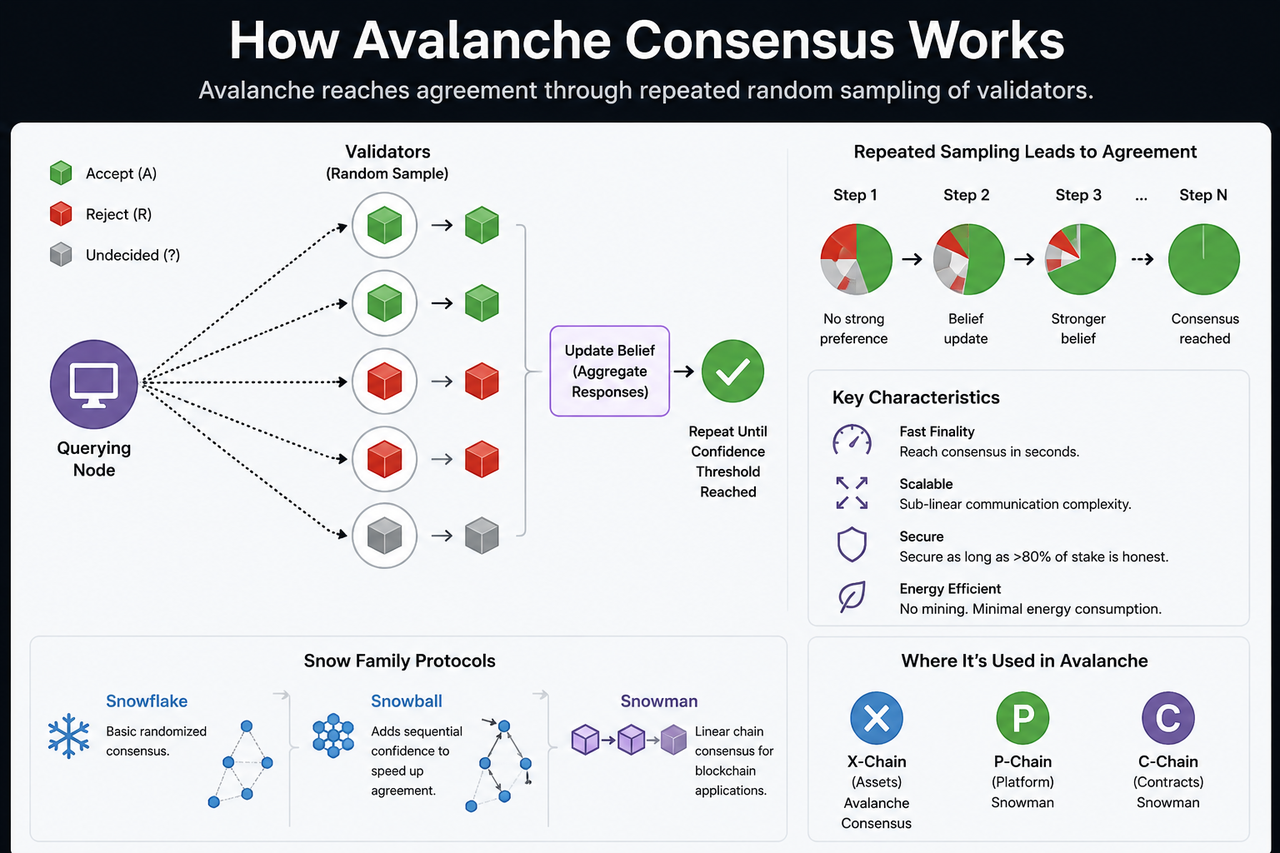
The core feature of Avalanche Consensus is its randomized sampling voting mechanism.
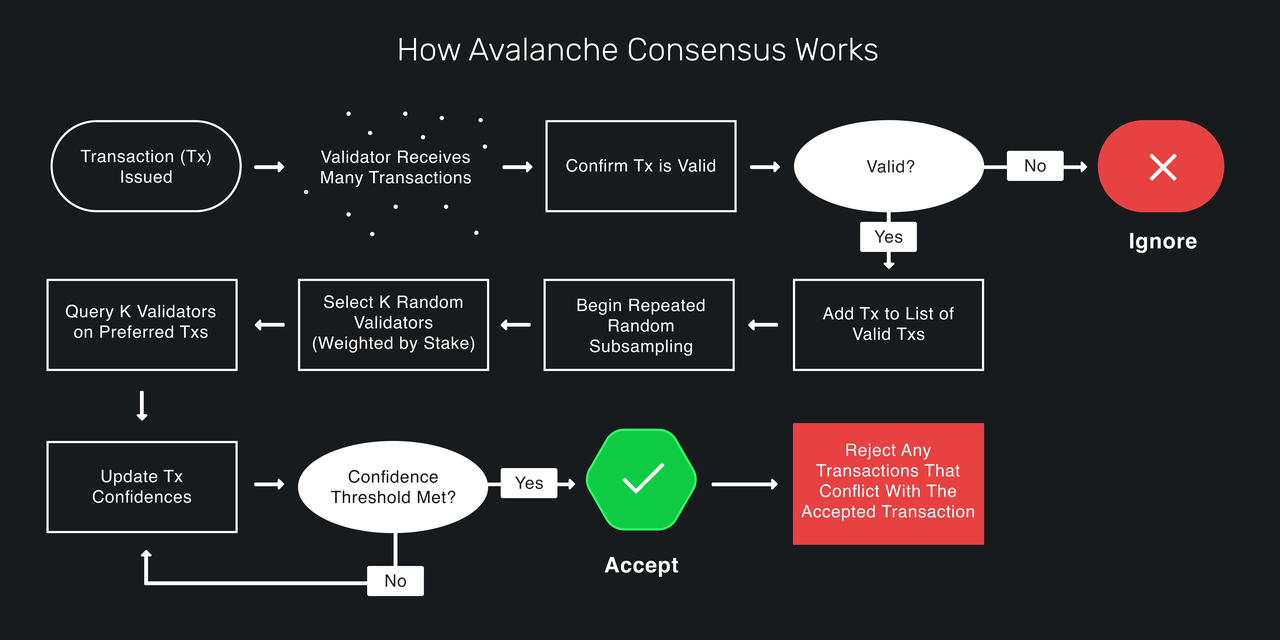
When a node receives a transaction, it does not immediately wait for confirmation from the entire network. Instead, it randomly queries a portion of validators. After validators return the results they support, the node updates its own preference based on the majority response.
As multiple rounds of randomized sampling continue, the entire network gradually converges on the same result.
$$P(A)=\frac{k}{n}$$
During this process, nodes do not need to communicate synchronously with every validator, which reduces network load and waiting time.
This design allows Avalanche to maintain decentralization while achieving faster transaction confirmation.
Snowflake, Snowball, and Snowman are different stages and protocol structures within the Avalanche consensus system.
Snowflake is the most basic randomized voting model. Nodes gradually form a preferred result through a small amount of random sampling.
Snowball builds on Snowflake by adding continuous preference counting. Nodes record the number of consecutive times they receive support for a preference, improving network stability.
Snowman is Avalanche’s linear chain-based version, making it better suited to scenarios that require strict block ordering, such as smart contracts and blockchain execution environments.
Because smart contract chains need to ensure consistent transaction ordering, Avalanche mainly uses the Snowman protocol on the C-Chain and P-Chain.
Why Avalanche Can Achieve Fast Finality
Avalanche’s fast finality is closely tied to its randomized sampling structure.
Traditional blockchains usually rely on the longest-chain rule to confirm transactions, which requires waiting for multiple new blocks to reduce fork risk. Avalanche nodes, on the other hand, continuously update results through local communication and quickly form probabilistic agreement.
This mechanism reduces the waiting time required for network-wide synchronization.
In addition, Avalanche’s validation process does not depend on the rotation of fixed block producers. As a result, even when network load increases, it can still maintain relatively stable confirmation efficiency.
In most cases, the Avalanche network can complete transaction finality within a short period of time.
How Avalanche Consensus Differs from PoW and PoS
Avalanche differs significantly from traditional PoW networks.
| Comparison |
Avalanche Consensus |
PoW |
| Validation method |
Randomized sampling and voting |
Hashpower competition |
| Energy consumption |
Relatively low |
High |
| Transaction confirmation |
Probabilistic convergence |
Accumulated block confirmations |
| Scalability |
Stronger |
Relatively limited |
Compared with traditional PoS, Avalanche also uses a staking-based validation model, but its consensus process does not rely on a fixed committee or a single block proposer. Instead, results are formed through dynamic randomized interactions.
This gives Avalanche clear differences from some classic PoS networks in both network communication structure and confirmation logic.
Why Snowman Is Suitable for Smart Contracts
Snowman is the linear protocol version of Avalanche Consensus, making it more suitable for smart contract scenarios.
Smart contract execution usually requires transaction ordering to remain consistent. Otherwise, state conflicts may occur. Compared with a DAG, or directed acyclic graph, structure, a linear chain can maintain a unified state order more easily.
For this reason, Avalanche uses the Snowman protocol on the C-Chain to support EVM and Solidity smart contract execution environments.
This structure preserves Avalanche’s randomized sampling advantages while also meeting the ordering consistency requirements of smart contracts.
Advantages and Limitations of Avalanche Consensus
The main advantages of Avalanche Consensus include high throughput, low latency, and relatively low energy consumption.
Its randomized sampling structure reduces the pressure of network-wide synchronization, while its probabilistic convergence mechanism improves transaction confirmation efficiency. In addition, Snowman strengthens Avalanche’s applicability in smart contract and modular blockchain scenarios.
However, the Avalanche consensus structure is relatively complex, which makes it harder for new users to understand. At the same time, its randomized sampling mechanism also depends on having a sufficient number of honest validators in the network.
Conclusion
Avalanche Consensus uses randomized sampling voting and the Snow family of protocols to achieve fast finality and scalability in high-performance blockchain networks.
Unlike traditional PoW networks or some classic PoS networks that rely on network-wide synchronous confirmation, Avalanche emphasizes local randomized interaction and probabilistic agreement. Snowman further meets the transaction ordering requirements of smart contract chains.
FAQs
What is the difference between Snowman and Avalanche Consensus?
Snowman is Avalanche’s linear chain-based consensus version, making it more suitable for smart contracts and block ordering scenarios.
Why is Avalanche’s confirmation speed fast?
Avalanche uses randomized sampling and probabilistic convergence, reducing the waiting time for network-wide synchronization and improving transaction confirmation efficiency.
Is Avalanche a PoS network?
Yes. Avalanche uses a staking-based validation model, but its consensus process differs from traditional PoS networks.
Does Avalanche Consensus support smart contracts?
Yes. Avalanche’s C-Chain uses the Snowman protocol and is compatible with the EVM smart contract environment.
What are the advantages of Avalanche Consensus?
The main advantages of Avalanche Consensus include high throughput, low latency, relatively low energy consumption, and strong scalability.







