As real-world asset (RWA) tokenization accelerates, traditional financial institutions are bringing assets like U.S. Treasuries, money market funds, and private funds onto blockchain networks. Unlike traditional funds that rely on banking and securities custody systems for trading and settlement, tokenized funds leverage blockchain to deliver more efficient asset registration, settlement, and digital management—giving institutional investors a more flexible way to manage capital.
Against this backdrop, BlackRock launched BUIDL (BlackRock USD Institutional Digital Liquidity Fund)—the first on-chain tokenized money market fund from the world's largest asset manager. Powered by the digital securities issuance and fund management infrastructure of Securitize, BUIDL serves as a critical bridge between traditional financial markets and the blockchain ecosystem, and has become one of the most emblematic institutional-grade products in the RWA space.
What Is BUIDL?
BUIDL (BlackRock USD Institutional Digital Liquidity Fund) is a tokenized USD money market fund for qualified institutional investors. Managed by BlackRock, it is supported by Securitize for digital securities issuance, investor onboarding, and on-chain operations.
Fund shares are issued as blockchain tokens, each representing a corresponding equity interest in the fund—not a standalone cryptocurrency. Investors hold fund shares that entitle them to the returns generated by the underlying assets.
The launch of BUIDL marks the first time a traditional money market fund has achieved a full on-chain lifecycle—from subscription and position management to income distribution—all enabled by blockchain infrastructure.
Why Was BUIDL Created?
In recent years, a growing number of traditional financial institutions have been exploring real-world asset tokenization, aiming to boost asset transfer efficiency through blockchain while preserving the regulatory framework of conventional financial products.
For money market funds, the traditional model typically involves settlement on business days, multiple intermediaries, and complex registration processes. Blockchain, by contrast, offers more transparent record-keeping, faster settlement, and programmable financial capabilities.
BlackRock launched BUIDL to explore how low-risk cash management products can integrate with blockchain infrastructure, providing institutional investors with a new on-chain USD liquidity management solution—while also paving the way for traditional financial assets to enter the digital asset ecosystem.
What Are BUIDL's Underlying Assets?
BUIDL does not invest in crypto assets. Instead, it invests in low-risk assets from traditional financial markets.
The fund's primary investment targets include:
| Asset Type |
Role |
| Short-Term U.S. Treasuries |
Provide a stable source of returns |
| Cash |
Meet liquidity needs |
| Repurchase Agreements |
Enhance short-term capital management |
Since its underlying assets are mainly high-liquidity, low-risk financial instruments, BUIDL is fundamentally a tokenized money market fund—not a stablecoin or crypto investment fund.
The fund is managed daily based on net asset value (NAV), and returns come from interest generated by the underlying assets, not from token price appreciation.
How Does BUIDL Generate Returns?
BUIDL's returns come from the traditional financial assets held in the fund's portfolio.
U.S. Treasuries and repurchase agreements continuously generate interest income. The fund manager credits this income to the fund's assets and distributes it to shareholders according to fund rules.
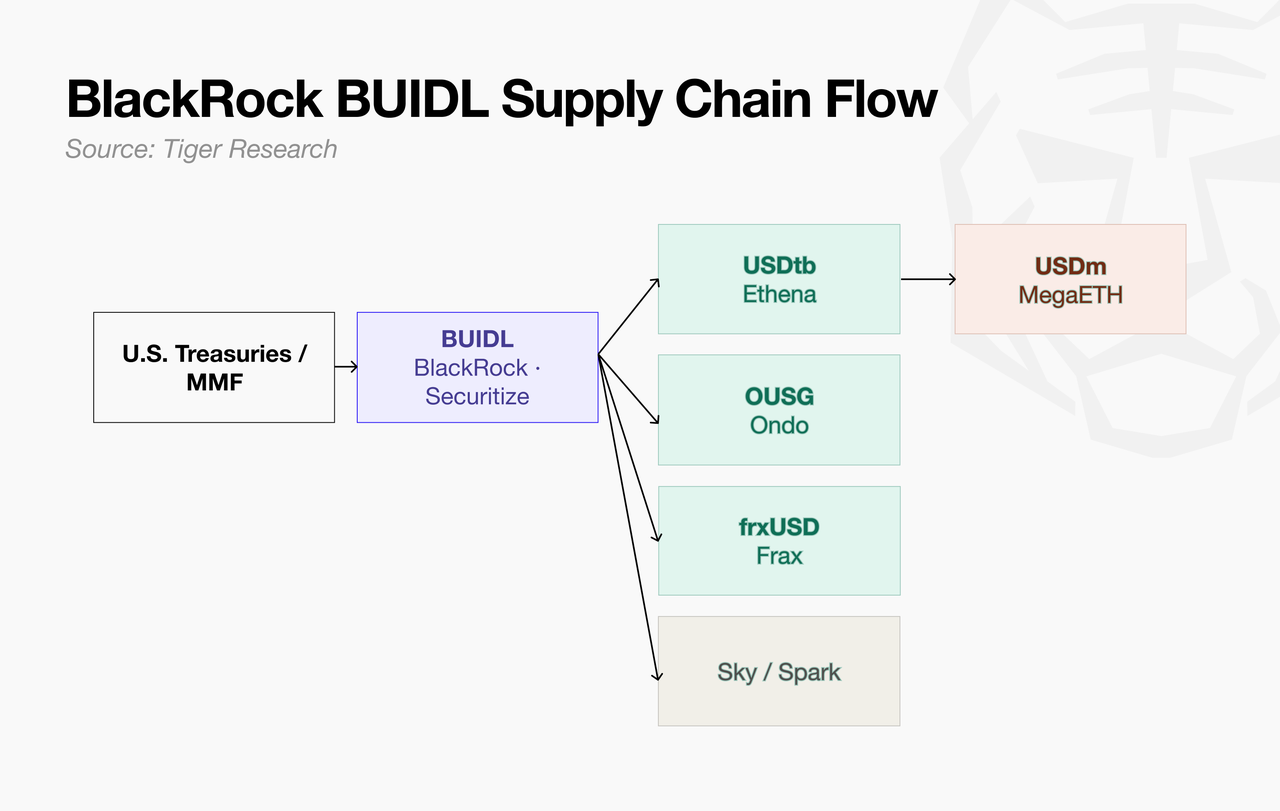
Because the shares are digitized, income distribution can be tied to on-chain records to manage investor entitlements, improving operational efficiency. However, returns still come from real-world financial assets, not from staking rewards or DeFi yields on the blockchain.
Therefore, BUIDL is closer to a digital version of a traditional money market fund than a high-yield on-chain investment product.
What's the Difference Between BUIDL and Stablecoins?
BUIDL and USD stablecoins both derive their value from USD-denominated assets, which can cause confusion—but their design purposes are clearly different.
Stablecoins are primarily used for payments, trading settlement, and on-chain liquidity. Their value is typically pegged to the U.S. dollar; they do not represent fund shares and do not automatically distribute returns from underlying assets.
BUIDL, on the other hand, represents ownership in a money market fund. Investors hold fund interests, not a payment instrument. Returns come from assets like U.S. Treasuries, and holders receive corresponding income according to fund rules.
In short, stablecoins are digital payment tools, while BUIDL is a tokenized security. Their regulatory frameworks, investment objectives, and use cases are all distinct.
BUIDL's Role in the RWA Ecosystem
BUIDL is widely seen as a major milestone in real-world asset tokenization, because it proves that large asset managers can use blockchain to issue and operate traditional financial products.
For institutional investors, on-chain fund shares can integrate with digital wallets, custody services, and certain DeFi infrastructure, opening up new possibilities for institutional on-chain finance.
At the same time, BUIDL has inspired more asset management firms to explore tokenization of U.S. Treasury funds, credit funds, and other real-world assets, providing a model for the growth of the RWA market.
As more public blockchains support institutional-grade asset deployment, tokenized funds are emerging as a key direction for the convergence of traditional finance and blockchain.
What Challenges Does BUIDL Face?
While BUIDL demonstrates the promise of tokenized funds, it still faces certain limitations.
First, BUIDL is a regulated security product available only to qualified institutional investors—not open to all users.
Second, the fund must still comply with traditional financial market regulations, including investor identity verification, securities compliance, and cross-border legal requirements, which constrain its on-chain circulation.
Furthermore, regulatory frameworks for digital securities and real-world asset tokenization continue to evolve across different countries and regions. Future market growth will hinge on the regulatory environment, institutional adoption, and infrastructure maturity.
Summary
BUIDL—BlackRock's first tokenized money market fund—is a landmark product in the real-world asset (RWA) space. Using the digital securities infrastructure provided by Securitize, BUIDL maps traditional financial assets such as U.S. Treasuries onto the blockchain, enabling digital issuance and management of fund shares. While BUIDL is neither a stablecoin nor a cryptocurrency, it shows how traditional funds can harness blockchain to boost operational efficiency and charts a practical path forward for institutional on-chain finance.
FAQs
What Is BUIDL?
BUIDL (BlackRock USD Institutional Digital Liquidity Fund) is a tokenized money market fund from BlackRock that invests primarily in short-term U.S. Treasuries, cash, and repurchase agreements, issuing digital fund shares via blockchain.
Is BUIDL a Stablecoin?
No. BUIDL is a tokenized fund share representing an investor's fund interest. Stablecoins are used mainly for payments and settlement—their legal nature, return sources, and use cases are fundamentally different.
Where Do BUIDL's Returns Come From?
BUIDL's returns come from interest income generated by the fund's holdings in U.S. Treasuries, cash management instruments, and repurchase agreements—not from blockchain staking rewards or crypto price volatility.
What's the Relationship Between BUIDL and Securitize?
BlackRock manages the BUIDL fund, while Securitize provides infrastructure for digital securities issuance, investor management, fund registration, and on-chain operations.
Can Retail Investors Buy BUIDL?
Currently, BUIDL is available only to qualified institutional investors who meet regulatory requirements. Investment eligibility depends on the securities laws and fund access conditions of the relevant jurisdiction, so not all individual investors can participate directly.