As the crypto market shifts into a narrative driven phase, meme coins have gradually evolved from simple “joke assets” into important vehicles for community consensus and user acquisition. From early examples like Dogecoin to later projects such as Shiba Inu, and now to emerging ecosystem native meme coins, these assets continue to attract large numbers of users through social virality, community incentives, and low barriers to entry. In bullish market cycles, they often act as amplifiers of sentiment and participation.
Following a period of slowdown in the Solana ecosystem, the emergence of BONK was widely seen as a turning point. By distributing tokens directly to real users rather than concentrating them among a small group of investors, BONK helped reactivate on chain trading and community engagement. This approach not only strengthened user retention but also positioned BONK as a bridge between users and applications, extending its role beyond that of a traditional meme coin.
What Is Bonk (BONK)?
As a decentralized meme coin built on the Solana blockchain, Bonk (BONK) is designed around a community first approach. Unlike many traditional meme coins, BONK was widely distributed through airdrops to real users from the beginning, rather than being concentrated in the hands of a small group of investors. This helped establish a more balanced token distribution structure.
BONK’s key characteristics can be understood from several aspects. It benefits from Solana’s high performance and low transaction costs, enabling fast and efficient on chain interactions. Its growth is largely driven by community participation, both in governance and in social propagation. In addition, BONK is deeply integrated into various ecosystem layers, including NFTs, decentralized finance, and gaming applications. The distribution model also emphasizes user ownership, reinforcing its identity as a community aligned asset.
From a functional perspective, BONK extends beyond being a simple trading asset. It is used in scenarios such as NFT payments, DeFi incentives, and on chain interactions. This shift from a purely symbolic asset toward a more utility oriented role gives BONK a degree of differentiation within the broader meme coin category.
Bonk (BONK) Origin and Development
The trajectory of BONK, from its launch to rapid growth, reflects both its community driven expansion and the underlying logic behind its evolving token model and use cases.
Origin
Bonk (BONK) emerged in late 2022, during a period when the Solana ecosystem was experiencing a decline in market confidence. To address this, the project introduced a large scale airdrop, distributing tokens to developers, NFT holders, and active users across the network.
This approach, which prioritized distribution before ecosystem building, helped BONK quickly establish an initial user base and generate early engagement. By placing tokens directly into the hands of real participants, BONK created a foundation for organic community growth from the outset.
Drivers of Growth
The rapid rise of BONK was not the result of a single factor, but rather a combination of reinforcing dynamics.
One key driver was the airdrop strategy, which reactivated dormant wallets and significantly increased on chain activity. At the same time, the inherent virality of meme coins enabled BONK to spread quickly through social channels, amplifying its visibility.
In addition, the broader context of the Solana ecosystem played an important role. At a time when liquidity and user confidence needed rebuilding, BONK became a symbolic catalyst for renewed participation. This alignment between narrative and timing contributed to both increased attention and market activity.
Narrative Evolution
As the ecosystem developed, BONK’s positioning began to shift.
Initially, it was often perceived as a Solana-based alternative to earlier meme coins. Over time, however, its narrative expanded beyond that framing. With growing integration into areas such as decentralized finance, NFTs, and on chain payments, BONK started to take on a more functional role within the ecosystem.
This transition from a purely meme driven asset to a token with practical use cases reflects a broader shift in how meme coins can evolve. The ability to extend beyond symbolic value into real usage has been one of the key factors supporting BONK’s continued relevance.
Bonk (BONK) Tokenomics Explained
From a design perspective, BONK’s tokenomics center on distributed ownership and community driven growth. The initial total supply is approximately 100 trillion tokens, with a significant portion distributed through airdrops to users within the Solana ecosystem.
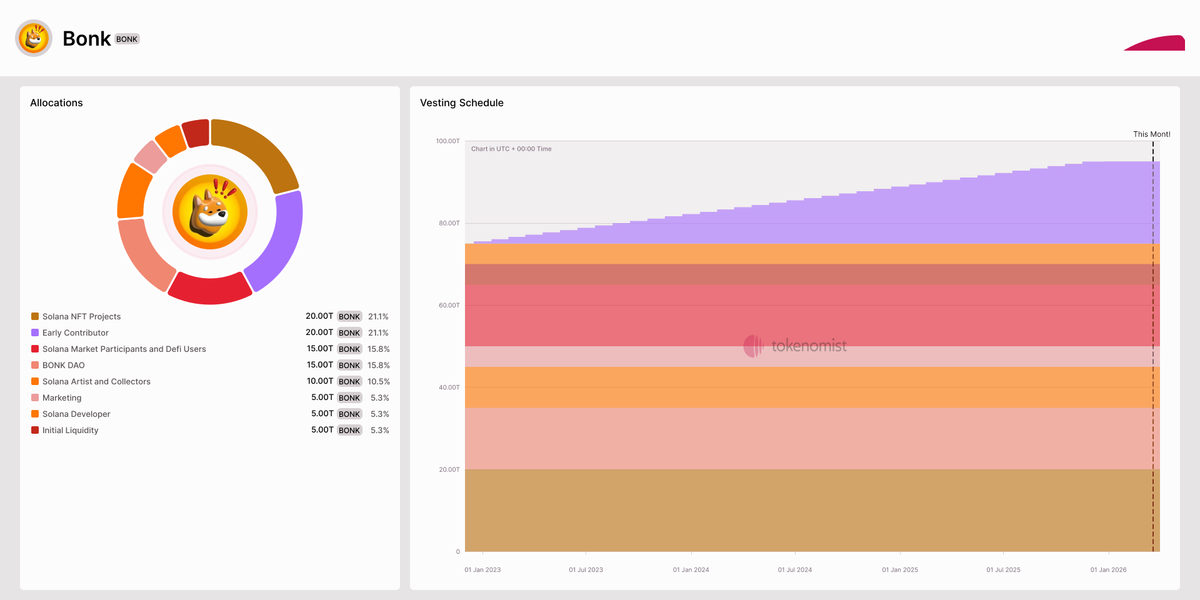
In terms of allocation, the community holds a dominant share, while the remaining portion is assigned to the team, liquidity support, and ecosystem development. BONK does not rely on a traditional mining mechanism. Instead, demand is primarily generated through trading activity and real usage scenarios. In certain applications, burn mechanisms may also be introduced to help regulate circulating supply.
Overall, BONK’s value framework does not depend on scarcity alone. It is more closely tied to the size of its community, the frequency of usage, and the depth of its integration within the ecosystem.
The Role of Bonk (BONK) in the Solana Ecosystem
Within the Solana network, BONK has gradually evolved into a multi purpose token that connects different application layers.
On one side, it contributes to liquidity provision on decentralized exchanges, supporting trading activity and improving on-chain market efficiency. On the other hand, BONK is used within NFT marketplaces for pricing and payments, which strengthens its practical utility.
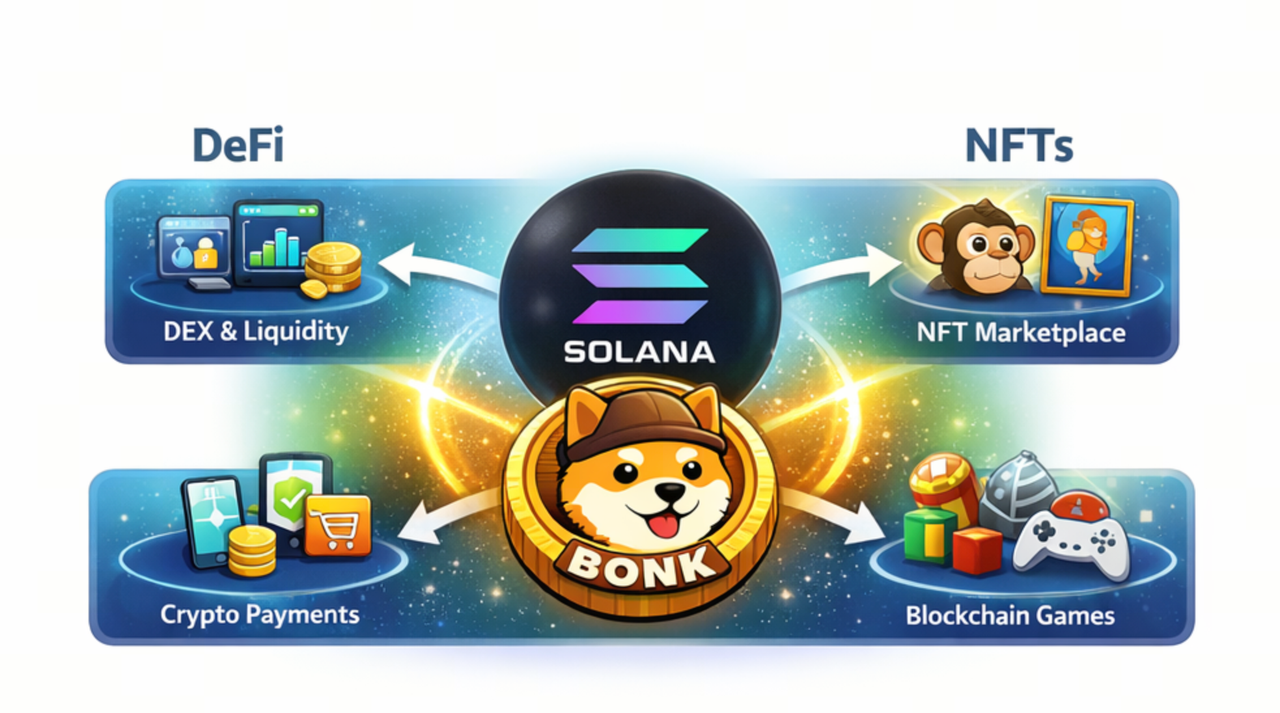
In the DeFi sector, BONK is also used as an incentive mechanism, rewarding liquidity providers and participants in specific protocols or campaigns. This cross scenario functionality allows BONK to extend beyond its meme origins and become part of the broader Solana ecosystem infrastructure.
How to Buy Bonk (BONK)?
For new users, acquiring BONK is relatively straightforward. It is typically available through centralized trading platforms, where users can create an account, deposit assets, and purchase BONK through spot trading pairs.
For users familiar with on-chain operations, BONK can also be obtained within the Solana ecosystem through decentralized exchanges or wallet integrated swap functions.
Due to the high volatility commonly associated with meme coins, it is important to understand the risks involved and apply appropriate risk management before participating.
Bonk vs Fartcoin vs Dogecoin: Key Differences
A clearer comparison can be made by examining how each meme coin differs across core dimensions such as infrastructure, distribution, and ecosystem depth.
| Dimension |
BONK |
Fartcoin |
Dogecoin |
| Blockchain |
Solana |
Often new or experimental chains |
Bitcoin fork chain |
| Distribution |
Large scale airdrop |
Niche or limited release |
Mining based issuance |
| Community Size |
Rapidly growing |
Relatively small |
Largest global meme community |
| Use Cases |
DeFi, NFT, payments |
Primarily entertainment |
Payments and tipping |
| Narrative |
Ecosystem driven meme |
Pure meme narrative |
Culture driven meme |
From a broader perspective, meme coins clearly follow different development paths. Dogecoin, as one of the earliest examples, places greater emphasis on cultural identity and community consensus, with its main use cases centered around payments and tipping. In contrast, BONK builds on the Solana ecosystem and is gradually evolving toward a more functional token, with stronger utility across DeFi and NFT scenarios.
By comparison, newer meme coins such as Fartcoin tend to remain focused on entertainment and short term market sentiment, with relatively limited ecosystem depth and user base. As a result, in terms of long term potential, BONK is closer to an ecosystem driven meme coin, while Dogecoin represents a culture driven model. The underlying logic that supports their value is fundamentally different.
Conclusion
The emergence of BONK reflects an important shift in how meme coins evolve. What once relied mainly on sentiment and viral spread is gradually transforming into ecosystem based tokens with practical applications. By first establishing a broad community through airdrops and then reinforcing demand through real use cases, BONK presents a new development path within the meme coin category.
Looking ahead, BONK’s performance will remain closely tied to the growth of the Solana ecosystem and its ability to expand real usage scenarios. While its growth potential attracts attention, participants should remain aware of the inherent volatility associated with meme-based assets.
FAQs
Does BONK have investment value?
BONK is a highly volatile asset, and its value largely depends on community consensus and ecosystem adoption.
What is the difference between BONK and Dogecoin?
BONK focuses more on ecosystem integration and practical use cases, while Dogecoin emphasizes cultural identity and payment related functions.
Where can BONK be purchased?
BONK can be purchased on major centralized exchanges as well as decentralized exchanges within the Solana ecosystem.
What are the main risks of BONK?
The primary risks include high price volatility, strong dependence on market sentiment, and the lack of stable intrinsic value support.