In modern capital markets, exchanges are more than just venues for buyers and sellers to complete trades; they are critical infrastructure for price discovery, risk management, and liquidity allocation. Stock markets, derivatives markets, and index product markets all depend on mature trading platforms to operate efficiently. Cboe is a key institution that plays a pivotal role in this ecosystem.
Unlike many stock exchanges familiar to investors, Cboe’s most defining feature is its options business and volatility product ecosystem. As institutional investors increasingly prioritize risk management, the importance of options and derivatives markets continues to rise, and Cboe has evolved into one of the most influential exchange groups in global finance.
What Is Cboe Global Markets
Cboe Global Markets is a publicly traded exchange group headquartered in Chicago. Founded in 1973, its mission was to create a standardized stock options market, offering investors a unified, transparent, and efficient trading platform.
Unlike commercial banks or asset managers, Cboe does not engage in lending or investment management. Its core function is to operate financial market infrastructure, providing trading environments and market services to investors, broker-dealers, market makers, institutional clients, and listed companies.
Today, Cboe has grown into a comprehensive exchange group covering stocks, options, futures, foreign exchange, and market data services. The company runs multiple trading platforms and serves financial institutions and investors worldwide.
From an industry standpoint, Cboe is a financial infrastructure provider whose business value is built on the continuous trading and risk management activities of market participants.
Cboe’s History and Market Positioning
Cboe’s history runs parallel to the development of the modern options market. In 1973, Cboe launched the first standardized stock options market, establishing uniform rules and standards for what had been a fragmented over-the-counter options market.
Standardized contracts dramatically improved market transparency and liquidity, transforming options from a niche institutional tool into a widely used financial product. As U.S. capital markets expanded, so did the options market, and Cboe emerged as the industry leader.
Entering the 21st century, Cboe broadened its reach through technological upgrades, product innovation, and strategic acquisitions. The company strengthened its options business while moving into stock trading, futures trading, and global market data services.
Today, Cboe has evolved from a single options exchange into a global, multi-asset exchange operator, holding a significant position in both U.S. and international capital markets.

How Cboe’s Exchange Business Works
The core mission of an exchange is to create a fair, transparent, and efficient market environment. Cboe connects buyers and sellers through electronic trading platforms, enabling market participants to execute trades under uniform rules.
When investors submit orders, the trading system automatically matches them based on price-time priority. Once a trade is executed, price and volume data are disseminated in real time, forming a price discovery mechanism.
Beyond order matching, Cboe is responsible for market surveillance and risk management. The exchange monitors for abnormal trading activity, maintains market order, and works with clearinghouses to ensure transaction security.
In modern capital markets, exchanges do more than execute trades; they are essential safeguards for liquidity and price transparency. As such, exchange operations have become indispensable infrastructure in the global financial system.
Cboe’s Options Market and Derivatives Ecosystem
The options market is Cboe’s core business and one of its greatest competitive advantages.
Options give investors the right—but not the obligation—to buy or sell an asset at a predetermined price on or before a specific date. They are widely used for risk management, yield enhancement, and portfolio protection. Both institutional and retail investors use options to hedge against market volatility.
Around this options market, Cboe has built a comprehensive derivatives ecosystem. In addition to stock options, the company operates markets for index options, volatility products, and various innovative derivatives. These products create synergies, allowing participants to allocate assets and manage risk according to their specific needs.
Because options markets benefit from strong network effects—higher liquidity leads to greater efficiency—leading exchanges like Cboe consistently attract new participants, reinforcing their competitive edge.
Why the VIX Volatility Index Is a Key Market Indicator
The VIX index is one of Cboe’s most globally recognized financial products and a critical gauge of market risk sentiment.
The VIX calculates expected future volatility using S&P 500 index option prices, reflecting investor expectations of market uncertainty. Because of its strong correlation with market sentiment, VIX is often called the "fear index."
When market risk increases, investors typically boost hedging activity, driving up option prices and pushing the VIX higher. Conversely, when sentiment stabilizes, the VIX tends to remain low.
As demand for volatility trading has grown, a full ecosystem of futures, options, ETFs, and related products has developed around the VIX. This has made the VIX not just a market indicator but one of Cboe’s most valuable brand assets.
Cboe’s Role in Global Capital Markets
Cboe’s role in global capital markets extends beyond operating trading platforms; it is central to building risk management systems.
Modern financial markets need a wide array of tools to help investors manage risk, and options and derivatives are key instruments for that purpose. By running the world’s leading options market, Cboe helps institutional and individual investors navigate market volatility more effectively.
At the same time, Cboe supports global investment decisions through its market data services and index offerings. Many financial institutions rely on its data for research, quantitative analysis, and asset allocation, making Cboe a vital information provider in global capital markets.
In essence, Cboe connects investors, market makers, institutional clients, and listed companies, forming a key part of the modern financial market structure.
How Cboe Differs from CME and ICE
While Cboe, CME, and ICE are all leading global exchange groups, their business focuses differ significantly.
| Exchange |
Core Strengths |
Representative Products |
| Cboe |
Stock options and volatility products |
Stock options, VIX |
| CME |
Futures and interest rate products |
Equity index futures, interest rate futures |
| ICE |
Energy and global trading network |
Crude oil, energy derivatives |
Cboe’s standout strength is its leadership in stock options and volatility markets. CME specializes in futures, particularly in interest rates, FX, and equity indices, where it holds global influence. ICE differentiates itself through energy markets and a global trading network.
These differences allow the three exchanges to serve distinct client bases and carve out unique market positions.
Key Use Cases for Cboe
Cboe’s applications center on investment, risk management, and market analysis.
For institutional investors, Cboe’s markets offer a wide range of options for portfolio hedging and risk control. Asset managers use index options and volatility products to build more complex strategies.
In market research, many investors track the VIX to assess risk sentiment. Cboe’s market data services provide foundational support for quantitative funds and fintech companies.
As derivatives markets grow, Cboe’s products are increasingly used across multiple facets of global capital markets.
How to Buy Cboe Global Markets (CBOE) Stock
CBOE is the ticker symbol for Cboe Global Markets, traded on U.S. stock exchanges. Traditionally, investors can purchase CBOE stock through a brokerage account that supports U.S. equities, gaining exposure to the global exchange industry.
Because Cboe’s revenue is closely tied to options volume, market activity, and participation in financial markets, many see it as a bellwether for global capital market activity.
As digital asset markets converge with traditional finance, more trading tools linked to U.S. stock prices have emerged. Some platforms offer CFD products tied to stock prices, allowing users to participate in price movements without holding the underlying shares.
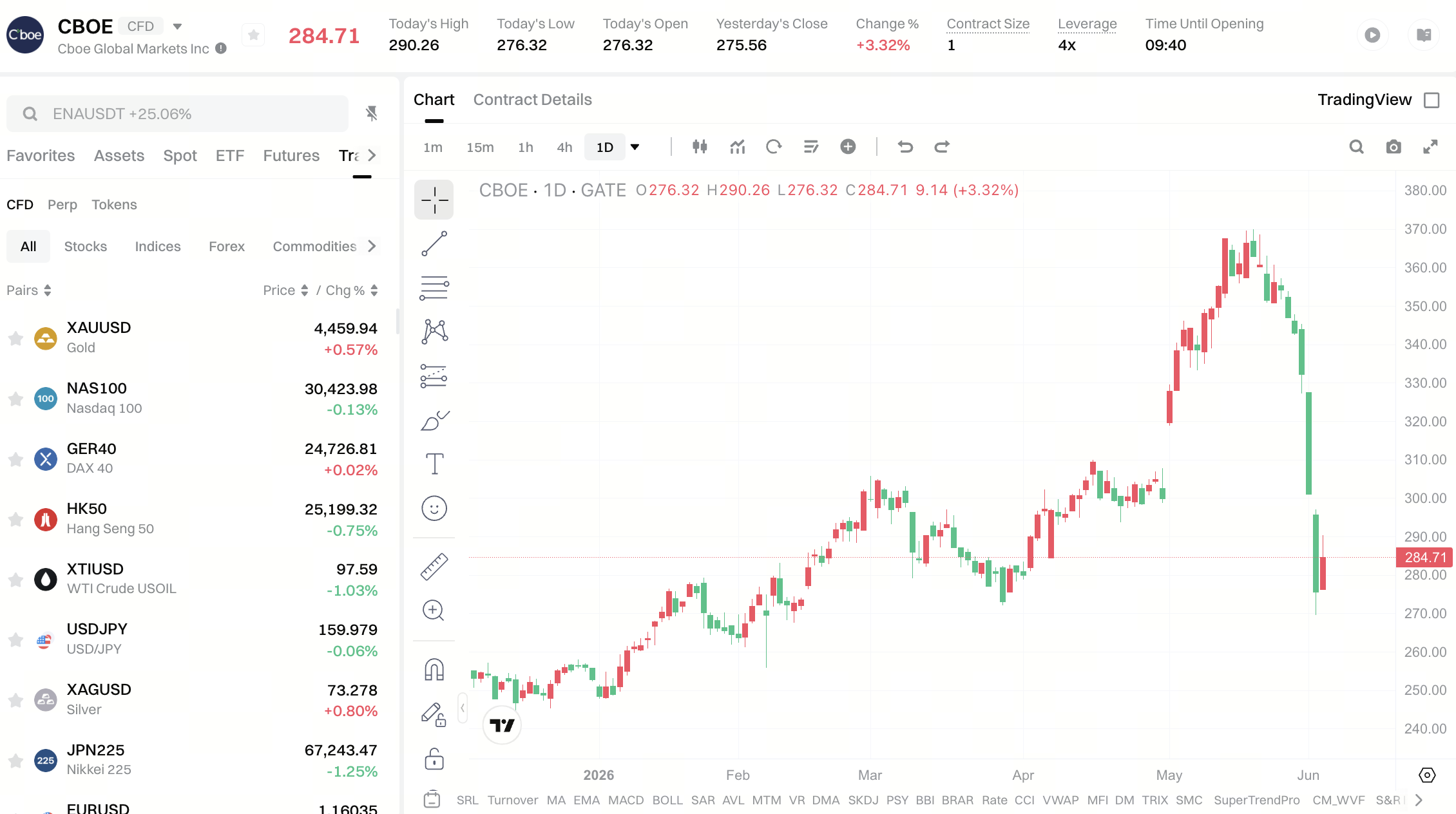
Gate TradFi is expanding its coverage of traditional financial assets, enabling users to monitor digital assets, U.S. stocks, ETFs, indices, and commodities from a single account. Some markets also offer Gate CFD products, providing more options for cross-market allocation and price tracking.
Regardless of the method, investors should fully understand the product structure, trading rules, and regulatory requirements in their jurisdiction.
Cboe’s Strengths and Limitations
Cboe’s greatest strength lies in its long-established leadership in options markets and its volatility product ecosystem. A mature liquidity framework, broad client base, and the VIX brand together form its core competitive advantages.
The exchange business also benefits from significant scale effects. Once market depth and liquidity are established, new entrants find it difficult to replicate, creating high barriers to entry.
However, the exchange industry faces competitive pressures. Global exchange groups are constantly launching new products and technologies, and market structure changes can impact volume growth. Regulatory shifts and market cycles also affect exchange operations.
As a result, while Cboe benefits from the expansion of global derivatives markets, it must continue innovating and upgrading its technology to maintain its competitive edge.
Conclusion
Cboe Global Markets is one of the world’s leading exchange operators and a key driver of the modern options market and volatility product ecosystem. By operating platforms for stocks, options, and derivatives, providing market data services, and building the VIX index system, Cboe has become an essential infrastructure provider in global capital markets. As demand for risk management grows, the importance of options and volatility markets will only increase, making Cboe’s role in the global financial system ever more critical.
FAQ
What company is Cboe?
Cboe Global Markets is one of the world’s leading exchange operators, primarily engaged in options, stocks, futures, and market data services.
Why is Cboe famous?
Cboe pioneered the modern standardized stock options market and created the VIX volatility index.
How is the VIX related to Cboe?
The VIX index is developed and operated by Cboe and is one of the most widely used market volatility indicators globally.
How does Cboe make money?
Cboe generates revenue primarily through transaction fees, market data services, index licensing, and related market services.
What’s the difference between Cboe and CME?
Cboe focuses on options and volatility products, while CME is known for futures and interest rate derivatives.
Is Cboe a financial institution or an exchange?
Cboe is an exchange operator and financial market infrastructure provider, not a bank or asset manager.