The importance of the CORE token lies in the fact that Core DAO must coordinate EVM smart contracts, the validator system, and participants from the Bitcoin ecosystem at the same time. The traditional Bitcoin network lacks native on-chain governance and smart contract incentive structures, so Core DAO uses CORE to build its on-chain economy and governance logic.
The CORE token mechanism involves gas payments, DPoS validator delegation, governance participation, reward distribution, and coordination with the BTCFi ecosystem. Together, these modules form Core DAO’s on-chain economic structure.
What Is the CORE Token
CORE is the native token of the Core DAO network, used to maintain network operations and on-chain incentives.
Structurally, CORE plays a role similar to tokens on traditional Layer 1 public blockchains, but its network logic is also tied to Bitcoin miners, BTC staking, and Satoshi Plus consensus.
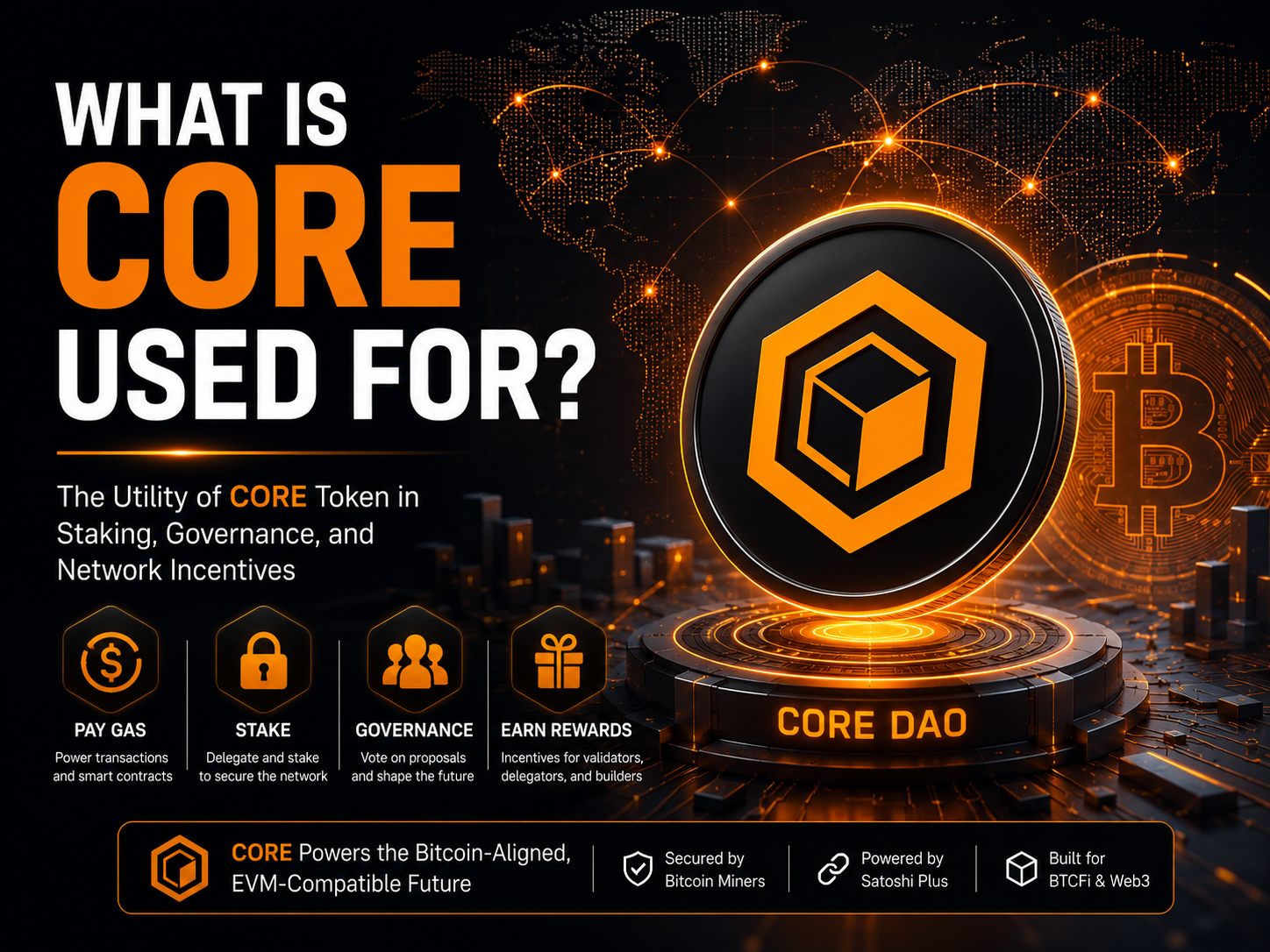
The main functions of CORE include:
-
Paying network gas
-
Participating in validator delegation
-
Supporting on-chain governance
-
Providing network rewards
Core DAO’s network security does not rely on a single token alone. Satoshi Plus consensus combines Bitcoin miner participation, BTC staking, and a DPoS structure, making CORE more of a governance and coordination resource within the network.
This mechanism means CORE is not only a medium of transaction, but also a security and governance asset in the Core DAO network.
How CORE Is Used for Network Fees
The most basic use of CORE in the Core network is to pay for on-chain transactions and smart contract execution.
Core DAO is compatible with the EVM, so the gas structure on the Core network is similar to that of Ethereum. When users send transactions or call smart contracts on the Core network, they need to use CORE to pay network fees.
The gas process for CORE begins when a user initiates an on-chain transaction. Core nodes then calculate the resources required to execute that transaction.
Next, validators process transaction ordering based on gas fees. Finally, CORE enters the network validation system as a transaction fee.
The table below shows the main roles of CORE in network fees:
| Use Case |
Role of CORE |
Network Impact |
| Transfers |
Pays gas |
Maintains network operation |
| Smart contracts |
Pays execution fees |
Supports EVM applications |
| DeFi interactions |
Pays for on-chain actions |
Drives ecosystem activity |
| Contract deployment |
Pays for resource consumption |
Supports the developer ecosystem |
CORE’s gas mechanism is essentially based on the balance between resource consumption and network security. The more complex a transaction is, the more CORE it usually requires.
This structure means CORE continues to circulate on-chain as activity on the Core network changes.
How CORE Participates in Staking and Validator Elections
One of CORE’s important uses is participation in validator delegation and the network staking system.
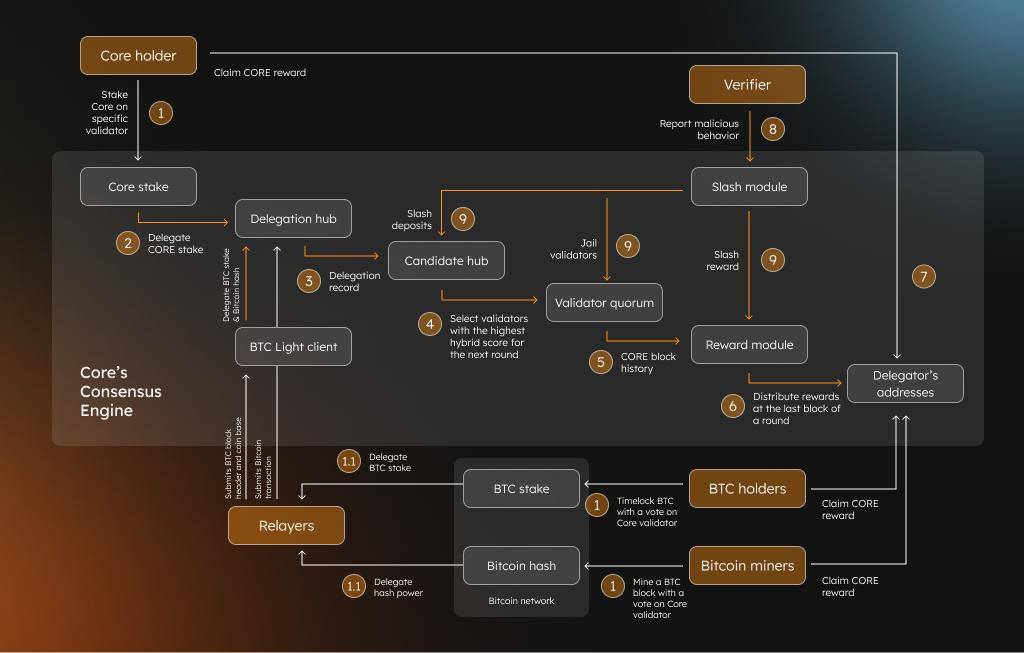
Satoshi Plus consensus combines DPoS with Bitcoin’s security structure, allowing CORE holders to participate in the allocation of validator weight through delegation.
The validator participation process for CORE begins when a node applies to become a validator. CORE holders then choose validators to delegate their tokens to.
Next, the network determines validator ranking according to the amount delegated and the consensus rules. Finally, validators participate in block production and network validation.
Core DAO’s staking mechanism differs from that of traditional PoS public chains. The Core network also introduces Bitcoin miner delegation and BTC staking, so CORE is not the only security resource.
This mechanism means Core DAO’s network security is maintained jointly by CORE holders and participants from the Bitcoin ecosystem.
How CORE Supports Core DAO Governance
The CORE token also supports on-chain governance in Core DAO, helping shape decisions around network parameters and ecosystem governance.
The importance of on-chain governance lies in Core DAO’s need to coordinate the interests of validators, developers, and ecosystem participants. Governance on the traditional Bitcoin network usually depends on off-chain consensus, while Core DAO introduces a token-based governance structure.
CORE’s governance process begins when community participants submit governance proposals. CORE holders then participate in on-chain voting.
Next, the governance system counts the voting results. Finally, approved governance proposals affect network rules or ecosystem parameters.
Core DAO governance typically involves:
-
Network parameters
-
Validation rules
-
Protocol upgrades
-
Ecosystem incentives
This mechanism means CORE is not only a utility token, but also a source of governance weight within the Core DAO network.
How the CORE Reward Mechanism Works
The CORE reward mechanism is used to coordinate incentives among validators, delegators, and Bitcoin ecosystem participants.
Core DAO’s reward system is fundamentally tied to network security and the block production process. Validators need to keep their nodes running continuously, so the network distributes rewards through CORE.
The reward process for CORE begins when validators complete block validation. The network then calculates rewards according to consensus rules.
Next, rewards are distributed to validators and delegation participants. Finally, CORE enters the on-chain circulation system.
Core DAO’s reward structure differs from that of traditional PoS networks. The Core network also combines Bitcoin miner delegation and BTC staking participation, making its incentive structure more complex.
This mechanism shows that Core DAO aims to improve coordination between Bitcoin and EVM networks through a multilayer participant structure.
What Is the Relationship Between CORE and Bitcoin Ecosystem Participants
The relationship between CORE and Bitcoin ecosystem participants comes mainly from Satoshi Plus consensus and the BTC staking system.
Core DAO’s network structure allows Bitcoin miners and BTC holders to participate in the network security system. CORE is then used to connect these forms of participation with the on-chain governance structure.
The coordination process between CORE and the Bitcoin ecosystem begins with Bitcoin miners participating through hash power delegation. BTC holders can then participate in the network through non-custodial BTC staking.
Next, the Core network combines CORE delegation with Bitcoin participation to calculate validation weight. Finally, CORE takes part in reward distribution and the governance system.
Unlike traditional EVM public chains, Core DAO places greater emphasis on bringing Bitcoin-native participants into the smart contract ecosystem.
This structure means CORE’s economic model is directly connected to Bitcoin network security resources.
What Are the Limitations of the CORE Token Mechanism
The main limitations of the CORE token mechanism involve governance complexity, ecosystem competition, and the efficiency of Bitcoin coordination.
Core DAO’s network structure combines DPoS, Bitcoin miners, and BTC staking at the same time, so the overall mechanism is more complex than that of traditional PoS networks.
The limitations of CORE’s mechanism begin with the need to coordinate multiple layers of participants. Validation rules and governance structures may then add further complexity to the network.
Core DAO also faces competition from other BTCFi projects and EVM public chains. Ultimately, ecosystem scale will affect CORE’s long-term network effects.
Current public materials mainly explain CORE’s network uses and consensus structure, but some long-term tokenomics data has not yet been fully disclosed. Official materials have not yet clearly disclosed the complete token allocation and long-term unlock structure.
This limitation means the market’s understanding of CORE’s long-term economic structure still needs to be evaluated alongside future public disclosures.
Conclusion
CORE is the native token of the Core DAO network. It mainly functions as gas, a validator delegation asset, an on-chain governance tool, and a network incentive mechanism.
CORE’s operating mechanism is closely connected to Satoshi Plus consensus, while also linking Bitcoin miners, BTC staking participants, and the EVM smart contract ecosystem.
Core DAO aims to use CORE to build an economic coordination mechanism between Bitcoin security and on-chain financial applications.
FAQs
What Is the CORE Token Used For?
CORE is mainly used to pay network gas, participate in validator delegation, support on-chain governance, and maintain the Core DAO network incentive system.
How Does CORE Participate in Staking?
CORE holders can delegate their tokens to validator nodes. Validators then participate in Core network block validation according to their delegated weight.
What Is the Relationship Between CORE and Bitcoin?
Core DAO combines Bitcoin miner participation, BTC staking, and CORE delegation to form Satoshi Plus consensus, so CORE has a coordinated relationship with Bitcoin’s network security structure.
Can CORE Be Used for Governance?
CORE can be used to participate in Core DAO governance voting. CORE holders can vote on certain network proposals and ecosystem rules.
Has Core DAO Published Complete Tokenomics?
Current public materials explain CORE’s uses and network mechanism, but official materials have not yet fully disclosed the complete long-term token allocation and unlock structure.