As global beauty consumption continues to grow, the “global fragrance market” and premium beauty industry are also expanding. Rising consumer demand for brands, personalization, and high end experiences has made the connection between fragrance, beauty, and fashion brands increasingly close.
At the same time, COTY’s development also reflects important trends in the global consumer industry. From social media marketing and e-commerce channels to luxury brand licensing models, COTY represents not only a traditional beauty company, but also a part of the global consumer brand economy.
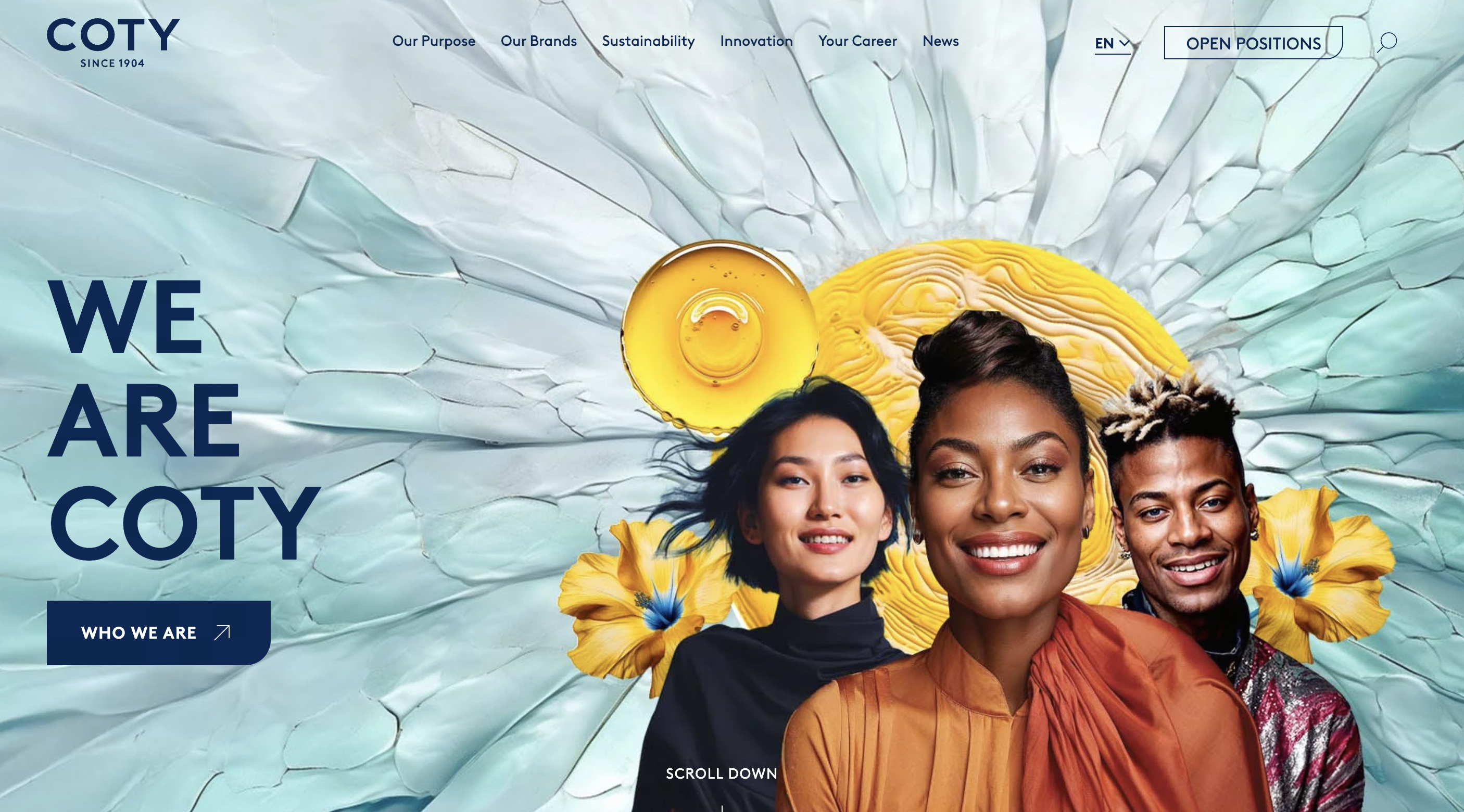
Source: coty.com
What Is Coty (COTY)?
Coty is a global consumer group built around fragrance, beauty, and personal care products, with a history dating back to the early 20th century. As a typical “COTY beauty group,” the company’s businesses span luxury fragrances, mass market cosmetics, skincare products, and other categories. Among these, fragrance has long been one of COTY’s most important sources of revenue.
Unlike traditional manufacturing companies, COTY’s core competitiveness comes more from brand operation capabilities. The company not only owns its own brands, but also works with many fashion brands through a “fragrance brand licensing” model. For example, the fragrance businesses of luxury brands such as Gucci, Burberry, and Hugo Boss all have deep partnerships with COTY. This model allows COTY to benefit from both global luxury consumption and growth in the mass beauty market.
Within the global “consumer beauty company” landscape, COTY has long been viewed as one of the important players in fragrance.
COTY’s Beauty Consumer Business Model Explained
The core of the “COTY business model” lies in the combination of brands, channels, and consumer trends. First, the beauty industry is essentially a brand driven industry. When consumers buy fragrance or cosmetics, they often care not only about the product itself, but also about brand image, fashion positioning, and emotional value.
As a result, COTY’s profit model depends heavily on brand operation and marketing capabilities. By working with luxury brands, the company can use the influence of fashion brands to enter the premium fragrance market. At the same time, the “fragrance business” usually has relatively high profit margins. Compared with food or daily necessities, beauty products are better able to command brand premiums, so the industry’s overall gross margins are usually higher.
In terms of channels, COTY’s business covers supermarkets, department stores, e-commerce, duty free shops, and beauty retail channels. As global e-commerce grows, the company is also placing greater emphasis on online sales and social media marketing. In addition, the beauty industry has clear economies of scale. Large companies can usually reduce costs through global supply chains, advertising investment, and distribution networks, thereby improving profit margins.
Coty’s (COTY) Core Brands
The “COTY brand portfolio” is one of the company’s most important assets. In premium fragrance, COTY works with a number of international fashion brands, including Gucci Beauty, Burberry Fragrances, Marc Jacobs Fragrances, and Hugo Boss.
These brands help COTY build strong influence in the “global fragrance market.” Because luxury fragrances carry strong brand premiums, the fragrance business has long enjoyed relatively high profitability. At the same time, COTY also has a presence in the mass beauty market. For example, brands such as CoverGirl, Max Factor, and Rimmel mainly serve mass market cosmetics consumers.
This dual structure of “premium fragrance plus mass beauty” allows COTY to reach different consumer segments at the same time. In addition, partnerships with celebrities and fashion brands are also an important part of how the beauty industry works. Through brand collaborations and fashion marketing, COTY can continuously strengthen brand visibility and consumer awareness. Therefore, the brand portfolio is not just a product mix, but an important source of COTY’s long term competitiveness.
Why the Fragrance Business Is Important to COTY
The “fragrance market” has long been one of the highest margin areas in the global beauty industry. Compared with ordinary skincare or cosmetics products, fragrance places more emphasis on brand, emotion, and identity. As a result, premium fragrances usually have stronger ability to command brand premiums. For COTY, the “luxury fragrance” business not only means higher profit margins, but also more stable brand value.
At the same time, rising global consumer demand for personalization and premium experiences continues to drive expansion in the fragrance market. Among younger consumers in particular, fragrance has gradually become an important lifestyle product. In addition, fragrance and fashion brands naturally have strong synergies. Consumer recognition of brands such as Gucci and Burberry can also extend to fragrance products. Therefore, the fragrance business is not only a source of revenue for COTY, but also a key part of the company’s brand strategy.
How COTY Benefits from Global Beauty Consumption Trends
The global beauty industry has long benefited from the trend of consumption upgrading. As the middle class expands and consumer demand for personalization increases, the “premium beauty market” continues to grow. Consumers are increasingly willing to pay a premium for brand experience, packaging design, and emotional value.
At the same time, Gen Z consumption habits are reshaping the industry structure. Younger consumers rely more heavily on social media for beauty information, so TikTok, Instagram, and KOL marketing are having a growing impact on the industry. In the “social media marketing” environment, beauty brands can create global reach more quickly. Popular fragrance or cosmetics products may even go viral rapidly because of short video content.
In addition, the growth of e-commerce channels has changed the traditional retail structure. Consumers no longer rely entirely on department stores. Instead, more of them are buying beauty products through online platforms. For COTY, this means the company must not only operate brands well, but also continue adapting to digital consumer trends.
How Coty Differs from Other Beauty Giants
In the “global beauty industry,” COTY, Estée Lauder, and L’Oréal are all important players, but their positioning differs clearly. Compared with Estée Lauder, which places more emphasis on premium skincare, COTY has long depended more on fragrance and brand licensing.
At the same time, L’Oréal has a broader business scope, covering everything from mass skincare to professional haircare, while COTY is more concentrated in the fragrance and cosmetics markets. In terms of brand structure, COTY has a stronger fashion brand partnership profile, so its business is more closely connected with luxury brands.
In addition, in the “COTY vs EL” comparison, Estée Lauder usually leans more toward premium department store channels, while COTY covers both mass retail and premium fragrance markets. Therefore, the core differences among beauty groups are not simply about the number of brands they own, but about market positioning and differences in consumer structure.
COTY’s Long Term Growth Logic and Potential Risks
The “COTY long term logic” is essentially built on the long term growth of global beauty consumption. First, demand for beauty and personal care has strong long term stability. No matter how the economic cycle changes, consumers usually maintain a certain level of spending on beauty. Second, brand premium power is also one of COTY’s core advantages. Strong brands can not only improve profit margins, but also help increase consumer loyalty. However, COTY also faces certain “beauty industry risks.”
For example, the company relies relatively heavily on the brand licensing model. Changes in partner brand strategies could affect the stability of the fragrance business. At the same time, e-commerce competition, shifts in consumer preferences, and rising marketing costs may also put pressure on traditional beauty groups. In addition, raw material prices, global supply chains, and changes in the consumer cycle can also affect the company’s profitability.
Therefore, although COTY has global brand advantages, it still needs to keep adapting to changes in the global consumer market.
Conclusion
At its core, COTY is a global consumer group built around fragrance, beauty, and brand operations.
Compared with traditional manufacturing companies, COTY places greater emphasis on brand value, consumer trends, and global channel capabilities. In the “global fragrance market” especially, the company has long held strong influence.
At the same time, COTY’s brand portfolio, fashion partnerships, and premium fragrance business also form its core competitive barriers.
As global beauty consumption, digital marketing, and premiumization trends continue to develop, the beauty industry still has long term room for growth. As an important global consumer brand group, COTY will also continue to occupy an important position in the global beauty industry.
FAQs
What Is Coty (COTY)?
Coty is a global beauty consumer group whose main businesses include fragrance, cosmetics, skincare, and personal care products.
What Industry Does COTY Belong To?
COTY belongs to the global consumer staples and beauty consumer industry.
What Brands Does Coty Own?
Its brands include Gucci Beauty, Burberry Fragrances, CoverGirl, Max Factor, and others.
Why Is the Fragrance Business Important to COTY?
Because the fragrance business usually has higher profit margins and stronger brand premium power, making it one of COTY’s core businesses.
How Is COTY Different from Estée Lauder?
COTY leans more toward fragrance and brand licensing, while Estée Lauder places more emphasis on the premium skincare market.