In the global technology industry, CTSH does not represent a traditional internet platform company. Instead, it is an important part of the broader “enterprise digital services provider” system. Over the past few decades, many companies have gradually outsourced software development, system maintenance, data management, cloud migration, and other technical capabilities to specialized service providers. This shift has also driven the rapid expansion of the entire “IT services company and technology outsourcing industry.”
As AI, cloud computing, and automation technologies move into the core of enterprise operations, the role of companies like CTSH is also changing. They are no longer simply traditional software outsourcing providers. Instead, they are becoming important participants in enterprise digital infrastructure. From the “digital transformation service model” to generative AI integration, CTSH represents the long-term trend of continuous upgrades across global enterprise technology systems.
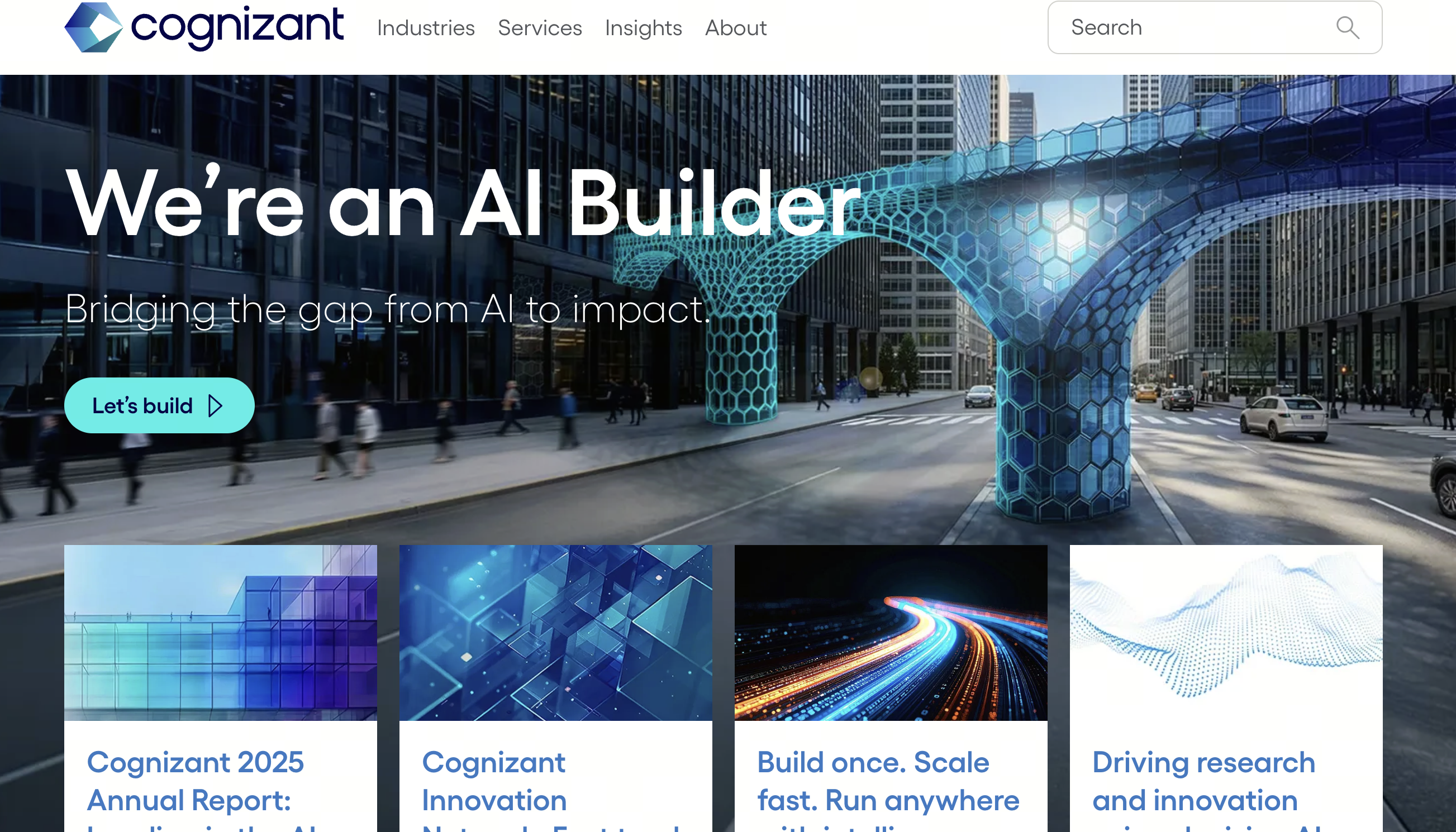
Source: cognizant.com
What Is CTSH (Cognizant)?
CTSH (Cognizant Technology Solutions) is a global IT services company headquartered in New Jersey, United States. Its core businesses include enterprise software development, digital consulting, cloud services, data analytics, AI automation, and IT systems operations.
From an industry classification perspective, CTSH is a typical enterprise technology services company. Unlike consumer internet companies, it does not serve ordinary consumers directly. Instead, it provides long-term technology support to large enterprises. Companies of this kind are usually regarded as major participants in the “global enterprise technology consulting market.”
In the early IT services industry, the core logic was mainly “technology outsourcing.” Many large enterprises did not have full software development capabilities, so they outsourced part of their technical work to external teams. As enterprise systems became increasingly complex, however, traditional outsourcing gradually evolved into a more comprehensive digital services system.
Today, Cognizant does much more than help companies “write code.” It is deeply involved in enterprise digital strategy. For example, when a large bank carries out cloud migration, it needs more than system development. It also requires data security, architecture upgrades, AI automation, operations and maintenance, and long-term technology consulting. This is the defining feature of the modern “digital transformation service model.”
From a global market perspective, CTSH, together with companies such as Accenture, Infosys, and TCS, forms an important infrastructure layer within the global IT services industry.
CTSH’s Core Business: The Enterprise Digital Services System
At its core, CTSH helps enterprises build, upgrade, and operate their technology systems over the long term. Its main businesses include enterprise technology consulting, software development, cloud computing services, data analytics, AI automation, and IT operations support. For many large enterprises, technology systems are no longer just supporting tools. They have become an essential part of business operations themselves. Banks need stable payment systems, insurance companies need risk data platforms, healthcare institutions need electronic medical record systems, and manufacturers need automated production and supply chain management platforms. This means companies are increasingly dependent on long-term technology partners, not just one-time development projects.
This is also why the modern IT services industry has gradually shifted from a “project-based” model to long-term operational services. In the past, a company might hire an external team simply to build a website. Today, large enterprises are more likely to look for long-term partners that can continuously manage system upgrades, cloud operations, data analytics, and AI automation. This model also makes the “enterprise digital transformation process” more complex and longer-term. At the same time, many people confuse “IT consulting” with “technology implementation.” In practice, consulting usually focuses on designing the technology strategy, while implementation is responsible for actually developing and deploying the system. One of CTSH’s defining characteristics is that it covers all three layers: consulting, technology implementation, and operations.
As enterprise systems gradually move to the cloud, “cloud computing and enterprise system upgrades” have also become one of the key growth drivers for CTSH.
Cognizant’s Business Model and Revenue Sources Explained
CTSH’s profit model is mainly built on long-term enterprise technology service contracts. Unlike SaaS companies, which rely on software subscriptions, Cognizant depends more heavily on enterprise service revenue. After a company pays for its services, CTSH may be responsible for system development, data migration, cloud service management, AI automation deployment, and ongoing maintenance.
One characteristic of this model is its relatively high revenue stability. Large enterprises usually do not change technology service providers frequently. Once a core system has been deployed, subsequent maintenance, upgrades, and operations often continue for many years. This is also an important reason why the “profit model of IT services companies” can generate long-term cash flow.
In addition, Cognizant has a typical “global outsourcing delivery center” system. Much of the technical development work is carried out collaboratively by engineering teams in different parts of the world, which helps reduce overall costs and improve project efficiency. This global delivery model is also one of the key features of the modern IT services industry.
From a profit structure perspective, IT services companies are still essentially “labor-intensive technology service companies.” They require large numbers of engineers, data analysts, and consultants, so personnel costs usually account for a relatively high proportion of expenses. This is also an important reason why the “revenue structure of technology consulting companies” differs significantly from that of traditional internet platform companies. However, as AI automation gradually enters the enterprise services field, the profit model of the IT services industry may also change in the future.
CTSH’s Relationship with AI, Cloud Computing, and Automation
The rise of AI and cloud computing is redefining the entire IT services industry. In the past, companies paid more attention to software development and system maintenance. Today, however, more and more companies are focusing on AI automation, data intelligence, and generative AI applications. This means IT services companies can no longer simply “develop systems.” They must help enterprises build complete AI technology capabilities.
In this process, CTSH plays the role of an enterprise AI integration service provider. For example, many companies want to connect generative AI to customer service systems, internal office platforms, or data analytics systems, but most do not have the ability to complete AI deployment independently. As a result, they need third-party technology service providers to assist with model integration, data governance, security management, and system compatibility.
This is also an important backdrop to the rapid growth of “generative AI enterprise applications.” At the same time, AI is changing the traditional IT outsourcing industry itself. “How AI is changing the IT outsourcing industry” has become an important discussion topic in the global technology services market.
In the past, a large amount of coding, testing, and operations work required manual effort. In the future, these tasks may increasingly be assisted by AI automation tools. As a result, the competitive focus of IT services companies is shifting from “low-cost development” to “high-value digital capabilities.” Beyond AI, “enterprise cloud migration services” are also an important business direction for CTSH. As companies move more systems to cloud platforms, IT services companies must also take on architecture optimization, data security, long-term operations support, and related work.
Industries Served by CTSH: Healthcare, Finance, and Manufacturing Digitalization Examples
CTSH has a very broad industry footprint, but healthcare, finance, and manufacturing have long been among its most important business areas. Healthcare, in particular, has long been viewed as one of Cognizant’s key strengths. Healthcare systems involve large volumes of complex data, regulatory requirements, and long-term operational needs, so hospitals, insurance institutions, and healthcare service companies usually rely heavily on specialized technology service providers. As a result, “digital transformation in healthcare” has become an important growth area in the global Healthcare IT market.
For example, electronic medical record systems, healthcare data management platforms, insurance claims systems, and AI-assisted diagnostics all require long-term technical maintenance and data security support. In the financial sector, CTSH mainly serves banks, insurance companies, and payment institutions. The financial industry has extremely high requirements for system stability and security, so many banks work with IT services companies over the long term to upgrade payment systems, build risk management platforms, and migrate cloud infrastructure.
This is also an important background to the ongoing expansion of “fintech IT infrastructure.” At the same time, digital upgrades in manufacturing have also supported CTSH’s business growth. As industrial automation and smart manufacturing become more widespread, more companies are building digital supply chains, industrial IoT systems, and automated production platforms. As a result, “manufacturing automation systems” have gradually become an important growth area for the IT services industry.
Overall, CTSH is not simply a software development company. It is an important participant in the global digital infrastructure of multiple industries.
How CTSH Differs from Accenture, Infosys, and TCS
Many users group CTSH, Accenture, Infosys, and TCS together because they are all major global IT services companies. In reality, however, their positioning differs in meaningful ways. Accenture leans more toward high-end enterprise consulting and strategic digital transformation, emphasizing the integration of enterprise management, business processes, and technology strategy. Infosys and TCS, by contrast, are more focused on large-scale technology outsourcing and global delivery systems.
CTSH sits somewhere between the two. It has a certain level of consulting capability while also maintaining deep roots in industry-specific IT services, especially in healthcare and finance, where it has strong market influence.
| Company |
Core Positioning |
Strong Areas |
Typical Customers |
| Cognizant |
Digital services and industry IT |
Healthcare, finance |
Large enterprises |
| Accenture |
Strategic consulting + technology |
Enterprise transformation |
Fortune Global 500 companies |
| Infosys |
IT outsourcing |
Software development |
Global enterprises |
| TCS |
Large-scale technology services |
Enterprise IT operations and maintenance |
Multinational organizations |
When many users search for “Cognizant vs Accenture,” they are essentially comparing the difference between a “consulting-driven” model and an “industry IT services-driven” model. The “difference between Infosys and TCS,” meanwhile, is more often focused on global delivery capabilities, customer structures, and regional market layouts. From an industry perspective, these companies together make up the core players in the “global IT outsourcing company comparison.”
Common Misunderstandings About CTSH
One of the most common misunderstandings about CTSH is that many people confuse it with an internet technology platform. In reality, CTSH is not a platform-style technology company like Google, Meta, or Microsoft. It is closer to an “enterprise technology services provider.”
This is also why many users easily confuse the “difference between SaaS companies and IT services companies.” SaaS companies usually provide standardized software products, such as CRM systems, collaboration tools, or cloud platforms. IT services companies, by contrast, place more emphasis on customized technology services and long-term operational support for enterprises.
In addition, although CTSH is actively expanding its AI services, it is not a typical “AI product company.” It is more like the latter category in the distinction between “AI companies and AI service providers,” meaning it helps enterprises deploy, integrate, and operate AI systems rather than directly launching its own large-scale AI model platform.
Another common question is: “Does technology outsourcing count as part of the technology industry?” The answer is generally yes. Although the IT services industry clearly has labor-intensive service characteristics, it is still fundamentally part of enterprise technology infrastructure. Especially in the age of AI and cloud computing, the technical value of IT services companies is continuing to rise.
Therefore, CTSH should not be viewed merely as an “outsourcing company.” It is a technology service node within the global enterprise digital system.
Summary
CTSH (Cognizant) is, at its core, a global enterprise digital services company. Its main role is not to provide internet products to consumers, but to help large enterprises build, operate, and upgrade their technology systems.
From traditional IT outsourcing to cloud computing, AI automation, and enterprise digital transformation, CTSH represents the long-term evolution of the global technology services industry.
As companies become increasingly dependent on data, cloud platforms, and AI technology, their internal systems are also becoming more complex. This means large enterprises need stable, long-term technology partners, and CTSH continues to expand against exactly this industry backdrop.
At the same time, AI is changing the competitive logic of the entire IT services industry. In the future, enterprise technology services may no longer center simply on “low-cost development.” Instead, they may revolve around AI integration, data governance, and digital operations. Understanding CTSH, therefore, is not just about understanding a listed company. It is also about understanding how global enterprise technology infrastructure works.
FAQs
What does CTSH (Cognizant) do?
CTSH (Cognizant) is a global IT services and digital transformation company that mainly provides enterprises with software development, cloud computing, data analytics, AI automation, and technology consulting services.
Is CTSH an AI company?
CTSH is not an AI product company in the traditional sense. It is an enterprise AI integration and digital services provider. Its core business remains enterprise technology services.
What is the difference between CTSH and Accenture?
Accenture leans more toward strategic consulting and enterprise management transformation, while CTSH places greater emphasis on industry IT services, system implementation, and long-term digital operations.
Why do large enterprises need companies like Cognizant?
Because many large enterprises lack full technology development and operations capabilities, they need long-term technology service providers to help with system construction, cloud migration, and AI deployment.
What are CTSH’s main customer industries?
CTSH mainly serves healthcare, finance, insurance, manufacturing, and retail. Healthcare has long been one of its core areas of strength.
Is CTSH a technology stock or an outsourcing company?
CTSH has the characteristics of both a “technology services company” and a “global IT outsourcing enterprise.” Its core business is enterprise digital technology services, not consumer internet platforms.