For a long time, online prediction markets have relied predominantly on centralized platforms. These platforms handle fund management, rule setting, market maintenance, and result settlement. While this model delivers a mature product experience, users often struggle to directly verify fund flows, settlement logic, and market operation processes.
As Web3 infrastructure advances, a growing number of applications are leveraging smart contracts and on-chain asset management to reinvent traditional internet services. Prediction markets—a key space for information discovery, market judgment, and user participation—have also become a major focus area within the blockchain industry.
Dexsport aims to combine sports event prediction, event prediction, and shared liquidity mechanisms through blockchain's transparency and verifiability, building a more open prediction market ecosystem. The project emphasizes not only market participation efficiency but also asset self-custody and on-chain transparency.
What Is Dexsport (DESU)?
The Dexsport ecosystem extends beyond a single prediction product, gradually forming a comprehensive network that integrates prediction markets, P2P event prediction, a shared liquidity system, and community governance mechanisms. Through these modules, the platform aims to create an open market environment capable of addressing diverse prediction needs.
From a product perspective, Dexsport has a dual identity: it is both a prediction market platform and an on-chain application protocol. Users can make market predictions on sports events and other occurrences, while the protocol itself sustains ecosystem efficiency through its liquidity mechanisms and token system.
In the Web3 landscape, prediction markets are recognized as vital tools for information aggregation and market judgment. Dexsport chose sports events as its starting point and is gradually expanding into broader event prediction fields, aiming to build a long-term sustainable on-chain prediction ecosystem.
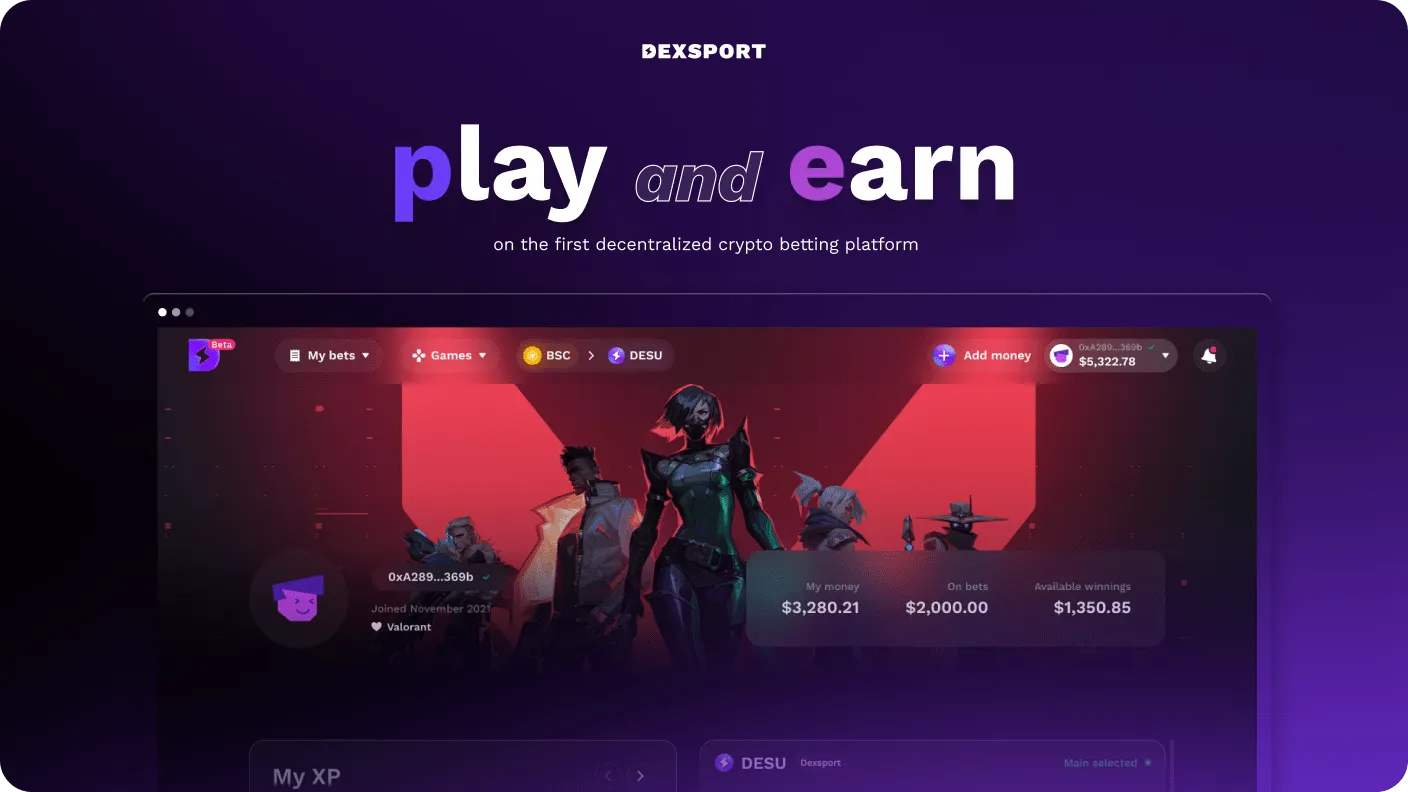
Source: dexsport.io
How Dexsport Builds a Web3 Sports Event Prediction Protocol
Dexsport's core concept is to redesign sports event prediction markets using blockchain technology. Traditional platforms typically rely on centralized databases to record user activity, while Dexsport shifts critical data and asset management processes on-chain, thereby increasing market transparency.
Users connect to Dexsport through a crypto wallet, maintaining self-custody of their assets. Market participation revolves around on-chain assets. Compared to platforms that depend on centralized account systems, this model reduces intermediaries and strengthens user control over their funds.
The Web3 architecture not only transforms asset management but also redefines market operation logic. Because on-chain data is publicly verifiable, market participants can more intuitively understand the protocol's fund flows and rule enforcement. This transparency helps users better grasp the platform's operational logic.
From an industry perspective, Web3 sports prediction protocols are not simply about porting traditional products to the blockchain. They leverage smart contracts, digital assets, and open networks to build new market infrastructure. Dexsport's goal is precisely to harness these technologies to enhance the openness and participation efficiency of prediction markets.
How Does Dexsport's Shared Liquidity Pool Work?
The shared liquidity pool is one of Dexsport's most distinctive mechanisms and a key differentiator from traditional prediction platforms. This model centralizes platform funds, providing unified support across multiple prediction markets.
Under this mechanism, user-deposited assets enter a shared liquidity pool. Different markets no longer have independent fund systems; instead, they collectively draw from a single liquidity source for reward distribution and settlement. This design improves capital efficiency and prevents liquidity from being fragmented across isolated markets. When a market result is determined, eligible participants receive rewards from the shared pool, while funds not used for rewards remain in the system to support future market operations, creating a continuous liquidity cycle.
The shared liquidity model also helps new markets quickly gain financial backing. In traditional setups, new markets must individually build liquidity pools, whereas a unified pool lowers that barrier. For prediction market protocols, adequate and stable liquidity is essential for user experience, making the shared liquidity pool a critical component of Dexsport's core architecture.
What Role Does the DESU Token Play in the Dexsport Ecosystem?
DESU is the native token of the Dexsport ecosystem, serving as a key link between users, the protocol, and the community. Like many Web3 projects, DESU is not only a medium of exchange but also a central element of the ecosystem's incentive system.
At the protocol level, DESU supports community activities, ecosystem rewards, and certain platform functions. Through token incentives, the protocol attracts user participation in ecosystem development, fostering a more active community network over time. This token mechanism enables the protocol to create a relatively independent internal economic cycle.
Another critical function of DESU is governance participation. In a decentralized ecosystem, community governance is often essential. Token holders can discuss ecosystem direction, feature enhancements, and key decisions, thereby strengthening community collaboration.
For a prediction market protocol, the token is more than a digital asset—it is a vital tool for maintaining the ecosystem's long-term health. DESU's value lies primarily in its ecosystem functions and governance role rather than purely as a trading asset.
Dexsport's Prediction Market and P2P Event Prediction Mechanism
The prediction market is a key component of the Dexsport ecosystem. It allows users to form market judgments about future event outcomes and reflect the probability expectations of different views through participation.
Compared to traditional prediction products, on-chain prediction markets are more open. Theoretically, any event with a clear outcome—including sports, industry events, and other verifiable activities—can form a prediction market. This allows prediction markets to expand beyond single scenarios into broader information discovery.
The P2P event prediction mechanism further enhances market flexibility. In the P2P model, users form direct market relationships with each other, while the platform primarily executes rules and facilitates matching. This design allows users to build more flexible prediction scenarios around specific events rather than relying solely on the platform's fixed product offerings.
The combination of prediction markets and the P2P mechanism makes Dexsport more than just a sports prediction platform—it becomes an open information prediction network. This structure expands the protocol's application boundaries and attracts a wider user base to participate in ecosystem development.
What Core Application Scenarios Does Dexsport Support?
Dexsport's application scenarios are built on prediction markets, but its scope extends beyond a single event type. As Web3 infrastructure matures, on-chain prediction markets are evolving from vertical applications into comprehensive information markets, and Dexsport's product design reflects this trend.
Sports event prediction is Dexsport's current core use case. Sports events have clear start and end times and verifiable outcomes, making them ideal for prediction markets. Events such as football, basketball, tennis, and esports are all suitable for user market predictions. Because event results are public and transparent, these markets are easier to settle and verify on-chain.
Beyond sports, Dexsport's architecture supports a broader range of event prediction scenarios. Theoretically, as long as an event has clear outcome criteria and reliable data sources, a corresponding market can be established on the protocol. This expandability allows prediction markets to transcend a single vertical and become important tools for information discovery and probability assessment.
As the Web3 user base grows, prediction markets are forming new synergies with community governance, data networks, and on-chain finance. Dexsport's long-term value comes not only from its specific markets but also from its potential as prediction infrastructure within a broader ecosystem.
The most significant differences between Dexsport and traditional online prediction platforms lie in their underlying architecture and asset management approaches. Traditional platforms operate centrally, managing user accounts, storing data, and completing market settlements. While users enjoy a mature product experience, they have limited insight into the platform's internal operations.
Dexsport, in contrast, leverages blockchain to improve market transparency. Core business logic is executed via smart contracts, and fund management and market activities are verifiable on-chain. This design doesn't solve every problem automatically, but it does enhance system openness and auditability.
Asset control also differs markedly between the two models. On centralized platforms, users entrust assets to the platform for management. In a Web3 environment, users interact via digital wallets and maintain direct asset control—aligning with the blockchain industry's emphasis on self-custody.
The table below summarizes key differences:
| Comparison Dimension |
Dexsport |
Traditional Online Prediction Platform |
| System Architecture |
Web3 Protocol |
Centralized Platform |
| Asset Management |
User Self-Custody |
Platform-Managed |
| Data Transparency |
High |
Relatively Limited |
| Participation Method |
On-Chain Interaction |
Platform Account System |
| Rule Execution |
Smart Contracts & Protocol Rules |
Platform Operational Rules |
| Market Openness |
Global Network |
Limited by Platform |
Neither model is inherently superior. Centralized platforms typically offer more mature operational experience and user services, while Web3 protocols emphasize openness, transparency, and user asset sovereignty. Different users may choose different platform types based on their needs.
What Is Dexsport's Positioning in the On-Chain Prediction Market Track?
Prediction markets are considered one of the most practically valuable applications in blockchain. Unlike projects reliant on a single narrative, prediction markets revolve around information, probability, and market judgment, enabling broad connections with finance, media, community, and data networks.
Within this space, Dexsport positions itself as a protocol that combines sports event prediction with comprehensive event prediction. The project initially entered via sports events, but its shared liquidity architecture and open market design enable expansion into many prediction scenarios. Compared to platforms serving only a single market, this structure offers stronger ecosystem extensibility.
From an industry perspective, on-chain prediction market development depends not only on user scale but also on liquidity quality and market efficiency. More accurate predictions, more participants, and deeper funds enhance the market's ability to reflect true expectations. Therefore, liquidity building is often a key competitive dimension.
Through its shared liquidity pool, P2P event prediction mechanism, and community-driven model, Dexsport aims to differentiate itself in the prediction market track. Its core positioning is not merely to provide prediction functions but to build on-chain infrastructure capable of supporting multiple prediction activities.
What Are Dexsport's Advantages and Limitations?
Dexsport's primary advantage is its transparent architecture. On-chain records and smart contracts improve the verifiability of market operations, helping users understand fund flows and settlement logic. For prediction markets that value openness and credibility, this transparency is highly significant.
The shared liquidity pool is another major advantage. A unified liquidity system enhances capital efficiency and reduces fragmentation between markets. For prediction markets requiring long-term activity, stable liquidity support is critical for market depth and user experience.
Additionally, Dexsport covers sports prediction, P2P event prediction, and open market mechanisms, giving it strong scenario expansion capabilities. As more event types enter the on-chain prediction space, the protocol can form a more diversified ecosystem.
However, Dexsport also faces real challenges. Prediction market growth heavily depends on user scale and liquidity levels. Insufficient participation can affect prediction validity and market activity. At the same time, prediction markets encounter varying legal and compliance requirements across regions, which can impact the protocol's development environment. For any on-chain prediction protocol, balancing openness, user experience, and long-term sustainability remains an ongoing challenge.
Summary
Dexsport is a Web3 protocol that combines sports event prediction, event prediction markets, and shared liquidity mechanisms. It leverages blockchain to enhance the transparency and openness of prediction markets. Compared to traditional online prediction platforms, Dexsport emphasizes on-chain asset management, publicly verifiable market rules, and user self-custody.
The shared liquidity pool is one of Dexsport's most representative infrastructure components. By supporting multiple markets with a unified fund pool, the protocol improves liquidity utilization efficiency and provides stable support for various prediction activities. Meanwhile, the DESU token drives ecosystem incentives and community governance, supporting the protocol's long-term growth.
As the on-chain prediction market track matures, Dexsport demonstrates Web3's potential for information discovery, probability assessment, and open market construction. Whether for sports predictions or broader event scenarios, Dexsport reflects the evolution of prediction market protocols toward comprehensive infrastructure.
FAQ
What is Dexsport?
Dexsport is a blockchain-based prediction market protocol that supports sports event prediction, P2P event prediction, and shared liquidity mechanisms. The project improves market transparency through Web3 infrastructure and leverages on-chain asset management to enhance the user participation experience.
What is the DESU token used for?
DESU is the native token of the Dexsport ecosystem. It is primarily used for ecosystem incentives, community activities, governance participation, and support for certain protocol functions. DESU also serves as a key link connecting users, the protocol, and the community.
What is Dexsport's shared liquidity pool?
The shared liquidity pool is Dexsport's core fund management mechanism. Multiple markets within the protocol use a unified liquidity source, improving capital efficiency and supporting reward distribution and settlement processes.
What is the difference between Dexsport and traditional online prediction platforms?
Dexsport adopts a Web3 architecture and on-chain asset management model, emphasizing transparency and user self-custody. Traditional online prediction platforms typically operate centrally, with the platform managing accounts, funds, and market rules.
What is the P2P event prediction mechanism?
The P2P event prediction mechanism allows users to form direct market relationships around specific events. The platform primarily handles rule execution and market matching, while prediction activities are driven jointly by market participants.
Which track does Dexsport belong to?
Dexsport is typically classified in the on-chain prediction market track. The project combines sports event prediction, event prediction, and shared liquidity mechanisms, representing a prediction market infrastructure direction within the Web3 application ecosystem.







