Image source: ENS Official Website
ENS (Ethereum Name Service) is a decentralized domain name system built on Ethereum. Its primary function is to map wallet addresses starting with 0x, smart contract addresses, content hashes, social profiles, and multi-chain accounts into easy-to-read names like name.eth. This eliminates the need for users to copy lengthy addresses and enhances the recognizability, portability, and composability of on-chain identities.
Within the Web3 ecosystem, identity, address, and asset control are tightly connected. While traditional internet platforms rely on accounts, email, phone numbers, and centralized services for user identification, blockchain places greater emphasis on private keys, addresses, and on-chain records. The significance of ENS lies in providing a human-readable naming infrastructure for decentralized networks, allowing wallets, DApps, DAOs, NFTs, DeFi, and on-chain social platforms to operate around a unified identity.
A comprehensive understanding of ENS’s role involves examining its project background, resolution mechanism, differences from traditional DNS, use cases, ENS token governance, comparisons with similar protocols, associated risks, and future market potential. Notably, the latest ENSv2 roadmap shows that ENS Labs has shifted from the earlier Namechain plan, opting to keep ENSv2 on Ethereum L1 and focus on optimizing registration, resolution, and cross-chain experiences. This decision highlights the evolving relationship between Ethereum mainnet scalability and identity infrastructure.
What Is ENS? Project Background and Development
ENS, or Ethereum Name Service, was initially developed by contributors from the Ethereum Foundation and has since evolved into an independent ecosystem project governed by ENS DAO. Unlike traditional domain name systems, ENS aims to establish an open, censorship-resistant, and programmable naming protocol tailored for blockchain environments.
The most common ENS format is the .eth domain, such as alice.eth. Users can link this name to their Ethereum address, as well as configure addresses from Bitcoin, Solana, and other chains, website content hashes, avatars, email, social accounts, and custom text records. As a result, an ENS name can serve as a user’s identity hub and asset gateway in Web3.
ENS has progressed through several stages: basic domain registration, reverse resolution, Name Wrapper, DAO governance, and the ENSv2 architecture upgrade. A recent notable change was ENS Labs’ initial plan to develop a dedicated Layer 2 solution (Namechain) to lower registration and management costs. However, due to falling Ethereum L1 gas fees and rapid mainnet scalability, ENSv2 will remain on Ethereum L1, and the independent Namechain initiative has been discontinued.
How Does ENS Work? Domain Resolution and On-Chain Identity
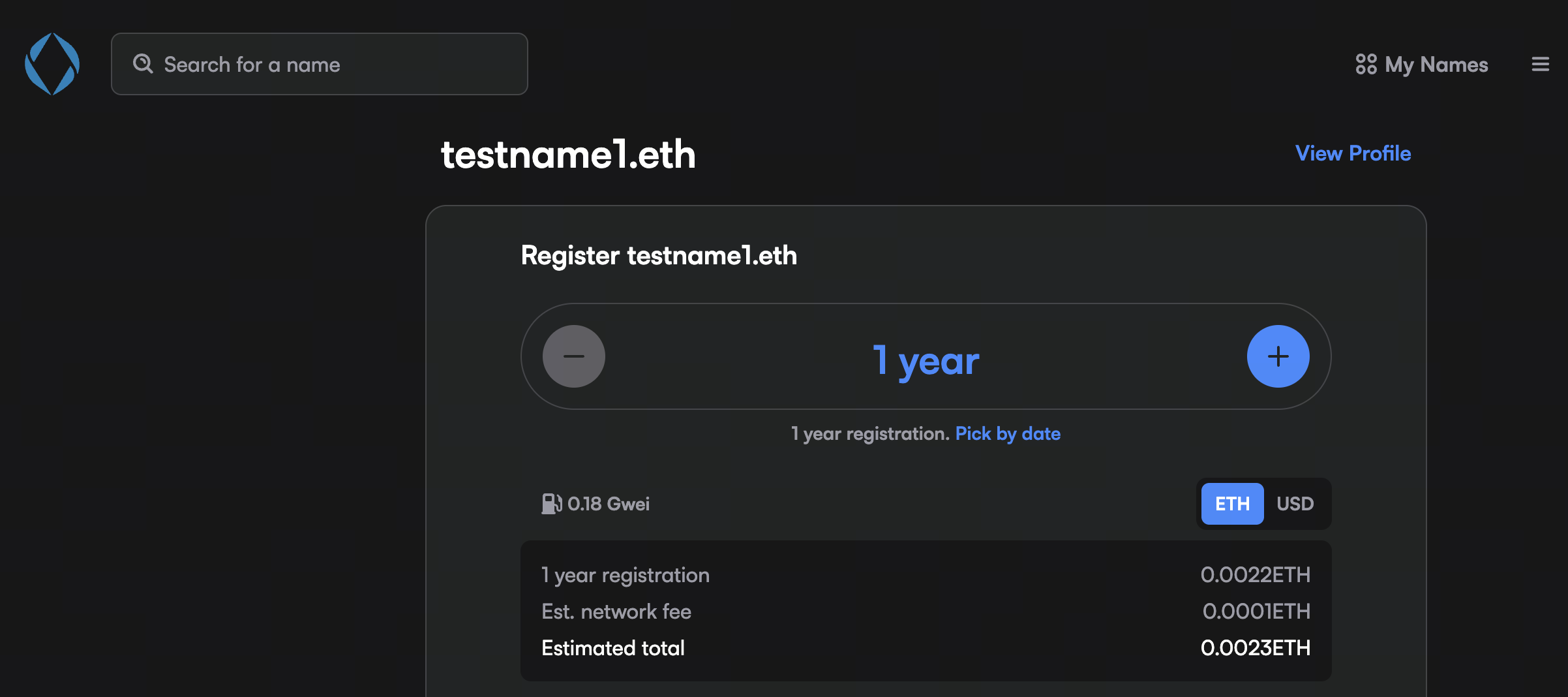
ENS’s core architecture consists of a registry, registrars, and resolvers. The registry records who controls each name and specifies the resolver; registrars handle domain registration, renewal, and rule management; resolvers store the actual resolution data, such as wallet addresses, content hashes, and text records.
When a user enters a name like vitalik.eth in a wallet, the wallet initiates the ENS resolution process by querying the resolver associated with that name and retrieving the relevant address record. This process is analogous to traditional DNS resolving a domain to an IP address, but ENS resolves to on-chain addresses, content identifiers, and identity information.
ENS also supports reverse resolution, enabling a wallet address to be mapped back to a primary ENS name. For example, an address can designate alice.eth as its primary name, so block explorers, wallets, or DApps display the user-friendly ENS name instead of a complex address. This brings on-chain interactions closer to real-world identity systems.
How Is ENS Different from Traditional Domain Name Systems?
Traditional DNS is managed by registrars, registries, and organizations like ICANN, all of which are centralized or semi-centralized. Domain ownership relies on provider accounts, DNS hosting, and the legal system. In contrast, ENS uses smart contracts to record ownership, and domain holders manage their names via wallet private keys.
ENS ownership is similar to on-chain assets. .eth names can be transferred, rented, or staked within protocols, and can be integrated with NFTs, DAOs, and on-chain reputation systems. While traditional domains primarily support website access, ENS is used for payments, identity, profile display, contract interactions, and multi-chain resolution.
ENS also offers superior censorship resistance and composability. As long as the underlying blockchain and smart contracts are operational, ENS records can be publicly verified and accessed by wallets, exchanges, DApps, and browser extensions. However, ENS is not immune to real-world issues—trademark disputes, phishing domains, frontend blocking, and jurisdictional challenges can still impact user experience.
ENS Use Cases in Web3
The most fundamental ENS application is wallet payments. Users can send funds to a name.eth address instead of copying long addresses, reducing transfer errors. Many major wallets, block explorers, and DeFi applications already support ENS display and resolution.
Another key use case is on-chain identity. ENS names can be linked to avatars, websites, social accounts, email, GitHub, Discord, and more—creating a public Web3 profile. For developers, DAO members, NFT creators, and DeFi users, a stable ENS identity helps establish reputation.
A third use case is decentralized websites. ENS can associate with IPFS or Arweave content hashes, allowing users to access websites or profile pages in a decentralized way. This supports censorship-resistant publishing, organizational homepages, and long-term storage.
A fourth use case is cross-chain identity. With Universal Resolver, cross-chain resolution, and ENSv2 developments, ENS is working to connect multiple chain addresses to a single name, enabling users to maintain a consistent identity across different blockchains.
ENS Token: Utility and Governance
The ENS token serves as the governance token for ENS DAO. It is not required for domain payments, but is used for protocol governance. Holders can vote directly or delegate their voting power to representatives for proposal discussions and governance decisions.
ENS DAO oversees protocol parameters, treasury management, working group budgets, public goods funding, ecosystem partnerships, and long-term planning. Recent governance has focused on service provider budgets, treasury management, working group grants, public goods support, and ENSv2 preparedness.
Effective governance is essential, as ENS is foundational public infrastructure. Decisions on fee models, protocol upgrades, resolution standards, fund allocation, and ecosystem incentives impact users, developers, and integrators. The ENS token’s value is rooted in governance rights, protocol influence, and ecosystem expectations, rather than direct cash flow or profit-sharing.
How Does ENS Compare to Other Decentralized Identity Protocols?
Compared to social protocols like Lens and Farcaster, ENS focuses on foundational naming and identity resolution. Lens and Farcaster emphasize social graphs, content distribution, and user relationships, while ENS provides readable names, address mapping, and identity data at the protocol layer.
Relative to blockchain domain services like Unstoppable Domains, ENS is more deeply integrated with the Ethereum ecosystem, offering greater protocol openness, wallet support, DApp integration, and mature DAO governance. The .eth suffix is one of the most recognized in Web3.
Compared to DID standards, ENS functions as a practical on-chain naming system, while DID is a general identity framework. The two are not direct competitors—ENS names can be used as part of DIDs, credentials, reputation systems, and on-chain account abstraction.
What Risks Are Involved in Using ENS?
-
Private key risk. ENS names are controlled by wallets; if the private key is compromised, attackers can transfer the domain or alter resolution records. High-value ENS names should be secured with hardware wallets, multisig, or robust permission management.
-
Renewal risk. .eth domains require annual renewal. Expired domains may enter a grace period before becoming available for others to register. Brand names, personal names, and short high-value domains require close attention to renewal timing.
-
Phishing and impersonation risk. Attackers may register similar, special character, or visually confusing domains to trick users into sending funds. Always verify the resolved address before transferring—do not rely solely on the name.
The fourth risk is market volatility. ENS names are tradable, but their value is influenced by scarcity, branding, market sentiment, and crypto cycles. ENS tokens are also subject to price volatility, and governance value does not guarantee investment returns.
ENS: Future Directions and Market Potential
ENS’s core strategy is to evolve from a domain registration tool into foundational Web3 identity infrastructure. ENSv2 aims to deliver a more streamlined registration process, flexible permission models, improved cross-chain resolution, and enhanced developer tools. The new ENS app and ENS Explorer are designed for a better user and developer experience.
According to the latest roadmap, ENSv2 will remain on Ethereum L1, reflecting the team’s confidence in mainnet scalability and lower gas costs to support future demand. For users, this may reduce cross-chain complexity; for developers, ENS continues to benefit from Ethereum L1’s security and ecosystem consensus.
ENS’s market potential centers on three factors: the ongoing adoption of wallets and payments; the demand for unified identity by on-chain identity, DAOs, and social apps; and the need for readable, verifiable identities by AI Agents, account abstraction, and multi-chain applications. As the Web3 user base grows, ENS could become foundational infrastructure, much like DNS for the internet.
Summary
ENS is a critical infrastructure in the Ethereum ecosystem, bridging addresses, identities, and applications. It converts complex addresses into readable names and, through smart contracts, resolvers, and DAO governance, enables Web3 identities that are open, verifiable, and composable.
With ENSv2, cross-chain resolution, and new product rollouts, ENS is expanding beyond .eth domain trading into wallet gateways, on-chain profiles, decentralized websites, DAO identities, and multi-chain account management. For users, ENS enhances convenience; for the Web3 ecosystem, it provides a reusable, long-term identity layer.
FAQs
Are ENS domains the same as regular website domains?
Not exactly. Regular domains are mainly for website access, while ENS domains also support wallet payments, on-chain identity, reverse resolution, decentralized websites, and multi-chain address binding.
Do I need ENS tokens to use ENS?
Registering and renewing .eth domains typically does not require ENS tokens; fees are paid via on-chain payment methods. ENS tokens are mainly for DAO governance and voting delegation.
Do ENS domains expire?
Yes. .eth domains require renewal and may be re-registered by others if they expire. Important domains should be renewed early and reminders set.
What’s new in ENSv2?
ENSv2 is ongoing, but the latest roadmap confirms deployment on Ethereum L1 and the end of the standalone Namechain plan. Key upgrades include a simpler registration experience, cross-chain resolution, hierarchical registration architecture, and improved application tools.