In the global energy market, the value of oil and natural gas does not come only from the resources themselves. It also depends on the ability to move those resources safely and efficiently to end markets. Whether it is crude oil from shale basins, natural gas from production fields or natural gas liquids widely used in the chemical industry, all of these products require a large infrastructure network for transportation, storage and distribution. As a result, alongside exploration and production companies and refining and petrochemical companies, the energy industry has developed a dedicated midstream sector responsible for logistics and infrastructure operations.
Enterprise Products Partners is one of the most representative companies in the U.S. midstream energy industry. The company owns pipeline systems, storage and transportation facilities, natural gas liquids processing networks and export terminals across several major energy regions in the United States. Because its business model depends more on infrastructure service fees and long term transportation contracts, it differs significantly from traditional energy producers that are more directly exposed to oil and gas price fluctuations. This has also made it one of the most recognizable energy infrastructure operators in the U.S. capital market.
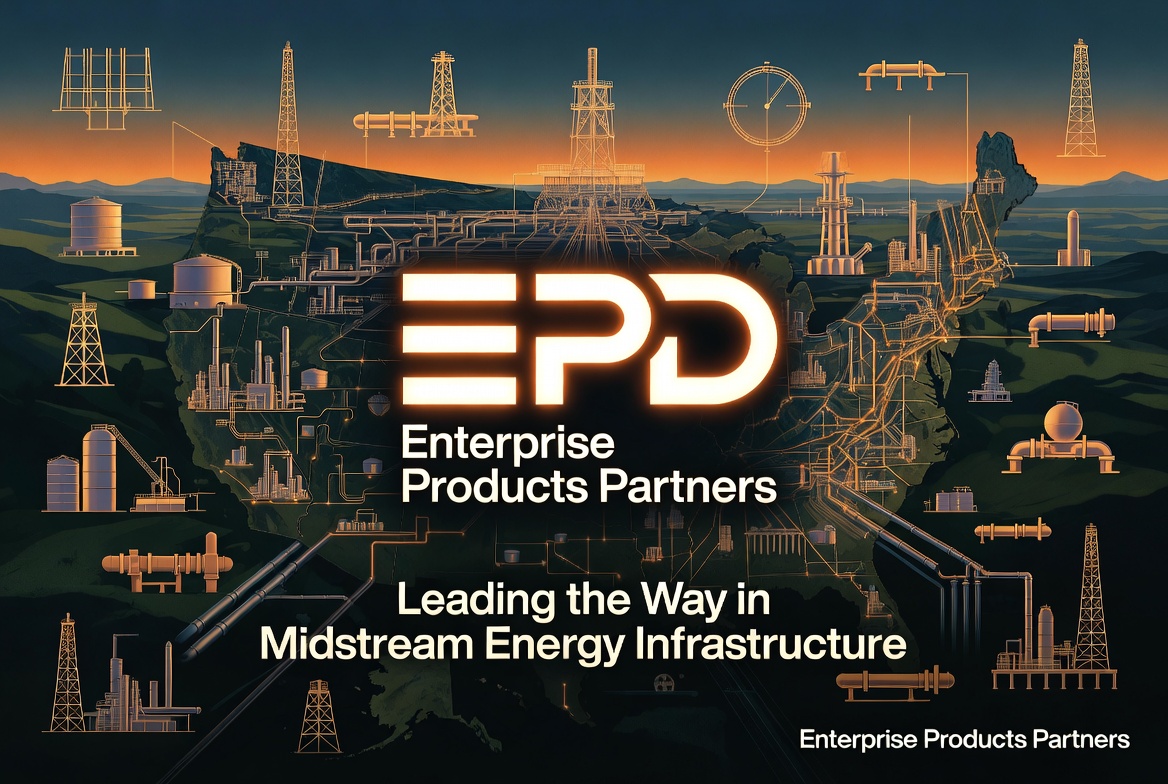
What Is EPD (Enterprise Products Partners)
Enterprise Products Partners is headquartered in Houston, Texas, and is one of the largest midstream energy companies in North America. The company mainly provides transportation, storage, processing and export services for crude oil, natural gas, natural gas liquids (NGLs) and petrochemical products. Its core assets consist of a large scale energy infrastructure network.
The energy industry is generally divided into three segments: upstream, midstream and downstream. Upstream companies are responsible for energy exploration and production, downstream companies handle refining, chemical processing and end sales, while midstream companies connect the two through transportation and logistics. Enterprise Products Partners plays an important role in this system, with operations that run through key nodes between multiple U.S. energy production areas and consumer markets.
Unlike integrated energy companies such as ExxonMobil and Chevron, EPD does not primarily focus on producing oil or natural gas. Instead, the company is more like a highway operator for the energy industry, charging fees for transportation, storage and processing services. For this reason, EPD’s operating performance is usually influenced more by energy production volumes and transportation demand than by direct swings in energy prices.
Enterprise Products Partners’ History and Market Position
The development of Enterprise Products Partners has closely followed the construction of modern energy infrastructure in the United States. The company’s roots can be traced back to the 1960s, when U.S. energy consumption was growing rapidly and demand for pipeline transportation and storage networks continued to rise. As the oil and gas industry expanded, the company gradually built an infrastructure system covering multiple types of energy products.
In 1998, Enterprise Products Partners went public under an MLP structure. Over the following decades, the company continued to expand its business footprint through capital investment, asset integration and infrastructure development. After the U.S. shale oil revolution in particular, large volumes of new crude oil and natural gas production required additional transportation and storage capacity, creating a period of rapid growth for EPD.
Today, Enterprise Products Partners has become one of the most important companies in the U.S. midstream energy sector. Its business spans crude oil, natural gas, natural gas liquids and petrochemical products, and it holds an important position in the energy export market. From a market positioning perspective, EPD is both a key infrastructure operator in the U.S. energy supply chain and an important participant in global energy trade.
How EPD’s Energy Infrastructure Business Works
EPD’s business model is built on energy transportation and logistics services. After crude oil and natural gas are extracted from oilfields or gas fields, energy producers usually do not build a complete transportation system on their own. Instead, they rely on specialized midstream companies to provide infrastructure support. Enterprise Products Partners performs this function through its pipelines, storage facilities and terminal network, charging customers transportation and service fees.
In practice, energy products first enter trunk pipeline networks through gathering systems, then move to refineries, chemical facilities, storage centers or export ports. For natural gas liquids, separation and processing are also required before transportation to meet the needs of downstream industrial customers. EPD owns assets across multiple stages of this process, allowing it to provide relatively complete integrated services.
A key feature of this model is stability. Because energy transportation demand exists over the long term, many customers enter into multi year contracts with EPD to secure transportation capacity and supply chain reliability. This allows the company to generate relatively stable cash flow, which is also one of the main characteristics that distinguishes it from energy producers.
EPD’s Role in the U.S. Oil and Gas Value Chain
The U.S. energy value chain is generally divided into resource production, transportation and logistics, and end consumption. Enterprise Products Partners sits in a critical connecting position within this chain. Without midstream infrastructure, energy products produced by upstream companies would struggle to reach consumer markets, and downstream companies would have difficulty securing stable feedstock supplies.
The U.S. shale oil revolution has driven rapid growth in several energy producing regions, including the Permian Basin, Eagle Ford and Haynesville. Large volumes of crude oil, natural gas and natural gas liquids produced in these regions must be transported through pipeline systems to refineries, chemical complexes and export terminals. EPD is an important part of this transportation system.
As the United States has gradually become a major global energy exporter, the importance of midstream infrastructure has increased further. Enterprise Products Partners serves not only the domestic U.S. market, but also connects with international energy trade networks through its export terminals. For this reason, EPD’s development is often viewed as an important reflection of the growth of the U.S. energy supply chain and export capacity.
For Enterprise Products Partners, infrastructure assets are the most important source of competitive advantage. Among them, the natural gas liquids (NGL) business is especially representative. Natural gas liquids include products such as ethane, propane and butane, which are widely used in the petrochemical industry, plastics manufacturing, fuel supply and industrial production. As a result, they benefit from long term and stable demand.
Around the natural gas liquids value chain, EPD has built a complete network covering gathering, transportation, storage and export. The company owns a large number of pipeline systems, and has also developed natural gas liquids fractionation facilities, underground storage facilities and export terminals. Together, these assets form an infrastructure system with very high barriers to entry.
| Core Asset Type |
Main Function |
| Crude oil pipelines |
Transport crude oil to refining and export markets |
| Natural gas pipelines |
Connect production areas with consumer markets |
| NGL transportation network |
Support the operation of the natural gas liquids value chain |
| Storage and transportation facilities |
Balance market supply and demand and support inventory management |
| Export terminals |
Serve international energy trade |
Because building these assets requires substantial capital investment and regulatory approval, new entrants find it difficult to replicate a similar network. As a result, EPD’s large scale infrastructure footprint not only improves operating efficiency, but also forms a key foundation for its long term competitive advantage.
How the MLP (Master Limited Partnership) Model Affects the Operating Structure
An MLP (Master Limited Partnership) is an organizational structure widely used in the U.S. energy infrastructure industry. Compared with traditional listed companies, MLPs place greater emphasis on cash flow distribution and usually focus on asset operation businesses with long term and stable sources of revenue.
Enterprise Products Partners uses the MLP model largely because energy infrastructure has a relatively high degree of predictability. Pipeline transportation, storage services and terminal operations often depend on long term contracts, which gives them more stable cash flow than many cyclical industries. The MLP structure is well suited to these business characteristics.
From an operational perspective, the MLP model allows EPD to continue investing in infrastructure projects while maintaining a stable capital return mechanism. This is also one of the main reasons many investors pay close attention to EPD. Unlike high growth technology companies, EPD’s core value is reflected more in its long term operating capabilities, cash flow management and the quality of its energy infrastructure assets.
How EPD Differs from Energy Transfer and Kinder Morgan
Enterprise Products Partners, Energy Transfer (ET) and Kinder Morgan (KMI) are all major companies in the U.S. midstream energy industry, but they differ clearly in asset structure and business focus.
Enterprise Products Partners has long focused on building out the natural gas liquids value chain, giving it strong advantages in NGL transportation, processing and export. Energy Transfer is characterized by a broad asset base covering crude oil, natural gas and natural gas liquids, and it has built a large network through continuous expansion. Kinder Morgan, by contrast, is more focused on the natural gas transportation market and holds an important position in North American natural gas infrastructure.
| Company |
Main Characteristics |
| EPD |
Strong advantages in the natural gas liquids value chain |
| ET |
Broad coverage across integrated energy networks |
| KMI |
Higher concentration in natural gas transportation |
Although all three companies are midstream infrastructure operators, their different asset layouts give them different advantages when market conditions change. For anyone trying to understand the U.S. energy infrastructure industry, these differences help clarify each company’s market position.
Main Use Cases for EPD
Enterprise Products Partners’ infrastructure network serves a wide range of industries. The most direct use case comes from the crude oil transportation market. Large volumes of crude oil produced by oilfields need to move through pipeline systems to refineries, and EPD’s transportation network serves as an important bridge between the production side and the processing side.
The natural gas market is also an important part of the company’s business. Power generators, industrial manufacturers and residential consumer markets all require stable natural gas supply. Through its natural gas transportation and storage facilities, EPD helps keep the energy supply chain running and supports demand across different types of markets.
In addition, natural gas liquids and petrochemical products represent another important use case. Modern plastics, chemical materials and some industrial products depend on natural gas liquids as raw materials. As U.S. energy exports have expanded, EPD’s export terminal facilities have also become important nodes linking global energy trade. Together, these diversified use cases support the long term market value of Enterprise Products Partners.
How to Buy EPD (Enterprise Products Partners) Stock
EPD is the ticker symbol for Enterprise Products Partners, which is traded on the New York Stock Exchange (NYSE). Traditionally, investors can buy EPD through a brokerage account that supports U.S. stock trading, allowing them to participate in the development of the U.S. energy infrastructure industry.
Because Enterprise Products Partners’ business is closely linked to U.S. oil and gas transportation, natural gas liquids exports and the broader energy logistics system, it is often viewed as one of the companies to watch when assessing the U.S. energy supply chain. Its operating performance is usually affected by energy production volumes, infrastructure utilization rates and international energy trade activity.
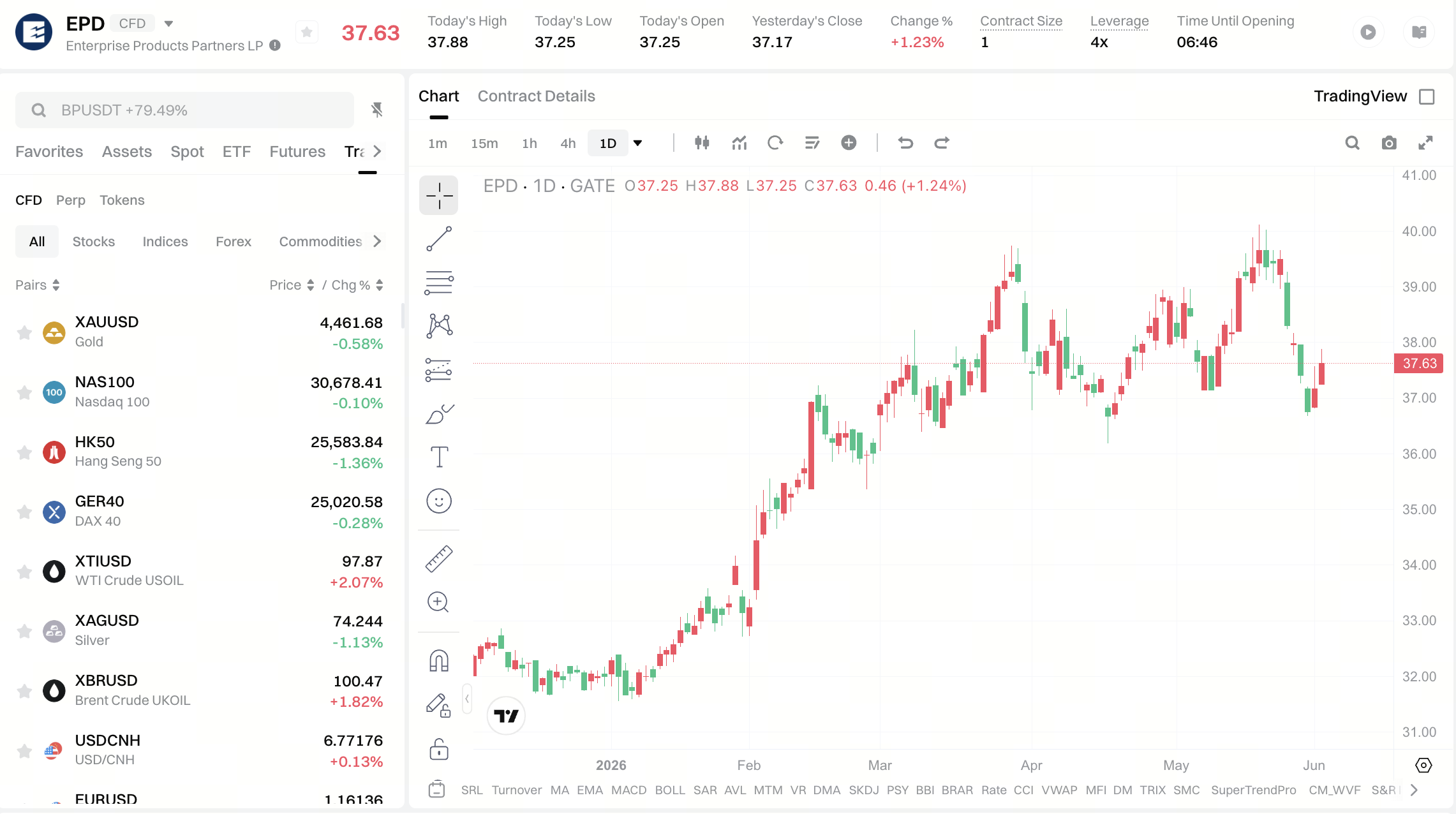
As the digital asset market and traditional financial markets gradually converge, more trading tools linked to the price movements of energy companies have appeared. For example, some platforms offer CFD products linked to stock prices, allowing users to participate in market movements through price changes without directly holding the underlying stock assets.
Taking Gate TradFi as an example, users can follow different markets within the same ecosystem, including digital assets, stocks, ETFs, indices and commodities. Some markets also provide Gate CFD products, offering more options for cross market asset allocation and price tracking.
Regardless of how investors choose to participate in the market, they should fully understand the product structure, trading rules and regulatory requirements in their own region.
EPD’s Strengths and Limitations
Enterprise Products Partners’ strengths begin with its massive energy infrastructure network. Pipelines, storage and transportation facilities, and export terminals all have extremely high construction barriers, making it difficult for new entrants to replicate a similar asset system in a short period of time. This allows EPD to maintain an important position in the U.S. midstream energy industry over the long term.
The natural gas liquids business is another core strength. As global petrochemical demand grows and U.S. energy exports expand, the natural gas liquids transportation and export markets continue to develop, and EPD has a complete value chain layout in this area. In addition, long term transportation contracts and the infrastructure service fee model help improve cash flow stability.
However, EPD still faces challenges from cyclical changes in the energy industry. If U.S. energy production growth slows, utilization rates for some infrastructure assets may be affected. At the same time, large infrastructure projects often face constraints related to regulatory approval, construction costs and environmental policies. Over the long term, the global energy transition may also change the demand structure for certain energy products, which could affect the direction of industry development.
Summary
EPD (Enterprise Products Partners) is one of the largest midstream energy companies in the United States. Its business covers multiple stages of crude oil, natural gas, natural gas liquids and petrochemical product transportation, storage, processing and export. Through its extensive infrastructure network and MLP operating model, Enterprise Products Partners plays a key role in the U.S. energy supply chain. Unlike energy producers that depend more directly on oil and gas price movements, EPD focuses on providing energy logistics and infrastructure services. Its long term value is built on asset scale, transportation demand and cash flow stability.
FAQs
What kind of company is EPD?
EPD is the ticker symbol for Enterprise Products Partners. The company is one of the largest midstream energy infrastructure companies in the United States, mainly engaged in energy transportation, storage, processing and export services.
Is EPD an oil company?
EPD is not a traditional oil production company. It mainly operates energy infrastructure and provides logistics services to the energy value chain through pipeline and storage networks.
What is the MLP model?
An MLP (Master Limited Partnership) is an organizational structure widely used in the U.S. energy infrastructure industry. It usually emphasizes long term asset operations and cash flow distribution.
What energy products does EPD mainly transport?
EPD mainly transports crude oil, natural gas, natural gas liquids and certain petrochemical products, while also providing related storage and export services.
How is EPD different from Kinder Morgan?
Both companies are midstream energy enterprises, but EPD has stronger advantages in the natural gas liquids value chain, while Kinder Morgan is more focused on natural gas transportation.
Why is EPD considered an energy infrastructure company?
Because EPD’s core assets are pipelines, storage and transportation facilities, and export terminals. Its main revenue comes from energy transportation and logistics services, not from energy production itself.