In the cryptocurrency market, whether a trading platform genuinely holds user assets has become one of the most critical factors for investors when choosing an exchange. In recent years, Proof of Reserves (PoR) has emerged as a key transparency standard for centralized trading platforms, and 100% reserves demonstrate that the platform has sufficient assets to cover all user deposits.
As one of the leading cryptocurrency exchanges to pledge 100% reserves, Gate has developed a verification framework that integrates Merkle Tree, zk-SNARK zero-knowledge proofs, and third-party audits. This system empowers users to independently verify that their assets are included in the reserve audit, delivering transparency, privacy protection, and robust security.
What Is Gate 100% Reserves?
100% reserves (Proof of Reserves) means the platform’s on-chain assets are fully sufficient to cover all user account balances. In other words, the combined assets in the platform’s cold and hot wallets must be greater than or equal to the total user assets, proving the platform’s complete solvency.
For centralized exchanges, user assets are typically recorded in internal ledgers, making it impossible for outsiders to directly confirm whether the platform actually holds the corresponding assets. To address this trust gap, Gate employs third-party audits, Merkle Tree, and zero-knowledge proofs to establish a publicly verifiable Proof of Reserves mechanism—making platform assets transparent while safeguarding user privacy.
Why Is 100% Reserves So Important?
In the digital asset market, transparency and security directly shape investor confidence. If a trading platform maintains full 100% reserves, it means the platform has enough assets to match all user deposits—even if many users withdraw simultaneously, redemptions can proceed smoothly. Conversely, if a platform cannot provide complete Proof of Reserves, it faces multiple risks including fund misappropriation, withdrawal delays, liquidity shortages, and even operational crises from bank runs.
Maintaining 100% reserves offers the following advantages:
-
Increased platform transparency
Third-party audits and public verification allow anyone to confirm the platform’s asset status without relying solely on the platform’s own declarations.
-
Enhanced user trust
When a platform can prove all user assets are fully backed, investors can store and trade digital assets with confidence.
-
Effective asset protection
100% reserves mean the platform has adequate asset backing, reducing the risk of shortages or liquidity issues.
-
Greater market stability
Even during extreme market volatility, the platform retains enough assets to meet large withdrawal demands, minimizing the risk of bank runs.
How Does Gate Audit 100% Reserves?
Gate’s Proof of Reserves isn’t simply publishing wallet addresses; it leverages multiple technologies for a comprehensive verification process, ensuring data is trustworthy and tamper-proof.
Step 1: Confirm Cold and Hot Wallet Assets
Gate submits all cold and hot wallets to independent auditors. Following audit requirements, the platform uses official wallets to transfer specific amounts to designated addresses, proving Gate’s actual control. Once verified, auditors tally the total on-chain assets controlled by the platform, which include both user deposits and Gate’s own funds.
Step 2: Create User Asset Snapshots
At a designated timestamp, Gate creates a comprehensive snapshot of all user accounts. This snapshot includes account balances, open orders, lending assets, unrealized profits and losses, interest, and more—calculating each user’s actual net assets.
The sum of all users’ net assets forms the asset benchmark for this Proof of Reserves.
Step 3: Build Merkle Tree
After the asset snapshot, the system hashes each user’s encrypted UID and account balance to generate a Merkle Tree. Each user corresponds to a leaf node, and all nodes are hashed layer by layer to produce a unique Merkle Root. Because the Merkle Tree is tamper-proof, any change in a user’s balance alters the Merkle Root, ensuring data integrity. Each user can use their verification data to confirm their assets are included in the audit.
How Is a Merkle Tree Built?
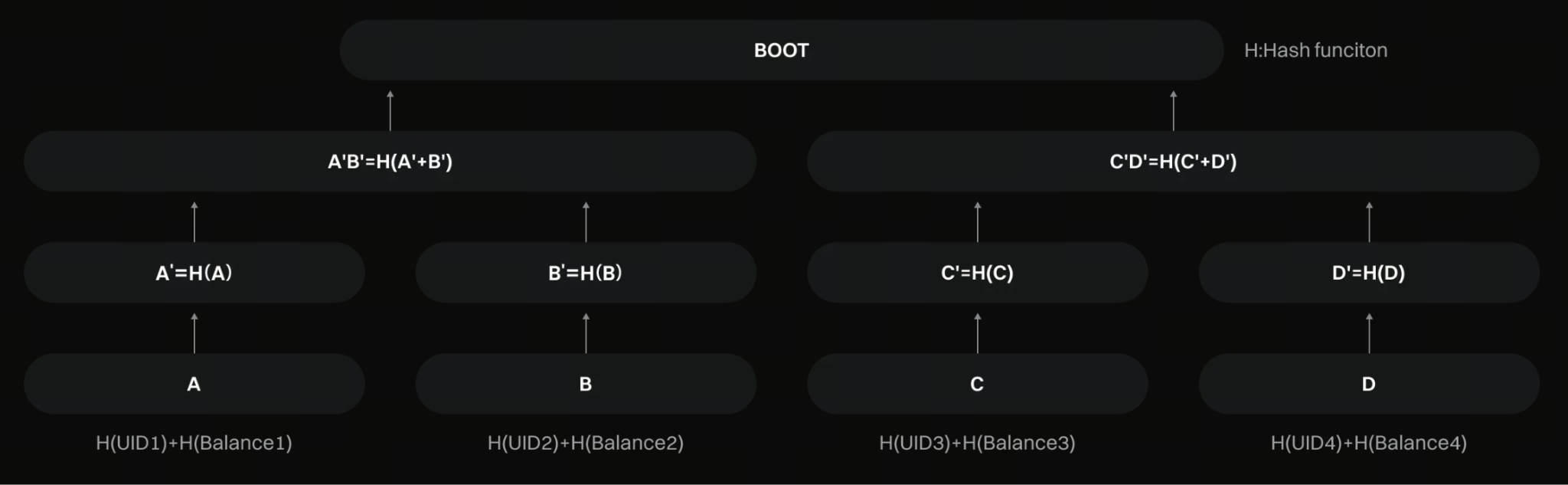
The Merkle Tree construction process includes the following steps: First, the system exports encrypted UIDs and corresponding asset balances from Gate’s database. Each UID and balance pair is hashed and combined to form the lowest-level data nodes. Adjacent nodes are hashed together, continuously generating parent nodes upward until only a single hash remains—the Merkle Root. Once complete, auditors disclose the Merkle Root and related verification data, enabling users to verify independently.
What Is a Merkle Tree?
A Merkle Tree is a data verification method widely used in blockchain and cryptography. It employs hash functions to layer-encrypt large datasets, so even minor changes affect the final Merkle Root. This enables rapid verification of data integrity—even across millions of records. Blockchain systems like Bitcoin and Ethereum use Merkle Trees extensively to validate transaction data.
How Does Gate Use zk-SNARK to Prove 100% Reserves?
Alongside Merkle Tree, Gate utilizes zk-SNARK zero-knowledge proofs. zk-SNARK is an advanced cryptographic technique that proves a statement’s truth without revealing sensitive information.
In Gate’s Proof of Reserves, zk-SNARK proves three key points:
- All user assets are included in the reserve calculation.
- Each user’s net assets are greater than or equal to zero—no negative accounts.
- Any change in account data synchronously alters the Merkle Root, so tampering cannot be concealed.
Zero-knowledge proofs allow users to verify reserves without learning other account details or exposing platform asset specifics, ensuring authenticity and reliability.
What Is zk-SNARK?
zk-SNARK stands for Zero-Knowledge Succinct Non-Interactive Argument of Knowledge. It is one of the most important zero-knowledge proof technologies in blockchain, enabling rapid verification without exposing original data. zk-SNARK delivers high efficiency, security, and privacy protection. Beyond Proof of Reserves, zk-SNARK is widely used for privacy transactions, identity authentication, Layer 2 scaling, and various Web3 applications.
How Can You Verify Your Assets Are Included in Gate’s Reserves?
Gate offers a complete user verification process, allowing anyone to confirm their assets are included in the reserve audit.
-
Download the official verification tool and obtain the relevant batch’s Merkle Tree and User Config files.
-
Place the verification tool in the designated folder and the User Config in the configuration directory.
-
After preparation, use the terminal or command prompt to navigate to the program folder and follow official instructions to run the verification tool.
Some operating systems may require granting execution permissions first. For example, Linux or macOS users should set execution permissions before launching the program. After verification, users can confirm whether their account is included in the Merkle Tree and that the public reserve data matches the zk-SNARK proof.
How Does Gate 100% Reserves Enhance Exchange Security?
Platform security depends not only on asset custody, but also on transparent verification. Gate integrates third-party audits, cold and hot wallet asset confirmation, Merkle Tree, and zk-SNARK into a comprehensive Proof of Reserves framework—enabling the platform to publicly prove sufficient asset reserves while protecting user privacy. Compared to only publishing partial wallet addresses or asset data, this verification structure offers greater credibility and allows every user to personally verify their assets are included in the audit, significantly boosting transparency and market trust.
Summary
As the cryptocurrency market matures, exchange transparency is now a key indicator of security. 100% reserves are more than an asset management promise—they prove the platform has sufficient assets to back all user holdings and is willing to undergo public, verifiable scrutiny. Gate leverages third-party audits, Merkle Tree, zk-SNARK zero-knowledge proofs, and public verification processes to deliver a robust Proof of Reserves mechanism, empowering every user to confirm their assets are included in the audit while balancing privacy, security, and transparency. For investors prioritizing asset safety and platform credibility, understanding 100% reserves and its verification methods supports more confident and rational exchange decisions.
FAQ
FAQ 1: What Does Gate’s 100% Reserves Mean?
Gate’s cold and hot wallet assets are greater than or equal to the sum of all user assets, ensuring complete solvency.
FAQ 2: How Does Merkle Tree Protect User Data?
Merkle Tree encrypts and hashes user UID and asset balances. Each user can verify their data exists in the tree, confirming assets are included in the audit without exposing others’ information.
FAQ 3: Why Does Gate Use zk-SNARK?
zk-SNARK proves the authenticity and validity of reserve data without disclosing actual asset figures, ensuring privacy, data integrity, and verification efficiency. It is a common and mature cryptographic technology for Proof of Reserves.







