GBP does not have a single market price that exists independently of other currencies. Its value is expressed through currency pairs. GBP/USD shows how many US dollars are required to buy one British pound, while EUR/GBP shows how many pounds are required to buy one euro.
As a major international currency, sterling is influenced by UK economic conditions, Bank of England monetary policy, global US dollar trends, and cross-border capital flows. According to the Bank for International Settlements’ 2025 foreign exchange survey, GBP was involved in approximately $939 billion in average daily transactions, representing about 12% of global FX turnover.
This guide is written for consumers, businesses, central banks, forex traders, and digital-asset users who need to understand how GBP functions in payments, trade, investment, or crypto-linked market access. It explains GBP’s currency code and symbol, how exchange rates are formed, the role of Bank of England policy, major GBP currency pairs, key price drivers, trading risks, and how USDT can be used to access GBP-related markets on Gate.com.
For digital-asset users, USDT can provide a familiar funding or settlement route for accessing GBP-related markets. However, a currency converter, direct GBP exchange, and leveraged forex derivative are different products. Users should identify the specific product structure before trading.
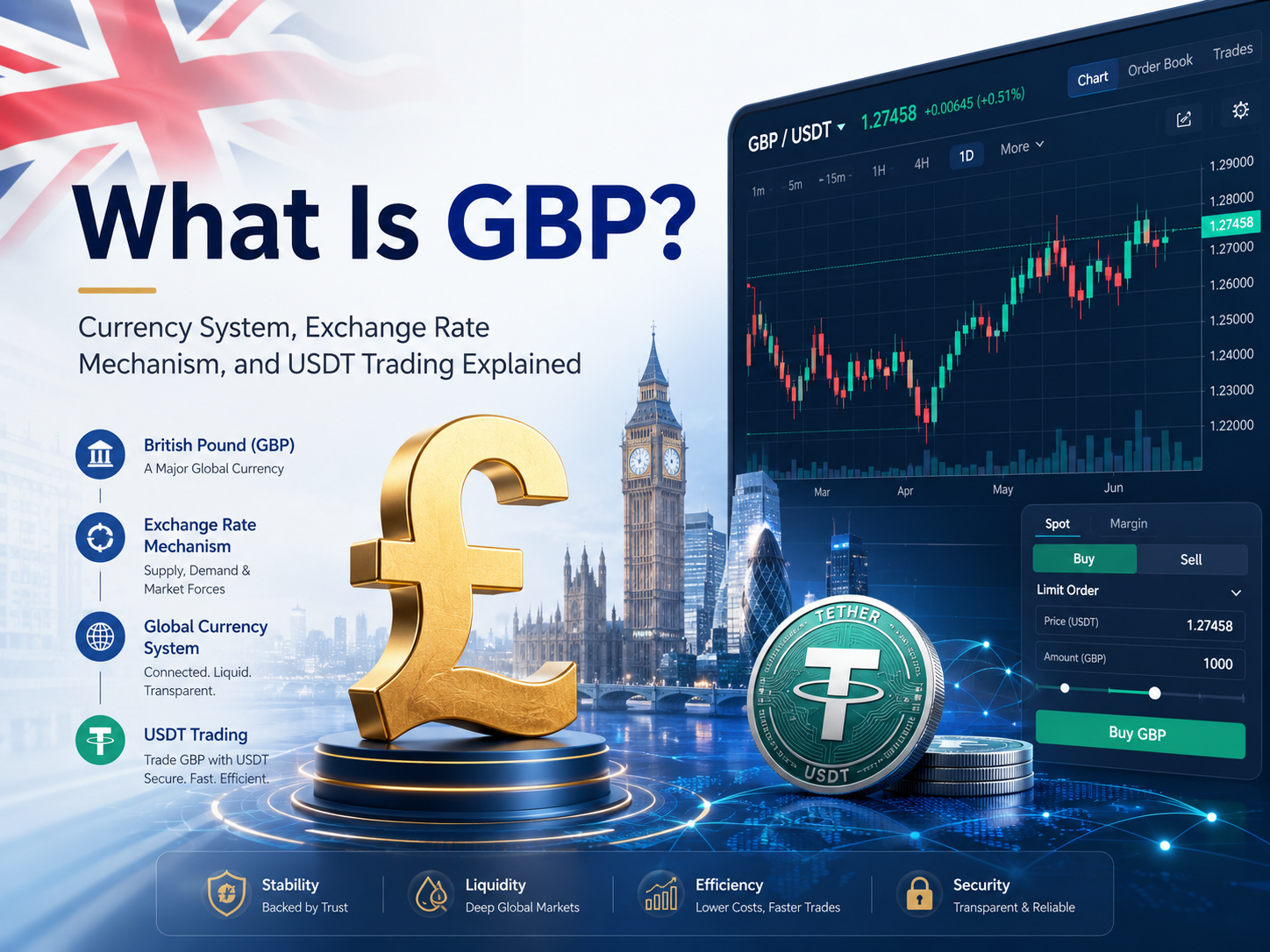
What Currency Is GBP? Sterling’s Code, Symbol, and Market Role
GBP is the standardized international code used to identify pound sterling in banking systems, foreign exchange markets, cross-border payments, and financial data. The letters “GB” refer to Great Britain, while “P” refers to pound.
The currency is commonly called the British Pound Sterling, and in international usage it may also be referred to as the GBP British Pound Sterling. Its symbol is £, and its smaller unit is the penny, with the plural form pence. Since the UK adopted decimal currency in 1971, one pound has been divided into 100 pence. Its origins trace back to Anglo-Saxon England, where the pound developed as a unit of account tied to silver-based money. British pound sterling is the oldest currency still in circulation, with roots over 1,200 years old dating to the 8th century.
| Item |
GBP Details |
| Currency name |
Pound sterling / British pound |
| International code |
GBP |
| Symbol |
£ |
| Subunit |
Penny / pence |
| Conversion |
1 GBP = 100 pence |
| Central bank |
Bank of England |
| Common currency pairs |
GBP/USD, EUR/GBP, GBP/JPY |
GBP serves several different groups. Consumers use it for payments and savings, companies use it for trade and accounting, central banks may hold it as a reserve asset, and forex traders use GBP currency pairs to express views on relative economic and monetary conditions.
What Is GBP’s Role in the Global Foreign Exchange Market?
Sterling is one of the most actively traded currencies in the global foreign exchange market, and it is one of the major currencies in global financial markets with wide use in international finance. The size of London’s financial sector, the UK’s international banking system, and its deep derivatives markets contribute to GBP’s liquidity and international use, closely tying it to the UK economy.
The Bank for International Settlements reported that GBP appeared on one side of about $939 billion in average daily FX transactions in April 2025. This represented approximately 12% of global foreign exchange turnover. Currency shares add up to more than 100% because each transaction involves two currencies. The British pound is the fourth most traded currency globally.
Sterling is also held by some governments and central banks as part of their official foreign exchange reserves. Alongside the US dollar, euro, Japanese yen, and other currencies, GBP forms part of the international reserve currency system. GBP accounts for about 5.19% of official reserves and is often treated as a benchmark currency in Europe. Sterling was the world’s dominant reserve currency in the 19th century and is still generally seen as a stable and reputable currency.
High trading activity does not mean that GBP is always stable. Interest-rate differences, fiscal policy, global risk sentiment, and changes in UK economic expectations can still cause substantial short-term exchange-rate movements.
How Are GBP Exchange Rates Determined?
GBP exchange rates are primarily determined by supply and demand in the foreign exchange market. Banks, companies, investment managers, governments, and individual traders buy or sell sterling through currency pairing for trade, investment, hedging, and speculative purposes.
The Bank of England does not set the daily market value of GBP/USD or other sterling pairs. The UK operates a floating exchange-rate regime, meaning the pound’s value changes with market conditions. Monetary policy affects sterling indirectly by changing interest rates, credit conditions, and the attractiveness of UK assets.
Forex markets also quote separate bid and ask prices. The difference between them is the spread. Spreads are generally narrower when liquidity is deep, but they may widen during major economic announcements, market reopenings, holidays, or periods of uncertainty.
| Exchange-rate factor |
How it affects GBP |
| Currency supply and demand |
Determines buying and selling pressure |
| Interest-rate expectations |
Changes the relative appeal of UK assets |
| Trade and investment flows |
Create demand for cross-border currency conversion |
| Market liquidity |
Affects spreads and execution quality |
| Risk sentiment |
Redirects capital between GBP, USD, and other currencies |
| Future expectations |
Prices in anticipated policy and economic changes |
A GBP exchange rate therefore reflects the market’s relative assessment of the UK and the economy represented by the other currency in the pair, and that structure helps avoid confusion about whether sterling is the base or quote side.
How Does the Bank of England Manage Sterling and Monetary Policy?
The Bank of England manages monetary policy with the objective of maintaining price stability. The UK government sets a 2% inflation target, and the Bank’s Monetary Policy Committee normally meets eight times a year to decide whether Bank Rate should change.
The Bank of England was established in 1694 to issue currency.
Bank Rate is the Bank of England’s main policy tool. Higher rates can reduce borrowing and demand while increasing the relative yield available on sterling-denominated assets. Lower rates can support borrowing and economic activity but may reduce GBP’s interest-rate advantage.
The Bank of England may also use balance-sheet policies and market operations to influence financial conditions. These measures affect liquidity, bond yields, borrowing costs, and expectations about future monetary policy.
During economic turmoil in 1931, the British government and the Bank moved away from the gold standard.
The relationship between Bank of England decisions and GBP is not automatic. A rate increase may already be reflected in market prices before it is announced. Sterling may also weaken after a hike if investors believe persistent inflation or tighter policy will damage UK growth. For example, periods of high inflation, including nearly 27% inflation in 1975, can weaken confidence in sterling even when policy is tightening.
How Should Traders Understand GBP/USD, EUR/GBP, and Other Currency Pairs?
GBP/USD shows how many US dollars are required to buy one British pound. GBP is the base currency, and USD is the quote currency. It is also a major forex trading pair in the forex market. When GBP/USD rises, sterling has generally strengthened against the dollar; when it falls, sterling has generally weakened.
EUR/GBP uses the opposite structure. The euro is the base currency, while sterling is the quote currency, with € and £ serving as a simple currency symbol example for each side of the pair. A rise in EUR/GBP normally means that the euro is strengthening against the pound. A decline usually means that sterling is strengthening against the euro.
Other widely followed sterling pairs include GBP/JPY, GBP/CHF, and GBP/AUD. Each pair reflects conditions in two economies, so GBP/USD and GBP/JPY can move differently during the same period.
| Currency pair |
What the quote means |
A rising price generally indicates |
| GBP/USD |
USD required to buy 1 GBP |
GBP strengthening against USD |
| EUR/GBP |
GBP required to buy 1 EUR |
EUR strengthening against GBP |
| GBP/JPY |
JPY required to buy 1 GBP |
GBP strengthening against JPY |
| GBP/CHF |
CHF required to buy 1 GBP |
GBP strengthening against CHF |
| GBP/AUD |
AUD required to buy 1 GBP |
GBP strengthening against AUD |
In 2022, GBP/USD daily turnover reached $432 billion.
Statements such as “GBP is rising” are incomplete unless the comparison currency is specified. Traders must also check whether sterling appears as the base or quote currency before interpreting the chart.
What Factors Affect the British Pound Exchange Rate?
GBP exchange rates are mainly influenced by Bank of England policy, inflation, economic growth, employment, fiscal policy, global US dollar conditions, and the trade balance, with markets watching these indicators alongside inflation and growth. Markets compare actual UK data with expectations and with the performance of other major currencies.
Inflation affects expectations for future interest rates, while GDP, purchasing managers’ indexes, retail sales, and employment data provide information about economic activity. A result that differs from market forecasts may produce a larger currency reaction than the absolute data level itself.
Government budgets, taxation, public borrowing, political stability, and trade relationships can also affect the risk premium attached to sterling. Concerns about fiscal sustainability or policy credibility may pressure GBP even when UK interest rates remain relatively high. Brexit is a clear example: GBP/USD fell about 10% after the vote as markets reassessed UK growth and economic policies.
Global dollar conditions are particularly important for GBP/USD. Federal Reserve policy, US economic releases, and safe-haven demand for dollars can move the pair even when there is no major change in the UK. Sterling also fell to $1.03 in September 2022, its all-time low against the US dollar, showing how political and macro stress can weigh on the british economy.
Exchange-rate risk is the most direct risk in GBP trading. Sterling can move quickly after central-bank decisions, inflation releases, fiscal announcements, elections, or unexpected global events. A seemingly positive economic indicator does not guarantee a predictable currency response.
Liquidity and execution also affect trading results. Bid-ask spreads may widen around major data releases or less active market periods, while market orders and stop instructions may experience slippage.
Different GBP products have different legal and financial characteristics. Direct currency conversion, forex spot trading, CFDs, futures, and other leveraged derivatives differ in ownership, margin, fees, financing costs, and liquidation mechanisms.
| Risk |
What it means |
| Exchange-rate risk |
GBP moves unfavorably against the quote currency |
| Interest-rate risk |
Monetary-policy changes affect pricing and financing |
| Liquidity risk |
Spreads widen or orders execute less efficiently |
| Leverage risk |
Small market movements create larger gains or losses |
| Overnight financing |
CFDs may charge ongoing holding costs |
| Product-identification risk |
A converter or derivative is mistaken for actual GBP ownership |
| USDT risk |
USDT temporarily trades away from its dollar reference value |
Users should confirm whether a product represents direct currency ownership or only price exposure. They should also review trading hours, regional availability, leverage, settlement rules, and applicable fees.
Gate provides a USDT-to-GBP conversion page that displays a reference value between Tether and pound sterling. A conversion tool shows comparative value, but it does not necessarily create a withdrawable GBP balance or leveraged foreign exchange position.
Within Gate’s account ecosystem, USDT may serve as the funding, collateral, or settlement asset for supported TradFi and derivative products. Where GBP-related forex CFDs are available, users can obtain exposure to pairs such as GBP/USD without first depositing fiat pounds.
| Comparison |
Gate USDT-based access |
Traditional forex account |
| Common funding source |
USDT and other supported assets |
USD, GBP, or other fiat currencies |
| Account settlement |
Product-specific, potentially using USDT-based accounting |
Usually a fiat account currency |
| Product type |
Converter or supported TradFi derivative |
Spot forex, rolling forex, or CFD |
| Direct ownership of GBP |
Depends on product; CFDs do not provide ownership |
Depends on whether the product is conversion or a derivative |
| Trading schedule |
Based on the selected product |
Generally follows global FX market hours |
| Main pricing source |
Global FX rates and platform pricing rules |
Interbank and broker FX markets |
A GBP/USDT reference also involves two relative prices: sterling’s value against the US dollar and USDT’s market value against the dollar. If USDT temporarily moves away from its dollar reference, GBP/USDT may not track GBP/USD perfectly.
Available markets may vary by region, account permissions, and platform updates. Users should determine whether the Gate page represents a converter, direct exchange, CFD, futures product, or another derivative before evaluating leverage and ownership.
Summary
GBP is the international currency code for pound sterling, the United Kingdom’s official currency. It uses the £ symbol, and one pound is divided into 100 pence. Sterling is used for domestic payments, international trade, foreign exchange, and reserve management.
GBP exchange rates are determined by supply and demand in the global foreign exchange market. The Bank of England does not directly set daily exchange rates, but its interest-rate and liquidity policies influence the attractiveness of sterling-denominated assets.
GBP/USD, EUR/GBP, and other pairs use different quote structures, so traders must identify the base and quote currencies before interpreting price movements. Economic data, fiscal policy, interest-rate expectations, US dollar conditions, and global risk sentiment all affect GBP.
Gate’s USDT conversion and supported TradFi products can connect digital-asset users with sterling-related values and markets. However, currency conversion, direct GBP ownership, and leveraged derivative exposure are separate activities with different settlement and risk structures.
FAQ
Why Is the British Pound Also Called Sterling?
Sterling is the traditional name for the british currency, and the great british pound is commonly referred to in markets as GBP. Pound sterling, British pound, and GBP generally refer to the same currency, although their usage varies by context; great britain pound is an informal phrasing, while British Pound Sterling is the formal name often used to avoid confusion internationally, alongside general slang terms.
Why Is One Pound Divided Into 100 Pence?
The UK adopted decimal currency in 1971 as part of a wider decimal coinage reform. In the run up to Decimal Day, dual pricing and public education helped people adjust to the change. Since then, one pound has been divided into 100 pence, replacing the older system based on pounds, shillings, and pre-decimal pennies rather than older silver coins.
Does the GBP Exchange Rate Stop Moving on Weekends?
The institutional forex market generally closes over the weekend, although some platforms may continue displaying indicative prices. Weekend events can cause gaps or wider spreads when markets reopen.
Are All British Pound Banknotes Issued by the Bank of England?
No. Not all sterling banknotes are issued by the Bank of England, as certain authorized banks elsewhere in the United Kingdom also issue them. These notes represent pound sterling, although acceptance may vary outside their home regions.
Common denominations of paper money are £5, £10, £20, and £50, and current polymer banknotes include security features such as raised print.
Some northern irish banks issue their own sterling notes, while the pound coin is the familiar £1 coin with a 12-sided design.
British Pound Sterling is also used in places such as Gibraltar, the Falkland Islands, and the Isle of Man, while legal tender rules can vary by region.
Why Might GBP/USDT and GBP/USD Move Differently?
GBP/USDT reflects both sterling’s value against the dollar and USDT’s market price relative to the dollar. A temporary USDT deviation can cause the two rates to move differently.
Do GBP Derivatives Pay Bank Deposit Interest?
GBP derivatives do not normally represent a pound-denominated bank deposit and therefore do not automatically earn deposit interest. Their financing costs and returns depend on the product’s contract rules.