As automotive electronics, industrial automation, 5G communications, and artificial intelligence applications continue to grow, demand is rising for chips that are stable, reliable, and available through long term supply. Rather than competing for the most advanced process nodes, GlobalFoundries has chosen to focus on mature nodes and specialty technology platforms, gradually building a differentiated competitive advantage.
What Is GFS (GlobalFoundries)?
Unlike chip design companies such as Nvidia, AMD, and Qualcomm, GlobalFoundries does not design end chips itself. Instead, it specializes in turning customers’ completed chip designs into mass producible semiconductor products. In this sense, GlobalFoundries is a typical Foundry, or wafer foundry, business.
A wafer foundry is responsible for the manufacturing stage of the semiconductor supply chain. After customers deliver chip design files to the foundry, the foundry uses advanced manufacturing equipment to produce wafers. These wafers are then sent to downstream packaging and testing companies, eventually becoming chips used in vehicles, communications equipment, industrial systems, and consumer electronics.
As one of the world’s leading foundries, GlobalFoundries has long served sectors including automotive electronics, industrial control, communications networks, the Internet of Things, and defense. Through its global manufacturing network, it provides customers with long term production support.
GlobalFoundries’ History and Market Positioning
GlobalFoundries was founded in 2009, and its development is closely tied to the semiconductor industry’s broader shift toward specialized division of labor. The company was originally spun out of AMD’s manufacturing division, then gradually built manufacturing bases across the United States, Germany, Singapore, and other regions through continued expansion and acquisitions. Compared with many emerging semiconductor companies, GlobalFoundries has a stronger manufacturing foundation and industry experience.
During its development, GlobalFoundries once competed in advanced process technologies, but later adjusted its strategy and chose to focus on mature process nodes and specialty technology markets. This shift allowed the company to avoid direct competition with TSMC and Samsung in the most advanced nodes, while concentrating its resources on markets with stable, long term demand.
Today, GlobalFoundries is positioned more like a “specialty process foundry platform.” Products such as automotive chips, RF chips, power management chips, and industrial control chips often place greater importance on stability, reliability, and lifecycle management than on maximum computing performance. These are precisely the markets GlobalFoundries focuses on serving.
How GlobalFoundries’ Wafer Foundry Business Works
The wafer foundry model is one of the most important business models in the modern semiconductor industry. Under the traditional vertically integrated model, companies had to handle both chip design and manufacturing. However, building an advanced wafer fab often requires billions of dollars, or even more, in capital investment. As manufacturing costs continue to rise, more companies have chosen to focus on design and outsource production to specialized foundries.
GlobalFoundries’ business process usually begins with customer demand. After a chip design company completes the chip architecture, it delivers the relevant design files to GlobalFoundries. GlobalFoundries then uses its manufacturing process platforms to produce wafers and provides different process nodes and technical support based on the customer’s needs.
This model allows customers to avoid building expensive manufacturing facilities while using GlobalFoundries’ mature production capabilities to move quickly into mass production. For this reason, wafer foundries have become essential infrastructure in the modern semiconductor ecosystem.
GlobalFoundries’ Role in the Global Semiconductor Supply Chain
The semiconductor supply chain is generally divided into several stages, including design, manufacturing, packaging and testing, and end applications. Within this system, GlobalFoundries sits at the core of the manufacturing stage. Without wafer foundries, chip design companies could not turn their designs into physical products. Without stable manufacturing capacity, automotive systems, industrial equipment, and communications networks would also struggle to secure reliable long term chip supply.
From an industry collaboration perspective, GlobalFoundries connects upstream equipment suppliers and materials suppliers with downstream chip design companies. At the same time, it serves end markets such as automakers, telecom operators, and industrial equipment companies.
This central position makes wafer foundries critical nodes in the global semiconductor supply chain. In recent years, growing attention to supply chain security has further increased the importance of wafer manufacturing companies.
Unlike companies that pursue the most advanced process nodes, GlobalFoundries has long focused on mature process nodes and specialty technology platforms. Mature process nodes generally refer to manufacturing technologies that have already achieved large scale mass production, offer high stability, and support long product lifecycles. For automotive electronics, industrial control, and IoT devices, long term supply is often more important than peak performance, which is why mature process nodes still command substantial market demand.
In addition to mature process nodes, GlobalFoundries also places strong emphasis on technologies related to RF chips, power semiconductors, embedded memory, and automotive grade chips. These specialty technologies usually require years of technical accumulation and have relatively high industry barriers.
Compared with the intense capital competition in advanced process markets, specialty technologies place greater emphasis on manufacturing experience, reliability validation, and long term customer relationships. As a result, specialty technology platforms have become one of GlobalFoundries’ most important competitive advantages.
How GlobalFoundries Serves Automotive, Industrial, and Communications Markets
Automotive, industrial, and communications have become some of GlobalFoundries’ most important end markets. Compared with smartphone processors or high performance AI chips, these markets have different requirements. They place greater emphasis on long term supply, reliability validation, and stable operating performance.
In automotive electronics, modern vehicles have become highly electronic products. From engine control systems to advanced driver assistance systems, ADAS, and from in vehicle communications to battery management systems, a large number of semiconductor devices must operate reliably over long periods. Automotive chips typically need to pass strict certifications and remain available for many years, which often gives mature process nodes an advantage over advanced nodes.
The same is true in industrial automation. Factory equipment, robot controllers, power systems, and industrial sensors usually have long product lifecycles, so manufacturers care more about stability and long term maintenance capabilities. The mature process platforms offered by GlobalFoundries can meet these needs.
In communications, GlobalFoundries has long been active in RF technology and communications chip manufacturing. 5G base stations, wireless network equipment, and IoT communications modules all require large numbers of RF chips, and RF technology is one of GlobalFoundries’ key technical strengths.
How GlobalFoundries Differs From TSMC and UMC
GlobalFoundries, TSMC, and UMC are all wafer foundries, but their development strategies differ significantly. TSMC has long focused on advanced process technologies and remains an industry leader in 5nm, 3nm, and future, more advanced nodes. Its customers mainly include high performance chip design companies such as Apple, Nvidia, and AMD, so its business benefits heavily from the growth of artificial intelligence, high performance computing, and smartphones.
UMC shares some similarities with GlobalFoundries, as both focus on mature process markets. However, UMC is more focused on standard mature node foundry services, while GlobalFoundries has further strengthened its positioning in RF chips, automotive electronics, and specialty technology platforms.
| Company |
Core Positioning |
Strengths |
| TSMC |
Advanced process foundry |
AI, high performance computing, smartphones |
| GlobalFoundries (GFS) |
Mature process nodes and specialty technologies |
Automotive, industrial, communications |
| UMC |
Mature process foundry |
Consumer electronics and industrial applications |
From a business model perspective, TSMC relies more on its advanced process technology advantage, while GlobalFoundries builds its competitiveness through long term customer relationships, supply chain stability, and barriers in specialty technologies.
Key Application Scenarios for GlobalFoundries
Although GlobalFoundries does not sell products directly to consumers, many people use devices powered by chips manufactured by the company every day. Automotive electronics are one of the most important application scenarios. Body control systems, powertrains, in vehicle networks, and safety systems in modern vehicles all require large numbers of chips, and a significant share of these chips are manufactured using mature process nodes.
Industrial automation equipment also widely uses chips manufactured by GlobalFoundries. Industrial controllers, sensors, robotic systems, and smart manufacturing equipment all require stable and reliable semiconductor components.
Communications networks are another important market for GlobalFoundries. 5G infrastructure, wireless communications equipment, and IoT terminals require large quantities of RF chips and connectivity chips, and these products are a key area of focus for the company.
In addition, consumer electronics, power management systems, medical devices, and the defense industry also rely on mature node chips. So while GlobalFoundries does not manufacture end products, its manufacturing capabilities are deeply embedded in the modern digital economy.
How to Buy GFS (GlobalFoundries) Stock
GFS is listed and traded on the Nasdaq market in the United States, making it one of the important public companies in the global semiconductor manufacturing industry. Traditionally, investors can buy GFS shares through brokerage accounts that support U.S. stock trading, gaining exposure to opportunities in the global semiconductor supply chain and wafer foundry market. Since GlobalFoundries’ business spans automotive electronics, industrial chips, communications infrastructure, and other areas, it is also viewed as an important company for observing the mature process market.
As digital assets and traditional financial markets gradually converge, more trading tools linked to stock price movements have emerged. For example, some platforms offer CFD products tied to stock prices, allowing users to participate in market price movements without directly holding the underlying shares.
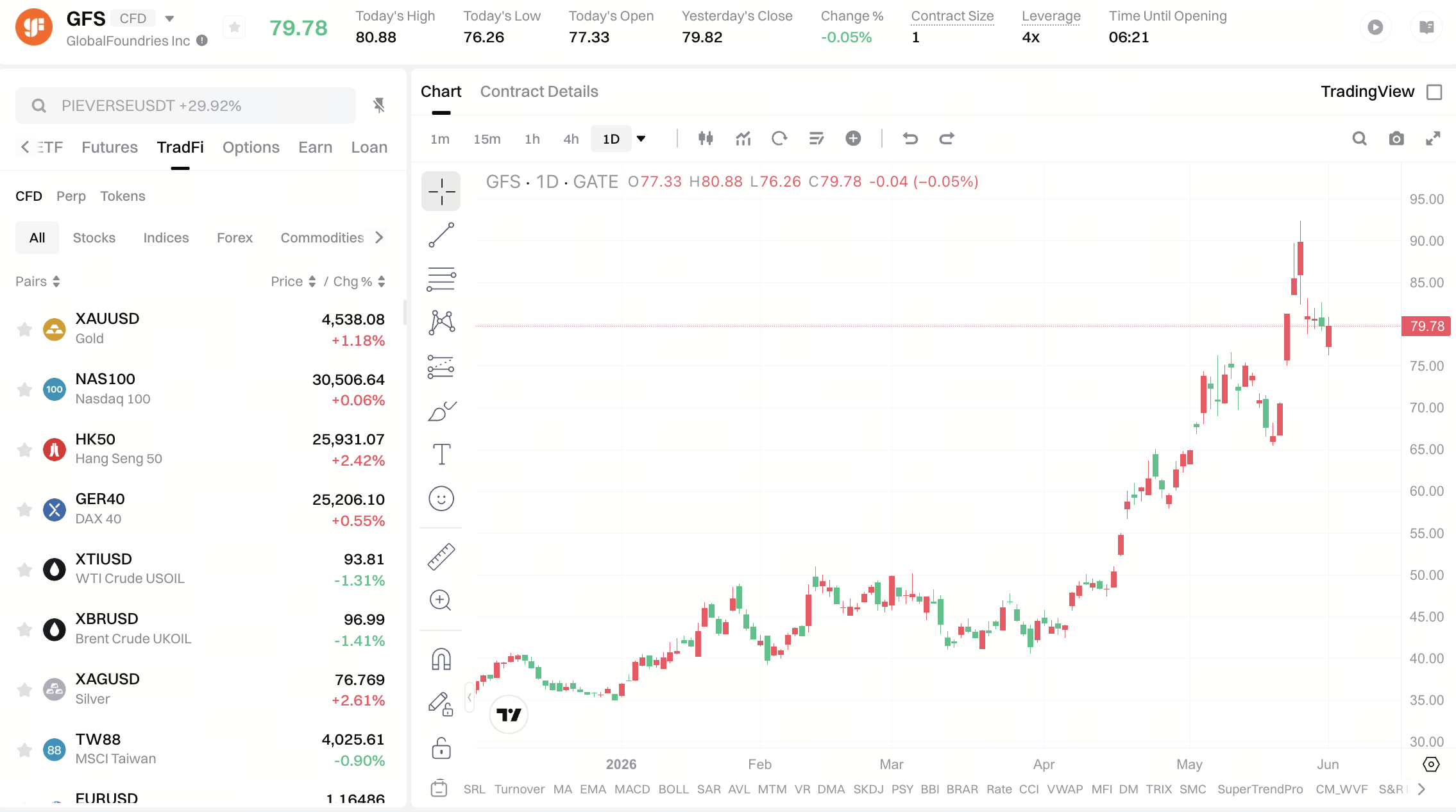
Taking Gate TradFi as an example, users can follow not only the digital asset market, but also traditional financial assets such as stocks, ETFs, indices, and commodities within the same ecosystem. Some markets also offer Gate CFD products, allowing users to participate in price movement trading for related assets through digital asset accounts, thereby improving cross market asset management efficiency.
Regardless of how investors choose to participate in the market, they should fully understand the product structure, trading rules, liquidity conditions, and regulatory requirements in their region.
GlobalFoundries’ Strengths and Limitations
GlobalFoundries’ greatest strength comes from its differentiated market positioning. Rather than continuously investing enormous sums to compete in the advanced process market, the company has chosen to focus on mature process nodes and specialty technologies, creating clearer competitive barriers.
Automotive electronics, industrial control, and communications infrastructure typically have long product lifecycles, so customers place greater value on supply stability and long term partnerships. These market characteristics help improve customer stickiness and strengthen revenue predictability.
In addition, specialty technology platforms such as RF chips, power management chips, and embedded memory have relatively high technical barriers, allowing GlobalFoundries to avoid direct competition with advanced node foundries.
However, GlobalFoundries also faces certain challenges. Because the company does not participate in the most advanced process market, it is less able to directly benefit from growth driven by high performance AI chips and flagship smartphone chips. At the same time, competition in the mature process market remains intense, with UMC, SMIC, and other foundries actively expanding related capacity.
Therefore, GlobalFoundries’ future development will still depend on continuing to strengthen its specialty technology capabilities and expanding its customer base in automotive, industrial, and communications markets, so it can maintain its differentiated competitive advantage.
Conclusion
GFS (GlobalFoundries) is one of the world’s leading wafer foundries, with a business model built on mature process nodes and specialty technology platforms. Unlike foundries focused on advanced process competition, GlobalFoundries mainly serves automotive electronics, industrial automation, communications networks, and IoT markets, building its competitive advantage through stable supply capabilities and long term customer relationships. In the global semiconductor supply chain, GlobalFoundries is not only an important manufacturing node, but also a key infrastructure company supporting the digital transformation of automotive, industrial, and communications sectors.
FAQs
What kind of company is GFS?
GFS is the stock ticker for GlobalFoundries. GlobalFoundries is a leading global wafer foundry that mainly provides semiconductor manufacturing services for chip design companies.
How is GlobalFoundries different from TSMC?
TSMC mainly focuses on the advanced process market, while GlobalFoundries specializes in mature process nodes and specialty technologies, with a focus on automotive, industrial, and communications markets.
Does GlobalFoundries design its own chips?
No. GlobalFoundries is a wafer foundry. Its main business is manufacturing chips, not designing them.
Why does the automotive industry need GlobalFoundries’ manufacturing capabilities?
Automotive chips usually require long term supply and high reliability validation, so mature process platforms are often better suited to the needs of the automotive industry than advanced process nodes.
Which industries does GlobalFoundries mainly serve?
GlobalFoundries mainly serves automotive electronics, industrial automation, communications networks, the Internet of Things, consumer electronics, and several other industries.
What is GlobalFoundries’ core competitive advantage?
GlobalFoundries’ core competitive advantage comes from its mature process platforms, specialty technology capabilities, and long term, stable customer relationships.