As the global online trading market continues to grow, gold CFD has become a cornerstone of the precious metals derivatives landscape. Unlike traditional physical gold investments, gold CFD is centered around trading price movements, making it a popular tool for short-term trading, trend following, and macro risk hedging.
Gold has long been a premier safe-haven asset in global financial markets. When inflation climbs, the dollar fluctuates, or geopolitical tensions rise, gold prices quickly draw market attention.
How Does Gold CFD Work?
Gold CFD operates on a core principle of "difference settlement".
For example, if a trader expects the international gold price to rise, they open a long gold CFD position at $2,300 per ounce. When the price reaches $2,350, they close the position and capture the $50 difference as profit.
Throughout the process, the trader never actually holds gold — they only participate in the price movement itself.
If the trader instead anticipates a decline, they can open a short position. Closing it after the price drops yields profit from the downward move.
Because gold CFD supports trading in both directions, opportunities exist in both rising and falling markets.
How Is Gold CFD Different from Physical Gold Investment?
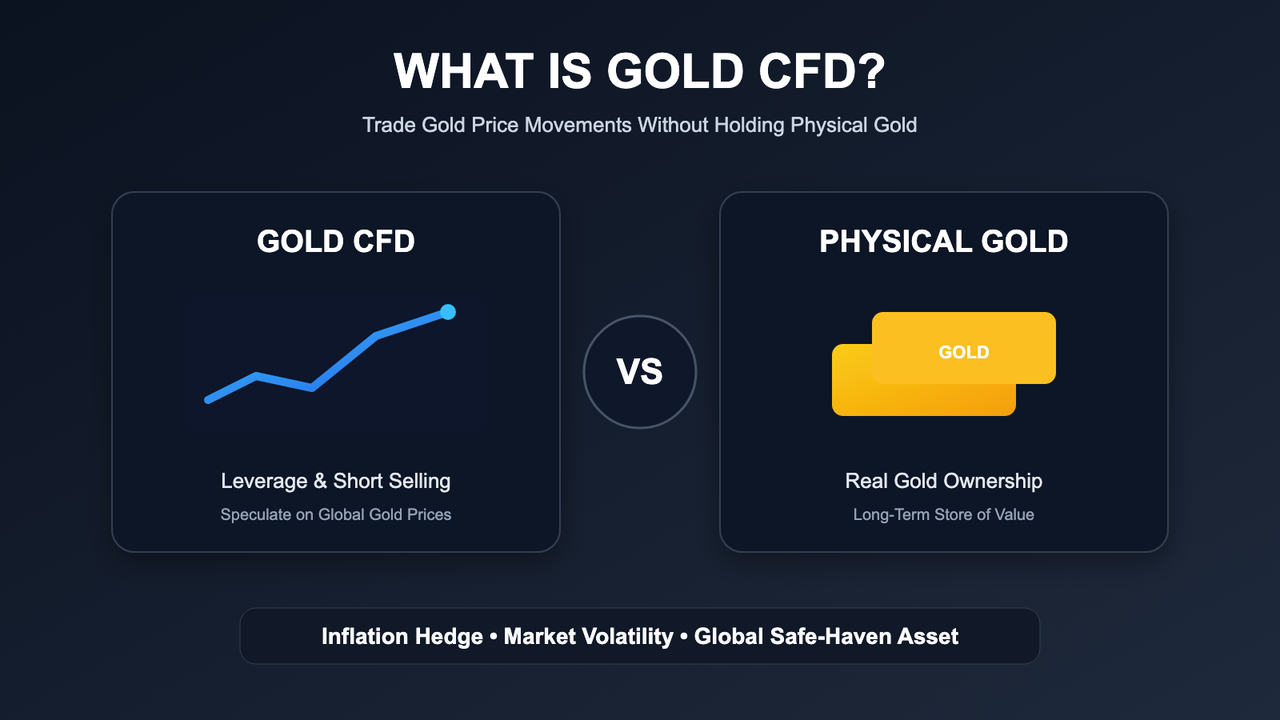
The key distinction between gold CFD and traditional physical gold lies in ownership: you never actually hold the gold.
Physical gold entails owning bars, coins, or jewelry. Gold CFD, on the other hand, is a derivative that tracks price changes without requiring physical delivery.
The core differences between the two include:
| Aspect |
Gold CFD |
Physical Gold Investment |
| Holds Real Gold |
No |
Yes |
| Leverage Available |
Often |
Rarely |
| Short Selling Supported |
Yes |
Rarely |
| Storage Required |
No |
Yes |
| Core Logic |
Price Difference Settlement |
Physical Gold Ownership |
Whereas physical gold is typically used for long-term wealth preservation, gold CFD is designed for short-term market participation.
Why Can You Short Gold CFD?
Since gold CFD is fundamentally a bet on price direction, traders can profit whether the market goes up or down.
For instance, if a trader expects a stronger dollar to pressure gold prices, they can open a short gold CFD position. If the price subsequently declines, closing the position locks in gains from that drop.
Unlike the physical gold market — where short selling is rarely possible — gold CFD offers a flexible mechanism that is widely used in macro trading.
This flexibility also makes gold CFD a go-to instrument for trading interest rate expectations and hedging against safe-haven flows.
How Does Leverage Work in Gold CFD?
Gold CFD is typically traded on margin.
For example, with 20x leverage, a trader needs only a fraction of the total position value as margin to control a much larger exposure in gold.
The leverage calculation logic can usually be expressed as:
Leverage boosts capital efficiency but also amplifies both potential gains and losses from market moves.
Because gold is sensitive to the dollar, interest rates, and risk sentiment, price swings can be sharp and sudden.
What Fees Come with Gold CFD?
The primary costs are the spread and overnight financing (swap) fees.
The spread — the gap between the bid and ask prices — is a key revenue source for the platform.
Holding a gold CFD position overnight typically incurs a financing fee, as the broker is effectively lending you the capital.
As a result, gold CFD is better suited for short-to-medium term trading than for long-term holding.
What Are the Key Risks of Gold CFD?
Gold CFD is a high-risk leveraged product. Key risks include:
- Leverage Risk
- Liquidation Risk
- Market Volatility Risk
- Liquidity Risk
- Financing Fee Risk
For example, during Federal Reserve rate announcements or US CPI releases, gold prices can move sharply, impacting open CFD positions.
With high leverage, even a small adverse price move can quickly erode your account equity.
Gold CFD vs. Gold Futures: What's the Difference?
Both gold CFD and gold futures allow traders to speculate on international gold price movements, making them frequent subjects of comparison.
But their underlying structures differ significantly.
Gold CFD is typically offered by online brokers and caters to retail traders, while gold futures are standardized exchange-traded contracts with set expiration dates.
In addition:
| Aspect |
Gold CFD |
Gold Futures |
| Expiration Date |
Typically No |
Yes |
| Trading Venue |
Online Brokers (Retail) |
Futures Exchanges |
| Leverage Model |
Margin-based |
Exchange Margin Requirements |
| Contract Format |
Non-Standardized |
Standardized |
| Typical Users |
Primarily Retail |
More Institutional |
Gold CFD prioritizes flexibility; gold futures are rooted in the professional commodity market structure.
Gold CFD's Role in Global Markets
Gold CFD offers a way to gain exposure to international gold prices without ever taking physical delivery.
Traders use gold CFD for short-term speculation, macro trading, inflation hedging, risk aversion, and dollar-move plays.
As online derivatives markets expand, gold CFD has become a staple of the modern precious metals trading ecosystem.
Summary
Gold CFD is a financial derivative that settles on the price difference of gold, enabling traders to participate in gold's price action without holding the physical metal.
Unlike traditional gold investments, gold CFD emphasizes leverage, two-way trading, and volatility participation — but it carries elevated risks such as liquidation, financing costs, and market swings.
FAQs
Do you need to own physical gold to trade gold CFD?
No. Gold CFD is a difference-settled derivative; you never take ownership of physical gold.
Why can you short gold CFD?
Because CFD is about price direction, not ownership. You can profit from both rising and falling prices.
How is gold CFD different from physical gold?
Physical gold means owning the metal; gold CFD settles in cash based on price changes.
Why is gold CFD high risk?
Gold CFD typically involves leverage, which amplifies both gains and losses from market moves.
What influences gold CFD prices?
The US dollar, interest rate policy, inflation, and global risk sentiment are key drivers.
Can you hold gold CFD long-term?
Because overnight financing fees accumulate over time, gold CFD is better suited for short-to-medium term trading.