With the development of new energy vehicles, smart mobility, and connected car technologies, the role of tire manufacturers is also changing. Beyond traditional tire products, more companies are moving into smart tires, fleet management systems, and mobility solutions, pushing the industry to shift from pure manufacturing toward a more integrated service model.
! GT Goodyear Tire & Rubber Company
What Is GT (Goodyear Tire & Rubber)
Goodyear was founded in 1898 and is headquartered in Ohio, United States. It is one of the oldest tire manufacturers in the world. After more than a century of development, Goodyear has become a major tire brand operating across many countries and regions. GT is the stock ticker of Goodyear Tire & Rubber Company in the U.S. securities market.
Goodyear’s products cover passenger car tires, SUV tires, light truck tires, commercial vehicle tires, construction machinery tires, aviation tires, and many other categories.
As an important participant in the global tire industry, Goodyear serves not only ordinary consumers, but also automakers, logistics companies, transportation fleets, and aviation operators.
Goodyear’s History and Market Position
Goodyear’s development has closely followed the history of the modern automotive industry.
During the 20th century, when the automobile industry expanded rapidly, tire demand continued to grow, driving Goodyear to gradually expand its production scale and global footprint. As the automotive supply chain became more mature, Goodyear also built a complete system covering research and development, manufacturing, sales, and services.
After decades of development, Goodyear has built strong brand influence and become one of the major suppliers to leading global automakers.
From a market positioning perspective, Goodyear serves both the original equipment manufacturer market, or OEM market, and the replacement tire market. This dual market structure allows the company to benefit from demand created by new vehicle sales while also generating long term revenue from ongoing vehicle maintenance and tire replacement.
How Goodyear’s Tire Manufacturing Business Works
Tire manufacturing is a highly specialized industrial activity involving materials science, engineering design, and large scale manufacturing capabilities.
Goodyear first relies on its research and development teams to design tire products for different vehicles and use cases, including key indicators such as tread structure, rubber compounds, wear resistance, and grip performance.
Natural rubber, synthetic rubber, steel wire, and fiber materials then enter the production process. Through mixing, calendering, forming, vulcanization, and other stages, they are made into finished products.
After production is completed, tires must go through strict testing and quality control procedures to ensure that they meet safety and performance standards.
Finally, the products enter the market through automakers, dealer networks, and aftermarket channels.
Goodyear’s Role in the Automotive Supply Chain
Goodyear sits at a key component supply point in the automotive supply chain.
For automakers, tires are essential components that must be installed before a vehicle leaves the factory, so the original equipment tire market is one of the important revenue sources for tire companies.
For consumers, tires are consumable products that require regular maintenance and replacement. Even when vehicle sales cycles fluctuate, vehicles already on the road still need ongoing tire replacement.
Because of this, the tire industry has characteristics of both manufacturing and consumer services.
This dual nature allows tire companies to benefit from growth in vehicle sales as well as expansion in the number of vehicles in use.
Goodyear’s Replacement Tire and Aftermarket Strategy
The replacement tire market is usually seen as one of the most stable revenue sources in the tire industry.
A car usually needs to replace its tires multiple times over its life, so tire companies depend not only on the new vehicle market, but also on the large market of vehicles already in use.
Compared with the original equipment market, the replacement tire business usually has higher profit potential because consumers pay closer attention to brand, performance, and safety, not just price.
Goodyear reaches many markets worldwide through its broad sales network and offers consumers tire products across different positioning levels.
As global vehicle ownership continues to grow, the replacement tire market remains an important support for the tire industry.
How Goodyear Is Expanding into EV Tires and Smart Mobility
The development of new energy vehicles is changing product demand in the tire industry.
Electric vehicles usually have higher torque, heavier vehicle weight, and stricter noise reduction requirements, so they need specially optimized tire products.
To adapt to this trend, Goodyear continues to develop tire solutions for new energy vehicles, including improvements in wear resistance, lower rolling resistance, and better noise reduction.
At the same time, the tire industry is also moving toward smarter products.
Some smart tires can monitor tire pressure, temperature, and wear in real time, then provide data support to drivers or fleet management platforms through digital systems.
These technologies are pushing tires to evolve from traditional mechanical products into smart mobility solutions.
How Goodyear Differs from Michelin and Bridgestone
Goodyear, Michelin, and Bridgestone have long been regarded as important global tire brands.
Although all three companies focus on the tire business, they differ in market layout and brand positioning.
| Dimension |
Goodyear |
Michelin |
Bridgestone |
| Headquarters |
United States |
France |
Japan |
| Main markets |
North America and global markets |
Global |
Global |
| Product coverage |
Passenger vehicles, commercial vehicles, aviation |
Premium passenger vehicles, commercial vehicles |
Comprehensive tire products |
| Brand positioning |
Comprehensive tire brand |
Premium brand |
Comprehensive brand |
| Smart mobility strategy |
Continuously expanding |
Continuously expanding |
Continuously expanding |
Goodyear’s important strengths lie in its long brand history and broad product coverage, while Michelin places greater emphasis on premium market positioning, and Bridgestone has a strong global manufacturing and sales network.
What Are Goodyear’s Main Use Cases
Goodyear’s products are used far beyond ordinary household vehicles.
In the passenger vehicle market, tires directly affect vehicle safety, handling performance, and fuel efficiency.
In commercial transportation, logistics fleets and long haul transport vehicles need highly durable tires to reduce operating costs and improve transport efficiency.
In construction machinery, mining equipment, construction machinery, and agricultural equipment also require specially designed tire products.
In addition, aviation transportation depends on high performance aircraft tires to support aircraft takeoff and landing safety.
As smart mobility and autonomous driving technologies develop, tires will also take on more functions related to data collection and vehicle condition monitoring.
How to Buy GT (Goodyear Tire & Rubber) Stock
GT is listed and traded on the Nasdaq market and is one of the important listed companies in the global auto parts and tire industries.
Investors can usually buy GT stock through brokerage accounts that support U.S. stock trading, and participate in market opportunities related to the development of the global automotive supply chain and tire industry.
As digital assets and traditional financial markets gradually converge, more trading tools linked to stock price movements have also appeared in the market. For example, some platforms offer CFD products linked to related stock prices, allowing users to participate in market movements through price changes without directly holding the underlying shares.
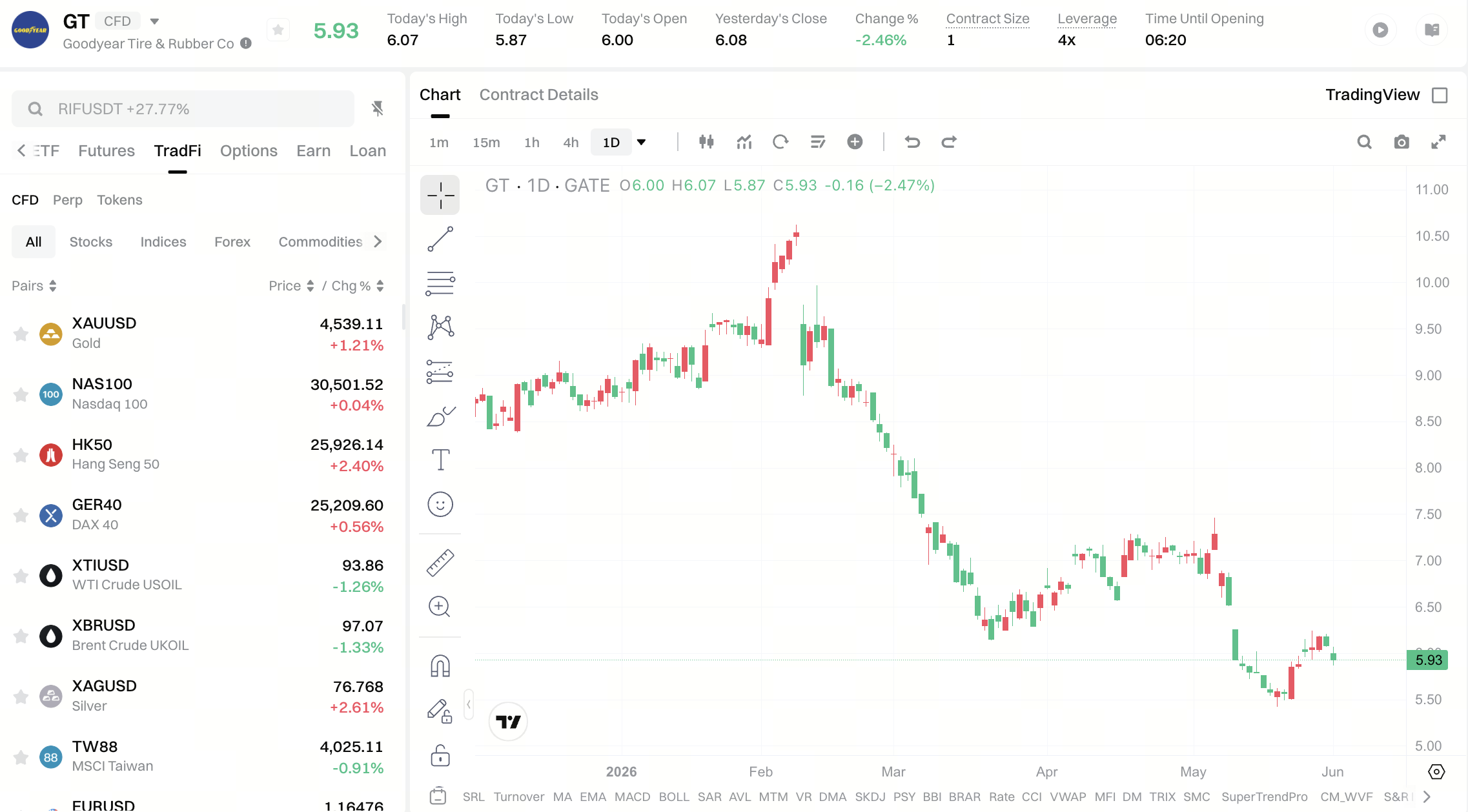
Taking Gate TradFi as an example, users can follow not only the digital asset market, but also traditional financial assets such as stocks, ETFs, indices, and commodities within the same ecosystem. Some markets also offer Gate CFD products, allowing users to participate in price movement trading for related assets through a digital asset account.
No matter how investors choose to participate in the market, they should fully understand the product structure, trading rules, liquidity conditions, and regulatory requirements in their region.
Goodyear’s Strengths and Limitations
Goodyear’s important strengths come from its brand history, global sales network, and tire research and development capabilities accumulated over many years.
The tire industry has relatively high technical barriers and brand barriers. For safety related products, consumers often prefer established brands, so industry leaders usually have strong competitive advantages.
At the same time, tire demand comes from both the new vehicle market and the replacement market, giving companies a relatively stable revenue base.
On the other hand, tire manufacturing is highly dependent on changes in the prices of raw materials such as rubber, steel, and energy.
Fluctuations in global vehicle sales, changes in economic cycles, and intensifying industry competition may also affect corporate profitability.
Therefore, tire companies need to continue improving product innovation capabilities and operational efficiency to maintain market competitiveness.
Conclusion
GT (Goodyear Tire & Rubber) is one of the oldest tire manufacturers in the world, with businesses covering passenger vehicles, commercial vehicles, construction machinery, aviation transportation, and other fields. Through a dual strategy in the original equipment market and the replacement tire market, Goodyear has built a global tire manufacturing and sales system. With the development of new energy vehicles, smart tires, and digital mobility, Goodyear is gradually expanding from a traditional tire manufacturer into a broader mobility ecosystem.
FAQs
What Kind of Company Is GT?
GT is the stock ticker of Goodyear Tire & Rubber Company. Goodyear is one of the world’s best known tire manufacturers.
What Products Does Goodyear Mainly Produce?
Goodyear mainly produces passenger car tires, commercial vehicle tires, construction machinery tires, aviation tires, and related mobility solutions.
Why Is the Tire Industry Important?
Tires directly affect vehicle safety, handling performance, and operating efficiency, making them one of the key components in the automotive supply chain.
How Is Goodyear Different from Michelin?
Goodyear is known for its broad portfolio of comprehensive tire products, while Michelin places greater emphasis on premium brand positioning. Both are among the world’s leading tire manufacturers.
Will Electric Vehicles Affect the Tire Industry?
Yes. Electric vehicles place higher demands on tire wear resistance, noise reduction, and energy efficiency, which is driving continued innovation across the industry.
Where Does Goodyear’s Revenue Mainly Come From?
Goodyear’s revenue mainly comes from original equipment tire sales and the replacement tire market, while also involving commercial transportation, aviation tires, and related service businesses.