Hana Network (HANA) is a Web4 Layer-1 public chain built on Cosmos SDK, designed for retail and social applications. Its core design deeply integrates blockchain's peer-to-peer (P2P) capabilities with mainstream Web2 social platforms, replacing the passive holding model of traditional centralized exchanges (CEX) with Hypercasual Finance. This enables users to participate in on-chain value creation through lightweight interactions, social dissemination, and instant feedback.
Unlike traditional Web3, which centers on wallets, smart contracts, and layered DeFi protocols, Hana Network represents a paradigm shift in on-chain finance — from a tool-first approach to an experience-first one. In the CEX era, users primarily deposited, traded, and withdrew. In the Web4 context, Hana embeds financial activity into daily social and entertainment routines through social distribution, casual earning, real-time tipping, and P2P markets, drastically lowering the cognitive and operational barriers for new users entering the crypto space.
From an industry evolution standpoint, Hana Network sits at the intersection of SocialFi, GameFi, and Layer-1 infrastructure: the underlying blockchain provides scalable settlement and governance; the upper-layer products (Gateway, Hanafuda, Reunion) drive acquisition and retention; and the HANA token ties together incentives, governance, and value capture. This article covers project background, tokenomics, technical architecture, the Hypercasual Finance concept, the core ecosystem, use cases, competitive positioning, investment risks, and future outlook, rounded out by an FAQ.
What Is Hana Network (HANA)? Project Background and Development History
Hana Network was founded in June 2022 by Japanese entrepreneur Kohei Hanasaka, registered in Dubai. The team has a strong engineering and product background (Hanasaka holds a degree from Kyoto University's Faculty of Engineering). The project was positioned early on as "moving from Web3 to Web4," with slogans like "No More CEX" — replacing the monopolistic traffic and custodial model of centralized exchanges with socially-driven P2P finance in the Web4 era.
Key Milestones (Abstract):
Time
Event
June 2022
Project Founded
2023
Selected for Binance Labs Incubation; Runner-Up at ETH Global zkDay
Hanafuda Surpasses 400,000 Unique Addresses; Tens of Millions in On-Chain Deposit Interactions
March–April 2025
"No More CEX" Fundraising Round (~$0.04 per Token)
June 2025
Private Round (Pre-TGE): ~$2M
September 26, 2025
HANA Token Generation Event (TGE) and Exchange Listing
March 2026
Binance Futures DCA Robot Supports HANA
May 2026
Circulating Market Cap: ~21M;Price:0.037
Publicly disclosed cumulative funding is estimated between 6Mand9M (including seed, strategic, and Builders rounds). Partners include Binance Labs / YZi Labs, Babylon, Hashkey Cloud, Morph, Solv Protocol, Osmosis, Kelp DAO, pStake, and Lombard. The official target audience is retail users in emerging markets like Asia and Africa — "The Next Billion Users."
HANA Tokenomics and Ecosystem Incentive Mechanisms
HANA serves as the ecosystem's governance and Utility token, with a total supply of 1 billion tokens and no additional inflation (per public information). The allocation structure is as follows:
Category
Percentage
Purpose
Community
51%
Ecosystem Growth (~30%) + Incentives (~21%)
Treasury
20%
Protocol Development, Strategic Partnerships
Team
19%
Core Contributors
Private / Investors
10%
Early Supporters
Multiple sale rounds before and after TGE were priced at ~0.04pertoken,implyingafullydilutedvaluation(FDV)of40 million. A significant portion of tokens from certain rounds unlocked at TGE, so lock-up terms should be carefully evaluated for selling pressure.
Incentive Logic:
Hana Points: Earned through deposits, tasks, and social actions in products like Hanafuda and Gateway. Points can be redeemed for privileges or qualify for future airdrops.
Governance: HANA holders vote on protocol parameters and ecosystem direction (governance capabilities will expand as the mainnet governance module matures).
Staking and Airdrops: The roadmap mentions future staking and airdrop programs; specific APY and unlock terms will be determined by on-chain governance.
As of May 2026, the circulating supply is approximately 570 million tokens (~57%). The all-time high was ~0.218(aroundtheTGEinSeptember2025),withalowof0.008 in January 2026 — a highly volatile, high-risk crypto asset.
Hana Network's Core Technology and Web4 Architecture
Consensus & Framework: Built on Cosmos SDK with Proof of Stake (PoS), enabling interoperability with the IBC ecosystem for cross-chain asset and liquidity collaboration.
Performance Focus: Designed for low-latency, high-concurrency mobile social interactions (tipping, mini-game settlements, task confirmations) rather than maximizing generic smart contract TVL.
Web4 Three Pillars (Official Definition): High interactivity (not passive browsing), mobile-first (touchscreen, fragmented time), and real-time engagement (live streaming, instant tipping, P2P matching).
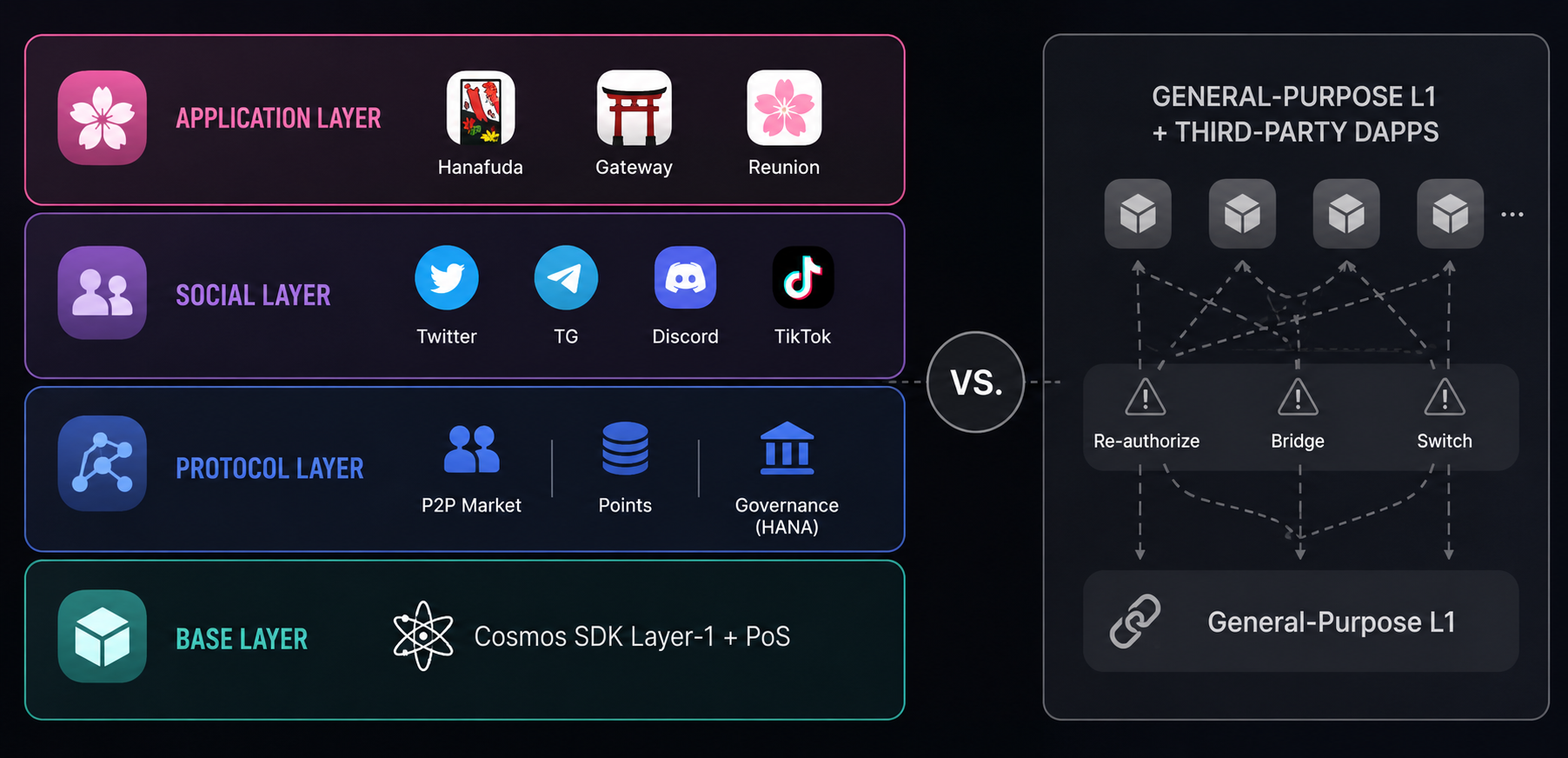
Architecture Layers (Conceptual Model)
Unlike the "generic L1 + third-party DApps" model, Hana emphasizes building native applications and social entry points together, eliminating friction from repeated approvals and cross-chain bridging across different products.
How Hypercasual Finance Is Redefining the On-Chain User Experience
Hypercasual Finance borrows from the hypercasual gaming playbook: simple rules, short session lengths, instant positive feedback, and easy viral spread. On-chain, this translates to:
Ultra-Low Barriers to Entry: On Hanafuda, simply depositing earns points and cards — no need to understand AMMs, liquidations, or Gas optimization.
Social as Distribution: Users share achievements and invite teammates via social platforms, creating UGC-driven acquisition that reduces reliance on CEX ads and listings.
Diversified Income Streams: Attention incentives, social tipping, P2P funding, and task rewards coexist — not just trading fees or staking yields.
From Passive to Active: Web3 CEX users typically "deposit-buy-sell"; Web4 behaviors include playing, sharing, tipping, and referring — blurring the lines between finance and entertainment.
For the industry, Hypercasual Finance addresses the persistent problems of low retail retention and stagnant DeFi adoption: if the on-chain experience can't compete with TikTok's instant gratification, the "next billion users" will never truly arrive. Hana's bet is that gamifying and socializing financial behavior — rather than just lowering Gas fees — will be the real catalyst for mass adoption.
Hana Gateway, Hanafuda, and the Social Finance Ecosystem
Hana Gateway
Hana Gateway is a trust-minimized fiat-to-crypto on/off ramp, launched in January 2024. Key features:
P2P Matching: Buyers and sellers connect directly; the platform doesn't custody fiat (reducing certain compliance and counterparty risks, but still subject to local laws).
Low Fees: No traditional intermediary commissions (actual costs depend on market makers and payment methods).
Scale (Public Data): Over 200,000 cumulative users and more than 1.6 million trades.
Gateway acts as the top of the funnel: channeling fiat users into the on-chain points ecosystem and then into Hanafuda and other apps.
Hanafuda
Hanafuda is positioned as a **"Card Lego"** project — the flagship application of the mainnet's first phase:
Users deposit supported assets to earn Hana Points and Hanafuda cards.
Users can form teams, enter competitions, and compete for special Tickets and other benefits.
By 2024, it had over 400,000 unique addresses and tens of millions of on-chain interactions — the ecosystem's core user base.
Reunion
Reunion is a DeFi protocol task and quest platform that helps partner protocols achieve growth goals (education, deposits, interactions). It's essentially an "on-chain growth hacker + bounty platform," complementing Hanafuda's game-based acquisition.
Upcoming Products on the Roadmap
Phase 2 — Capsule Shop: NFT gachapon, interest clubs, social tipping, and tasks.
Phase 3 — Dipsy: A live-streaming app for enhanced real-time interaction.
Phase 4: Integration with real-world consumption scenarios to complete the Web4 "daily usable" loop.
Hana Network Use Cases: SocialFi and On-Chain Interaction
Use Case
Mechanism
Value
Social Acquisition
Sharing, invites, teams on social platforms
Lower CAC, viral growth
Casual Earning
Mini-games + deposit points
Non-trading on-chain income opportunities
Real-Time Tipping
Live streaming / groups (planned in Dipsy)
On-chain creator economy
P2P On/Off Ramp
Gateway
Fiat corridor for emerging markets
DeFi Growth
Reunion Quests
Quantifiable user acquisition for protocols
Cross-Chain Collaboration
Cosmos / IBC partners
Asset and liquidity spillover
Unlike SocialFi projects like Friend.tech or Farcaster that focus on "fan tokens / decentralized social graphs," Hana emphasizes gamified financial behavior and P2P infrastructure, with social interaction as a channel rather than the product itself.
How Hana Network Differs from Traditional Exchanges and Other SocialFi Projects
Dimension
CEX (e.g., Binance)
Typical SocialFi
Hana Network
Custody
Centralized
Varies by product
Non-custodial / P2P-oriented
User Experience
Trading-focused
Social graph / tokenized fans
Gaming + social + finance
Acquisition
Ads, listings
KOLs, on-chain identity
Viral spread via social platforms
Tech Stack
Off-chain order book
Mostly L2 or standalone apps
Self-built Cosmos L1
Token Role
Fee discounts (exchange tokens)
Social benefits
Governance + full ecosystem incentives
Hana's key differentiator is its "L1 + native hit application + social channel" trinity — not just a single DApp or exchange. The risk: if Hanafuda activity declines, the L1 narrative weakens. Conversely, if mainnet Phases 2–4 products underperform, the token may rely on speculation rather than fundamentals.
Key Risks for HANA Token Investors
Price Volatility: Already experienced a >80% drawdown from ATH post-TGE; high-beta, small-cap asset.
Unlock Schedules & Selling Pressure: Team, investor, and community unlocks require ongoing monitoring of on-chain data and announcements.
Regulatory Risk: Gateway's fiat P2P transactions may face payment licensing, KYC/AML requirements across jurisdictions.
Product Concentration: Ecosystem traffic heavily reliant on Hanafuda and Gateway; new product launches carry execution risk.
Competition: Exchanges, wallets with built-in SocialFi, and other GameFi L1s can divert users and liquidity.
Macro & Liquidity: With a market cap in the tens of millions, large orders can trigger sharp price swings.
Information Asymmetry & Market Manipulation: Small-cap tokens are easily influenced by social media narratives; always cross-check with official sources.
Not investment advice: Crypto assets can result in total loss of principal. Make decisions based on your risk tolerance and consult official docs and on-chain data.
Hana Network's Future Direction and Market Potential
Outlook (based on public roadmap and industry trends):
Short Term (2026): Consolidate Hanafuda and Gateway metrics; advance Capsule Shop; increase HANA accessibility on major exchanges and derivative tools (e.g., Binance DCA).
Medium Term: Launch Dipsy live streaming and real-time tipping, validating the "hypercasual + real-time" loop; leverage IBC partners (Osmosis, Babylon, etc.) for cross-chain asset use cases.
Long Term: If the Web4 narrative gains traction, Hana could become the first chain for retail users in emerging markets. However, it must demonstrate that revenue and active addresses translate into HANA demand (buybacks, staking, fee burns); otherwise, the token risks decoupling from ecosystem activity.
Market Potential: The global casual gaming and mobile payment user base is in the billions. If Hana converts even a tiny fraction into monthly on-chain active users, the valuation upside is significant. If it remains a "points + airdrop expectations" model without sustainable protocol revenue, long-term value is questionable. Interim price spikes on HTX and Binance tool integrations in early 2026 reflect liquidity and narrative attention, not necessarily fundamental progress.
Conclusion
Hana Network (HANA) is a Web4 Layer-1 built on Cosmos SDK, stitching together social, gaming, and P2P finance under the Hypercasual Finance banner. It aims to replace CEX as the default retail entry point through a product chain spanning Hana Gateway, Hanafuda, and Reunion. The HANA token handles governance and ecosystem incentives, with over half allocated to the community. TGE took place in September 2025, and the network is in the early stages of multi-phase mainnet expansion.
For researchers and investors, key monitoring metrics include: Hanafuda unique addresses and deposit retention, Gateway P2P volume and compliance progress, Capsule Shop / Dipsy launch cadence, HANA unlock curves, and whether ecosystem revenue starts feeding back into token value capture. Web4 is still an evolving concept, and Hana is one of the more product-ready, well-funded examples — but high volatility and execution risk remain. Approach with a rational, analytical mindset.
FAQs
What is the relationship between Hana Network and HANA tokens? Hana Network is the public chain and product ecosystem brand; HANA is its native governance and utility token for incentives, governance, and future protocol functions.
Is Hana Network a Layer-1 or an application chain? Officially a Web4 Layer-1 based on Cosmos SDK, but it also builds native applications (Hanafuda, Gateway) to drive adoption.
What is Hypercasual Finance? "Ultra-casual finance" — borrowing the low barrier, short session, and strong feedback loops of hypercasual games to embed on-chain earning, tipping, and P2P trading into social and entertainment contexts.
When was the HANA TGE, and what is the total supply? TGE occurred on September 26, 2025; total supply is 1 billion tokens. See the official whitepaper for allocation details.
Is Hana Gateway safe? Gateway is P2P and non-custodial, but P2P trading still carries counterparty and fraud risks. Users must vet trading partners and comply with local regulations.
Author: Max
Disclaimer
* The information is not intended to be and does not constitute financial advice or any other recommendation of any sort offered or endorsed by Gate.
* This article may not be reproduced, transmitted or copied without referencing Gate. Contravention is an infringement of Copyright Act and may be subject to legal action.
Solana faces both opportunities and challenges in its development. Recently, severe network congestion has led to a high transaction failure rate and increased fees. Consequently, some have suggested using Layer 2 and appchain technologies to address this issue. This article explores the feasibility of this strategy.
Sui is a PoS L1 blockchain with a novel architecture whose object-centric model enables parallelization of transactions through verifier level scaling. In this research paper the unique features of the Sui blockchain will be introduced, the economic prospects of SUI tokens will be presented, and it will be explained how investors can learn about which dApps are driving the use of the chain through the Sui application campaign.
This article introduces the technical principles, framework, and applications of Zero-Knowledge (ZK) technology, covering aspects from privacy, identity (ID), decentralized exchanges (DEX), to oracles.
Tronscan is a blockchain explorer that goes beyond the basics, offering wallet management, token tracking, smart contract insights, and governance participation. By 2025, it has evolved with enhanced security features, expanded analytics, cross-chain integration, and improved mobile experience. The platform now includes advanced biometric authentication, real-time transaction monitoring, and a comprehensive DeFi dashboard. Developers benefit from AI-powered smart contract analysis and improved testing environments, while users enjoy a unified multi-chain portfolio view and gesture-based navigation on mobile devices.
An altcoin is also known as a Bitcoin Alternative or Alternative Cryptocoin, which refers to all cryptocurrencies other than Bitcoin. Most of the cryptocurrencies in the early stage were created through forking (copying Bitcoin codes).