As DeFi expands from spot trading into perpetual futures, lending, and structured products, the options market is becoming a vital component of on-chain financial infrastructure. Developed by the Synapse team, Hypercall is designed not only as an options trading platform but also as a liquidity and trading infrastructure for the future of on-chain derivatives.
What Is Hypercall's Positioning in the On-Chain Derivatives Industry?
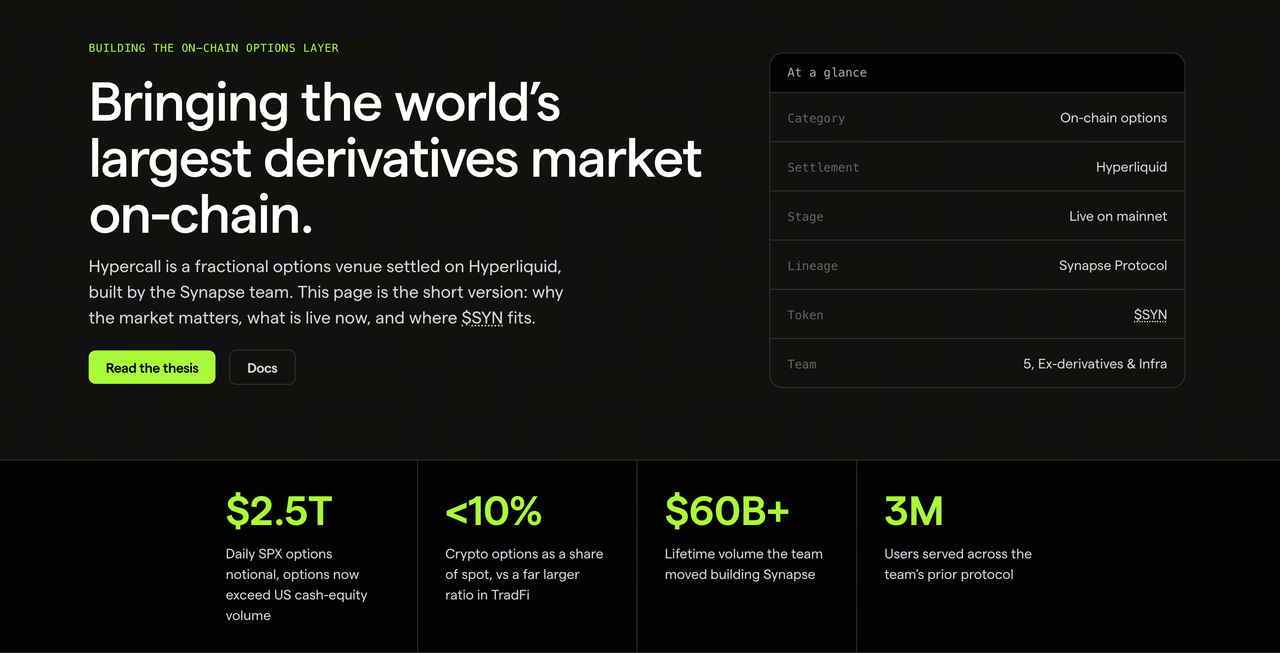
Hypercall is an options trading protocol in the on-chain derivatives sector.
If we divide the on-chain financial market into four primary categories—spot, lending, perpetual futures, and options—Hypercall sits squarely in the options infrastructure layer.
Unlike most platforms focused on perpetual futures, Hypercall prioritizes volatility trading and risk management markets.
Within the broader ecosystem, Hypercall can be seen as a key extension of the Hyperliquid derivatives ecosystem into options, and a major product move by the Synapse team beyond cross-chain infrastructure.
What Are Fractional Options?
Fractional options are one of Hypercall's standout features.
Traditional options are typically traded in fixed-size contracts. For users with smaller capital, some options products carry high participation costs.
Fractional options break option positions into smaller units, enabling users to enter the market with less capital.
This approach mirrors Bitcoin's support for fractional units—it lowers the entry barrier without altering the core financial characteristics of options.
By offering fractional structures, Hypercall allows more users to access the volatility market and use options for risk management.
How Does Hypercall Work?
Hypercall operates in four stages: market creation, order matching, position management, and on-chain settlement.
First, the platform creates options markets with various expiration dates and strike prices.
Users can then choose to buy or sell call options or put options.
When a trade is executed, the system records the user's position and leverages Hyperliquid's infrastructure for margin management and settlement.
Upon expiration, the protocol automatically calculates profit or loss based on the settlement price and distributes funds accordingly.
Everything happens on-chain, making all positions and settlement records publicly verifiable.
Why Did Hypercall Choose Hyperliquid as Its Settlement Layer?
Hyperliquid is a cornerstone of on-chain derivatives, known for its high-performance order book and low-latency trading.
For options markets, settlement efficiency and liquidity quality are paramount.
By selecting Hyperliquid as its settlement layer, Hypercall benefits from a proven trading architecture and liquidity infrastructure.
This is similar to financial applications building on established trading networks—they can focus on product innovation rather than rebuilding the underlying system.
As a result, Hypercall can channel more resources into options product design and user experience optimization.
How Does Hypercall Differ From Traditional On-Chain Options Protocols?
Several options protocols have appeared on-chain, but most target professional traders.
Hypercall stands out in product design and user focus.
First, it introduces fractional options to lower the capital barrier.
Second, it runs on Hyperliquid's high-performance trading environment for better execution.
Third, Hypercall emphasizes broad market coverage, aiming to create an "Options Exchange for Everything" rather than limiting itself to a single asset class.
| Comparison Dimension |
Hypercall |
Traditional On-Chain Options Protocol |
| Core Product |
Fractional Options |
Standard Options |
| User Focus |
Broader user base |
Professional traders |
| Capital Barrier |
Lower |
Relatively higher |
| Settlement Environment |
Hyperliquid |
Various on-chain protocols |
| Product Scalability |
Multi-asset |
More limited |
What Are Hypercall's Core Features?
Hypercall is building its ecosystem around on-chain options trading.
Core features include options market creation, fractional position trading, on-chain settlement, and risk management tools.
For buyers, Hypercall provides tools to trade market volatility.
For sellers, it offers a market to earn option premiums.
As the product evolves, it may expand into combination strategies, structured products, and a wider range of derivatives.
Hypercall is developed and operated by the Synapse team.
Synapse has long focused on cross-chain interoperability infrastructure, including cross-chain bridges, liquidity networks, and messaging systems.
Hypercall represents the team's expansion into the on-chain financial application layer.
Although Hypercall and Synapse Protocol are different products, they share the same development team and technical expertise.
From a development standpoint, Hypercall is an important exploration by the Synapse team into on-chain finance and derivatives.
Summary
Hypercall is an on-chain options trading protocol built by the Synapse team and settled on Hyperliquid. Its core goal is to lower participation barriers through fractional options and build a more open on-chain derivatives market. Compared with traditional on-chain options protocols, Hypercall emphasizes accessibility, execution efficiency, and market scalability.
FAQs
What is Hypercall?
Hypercall is an on-chain options trading protocol developed by the Synapse team, settled on Hyperliquid, with fractional options as its core product.
How is Hypercall related to Synapse Protocol?
Hypercall is built by the Synapse team but differs in product focus. Synapse focuses on cross-chain interoperability infrastructure, while Hypercall targets the on-chain options market.
Why does Hypercall use Fractional Options?
Fractional options reduce the capital required per trade, allowing more users to access the options market and utilize risk management tools.
Is Hypercall built on Hyperliquid?
Yes. Hypercall uses Hyperliquid as its settlement infrastructure and leverages its high-performance trading environment to power its options market.
What is the difference between Hypercall and perpetual futures?
Perpetual futures track the price movement of the underlying asset, while options give the buyer the right to execute a trade under specific conditions. Therefore, their risk structures and use cases are distinct.







