Over the past few decades, the global automotive industry has shifted from being driven by mechanical engineering to electronics, digitalization, and now intelligence. As electric vehicles, autonomous driving, and in-vehicle software capabilities continue to evolve, traditional automakers are redefining their roles—no longer just producing transportation tools, but gradually transforming into mobility service platforms. Hyundai Motor has been expanding its technological capabilities and global footprint throughout this industrial transformation, aiming to secure long-term competitive advantages.
From an industry standpoint, Hyundai Motor currently sits at a pivotal point in the global automotive industry’s upgrade. On one hand, it retains its traditional vehicle manufacturing and supply chain strengths; on the other, it actively advances new energy, Software-Defined Vehicles (SDV), and future mobility strategies. Understanding Hyundai Motor’s development logic is essentially understanding how the global automotive industry moves from the manufacturing age to the intelligent transportation era.
What Are Hyundai Motor and Hyundai Motor Group?
Many users initially encountering Hyundai Motor may assume that “Hyundai Motor” and “Hyundai Group” are the same entity. In reality, they belong to different organizational systems, and Hyundai Motor itself represents more than just a single brand.
Hyundai Motor typically refers to Hyundai Motor Company, an automotive enterprise centered on vehicle research, development, production, and sales. Hyundai Motor Group, however, is a larger industrial organization whose business spans automobiles, parts, logistics, technology services, and future mobility. The group creates synergies across multiple brands and industrial modules, connecting R&D, production, supply chains, and global markets.
This organizational model is common in the global automotive industry. As vehicles grow increasingly complex, relying solely on manufacturing capabilities is no longer enough to sustain long-term competition. Consequently, large automakers often build entire ecosystems. Hyundai Motor Group’s growth path is also an important part of the long-term upgrade of Korea’s industrial system.
From an industrial structure perspective, Hyundai Motor Group’s value lies not just in vehicle sales but in forming a complete automotive capability network. For example, from vehicle design to supply chain coordination, after-sales systems, and global channel development—multiple competencies collectively determine final competitiveness. This is a key foundation for Hyundai Motor’s sustained participation in the global automotive market.
At the same time, the group’s evolution mirrors the trajectory of Korea’s automotive industry. In the past, Korean manufacturing emphasized scale efficiency. Today, in the intelligent vehicle era, companies focus more on technological independence, software capabilities, and international collaboration.
Thus, understanding the relationship between Hyundai Motor and Hyundai Motor Group means understanding how the modern automotive industry builds long-term capabilities through a group structure—not just a single company.
Hyundai Motor’s Development Path and Global Expansion
Hyundai Motor’s development fundamentally reflects the global automotive industry’s shift from regional manufacturing to international competition.
Early in the industry’s history, automakers often relied on domestic markets. As global supply chains matured, they entered cross-regional competition. Hyundai Motor’s rise from a regional manufacturer to a global player is closely tied to its relentless internationalization strategy.
During global expansion, Hyundai Motor didn’t simply replicate the traditional manufacturing model. Instead, it gradually built a coordinated system of R&D, local production, and regional operations. This means the company not only exports products but also strengthens local manufacturing capabilities to meet diverse market demands.
Meanwhile, brand portfolio building became a key part of globalization. Different markets vary significantly in price sensitivity, performance expectations, energy preferences, and usage habits. Therefore, Hyundai Motor developed a multi-tiered product structure to serve a broader customer base.
From an industry perspective, the global auto market is now highly competitive. Relying on growth from a single region is increasingly difficult. Hyundai Motor’s continuous international expansion aims not just to boost sales but to build a more stable global operating system.
As the industry upgrades, the importance of international strategy may grow further. Automotive products increasingly depend on software updates, digital services, and long-term operational capabilities, making global coordination a critical factor for long-term success.
Therefore, Hyundai Motor’s development path isn’t about simply scaling production—it’s about continuously adjusting its organization and technology in response to changes in the global automotive industry.
How Hyundai Motor Makes Money: Automotive Industry Business Model
Many users think automakers earn money straightforwardly—by manufacturing and selling cars. But Hyundai Motor’s business model is far more complex than a one-time transaction.
Vehicle sales remain a significant revenue component. R&D, production, and delivery form the industry’s core value chain and the foundation for traditional automakers’ long-term growth. However, as markets mature, relying on new car sales alone makes sustained growth increasingly difficult.
Hence, Hyundai Motor has diversified its revenue streams.
Automotive finance has become an important part. When buying cars, consumers often need financing, leasing, and long-term services. A financial system extends customer relationships and generates more stable income. This model is now widely adopted by major global automakers.
After-sales services and long-term operational capabilities are also rising in importance. Vehicle maintenance, software upgrades, digital services, and user lifecycle management have become significant supplements to profit models.
Electrification is reshaping the business model. In the future, automakers may not just sell vehicles but continuously provide energy management, software features, and intelligent services.
For Hyundai Motor, this means its corporate identity is changing. Transitioning from a traditional manufacturer to a mobility platform requires balancing manufacturing efficiency, technology investment, and long-term user value.
Looking ahead, the future of automotive competition may not be about selling more cars, but about who can build a sustainable automotive ecosystem.
How Electrification Is Changing Hyundai Motor’s Strategy
Electrification isn’t just swapping fuel for batteries—it’s redefining production methods, value structures, and long-term competition. For Hyundai Motor, the importance of its EV strategy lies not only in launching more new energy models but in using this shift to upgrade its corporate capabilities.
In the past, core competitiveness in the traditional auto industry centered on engine technology, manufacturing efficiency, and supply chain capabilities. Now, competition has shifted to battery tech, software, electronic architecture, and continuous upgrade capabilities. Automakers must rebuild their technology systems, not just replace power sources.
Hyundai Motor’s electrification path follows a platform-based approach. Platformization means multiple models share a common underlying architecture, achieving higher coordination in R&D, production, and maintenance. This reduces complexity and accelerates product updates, allowing faster responses to market changes.
At the same time, EVs are transforming traditional supply chains. In the past, value was concentrated in mechanical components; now, value is shifting toward batteries, chips, software, and energy systems. Therefore, Hyundai Motor is strengthening upstream and downstream coordination to maintain its competitive position.
From an industry perspective, the EV value chain is no longer just about manufacturing—it involves energy, digital infrastructure, and user operations. What customers buy is not just a vehicle but a long-term usage experience.
This is why Hyundai Motor has placed electrification and future mobility under a unified strategic framework. EVs are both a product upgrade and an organizational capability upgrade. The goal isn’t to replace traditional models but to build a new foundation for the next-generation automotive ecosystem.
Software-Defined Vehicles (SDV) and Intelligent Vehicle Strategy
If electrification changes the powertrain, Software-Defined Vehicles (SDV) change the operational logic of vehicles.
Traditional vehicles typically have fixed functions determined at the factory, with limited subsequent changes. The core idea of SDV is to turn the vehicle into a continuously running and upgradable platform, expanding capabilities through software.
This means future vehicles will be more like smart devices than just transportation tools.
In recent years, Hyundai Motor has strengthened its software capabilities, focusing on in-vehicle systems, over-the-air (OTA) updates, data coordination, and intelligent interaction. By adopting a unified software architecture, different models can iterate continuously without relying solely on hardware updates.
SDV is also changing internal company structures. Previously, R&D cycles revolved around hardware. In the future, product evolution will depend more on software teams, data capabilities, and continuous operations.
The development of autonomous driving further accelerates this shift. Autonomous driving isn’t a single function—it’s a complete system of sensors, computing platforms, software, and decision-making. As technology advances, vehicles gain environmental awareness, assisted judgment, and autonomous execution.
For Hyundai Motor, SDV doesn’t mean becoming an internet company. Instead, it means embedding software capabilities into the product lifecycle while maintaining manufacturing strengths.
Over the long term, intelligent vehicle platforms may become the new center of competition. Vehicle value will come less from mechanical performance and increasingly from continuous updates and user experience.
How Hyundai Motor, Toyota, and Tesla Differ
Hyundai Motor, Toyota, and Tesla are all major players in the global auto industry, but each represents a different development logic. Hyundai Motor emphasizes the synergy of global manufacturing and technology upgrades; Toyota has long excelled in manufacturing systems and scale efficiency; Tesla drives software-led and electrification restructuring.
Understanding their differences requires looking beyond sales or models to their industry positions.
Hyundai Motor’s path is relatively balanced. On one hand, it retains traditional automakers’ global production and supply chain capabilities; on the other, it advances new energy, software, and future mobility. This structure gives it both a mature manufacturing system and the ability to participate in new technology cycles.
Toyota has long emphasized production systems and operational efficiency. Its advantages stem from decades of manufacturing experience, process management, and global networks, making it a representative of traditional automotive industry upgrades.
Tesla’s approach is distinctly different, focusing on electric platforms, software, and rapid iteration to drive industry change by rethinking product logic.
| Dimension |
Hyundai Motor |
Toyota |
Tesla |
| Core Positioning |
Global automotive group |
Manufacturing efficiency system |
Software-driven vehicle platform |
| Key Strengths |
Manufacturing + tech upgrade |
Scale and processes |
Electrification and software |
| Powertrain Structure |
Fuel + new energy parallel |
Multi-path strategy |
Electrification as core |
| Software Capability |
Continuously strengthening SDV |
Steady progress |
High software integration |
| Global Presence |
Multi-region coordination |
Global manufacturing network |
Global market expansion |
| Long-Term Direction |
Intelligent mobility ecosystem |
Manufacturing upgrade |
Intelligent vehicle platform |
From an industrial structure perspective, future automotive competition may not have just one model. Different companies will follow different paths based on their historical strengths—some reinforcing manufacturing, some focusing on software, and some trying to connect multiple layers.
Hyundai Motor’s uniqueness is that it hasn’t abandoned its traditional advantages but is gradually absorbing electrification and intelligence capabilities from a manufacturing base. This approach means a more balanced transformation pace but requires continuous investment in multiple technology directions.
Therefore, understanding the differences between Hyundai Motor, Toyota, and Tesla is essentially understanding how the global automotive industry evolves from a traditional industry to an intelligent transportation ecosystem.
Hyundai Motor’s Position in the Global Automotive Competitive Landscape
The global automotive industry is undergoing its most profound structural change in decades. In the traditional era, competition focused on production scale, channel coverage, and manufacturing efficiency. In the electrification and intelligence era, competition has expanded to software, energy systems, data coordination, and global operations. The auto industry is no longer just about manufacturing—it has become a competition of comprehensive technology ecosystems.
In this context, Hyundai Motor occupies a unique position. Compared to pure new energy companies, Hyundai Motor has a mature manufacturing system and global operational experience. Compared to traditional manufacturers, it actively advances software, electrification, and future mobility. This puts Hyundai Motor on a development path bridging traditional industrial capabilities and new technologies.
Regionally, global automotive competition is becoming multi-polar. North America continues to strengthen software and platform capabilities; Europe emphasizes high-end manufacturing and industrial upgrades; Asia drives manufacturing efficiency, battery tech, and intelligent terminal coordination. In this environment, Hyundai Motor uses its global layout to reduce the impact of regional cycles and enhance long-term operational capabilities.
Future competition increasingly demands system coordination. The vehicle itself is no longer the only product—it’s an entry point connecting energy, software, services, and digital capabilities. An enterprise’s future value may not come from how many vehicles it sells but from how well it manages ongoing user relationships.
For Hyundai Motor, its long-term position may not be to become the largest automaker but to establish a competitive system combining manufacturing and tech capabilities during the global automotive transformation.
Looking ahead, the future auto market may form a three-layer structure: basic manufacturing layer, intelligent capability layer, and mobility service layer. Hyundai Motor is trying to participate in multiple layers simultaneously to adapt to the next phase of industry change.
How to Trade Hyundai Motor Stocks on Gate
As global capital markets become more digital, more users are exploring international asset allocation. For those interested in Hyundai Motor’s market performance, digital trading tools are lowering cross-market barriers. Note: stock trading carries market risk. The following is for illustration of the trading process only and does not constitute investment advice.
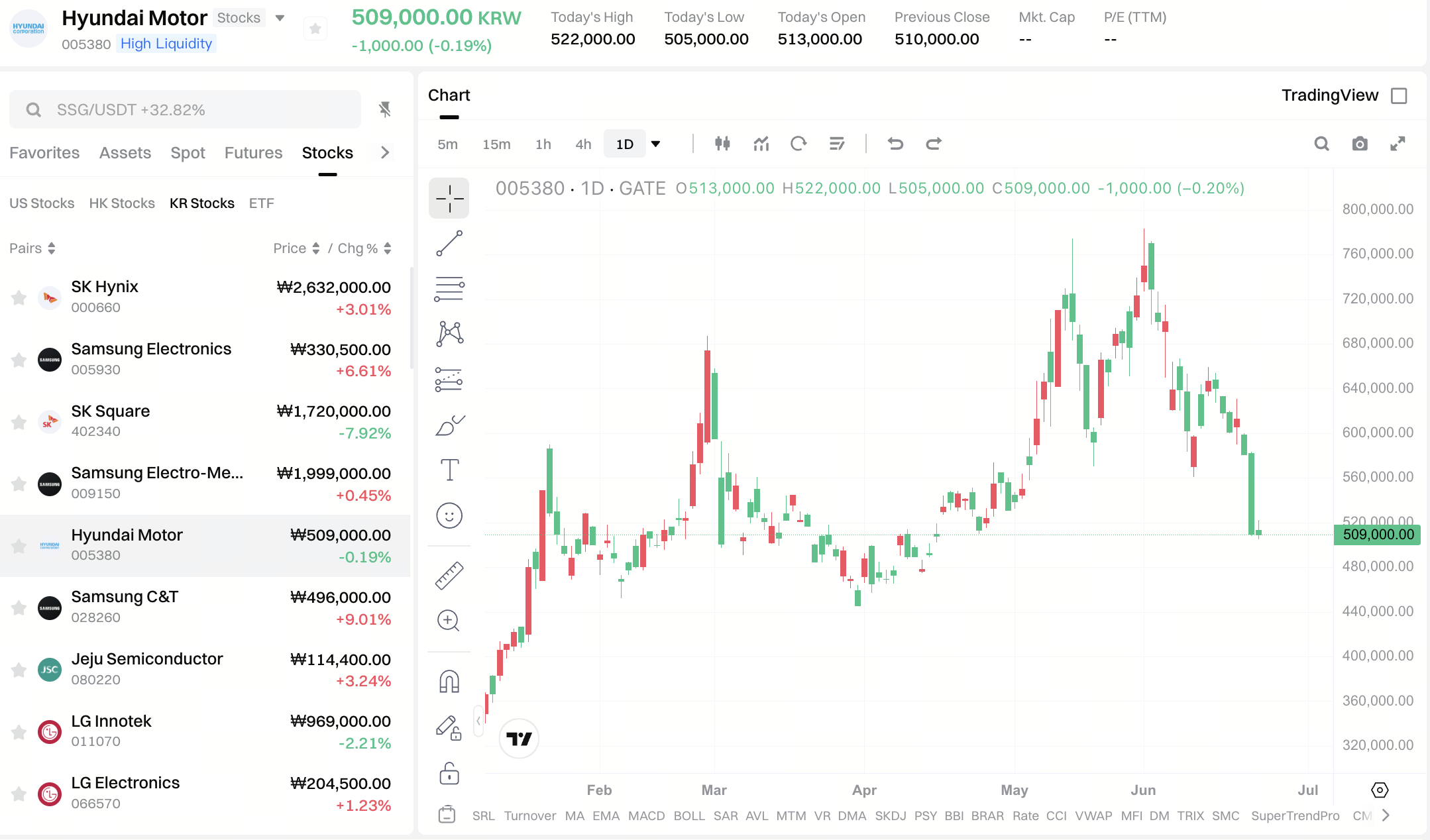
If you want to trade Hyundai Motor stocks on Gate, the process generally involves three steps:
Step 1: Complete account registration and identity verification. Download the app, sign up, and undergo KYC (identity verification) to activate your account and meet trading requirements.
Step 2: Fund your account. The platform accepts digital assets like USDT as account funds. After depositing into your trading account, you can proceed to asset selection. Compared to traditional cross-border accounts, this digital asset path often reduces steps like currency exchange and cross-platform transfers.
Step 3: Go to the stock trading section and search for the asset. Once funded, you can view the target stock or related assets based on the product’s support and execute trades.
The core change here isn’t about altering the stock itself—it’s about changing how you participate in global asset markets. Over the long term, digital stock trading may increasingly emphasize unified accounts, cross-asset coordination, and higher operational efficiency. What users really need to understand isn’t just the trading interface but the company’s long-term business model and industry position. So, when looking at Hyundai Motor, rather than focusing solely on price movements, first understand its industry structure, technology direction, and global competition logic.
Summary
Hyundai Motor is no longer just a traditional automotive manufacturer. It is evolving into a comprehensive automotive group covering manufacturing, electrification, software capabilities, and future mobility ecosystems. From an industry perspective, Hyundai Motor bridges traditional vehicle capabilities and the next-generation intelligent transportation system. On one hand, it relies on global manufacturing and supply chain coordination; on the other, it actively advances EVs, SDVs, and future mobility strategies to adapt to new competitive dynamics.
Unlike companies that focus only on single breakthroughs, Hyundai Motor’s path is one of capability integration—building long-term competitiveness through manufacturing, technology, and global operations. Understanding Hyundai Motor means understanding how the global auto industry transitions from the mechanical age to the intelligent mobility age.
FAQ
Is Hyundai Motor part of a Korean chaebol?
Hyundai Motor is generally considered a key part of Korea’s large enterprise system, but Hyundai Motor Group and the historical Hyundai Group have different organizational structures and operate independently.
Are Hyundai Motor and Hyundai Group the same?
Not exactly. Hyundai Motor usually refers to the automotive business, while Hyundai Group is an earlier comprehensive industrial system. They are not fully equivalent.
What products does Hyundai Motor mainly sell?
Hyundai Motor’s core business is primarily vehicles, while also covering new energy vehicles, intelligent vehicles, and related mobility capabilities.
Is Hyundai Motor a new energy vehicle company?
No. Hyundai Motor is not a pure new energy company; it is a comprehensive automaker developing both traditional manufacturing capabilities and new energy transformation in parallel.
Can I use USDT to buy Hyundai Motor stocks?
The specific support depends on the platform’s product rules. Digital asset trading changes the participation method but does not alter the nature of the stock itself.