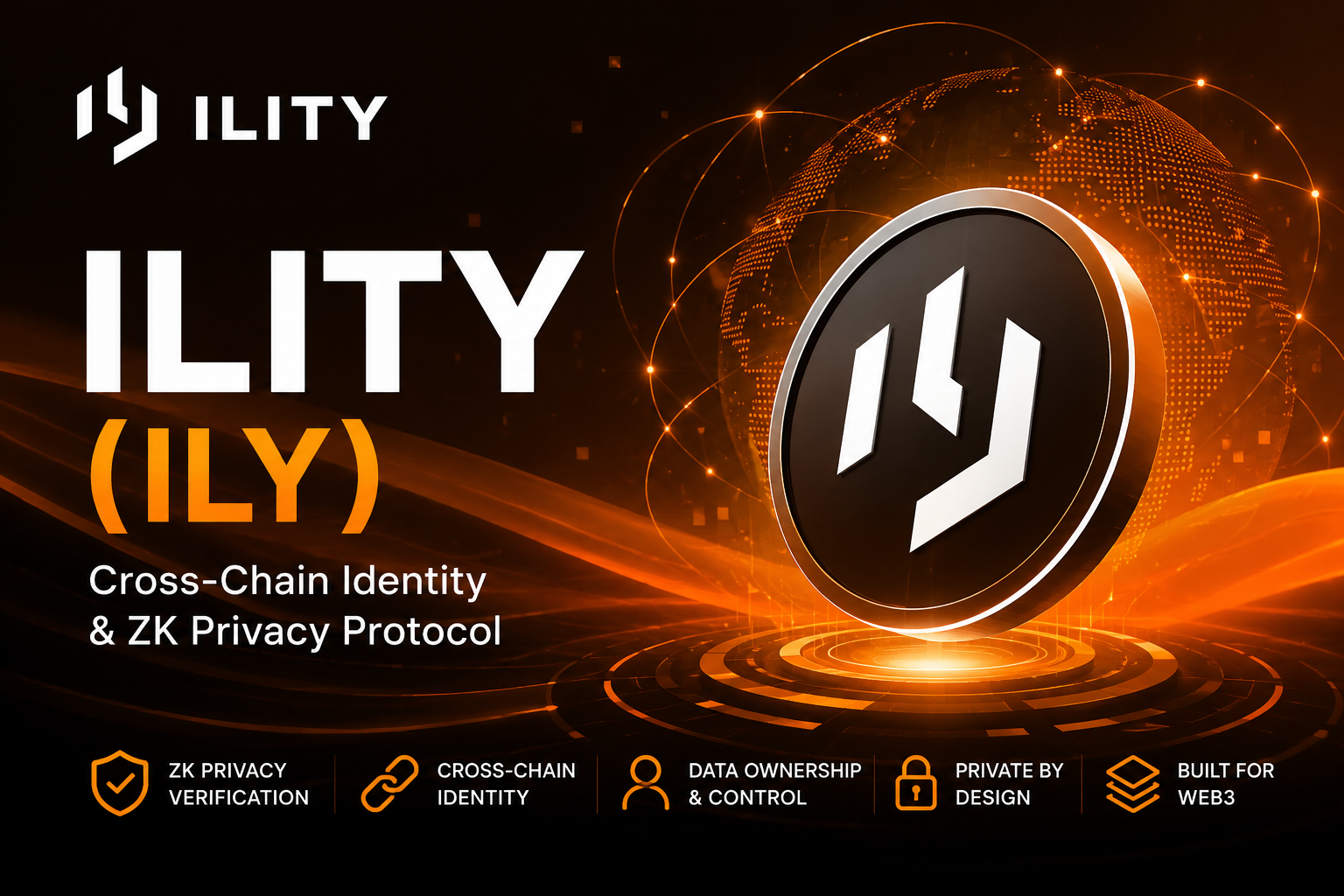
ILITY’s core focus is on on-chain identity, Zero-Knowledge Proofs, and data privacy. Its design centers on allowing users to verify identity, prove assets, and authenticate behavior without exposing complete data. The entire system is built around cross-chain data, privacy-preserving verification, and user control, while ILY plays an important functional role within the ecosystem.

As users interact more frequently across multiple blockchains, the traditional single-chain account model can no longer fully represent a user’s on-chain identity. ILITY can be understood as a form of Web3 infrastructure built around cross-chain identity and privacy-preserving verification. Its main goal is to help users verify on-chain data while keeping their privacy protected.
Structurally, ILITY is not just a single application. It is a protocol framework that combines an identity system, ZK verification, and multi-chain data integration capabilities. Through ILITY, users can verify their assets, on-chain behavior, or account status without disclosing complete wallet data to external parties.
This means users can build a verifiable on-chain identity while still retaining control over data visibility. For the Web3 ecosystem, the importance of this type of protocol lies in its attempt to address the tension between on-chain transparency and user privacy.
Unlike traditional account systems, ILITY’s identity logic places greater emphasis on data ownership. The system is built around user self-control, cross-chain behavior verification, and zero-knowledge proofs, rather than relying on centralized platforms to store account information.
In a multi-chain environment, users often hold multiple wallets, asset accounts, and interaction records across different chains. One of ILITY’s core mechanisms is to integrate these scattered data points into a verifiable on-chain identity.
The key is that ILITY does not require users to disclose all of their data. Instead, it uses a verification mechanism to confirm whether a specific condition is true. For example, users can prove that they hold a certain type of asset, have completed a specific on-chain action, or meet certain identity conditions, without revealing their full wallet balance or transaction history.
Structurally, ILITY’s cross-chain identity system typically includes:
Multi-chain data integration
Identity mapping mechanisms
Zero-knowledge verification
Permission control systems
Together, these modules form the framework for on-chain identity verification.
The importance of this mechanism is that it allows Web3 identity to move beyond a single wallet address and instead build a more complete user profile around multi-chain behavior. At the same time, the identity verification process does not fully expose user data, which strengthens privacy protection.
For on-chain applications, cross-chain identity verification can also be used in permission management, on-chain reputation, asset authentication, and certain social and governance scenarios.
Traditional blockchain verification usually relies on public data, while Zero-Knowledge Proofs are designed to prove that something is true without revealing the specific underlying information. ILITY’s privacy mechanism is built on this logic.
In simple terms, Zero-Knowledge Proofs allow users to complete verification without disclosing full information. For example, a user can prove that they meet a certain condition without revealing their entire asset structure, transaction history, or identity information.
Structurally, ILITY’s ZK mechanism typically includes:
| Module | Function |
|---|---|
| Data input | Provides on-chain behavior information |
| ZK proof generation | Builds privacy-preserving verification results |
| Verification layer | Confirms whether conditions are satisfied |
| Permission system | Controls the visible scope of data |
| Identity mapping | Links cross-chain account behavior |
This means ILITY is not merely a data storage protocol. It is more like a data coordination system built around privacy-preserving verification. For Web3 users, the value of ZK Proof lies in reducing unnecessary data exposure.
Unlike the traditional model of fully public on-chain data, ILITY places greater emphasis on minimizing information disclosure. This type of mechanism is especially important for identity authentication, asset proof, and on-chain reputation systems, because many use cases do not require users to reveal all of their information.
As users engage in more cross-chain activity, their assets and interactions become scattered across different networks. One of ILITY’s key functions is to help users integrate this fragmented data.
The core of ILITY lies in building a unified identity layer. A user’s wallets, assets, and behavior records across different chains can be connected through a mapping mechanism to form a unified verification structure. As a result, on-chain identity no longer depends on a single address, but on relationships across cross-chain data.
Mechanically, ILITY classifies and verifies behavior across different networks, while using a privacy system to control data visibility. The process is closer to a form of on-chain identity aggregation than traditional database synchronization.
The importance of this mechanism is that it is becoming increasingly difficult for Web3 users to establish identity through single-chain behavior alone. Multi-chain assets, cross-chain interactions, and participation records across different protocols have already become important components of on-chain identity.
For developers, multi-chain data integration can also help applications build more complete user verification systems. For example, certain permission controls, reputation certifications, or ecosystem reward mechanisms may all depend on cross-chain identity structures.
Within the ILITY ecosystem, ILY mainly supports network interactions, protocol operations, and ecosystem incentives. It is not only a utility token inside the protocol, but also a link between identity verification, data access, and ecosystem participation mechanisms.
Structurally, the role of ILY typically includes:
Protocol interaction fees
Data verification incentives
Network governance participation
Node coordination mechanisms
Together, these modules form ILITY’s economic structure.
The design focuses on creating an on-chain economic relationship around identity verification and data access. For example, when users or applications call verification services, they may need to use ILY to complete protocol interactions. Nodes that participate in verification and network maintenance may then receive incentives through related mechanisms.
This means ILY is not just an ordinary payment token. It is an important medium that connects data, verification, and ecosystem operations. For privacy protocols, a token mechanism can also help coordinate resource allocation among different participants.
However, a more complete explanation of the supply structure, release mechanism, and governance logic is usually covered separately on the Cluster page.
Unlike traditional public blockchain structures, one of ILITY’s key focuses is selective disclosure. Users do not need to fully expose their data. Instead, they can control which information is verified and which information remains hidden.
The key point is that ILITY does not reject blockchain transparency. Rather, it tries to establish a balance between transparency and privacy. Through Zero-Knowledge Proofs and permission control mechanisms, users can disclose only the necessary verification results instead of their complete on-chain history.
Structurally, ILITY’s privacy mechanism usually centers on:
Minimizing data disclosure
On-chain identity separation
Permission verification
Privacy proofs
and related areas.
The importance of this mechanism is that although fully public on-chain data supports transparency, it can also lead to issues such as asset exposure, behavior tracking, and identity linkage. ILITY’s design attempts to reduce these risks.
For Web3 applications, privacy-preserving verification mechanisms can also be used in on-chain social products, identity systems, data authentication, and some institutional use cases.
Traditional on-chain identity protocols usually lean more toward public identity mapping, while ILITY places greater emphasis on privacy-preserving verification and data control. The biggest difference between the two lies in how they handle data visibility.
The table below shows some of these differences:
| Comparison Dimension | Traditional On-Chain Identity Protocols | ILITY |
|---|---|---|
| Data disclosure method | Tends toward public mapping | Tends toward selective verification |
| Identity structure | Single-chain or fixed address | Multi-chain identity aggregation |
| Privacy mechanism | Relatively weak | Supported by ZK Proof |
| Data control | Led by the protocol or platform | User control comes first |
| Verification logic | Full data disclosure | Conditional verification |
From an overall structural perspective, ILITY is closer to a privacy-first identity protocol. Its focus is not only on proving that an identity exists, but also on reducing data leakage during the identity verification process.
This difference means ILITY is better suited for scenarios that require asset verification, behavior authentication, and privacy protection at the same time, while traditional public protocols place more emphasis on on-chain transparency.
ILITY’s main advantages come from its cross-chain identity integration and ZK privacy mechanism. For the multi-chain ecosystem, this type of structure can help users establish a more unified on-chain identity while reducing unnecessary data disclosure.
From an application perspective, ILITY has strong potential in identity verification, asset proof, on-chain reputation, and privacy authentication. As multi-chain activity increases, demand for unified identity and data verification is also gradually expanding.
However, privacy protocols usually come with a high level of complexity. The implementation cost of Zero-Knowledge Proofs, cross-chain data synchronization, and permission system design may all affect protocol operating efficiency.
In addition, on-chain identity protocols also face ecosystem compatibility challenges. Only when more applications support identity verification and privacy proofs will the practical value of this type of protocol expand further.
Therefore, ILITY’s challenges come not only from technical implementation, but also from the broader Web3 ecosystem’s acceptance of privacy-preserving verification and cross-chain identity systems.
ILITY (ILY) is a Web3 privacy protocol built around cross-chain identity verification and Zero-Knowledge Proofs. Its core goal is to help users establish verifiable identities in a multi-chain environment while reducing unnecessary data exposure.
The entire system is built around cross-chain data, privacy-preserving verification, on-chain identity, and user control, while ILY plays an important functional role within the ecosystem. Compared with traditional public identity protocols, ILITY places greater emphasis on selective verification and user-controlled data. This gives it a relatively clear position within the on-chain privacy sector.
ILITY is mainly used for cross-chain identity verification, on-chain data authentication, and privacy proofs, with a focus on multi-chain Web3 identity scenarios.
Zero-Knowledge Proofs help users complete identity or asset verification without revealing complete data, thereby strengthening privacy protection.
ILY is mainly used for protocol interactions, data verification incentives, network operations, and ecosystem governance-related mechanisms.
Traditional DID protocols tend to focus more on public identity mapping, while ILITY places greater emphasis on cross-chain data integration and privacy-preserving verification mechanisms.
As users interact more frequently across multiple blockchains, a single-chain address can no longer fully reflect user behavior, making cross-chain identity verification increasingly important.