Unlike traditional news aggregators that simply list links or match shallow keywords, KAITO addresses the extreme fragmentation of information in the crypto space, where distribution paths depend heavily on social platform algorithms and marketing noise is mixed with genuine signals. On-chain status often diverges from public opinion heat, and the same protocol can evolve multiple narratives across governance forums, instant messaging, and short video channels simultaneously. Without semantic-level integration and weighted assessments of contribution quality, research analysis, growth strategies, and risk management are prone to delays or systemic misjudgments. Thus, leveraging AI for cross-source aggregation, topic clustering, and influence evaluation not only improves search efficiency but also meets the structural need to reduce mispriced attention and resource misallocation.
From a technology and industry evolution standpoint, KAITO represents a composable pathway for Web3 and artificial intelligence in the "information and attention" dimension: integrating public opinion influence, creator reputation, and token incentives into an auditable, iterative rule set, aligning intelligence services and value capture through on-chain or verifiable processes. With features like leaderboards, launchpads, and connections to prediction market infrastructure, the ecosystem aims to strengthen the link between narrative momentum and capital allocation, enabling artificial intelligence to become not just an off-site content summarization tool but an on-chain resource layer for programmable incentives, participatory governance, and commercial integration. This architecture addresses industry pain points like model invocation costs, data accessibility, and incentive compatibility, and, as social platform API policies and compliance boundaries tighten, offers brands, protocol teams, and data consumers an adaptable information infrastructure.
What Is KAITO? Project Background and Development History
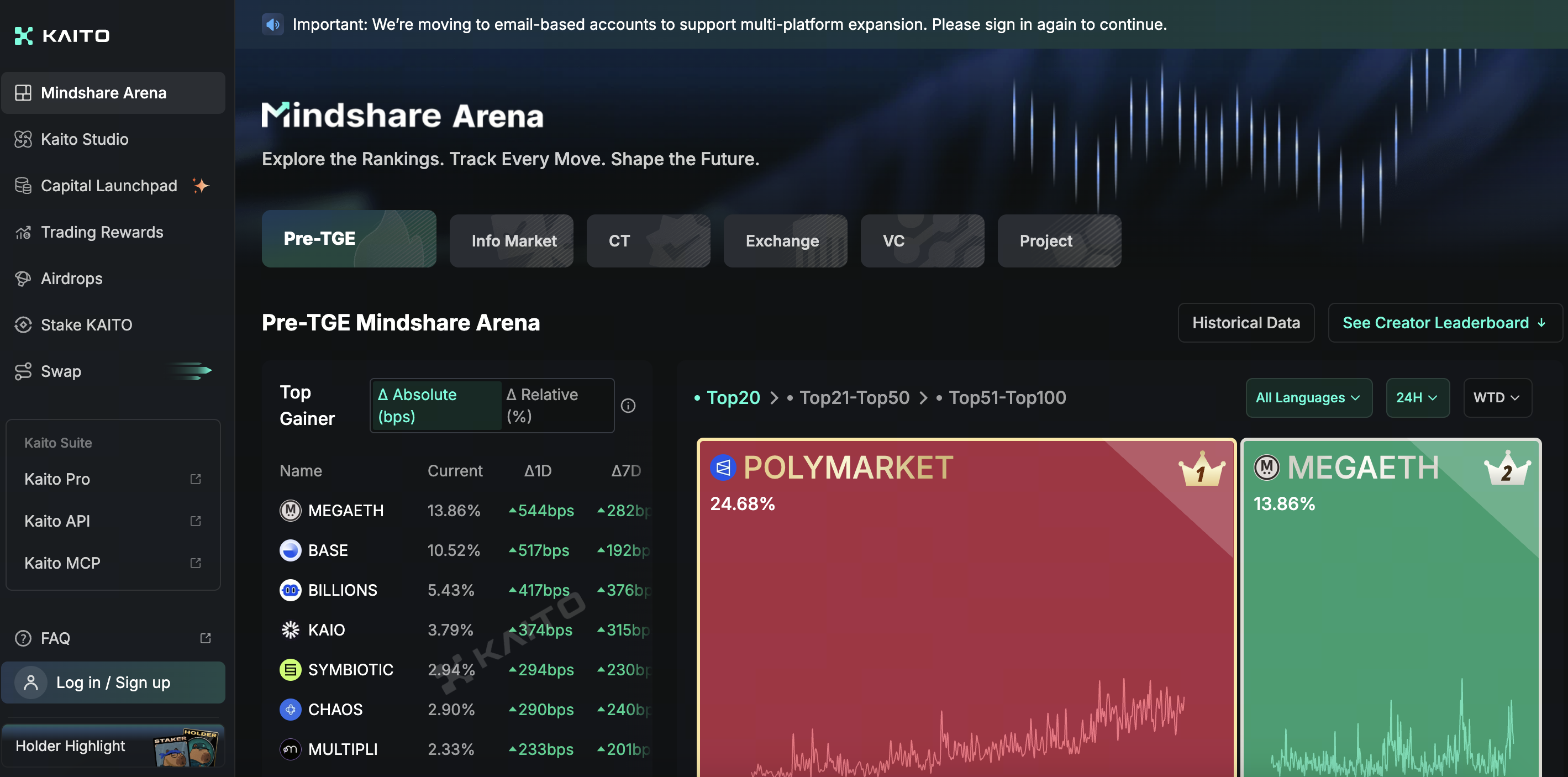
Image source: Kaito Official Website
KAITO refers to the crypto information and intelligence infrastructure developed by the Kaito team. Its core narrative centers on using AI to aggregate, sort, and quantify "who is saying what and where market attention is focused" amid the highly decentralized landscape of social media, forums, governance proposals, and on-chain events. Public sources often categorize it as part of the InfoFi (Information Finance) sector—not only indexing content but also mapping influence and participation to an incentivizable, analyzable metric system.
The team’s background includes founders with experience in traditional quantitative and hedge funds. The project began to take shape around 2022, initially focusing on research and intelligence tools, then expanding into a product matrix for creators, brands, and broader crypto users. Recent industry shifts—such as tighter social media API policies and increased compliance scrutiny of incentive posting products—prompted KAITO to adjust its core approach. Reports indicate that by January 2026, the platform announced a gradual end to the Yaps product line, which relied on specific social platform incentive mechanisms, and transitioned to creator and brand marketing systems represented by Kaito Studio. This marks a shift from "large-scale open posting mining" to a "more auditable, quality-oriented model closer to commercial collaboration." This evolution demonstrates that KAITO is not just a technical product but also a business and community structure continuously iterating within platform rules and regulatory environments.
KAITO Tokenomics and Core Functions
According to official documentation and institutional summaries, the total supply of KAITO tokens is 1 billion, with allocations covering ecosystem growth, core contributors, foundation, early supporters, liquidity, and user incentives. Community and ecosystem allocations typically account for more than half, emphasizing long-term network effects. There are also portions dedicated to liquidity and market making to support secondary market depth and trading continuity.
Functionally, the token has historically been tied to attention mining, leaderboards, and airdrop distribution rules. As product priorities shift, the token’s "utility anchor" has moved from single posting incentives to more complex scenarios—such as creator collaboration, launchpad participation eligibility, ecosystem governance, or fee medium—as specified in the latest official statements. For researchers, it’s crucial to distinguish between allocation ratios on paper, actual circulation pace (unlock schedule), and currently available on-chain utility, which are not always consistent.
KAITO’s AI and InfoFi Network Technology
In its technical narrative, KAITO relies on multi-source data collection, natural language processing, and retrieval-augmented generation (RAG), converting unstructured text into searchable knowledge units and trend signals. Official documentation on "Kaito Connect / InfoFi Network" emphasizes three layers: first, abstracting attention behaviors into comparable, sortable contribution metrics; second, forming public incentive constraints through leaderboards or reputation mechanisms; third, making capital and issuance mechanisms rely more on market discovery than centralized distribution.
AI serves as both an "efficiency engine" (rapidly summarizing noise) and a potential amplifier of "indicator gaming" risk—when users optimize behavior around model-observable metrics, the platform must continuously iterate anti-cheating and quality evaluation mechanisms, which was a major source of industry controversy during the later Yaps phase.
Crypto information fragmentation manifests as the parallel evolution of the same topic across X (Twitter), Discord, governance forums, Telegram, and on-chain event streams, making it difficult for traditional search engines to capture semantic relevance in real time. KAITO’s approach combines aggregation, semantic sorting, and influence weighting: expanding coverage, using models to identify topic clusters and key participants, and delivering results to researchers, traders, and institutional users via dashboards, search tools, or leaderboards.
On the incentive side, the project has sought to convert public discussion into measurable contributions; following policy tightening, it now emphasizes more controllable commercial collaboration processes (Studio) and cross-platform distribution to reduce structural dependence on a single platform API. In short, "solving fragmentation" is not just an algorithmic challenge but also a product and compliance strategy issue.
Typical scenarios include:
-
Research and investment analysis: Quickly pinpointing the heat migration and opinion leader distribution for a protocol or narrative across social media.
-
Branding and growth: Project teams assess the true influence range of collaborating creators, rather than relying solely on follower counts.
-
Capital market tools: Some products integrate with launchpad or token issuance processes to align attention with fundraising pace (specific rules updated by version).
-
Prediction and attention markets: Industry sources indicate the team is exploring integration with prediction market infrastructure for trading "narrative heat" propositions—such designs require high transparency from oracles and rules.
User value depends on stable data coverage, explainable sorting, and the ability to operate within a compliance framework.
How KAITO Differs from Other AI + Blockchain Projects
Compared to generic on-chain AI agents or universal large-model projects, KAITO is more specialized: data sources are inherently tied to the crypto opinion sphere, and metrics are built around attention and narrative lifecycle. Unlike pure on-chain analysis tools, KAITO emphasizes integration of social text and reputation signals. Compared to pure infrastructure projects, its tokenomics is more deeply linked to creator commercialization, making it more sensitive to external platform policies (such as whether social platforms permit incentive posting).
Competing projects often differ in data coverage, sorting transparency, and incentive sustainability. KAITO’s historical advantage was large-scale community participation, but its challenge is converting that participation into long-term utility unaffected by single channel bans.
Risks to Consider When Investing in KAITO Tokens
-
Token price volatility and unlocking: Unlocking by large investors, market making strategies, and market sentiment can all cause significant volatility. Abnormal on-chain transfers and market concerns may occur around major announcements, requiring independent verification of information sources.
-
Regulation and platform policy: Social media and advertising compliance continue to evolve, and attention financialization products face higher scrutiny.
-
Utility migration risk: After changes to core gameplay, historical narratives may not persist in the new token demand model.
-
Technical and reputation risk: AI summarization errors, leaderboard gaming, and fake traffic can undermine brand trust.
-
Competition and substitutability: Major exchanges, data giants, and open-source indexing tools compete for the same user engagement.
Crypto assets are not equivalent to bank deposits or fixed income products; readers should carefully assess their own risk tolerance.
KAITO’s Future Development and Potential
Looking ahead, if KAITO achieves substantive progress in the following areas, its positioning as "information and attention infrastructure" will become clearer: reducing dependence on a single social platform and building a cross-channel creator and partner system (Studio is aimed at this); making AI output more auditable, such as disclosing sorting factors or human-machine collaborative verification processes; integrating with compliance-friendly capital market tools to reduce gray incentive spaces; and expanding trustworthy on-chain and off-chain alignment methods at the data layer.
Potential and uncertainty coexist: The ceiling for the narrative sector depends on the overall incremental capital and attention in the crypto industry, while team execution and external environment will jointly determine whether the product can shift from "hotspot-driven" to "recurring demand-driven."
Summary
KAITO exemplifies a typical InfoFi experiment that weaves together crypto opinion, artificial intelligence, and token incentives. It aims to solve information fragmentation and must also address fragmented governance and external platform rules. Understanding its historical path and model iterations is more valuable for building robust insight than chasing a single tag.
FAQs
Q: Is KAITO the same as Yaps?
A: Yaps was a product form within the ecosystem focused on posting incentives. Public information indicates this path has gradually exited under policy pressure, with creator needs now served by products like Kaito Studio. The token name remains KAITO, but participation methods have changed.
Q: How can ordinary users start using KAITO?
A: Typically, users should visit the official website or documentation, distinguish between "intelligence retrieval / Pro tools" and "creator collaboration Studio" entry points. Account requirements and fees are subject to the official interface.
Q: What are the main uses of KAITO tokens?
A: Historically, they were tied to incentives and ecosystem participation. As products evolve, uses may include governance, fees, collaboration equity, or launchpad participation eligibility. Always consult the latest white paper or announcements to avoid outdated descriptions.
Q: Why is KAITO considered InfoFi?
A: Because it not only distributes information but also maps attention and influence into an incentivizable and tradable framework, giving "information" stronger resource allocation significance.
Q: What recent macro variables should be noted?
A: Social platform API policies, enforcement approaches regarding token incentives and securities attributes in major jurisdictions, and crypto market liquidity cycles will all indirectly affect the operating space and token performance of such projects.
Q: Does this article constitute investment advice?
A: It does not. Crypto asset risks are extremely high; this article is for informational and educational purposes only.