PoW public blockchains have long grappled with a structural dilemma between block interval and confirmation speed: intervals that are too short can trigger orphan blocks and wasted hashrate, while intervals that are too long slow down transaction confirmations. Kaspa addresses this by enabling miners to submit multiple blocks in parallel, then uses GHOSTDAG to sort the block graph—boosting throughput and confirmation efficiency without compromising the PoW security model.
KAS is used for trading fee payments and miner rewards. To fully understand Kaspa, one must grasp the blockDAG structure, fair launch mechanism, KHeavyHash mining, and the specific roles within the network.
What Is Kaspa (KAS)? How Does It Differ From Bitcoin?
Kaspa operates as a PoW Layer 1 blockchain, replacing the traditional single-chain block header linkage with blockDAG. Bitcoin (BTC) typically retains only one valid block per height, discarding other competing blocks as orphans; Kaspa, in contrast, allows multiple valid parallel blocks to coexist, with GHOSTDAG determining global ordering and finality.
Kaspa vs Bitcoin: Core Differences focus on four key areas: data structure, block production rate, orphan block handling, and confirmation logic. Bitcoin emphasizes a simple chain and a block interval of roughly 10 minutes. Kaspa targets a higher block frequency—about 10 blocks per second—with parallel blocks incorporated into the ledger via consensus rules rather than being discarded.
| Dimension |
Kaspa (KAS) |
Bitcoin (BTC) |
| Data Structure |
blockDAG (Directed Acyclic Graph) |
Single-chain linear blocks |
| Block Production |
Parallel multi-block |
Single block per height |
| Consensus Protocol |
GHOSTDAG (PHANTOM family) |
Nakamoto longest chain |
| Orphan Block Handling |
Included in sorting, rewarded per rules |
Usually discarded as orphan blocks |
| Target Block Rate |
About 10 blocks/sec |
About 10 minutes/block |
| Mining Algorithm |
KHeavyHash |
SHA-256 |
The table highlights the architectural differences. Kaspa's systematic redesign of the data structure and consensus layer enables greater parallelism.
How Does the blockDAG Architecture Work? Why Is It Faster Than Traditional Single-Chain Models?
blockDAG (Directed Acyclic Graph) lets each new block reference one or more existing blocks, forming a mesh-like structure instead of a single-parent chain. Miners can broadcast blocks independently within similar time windows, and the network no longer restricts each height to a single winner.
Shortening block intervals in a single chain can generate many orphan blocks and waste hashrate. blockDAG allows multiple parallel blocks to coexist and participate in final sorting, boosting throughput. blockDAG and GHOSTDAG solve parallel recording and ordered ledger challenges, so transaction confirmations are no longer bound to linear single-chain waits.
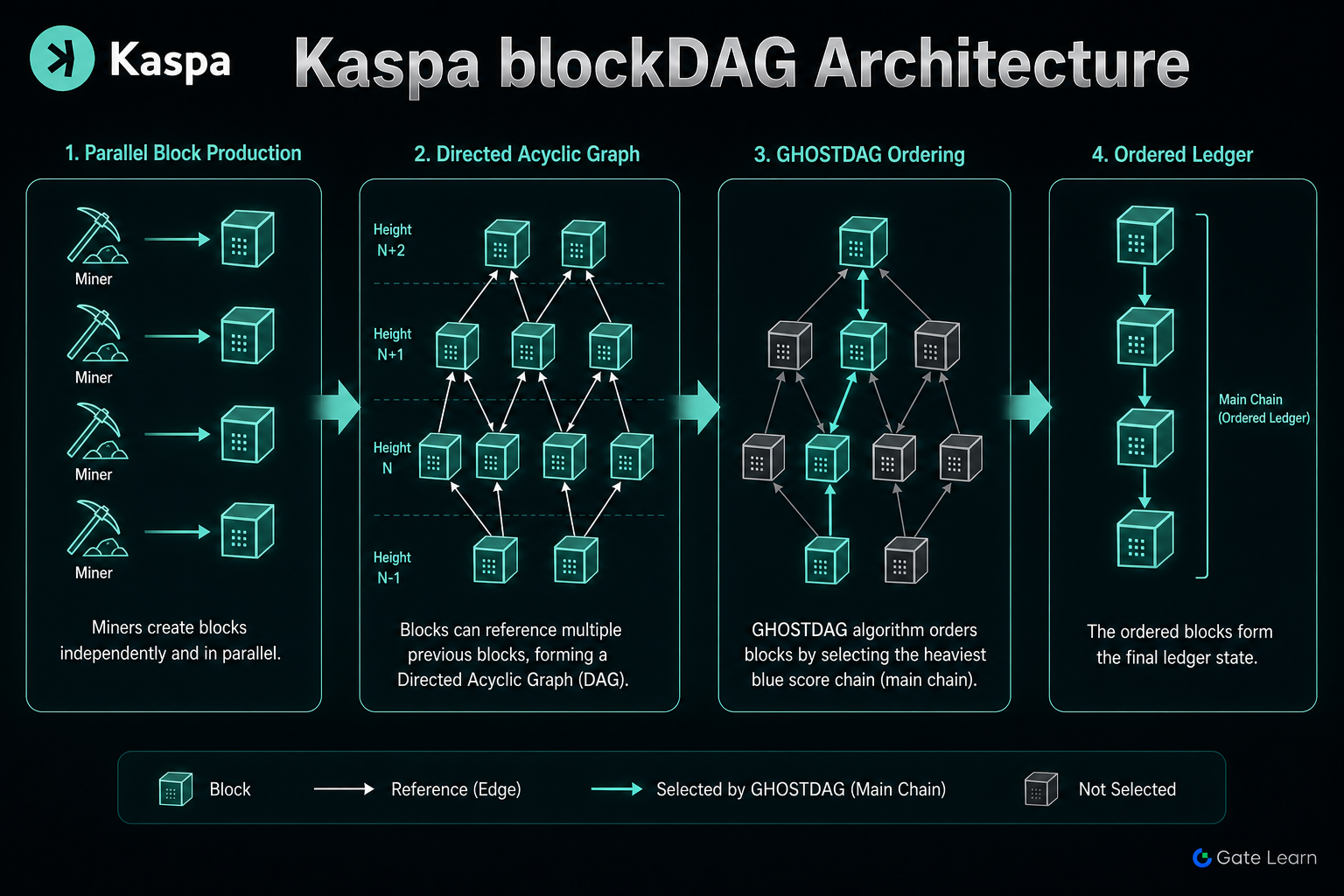
Figure 1. Kaspa blockDAG architecture: miners produce blocks in parallel, forming a DAG. GHOSTDAG sorts parallel blocks into an ordered ledger.
How Does GHOSTDAG Consensus Turn Parallel Blocks Into an Ordered Ledger?
GHOSTDAG is Kaspa’s consensus protocol, derived from the GHOST (Greedy Heaviest Observed SubTree) concept and part of the PHANTOM protocol family. GHOSTDAG calculates a “blue set” and “red set” for each block on blockDAG; blue blocks are included in the main sequence, while red blocks are either processed or excluded according to rules, yielding a globally consistent transaction order from the parallel graph.
Miners still compete for block production via PoW, using GHOSTDAG rules to select the heaviest subtree and mark block colors. New blocks maintain DAG connectivity through multi-parent references. Parallel block production no longer equates to orphan block waste, and confirmation speed is typically faster than traditional single-chain PoW.
| GHOSTDAG Core Concept |
Function |
| blockDAG |
Structure for parallel blocks |
| Blue Set |
Blocks included in main sequence and consensus |
| Red Set |
Blocks conflicting with main sequence or pending |
| Heaviest Subtree |
Determines main chain direction |
| Multi-parent Reference |
New blocks point to multiple predecessors, maintaining DAG connectivity |
This table outlines key GHOSTDAG terminology to distinguish parallel block production from unordered ledgers.
How Is the KAS Token Issued? What Are the Fair Launch and Block Reward Mechanisms?
KAS is Kaspa’s native token, used for trading fees and block rewards to miners. Kaspa follows a fair launch: no pre-mining, no ICO, no hidden team allocations. All KAS are released through mining after the genesis block.
KAS Tokenomics and Mining revolve around the issuance curve, block reward reduction, and KHeavyHash hashrate competition. Kaspa’s total supply is capped at about 28.7 billion KAS, with block rewards decreasing over time, similar to Bitcoin’s halving logic but at a faster pace to match higher block frequency.
| Token Mechanism |
Description |
| Launch Method |
Fair launch, no pre-mining or hidden allocations |
| Issuance Path |
100% released via mining |
| Mining Algorithm |
KHeavyHash (memory and hashrate hybrid) |
| Supply Cap |
About 28.7 billion KAS |
| Reward Schedule |
Decreases by block height |
| Trading Fee |
Transactions pay KAS as miner incentive |
All tokens are released through PoW competition with no privileged allocation pool.
Who Are the Key Participants in the Kaspa Network? How Do Miners, Full Nodes, and Wallets Work Together?
Kaspa’s network is maintained by miners, full nodes, light nodes, and wallets. Miners run KHeavyHash mining software to compete for blocks and broadcast new blocks to the network. Full nodes (primarily RustyKaspa) verify blocks and transactions, maintain the complete blockDAG state, and relay data. Wallets handle key management, balance queries, and transaction signing/broadcasting.
Miners depend on full nodes for on-chain data. Full nodes execute GHOSTDAG verification and maintain blockDAG state. RustyKaspa, written in Rust, handles P2P sync, block verification, and UTXO maintenance. Wallets manage keys and broadcast transaction signatures.
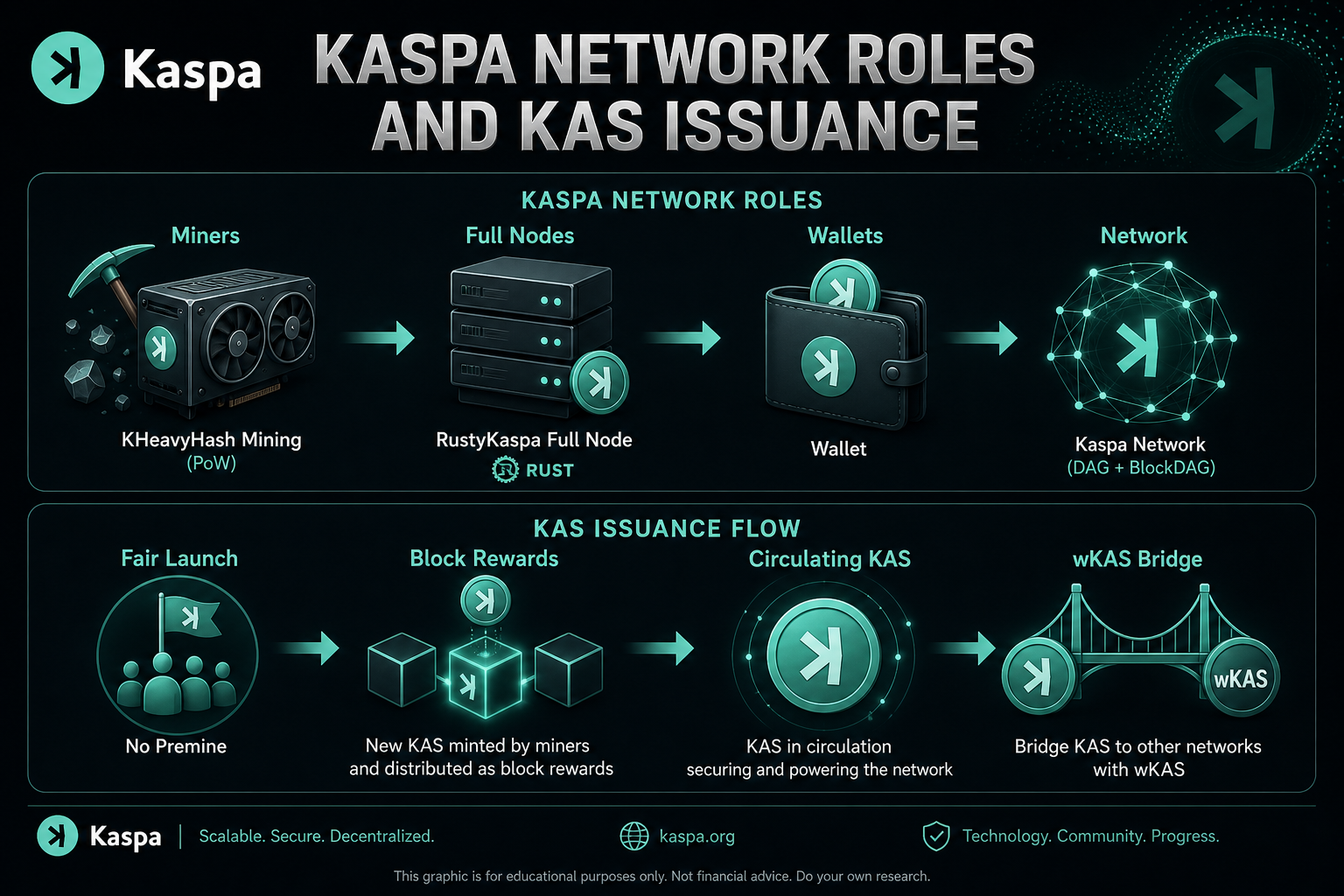
Figure 2. Kaspa network roles and KAS issuance: miners, RustyKaspa full nodes, and wallets collaborate, with KAS released through fair launch and block rewards.
What Ecosystem Extensions Does Kaspa Offer? How Do wKAS Cross-Chain and Interoperability Work?
Kaspa mainnet focuses on Layer 1 consensus and settlement. Ecosystem extensions include browsers, mining pool tools, third-party wallets, and cross-chain solutions. wKAS is a wrapped token version of KAS, used to represent KAS value on external chains like Ethereum, facilitating access to DeFi protocols and interoperability scenarios.
wKAS is not a native mainnet asset; its collateral and redemption mechanism depends on bridge contract design and must be distinguished from mainnet KAS. Kaspa vs Other PoW Public Chains shows that, compared to Litecoin (LTC) and Monero (XMR), Kaspa stands out for its blockDAG and high-frequency block production, though ecosystem applications are still developing.
What Are the Advantages, Risks, and Limitations of Using or Holding KAS?
Advantages: The blockDAG and GHOSTDAG combination delivers higher throughput and faster confirmations, while retaining the PoW security model. Fair launch and no pre-mining ensure transparent token allocation. KHeavyHash’s ASIC friendliness and mining threshold are independently parameterized, and RustyKaspa is actively maintained.
Risks: Parallel block production and high-frequency confirmations rely on network propagation quality. Extreme network conditions may cause reorganizations or confirmation delays. PoW chains face risks like hashrate centralization and theoretical 51% attacks. Cross-chain forms like wKAS introduce smart contract and bridge counterparty risks, which differ from mainnet security.
Limitations: blockDAG architecture is more complex for wallet, browser, and developer integration compared to traditional single-chain. Ecosystem applications and DeFi infrastructure are less mature than account-model chains like Ethereum. High block frequency increases on-chain data growth, requiring ongoing assessment of full node storage and bandwidth.
Summary
Kaspa (KAS) is a PoW Layer 1 blockchain that replaces the single-chain structure with blockDAG, sorts parallel blocks into an ordered ledger via GHOSTDAG consensus, and targets high-frequency block production and rapid confirmation. KAS is issued through a fair launch with no pre-mining, uses the KHeavyHash mining algorithm, and the network is maintained by RustyKaspa full nodes, miners, and wallets. Understanding Kaspa requires insight into its architectural differences from Bitcoin, token release rules, network roles, and ecosystem extensions like wKAS.
FAQ
What Is Kaspa?
Kaspa (KAS) is a PoW-based Layer 1 public blockchain featuring blockDAG and GHOSTDAG consensus, targeting about 10 blocks per second. The native token KAS is used for trading fees and miner rewards, and the network is issued via fair launch with no pre-mining or hidden allocations.
How Is Kaspa Different From Bitcoin?
Bitcoin uses a single-chain structure and a block interval of about 10 minutes, with competing blocks usually orphaned. Kaspa uses blockDAG for parallel block production, GHOSTDAG to integrate parallel blocks into an ordered ledger, targets about 10 blocks per second, and uses KHeavyHash instead of SHA-256.
What Is blockDAG? What Is GHOSTDAG Consensus?
blockDAG is a directed acyclic graph structure where each block can reference multiple predecessors, supporting parallel block production. GHOSTDAG assigns global order to parallel blocks on blockDAG using blue set and heaviest subtree rules, enabling PoW networks to boost throughput while maintaining security.
Does Kaspa Have Pre-Mining? What Is the Total KAS Supply?
Kaspa follows a fair launch with no pre-mining, ICO, or hidden allocations. All KAS are released through mining. The total supply is capped at about 28.7 billion, with block rewards decreasing by height, and the release curve and KHeavyHash mining rules jointly determine the circulation pace.
How Fast Are KAS Transaction Confirmations?
Kaspa targets about 10 blocks per second. Transaction confirmation depends on DAG depth and network conditions, typically much faster than the minute-level waits of traditional single-chain PoW. Actual confirmation time is influenced by hashrate distribution, node sync status, and trading fees.
Is Kaspa Secure? Is PoW Still Trustworthy?
Kaspa’s security model relies on PoW hashrate competition and GHOSTDAG verification. Full nodes (RustyKaspa) independently verify every transaction and block. PoW’s security depends on decentralized hashrate and protocol quality; parallel block production does not weaken PoW principles, but network propagation and reorganization risks must be considered.







