The evolution of the DeFi derivatives market has fueled demand for on-chain leveraged trading, yet liquidity scarcity and capital fragmentation remain persistent industry challenges. Many decentralized exchange protocols require separate liquidity pools for each trading pair, which reduces capital efficiency and limits market depth.
In response, the shared liquidity model has emerged as a pivotal trend for on-chain derivatives protocols. By centralizing liquidity across multiple markets and trading pairs, protocols can enhance capital efficiency and deliver a more consistent trading experience.
As a cornerstone of the Levare Multi-Asset Perpetual Contract Protocol, the Liquidity Vault is responsible for unified liquidity management and trade settlement. Whether users trade cryptocurrencies, forex, or commodity indices, all liquidity is sourced from a single shared pool.
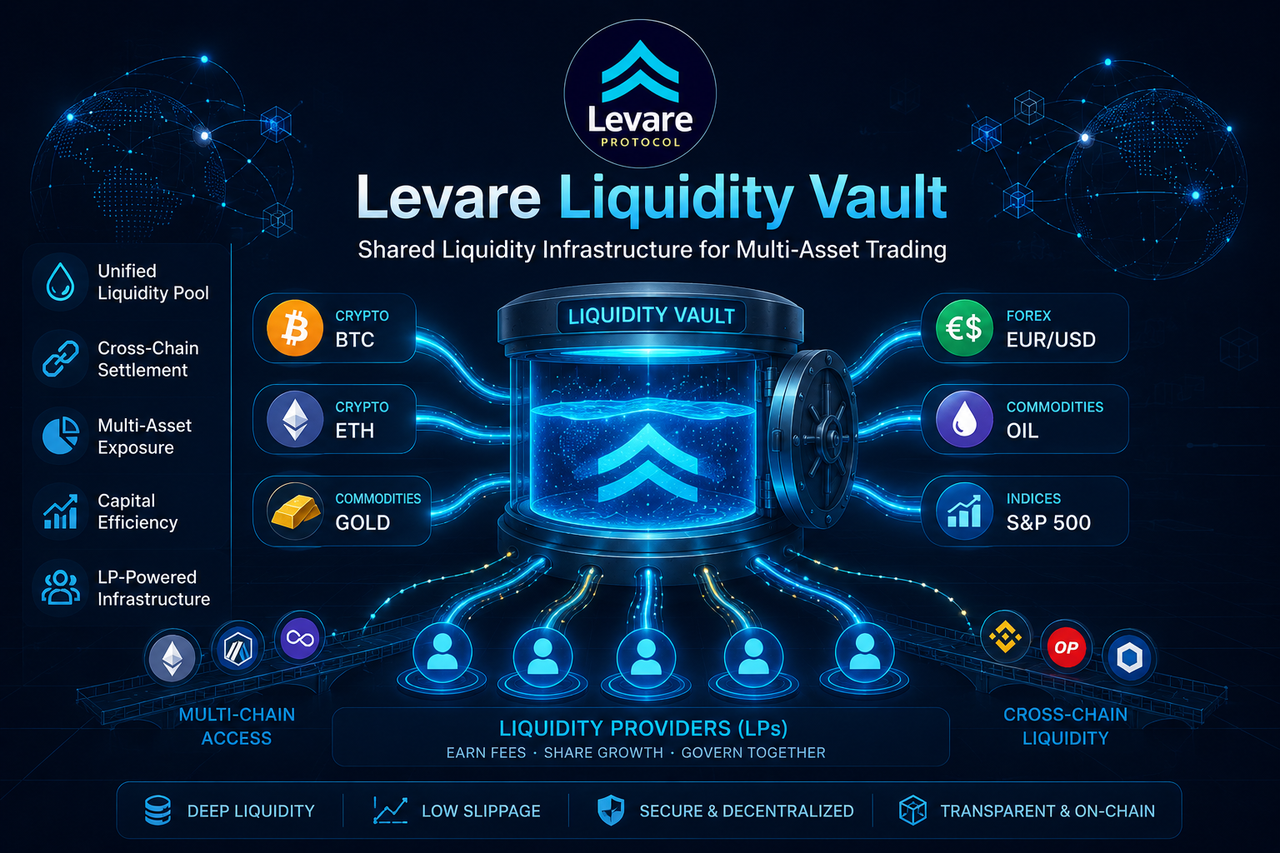
What Is the Liquidity Vault?
The Liquidity Vault functions as the Levare protocol's shared liquidity treasury, funding all trading activity.
Unlike centralized exchanges that rely on order book matching, Levare uses a liquidity pool model to settle trades. After liquidity providers deposit funds into the Vault, the protocol draws on these reserves to supply market liquidity.
For traders, the Vault serves as the system-wide counterparty. When a user opens a position, the Liquidity Vault—not another trader—assumes the risk and handles profit and loss settlement.
Why Does Levare Need a Shared Liquidity Model?
Traditional DeFi protocols typically create separate liquidity pools for each asset—for instance, separate pools for BTC, ETH, and gold.
As more assets are added, liquidity becomes fragmented across numerous markets. Even with a large total capital base, individual markets may still suffer from shallow depth.
Levare supports multi-asset trading across cryptocurrencies, forex, precious metals, commodities, and indices. Relying on individual pools would strand significant capital and lower efficiency.
The shared liquidity model lets all markets tap the same capital pool, boosting overall utilization and strengthening the protocol's capacity to execute large trades.
How Does the Liquidity Vault Work?
The Liquidity Vault operates in three phases: deposit, trade support, and settlement.
First, liquidity providers deposit stablecoins or protocol-supported assets into the Vault. These funds become the shared liquidity reserve for the entire protocol.
Second, when a trader opens a long or short position, the Vault assumes the corresponding risk exposure. The trader's gains or losses directly impact the Vault's capital.
Finally, when the trade closes, the protocol calculates profit or loss based on market price changes and automatically settles. All processes are executed by smart contracts with no human intervention.
This model allows liquidity to flow dynamically across markets without being locked into specific trading pairs.
How Does the Liquidity Vault Support Multi-Asset Trading?
Multi-asset trading must accommodate different markets' price volatility and demand patterns, requiring substantial liquidity.
Thanks to its unified pool design, the Liquidity Vault can simultaneously support Bitcoin, gold, EUR/USD exchange rates, stock indices, and more.
When demand surges in one market, the protocol draws directly from the shared pool rather than raising new liquidity.
This approach improves overall market depth and reduces competition for liquidity across asset classes.
For users, shared liquidity means a more stable trading environment and lower slippage risk.
How Is the Liquidity Vault Different From Traditional AMMs?
Both the Liquidity Vault and Automated Market Makers (AMMs) use liquidity pools, but their design goals differ significantly.
Traditional AMMs primarily serve spot trading, using token swaps for price discovery. Liquidity is typically managed per pair—for example, an ETH-USDC pool or a BTC-USDT pool.
The Levare Liquidity Vault, in contrast, supports perpetual futures trading. Its core role is to assume trading risk and enable a leveraged market.
| Dimension |
Liquidity Vault |
Traditional AMM |
| Primary Use |
Perpetual futures trading |
Spot trading |
| Liquidity Structure |
Unified shared pool |
Individual per-pair pools |
| Risk Assumption |
Vault acts as counterparty |
LPs bear impermanent loss |
| Capital Efficiency |
High |
Relatively low |
| Markets Supported |
Multi-asset derivatives |
Single trading pair |
The shared liquidity model is better suited for derivative markets that require substantial capital backing.
How Do Liquidity Providers (LPs) Earn Returns?
Liquidity for the Vault comes primarily from LP deposits.
In return, LPs receive a share of the trading fees generated by the protocol. As trading volume grows, so do the fees collected by the Vault.
Under certain market conditions, net losses from traders can also become a source of pool returns.
Additionally, some protocols distribute governance tokens to LPs as incentives for long-term ecosystem participation.
LP returns are closely tied to trading activity, market volatility, and pool size.
What Risks Does the Liquidity Vault Face?
While the shared liquidity model boosts capital efficiency, it also introduces new risk dynamics.
If traders are broadly profitable, the Vault may face capital outflows. Sustained one-sided market movements can erode pool returns.
Oracle risk is another key challenge. Because multi-asset trading relies on external price feeds, inaccurate or delayed prices can lead to faulty settlements.
Smart contract vulnerabilities, cross-chain communication failures, and extreme market volatility also threaten the Vault's stability.
Accordingly, robust risk controls, capital management strategies, and security audits are essential for the Liquidity Vault's long-term operation.
Summary
The Levare Liquidity Vault serves as the shared liquidity treasury for the Levare Multi-Asset Perpetual Contract Protocol, providing unified capital support for all trading activity. By centralizing liquidity, the Vault deepens markets across cryptocurrencies, forex, precious metals, commodities, and indices while improving overall capital efficiency.
Compared to traditional separate pools, the shared liquidity model reduces capital fragmentation and supports cross-market and cross-chain expansion. As a vital component of the Levare ecosystem, the Liquidity Vault is not only the infrastructure for trade execution but also a key mechanism for risk management and value creation.
FAQs
What is the Liquidity Vault?
The Liquidity Vault is the Levare protocol's shared liquidity treasury, composed of funds deposited by liquidity providers. It provides unified liquidity support for all perpetual futures trading.
How does the Liquidity Vault make money?
The Liquidity Vault earns revenue mainly from trading fees and, in some market conditions, from capital inflows due to net trader losses. Actual returns depend on trading volume and market conditions.
Why is the Liquidity Vault more efficient than separate pools?
The shared liquidity model lets multiple markets use the same capital pool, reducing idle funds and liquidity fragmentation, thereby boosting capital efficiency.
How is the Liquidity Vault different from traditional AMMs?
Traditional AMMs focus on spot trading, while the Liquidity Vault serves the perpetual futures market. The Vault assumes counterparty risk, whereas AMMs emphasize token swaps and price discovery.
What risks do LPs bear in the Liquidity Vault?
LPs face risks from overall trader profitability, oracle anomalies, smart contract vulnerabilities, and extreme market volatility. Thus, returns and risks are inherently linked.
Why is the Liquidity Vault important for Levare?
The Liquidity Vault is the core infrastructure of Levare's multi-asset trading system. It handles liquidity management, risk assumption, trade settlement, and cross-chain capital integration, making it essential to the protocol's operation.







