As decentralized exchanges continue to evolve, the demand for efficient liquidity management is growing. Magma Finance builds on the foundations of traditional AMM and CLMM models to create ALMM, aiming to balance capital efficiency, user experience, and automated management while delivering a smarter liquidity infrastructure for the Sui ecosystem.
What Is ALMM?
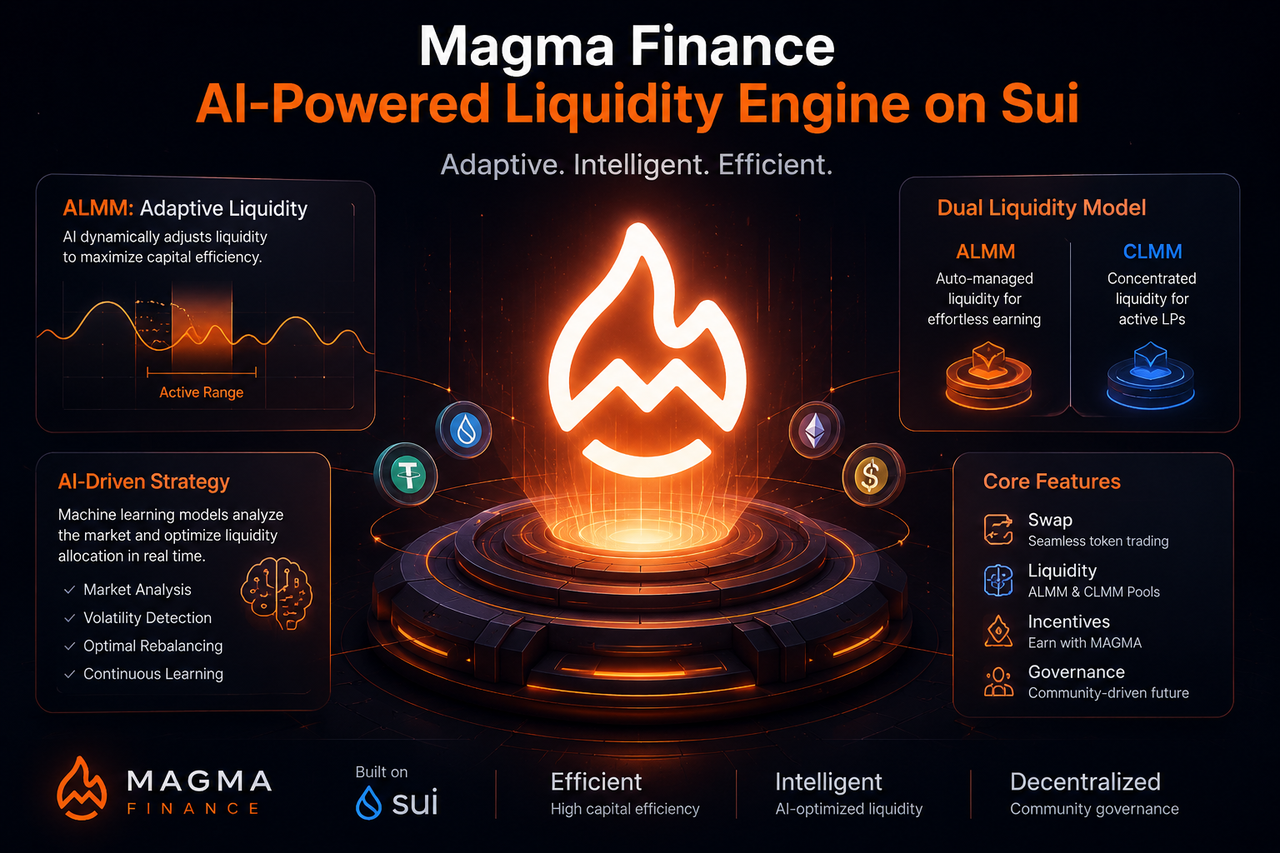
ALMM stands for Adaptive Liquidity Market Maker. Its core goal is to lower the barriers to liquidity management while maintaining high capital efficiency, allowing liquidity to adjust automatically to market changes without requiring frequent user intervention.
Compared to traditional automated market makers, ALMM focuses more on capital utilization. Compared to concentrated liquidity market makers (CLMM), ALMM emphasizes automated management capabilities.
How Does ALMM Work?
ALMM's core logic dynamically adjusts liquidity allocation based on market conditions. After users deposit assets into a liquidity pool, the system does not maintain a fixed distribution indefinitely. Instead, it continuously monitors key indicators such as market price, trading volume, and liquidity utilization rate.
When the market price shifts significantly, the protocol automatically reallocates liquidity to keep funds concentrated around the most active trading zones. Unlike CLMM, which requires manual management, ALMM automates part of the liquidity management process, reducing the operational burden and improving capital efficiency.
This mechanism allows liquidity to adapt more flexibly to market changes without requiring users to constantly adjust their strategies.
What Role Does AI Play in ALMM?
AI is a key component of Magma Finance's liquidity management system. Traditional liquidity models rely on fixed rules, whereas AI enables dynamic analysis using market data, including price volatility, trading activity, capital utilization, and historical market behavior across multiple dimensions.
Based on this data, the system identifies areas of high liquidity demand and assists in capital redeployment. The goal of AI is not to predict price movements but to improve the efficiency of liquidity allocation, ensuring more capital is actively used in market trading.
By integrating intelligent analysis, ALMM optimizes capital utilization while maintaining automated operation.
How Does the Dynamic Liquidity Range Improve Capital Efficiency?
Capital efficiency is a key metric for evaluating liquidity models. In traditional AMMs, most funds are spread across the entire price curve, while actual market prices typically fluctuate within a limited range, leaving many funds idle for extended periods.
ALMM uses a dynamic liquidity range design, concentrating more liquidity in the currently active market zones. When prices enter a new range, the system automatically adjusts fund positions to keep liquidity continuously effective.
This dynamic allocation enables the same amount of capital to support more trading activity, improving overall market depth and fee generation potential.
What Are the Differences Between ALMM and CLMM?
Both ALMM and CLMM aim to improve capital efficiency, but they take different approaches. CLMM relies on users to actively set price ranges, giving them more control but also requiring ongoing management.
ALMM, on the other hand, uses automated strategies to handle some liquidity management tasks. The system adjusts liquidity positions automatically based on market changes, reducing the need for frequent rebalancing.
| Dimension |
ALMM |
CLMM |
| Liquidity Allocation |
Automatic |
Manual |
| User Involvement |
Lower |
Higher |
| Capital Efficiency |
Higher |
Higher |
| Rebalancing |
Automated |
User-executed |
| Target Audience |
General users and LPs |
Advanced LPs |
These two models do not replace each other—they serve different user groups. CLMM remains attractive for professional liquidity providers who want to actively manage their funds, while ALMM offers a lower-barrier entry for users seeking a convenient experience.
What Impact Does ALMM Have on Liquidity Providers?
ALMM's greatest value is reducing the complexity of liquidity management. Traditional CLMM requires users to constantly monitor market prices, whereas ALMM automates much of the adjustment process, eliminating the need for frequent range modifications.
At the same time, the dynamic allocation mechanism increases the likelihood of capital participating in trades, boosting capital utilization. For users without professional market-making experience, ALMM provides a more accessible way to provide liquidity.
This design helps attract more general users to high-capital-efficiency markets and strengthens the protocol's overall liquidity depth.
Are There Potential Risks With ALMM?
ALMM improves automation but does not eliminate market risk. Impermanent loss remains a common issue across all liquidity models—when asset prices experience large swings, liquidity providers may still suffer losses.
Additionally, the effectiveness of automated strategies depends on market conditions. In extreme scenarios, liquidity adjustments may not keep pace with price changes. AI models can also have prediction errors and strategy adaptability limitations.
Therefore, ALMM's role is to optimize liquidity management efficiency, not to completely avoid risk.
Summary
As an adaptive liquidity market-making mechanism introduced by Magma Finance, ALMM improves capital efficiency through dynamic liquidity allocation, automated rebalancing, and AI-driven strategies. Compared to traditional AMMs, ALMM reduces idle capital. Compared to CLMM, it significantly lowers the barriers to liquidity management.
FAQs
What Does ALMM Mean?
ALMM stands for Adaptive Liquidity Market Maker. This mechanism improves capital utilization and trading efficiency by dynamically adjusting liquidity allocation.
What Is the Difference Between ALMM and Traditional AMM?
Traditional AMM distributes liquidity across the entire price range, while ALMM dynamically adjusts fund positions based on market changes, concentrating liquidity in active trading zones.
Which Has Higher Capital Efficiency, ALMM or CLMM?
Both offer high capital efficiency. CLMM relies on active user management, while ALMM optimizes liquidity through automation, giving it an edge in user experience.
What Role Does AI Play in ALMM?
AI analyzes market data and optimizes liquidity distribution strategies. Its goal is to improve capital utilization, not to predict market prices.
Can ALMM Completely Avoid Impermanent Loss?
No. Impermanent loss is a common risk in liquidity provision. ALMM can optimize liquidity allocation but cannot fully eliminate the impact of market volatility.
Why Is ALMM Considered Suitable for General Users?
ALMM reduces the need for manually adjusting liquidity ranges. Users can participate in high-capital-efficiency liquidity markets without frequent position management, making it ideal for those without professional market-making experience.