In the modular ZK blockchain, a single token must serve both the application scaling layer and the identity compliance layer. Atlantic uses MANTA to pay Gas and secures the network through DPoS-delegated collators; Pacific pays Gas with ETH, while MANTA is used for governance, Restaking participation in fast finality, and ecosystem incentives. The following analysis breaks down four dimensions: supply structure, issuance mechanism, dual-chain roles, and governance architecture.
From the Manta Network ecosystem perspective, MANTA is both the native medium for Atlantic network security and fees and the credential for Pacific governance and Restaking participation. The two chains share a unified supply denominator via the Celer bridge, making tokenomics the key to understanding how the two chains work together.
What Is MANTA Tokenomics?
MANTA tokenomics describes MANTA's total supply design, distribution and release, inflation issuance, and incentive rules for each participant. On Atlantic, MANTA functions as a Gas medium, collator staking collateral, and a purchase medium for zkSBT credentials; on Pacific, it serves governance voting, Symbiotic Restaking security participation, and ecosystem incentive distribution.
The two chains share the genesis total supply but have different mechanisms. Pacific Gas is denominated in ETH, while Atlantic network fees are denominated in MANTA. The Celer bridge coordinates token representation across the two chains, and the total unlocked tokens on both chains jointly determine the circulating supply.
How Is the 1 Billion MANTA Allocated?
MANTA's genesis total supply is 1 billion tokens, with initial allocation set at TGE. Beyond the genesis distribution, the network has an annual inflation of 2% starting from TGE, specifically for staking rewards, which is not included in the static genesis allocation ratio. The initial circulating supply at TGE is approximately 251 million tokens, with the remainder gradually released through cliff and linear unlock schedules. The main allocations are as follows:
| Allocation Category |
Percentage |
Release Schedule (Overview) |
| Ecosystem/Community |
21.19% |
Partial release at TGE, remainder linearly unlocked over 48 months |
| Foundation Treasury |
13.50% |
Linear release over 72 months |
| Private Sale |
12.94% |
12-month cliff, linear release over 36 months |
| Team |
10.00% |
18-month cliff, linear release over 48 months |
| Advisors |
8.10% |
Partial release at TGE, remainder monthly over 30 months |
| Public Sale |
8.00% |
Partial release at TGE, remainder monthly over 6 months |
| New Paradigm |
6.50% |
Staged release at TGE and deferred |
| Strategic Investors |
6.17% |
12-month cliff, linear release over 36 months |
| Airdrop |
5.60% |
Released within the TGE claim window |
| Institutional Investors |
5.00% |
12-month cliff, linear release over 36 months |
| Binance Launchpool |
3.00% |
Fully released at TGE |
Ecosystem/Community and Foundation together account for over one-third of the genesis supply, reflecting a focus on long-term ecosystem development. All investor and team shares include cliff and linear unlock periods to reduce the impact of concentrated near-term releases. Unclaimed airdrop rewards flow back to the ecosystem treasury, with future use determined by community governance.
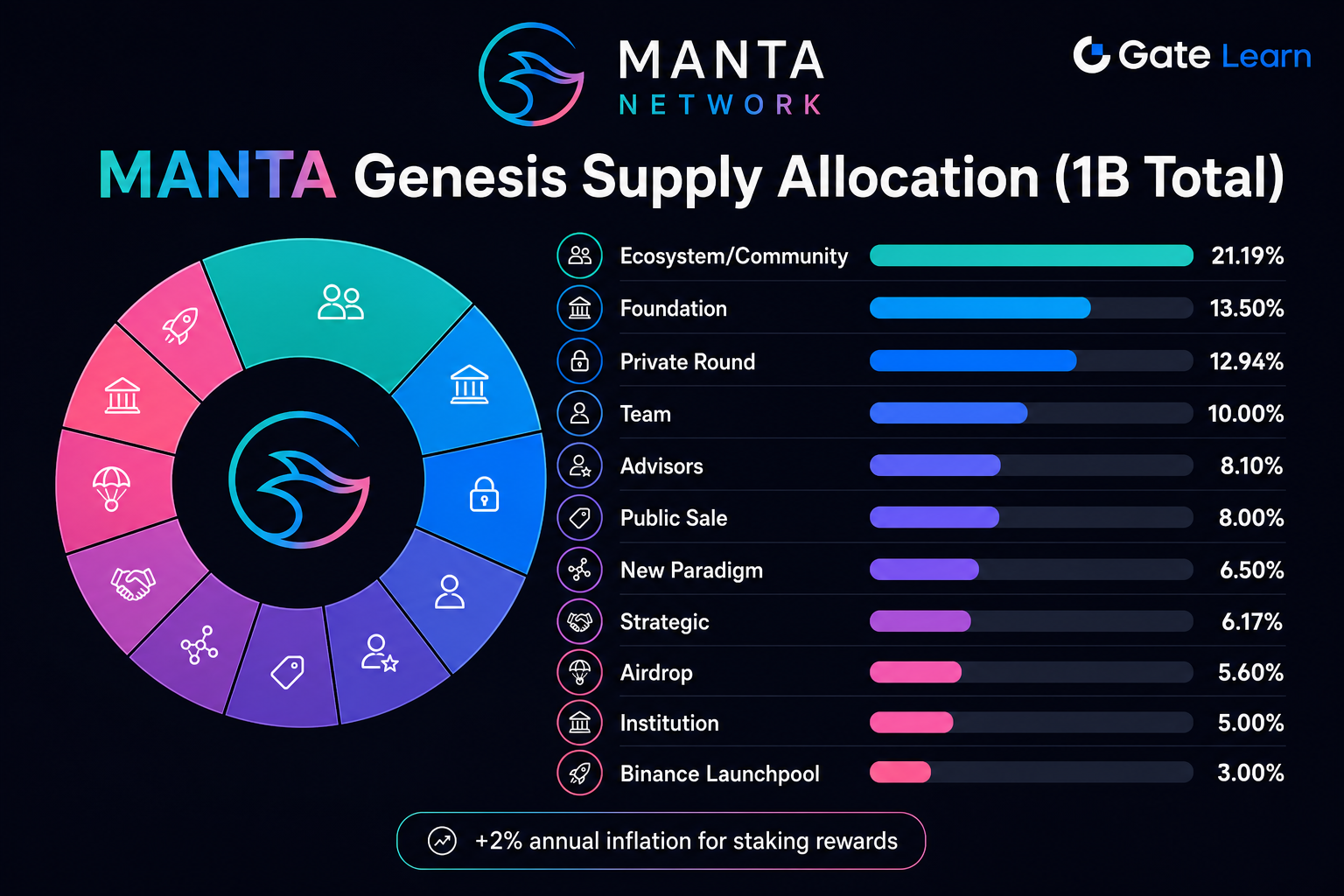 Figure 1. MANTA genesis supply allocation across major categories, with 2% annual inflation for staking rewards.
Where Does the 2% Annual Inflation Go?
Beyond the 1 billion genesis supply, MANTA has an ongoing annual inflation of 2%, minted yearly from token genesis and distributed to stakers for maintaining network security. This inflation falls under the "Estimated Validator/Issuance Reward" category, causing the total supply to exceed the genesis base over time.
The 2% annual inflation primarily flows to Manta Atlantic block producers. The network selects collators to produce blocks based on total stake ranking. Holders can earn reward shares by delegating to collators or running their own nodes. Long-term supply must be understood across three dimensions: genesis allocation gradually circulating according to vesting, annual inflation continuously increasing total supply, and cross-chain locking making circulating statistics based on unlocked tokens on both chains.
What Are the Uses of MANTA on Atlantic?
As a ZK L1 in the Polkadot ecosystem, Manta Atlantic assigns MANTA three roles: network fee medium, governance voting weight, and collator security staking. Atlantic uses a DPoS variant where collators package transactions and maintain block liveness. Holders can delegate to collators or stake to run their own nodes.
To become a collator, one must meet a minimum staking threshold (publicly documented as 400,000 MANTA) and hardware requirements. Collators ranked by staking volume participate in block production. Atlantic network fees are denominated in MANTA, with the following allocation: 72% to ecosystem projects, 18% to the treasury, and 10% as collator rewards. MANTA also serves as a purchase medium for on-chain credentials such as zkSBT and zkKYC.
What Role Does MANTA Play on Pacific?
Pacific transaction Gas is denominated in ETH, so users do not directly pay fees with MANTA in daily interactions. Pacific uses Celestia modular DA to reduce data costs. Gas savings and sequencer revenue are the main sources of value accumulation, with a portion flowing back to ecosystem development for on-chain activity grants, ZK application support, and public goods funding.
On Pacific, MANTA is primarily used for governance voting, participation in Symbiotic Restaking for fast finality verification, and ecosystem incentive distribution. MANTA and BTC can delegate nodes to verify state roots through Restaking, and delegators can receive MANTA inflation rewards. Pacific forms a dual-token collaboration model: "ETH pays Gas, while MANTA handles governance and security."
How Can MANTA Holders Participate in Governance?
MANTA carries governance voting weight on both chains. Holders can vote on referenda, council elections, and network direction. Governance 1.0 relied mainly on community forum discussions, with execution handled by the Manta Foundation. Governance 2.0 transitions to a five-layer Council model, separating legislative, executive, judicial, supervisory, and audit functions:
| Council Level |
Core Function |
| Legislative Council |
MANTA holders decide network direction, vision, and tokenomics |
| Executive Council |
Translates legislative decisions into operational, educational, and R&D actions |
| Judicial Council |
Oversees grant distribution and governance tool implementation |
| Examination Council |
Manages Foundation member elections and accountability |
| Control Council |
Audits the entire governance process, ensuring transparency and fairness |
The Legislative Council is led by MANTA holders on strategy, while the other layers handle execution and checks and balances. Unreleased portions from ecosystem/community allocations will have their future uses determined via on-chain governance.
What Are the Differences in MANTA's Role across the Two Chains?
The core of MANTA tokenomics' dual-chain design is "same token, different roles":
| Function Dimension |
Manta Pacific |
Manta Atlantic |
| Gas Payment |
ETH-denominated |
MANTA-denominated |
| Governance Voting |
Supported |
Supported |
| Staking/Delegation |
Symbiotic Restaking for fast finality |
Collator staking and delegation (DPoS) |
| Credential Purchase |
Ecosystem liquidity and collateral |
Medium for purchasing zkSBT, zkKYC |
| Value Return |
Sequencer revenue and DA savings flow back to ecosystem |
72% of network fees allocated to ecosystem projects |
Cross-chain circulation is achieved via the Celer bridge: each chain represents the 1 billion genesis total, and tokens are locked and unlocked in the bridge pool during cross-chain transfers. When tokens unlock on the Atlantic side, the corresponding contract on the Pacific side deploys an equivalent amount of tokens to the liquidity pool for bridging. When evaluating MANTA's role, first identify the chain, as the mechanisms of the two chains cannot be conflated.
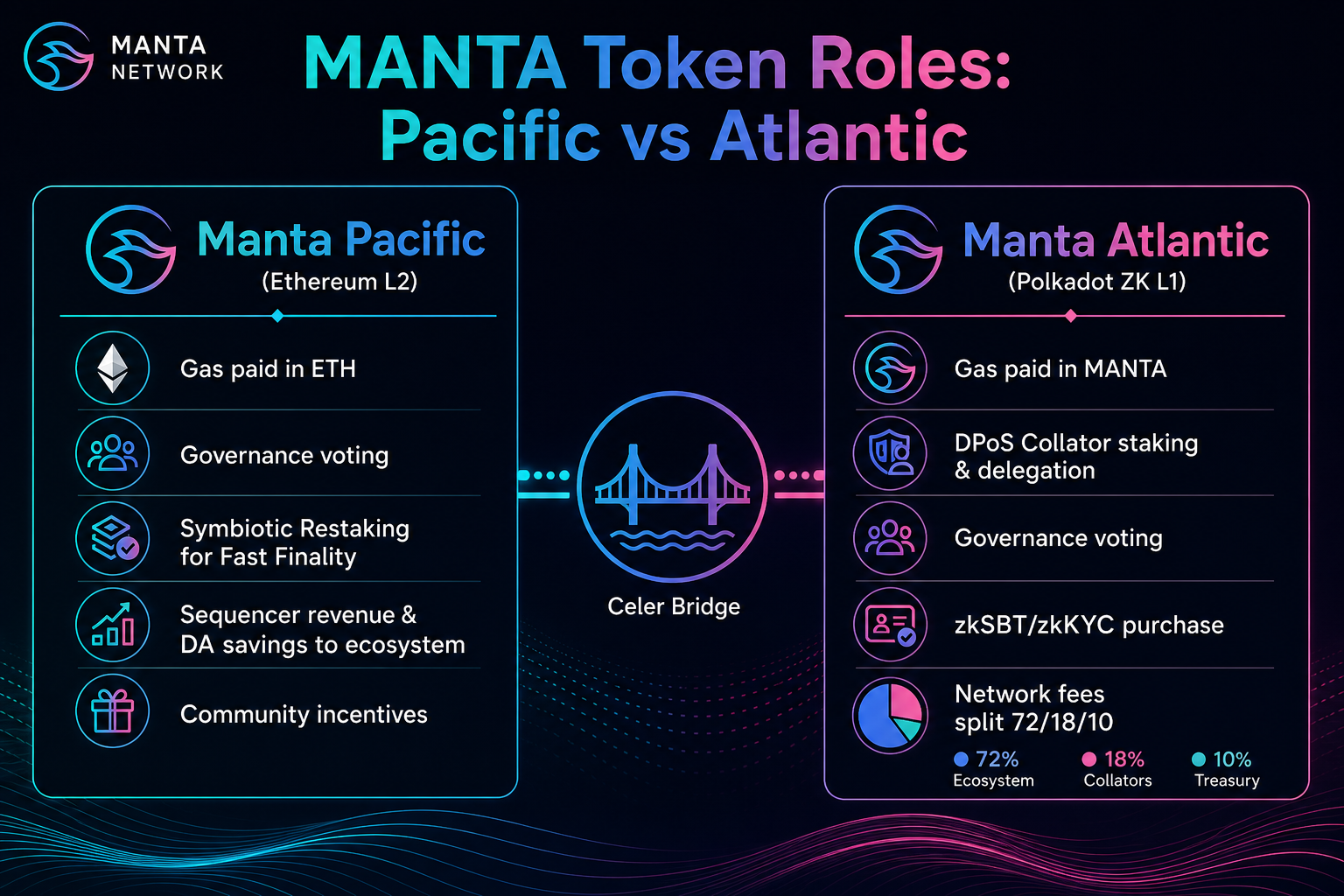 Figure 2. MANTA token roles across Manta Pacific (ETH gas, Restaking, ecosystem incentives) and Manta Atlantic (MANTA gas, DPoS collators, credentials).
What Are the Advantages and Risks of MANTA's Tokenomics?
MANTA tokenomics has structural characteristics in three dimensions: dual-chain division of labor, long-term ecosystem funding, and decentralized governance. Limitations include: cross-chain reliance on Celer bridge security and liquidity; limited direct Gas utility of MANTA on Pacific; and full implementation of the five-layer Council depending on ecosystem maturity. Related risks include the periodic supply impact of vesting unlocks, evolution of staking slashing rules, and confusion from fake MANTA contracts. This does not constitute an investment judgment.
Summary
MANTA tokenomics is based on a 1 billion genesis total supply and a 2% annual inflation, with controlled release through multi-category allocation and vesting. On Atlantic, MANTA serves as Gas, DPoS collator staking, governance, and credential purchase; on Pacific, ETH pays Gas, while MANTA is used for governance, Restaking, and ecosystem incentives. A five-layer Council separates governance powers, and the Celer bridge coordinates dual-chain circulation. Understanding supply allocation, functional differences between the two chains, and participant roles is key to grasping MANTA's position in the Manta Network ecosystem.
FAQ
What is MANTA tokenomics?
MANTA tokenomics is the economic mechanism system built by Manta Network around its native token MANTA, encompassing supply distribution, inflation incentives, governance voting, and dual-chain network participation roles. The genesis total supply is 1 billion tokens, with a 2% annual inflation for staking rewards.
What is MANTA's genesis total supply and how is it distributed?
MANTA's genesis total supply is 1 billion tokens, with major allocations including Ecosystem/Community 21.19%, Foundation 13.50%, Private Sale 12.94%, Team 10.00%, and others. Each category has a cliff and linear unlock schedule. The initial circulating supply at TGE is approximately 251 million tokens.
Where does the 2% annual inflation of MANTA go?
The 2% annual inflation is minted yearly from token genesis and primarily distributed to Manta Atlantic staking participants. Holders can delegate to collators or run their own nodes to help maintain security and earn block rewards.
How do MANTA's functions differ on Pacific and Atlantic?
Manta Atlantic uses MANTA to pay Gas, supports collator staking, governance, and zkSBT purchases. Manta Pacific uses ETH to pay Gas, while MANTA is used for governance, Restaking, and ecosystem incentives. The mechanisms of the two chains cannot be conflated.
What is the five-layer Council governance?
The five-layer Council is a decentralized governance structure under Governance 2.0: the Legislative Council, led by MANTA holders, decides direction; the Executive Council implements operations; the Judicial Council oversees grants; the Examination Council manages elections; and the Control Council ensures process transparency and fairness.
How does MANTA circulate across the two chains?
Each chain represents the 1 billion genesis total, and cross-chain circulation is achieved by locking and unlocking tokens through the Celer bridge. Circulating supply is calculated based on the total unlocked tokens on both chains to avoid double counting.







