Unlike the hotel companies many people imagine, today’s large hotel groups do not necessarily own a large number of hotel properties. Over the past few decades, the global hotel industry has gradually shifted from an asset-heavy operating model to an asset-light management model. Hotel groups are more often responsible for brand building, operational management, membership systems, and global reservation networks, while hotel properties are held by real estate investors, hotel owners, or institutional capital.
Against this industry backdrop, Marriott International has steadily built a brand system covering multiple market segments, including luxury hotels, premium hotels, midscale hotels, and extended-stay hotels. Through its global operating network, it connects consumers, hotel owners, and the broader travel industry chain. Today, whether for business trips, leisure travel, or long-term stays, Marriott has become one of the key representatives of the global hotel industry.
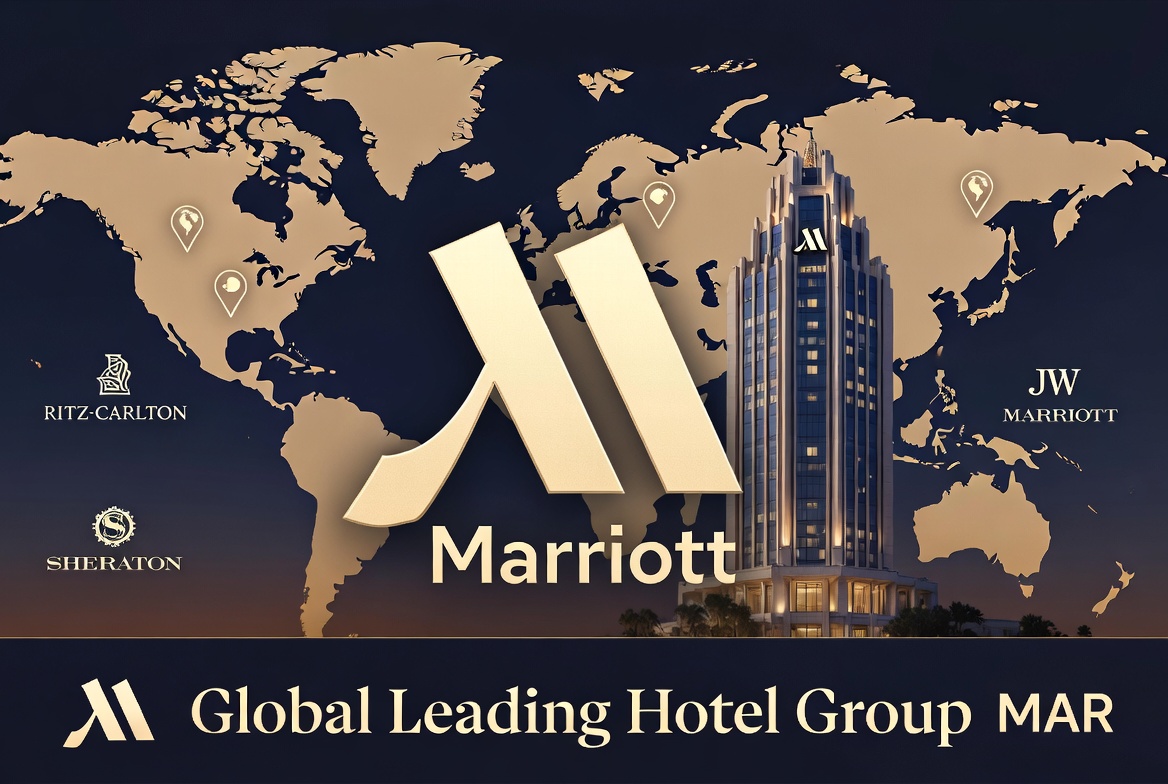
What Is MAR (Marriott International)?
Hotel owners are responsible for property investment and construction, while Marriott International provides brand standards, operating systems, marketing support, and access to global reservation platforms. MAR (Marriott International) is one of the world’s largest hotel groups. Through hotel management, brand licensing, and membership ecosystem operations, it holds an important position in the global lodging and travel market.
This business model allows Marriott to continue expanding its global business network without holding large-scale real estate assets. Compared with the traditional asset-heavy hotel operating model, the asset-light model usually offers higher capital efficiency and stronger scalability.
Today, Marriott International owns hotel brands that cover multiple consumer tiers and operates in many countries and regions around the world, making it a major participant in the global travel and hotel industry.
Marriott International’s History and Market Positioning
The history of Marriott International runs almost in parallel with the development of the modern hotel industry. The company can be traced back to 1927, when it first operated in the food and beverage business before gradually entering the hotel industry. As global business travel and international tourism continued to expand, Marriott accelerated its global rollout and gradually built a hotel network spanning many countries and regions.
In 2016, Marriott completed its acquisition of Starwood Hotels & Resorts, one of the most influential mergers and acquisitions in the global hotel industry. Through this integration, Marriott gained a number of well-known brands, including St. Regis, W Hotels, Sheraton, and Westin, further expanding its market share.
Today, Marriott is positioned not only as a hotel operator, but also as a global hotel ecosystem platform. Through its brands, membership system, digital platforms, and global operating standards, the company connects hotel owners with consumers and plays an important role in the global lodging industry chain.
How Marriott International’s Hotel Management Business Works
Hotel management is one of Marriott International’s most important sources of revenue.
Under the hotel management model, hotel properties are usually owned and invested in by independent owners. Marriott International provides brand licensing, operating systems, management team training, marketing support, and service standard management. Once a hotel officially begins operations, Marriott collects management fees based on the terms of the contract.
For hotel owners, joining an international brand system provides access to a global reservation network, brand recognition, and mature operating expertise, helping improve occupancy rates and operational efficiency. For Marriott, it enables business expansion without taking on heavy real estate investment costs.
This model has become an important direction for the modern hotel industry. Compared with the traditional model of owning properties directly, the management contract model allows hotel groups to invest more resources in brand building, digital operations, and customer service systems.
The brand system is one of Marriott International’s most important competitive advantages. Consumers have clearly different expectations for their lodging experience. Business travelers may care more about convenient transportation and meeting facilities, high-end consumers place greater emphasis on personalized service and brand experience, while extended-stay guests are more focused on living comfort and practical residential features. To cover these different needs, Marriott has built a large brand matrix.
| Brand Tier |
Representative Brands |
| Luxury Hotels |
Ritz-Carlton, St. Regis, JW Marriott |
| Premium Hotels |
Marriott Hotels, Sheraton, Westin |
| Select-Service Hotels |
Courtyard, Fairfield |
| Extended-Stay Hotels |
Residence Inn, TownePlace Suites |
Through its multi-brand strategy, Marriott can cover a wide market ranging from luxury travel to mainstream business travel, improving its overall market coverage and ability to reach customers.
At present, Marriott hotels are located across North America, Europe, Asia Pacific, the Middle East, Latin America, and other regions, forming a global operating network.
How Marriott Bonvoy Creates Value
Marriott Bonvoy is one of Marriott International’s most important customer ecosystems. Competition in the hotel industry is intense, and the cost of acquiring new customers is often higher than the cost of retaining existing ones. For this reason, large hotel groups commonly build membership systems that use points rewards and exclusive benefits to strengthen customer loyalty.
Marriott Bonvoy allows members to earn points when staying at hotels and redeem them for stays, room upgrades, or services from other partners. As members move up in status, they can also receive more exclusive benefits, such as late checkout, executive lounge access, and opportunities for room upgrades.
For consumers, the membership system makes the experience more consistent across different brands. For Marriott, the membership ecosystem not only helps increase repeat purchases, but also allows the company to accumulate large amounts of user behavior data, which can then be used to optimize marketing and operational decisions.
As a result, Marriott Bonvoy has become an important competitive barrier in addition to the company’s brand system.
Marriott International’s Role in the Global Travel and Business Travel Markets
Marriott International is not only a hotel group, but also an important part of global travel infrastructure. Business travel has long been a major source of demand for the hotel industry. Corporate travel by employees of multinational companies, international conferences, and business exhibitions all create stable lodging demand. Because business travelers usually place greater importance on brand reliability and service standards, international hotel groups have a strong competitive advantage.
At the same time, the global leisure travel market continues to expand. As international tourism recovers and grows, more consumers are choosing standardized, globally operated hotel brands to secure a more reliable lodging experience.
Through its global hotel network, Marriott connects multiple parts of the industry chain, including travel, aviation, meetings and events, and corporate services, playing an important role in the global travel economy.
How Marriott International Differs from Hilton and Hyatt
Marriott, Hilton, and Hyatt are all well-known global hotel groups, but their development strategies differ in certain ways. In terms of scale, Marriott has one of the largest global hotel brand networks, with broader brand coverage. Whether in luxury hotels or mainstream business hotels, Marriott has corresponding brand layouts.
Hilton also follows an asset-light model, but places greater emphasis on its membership ecosystem and brand consistency. Hilton Honors has long been viewed as one of the leading membership programs in the hotel industry.
Hyatt, by comparison, is more focused on the premium and luxury markets. Its hotel count is lower than that of Marriott and Hilton, but its influence in high-end brands is strong.
| Company |
Core Characteristics |
| Marriott International |
The world’s largest brand matrix |
| Hilton |
Strong membership ecosystem and standardized brand operations |
| Hyatt |
Clear advantages in the premium and luxury markets |
These different positions allow the three companies to serve different consumer groups and market needs.
What Are the Main Use Cases for Marriott International?
Marriott International’s service scenarios are broad. Business travel is one of the most typical use cases. Corporate employee travel, business meetings, and industry exhibitions often require standardized lodging services, and international hotel brands can provide a consistent service experience.
Leisure travel is also an important market. Family trips, vacation spending, and international tourism all make up important sources of guests for Marriott’s hotels.
In addition, the extended-stay market is continuing to grow. As remote work, cross-regional employment, and long-term business assignments increase, extended-stay hotels have gradually become an important segment of the hotel industry.
By covering a diverse range of scenarios, Marriott can maintain a relatively stable business foundation across different economic cycles and market environments.
How to Buy MAR (Marriott International) Stock
MAR is the ticker symbol under which Marriott International trades on the Nasdaq Stock Market in the United States. Traditionally, investors can buy MAR stock through brokerage accounts that support U.S. stock trading, thereby participating in the development of the global hotel and travel industry. Because Marriott International’s business is closely related to global travel activity, business travel, and hotel consumption demand, it is also regarded as one of the key companies for observing the global travel industry.
As the digital asset market and traditional financial markets gradually become more integrated, more trading tools linked to stock price movements have also appeared in the market. For example, some platforms offer CFD products tied to stock prices, allowing users to participate in price movements without directly holding the underlying shares.
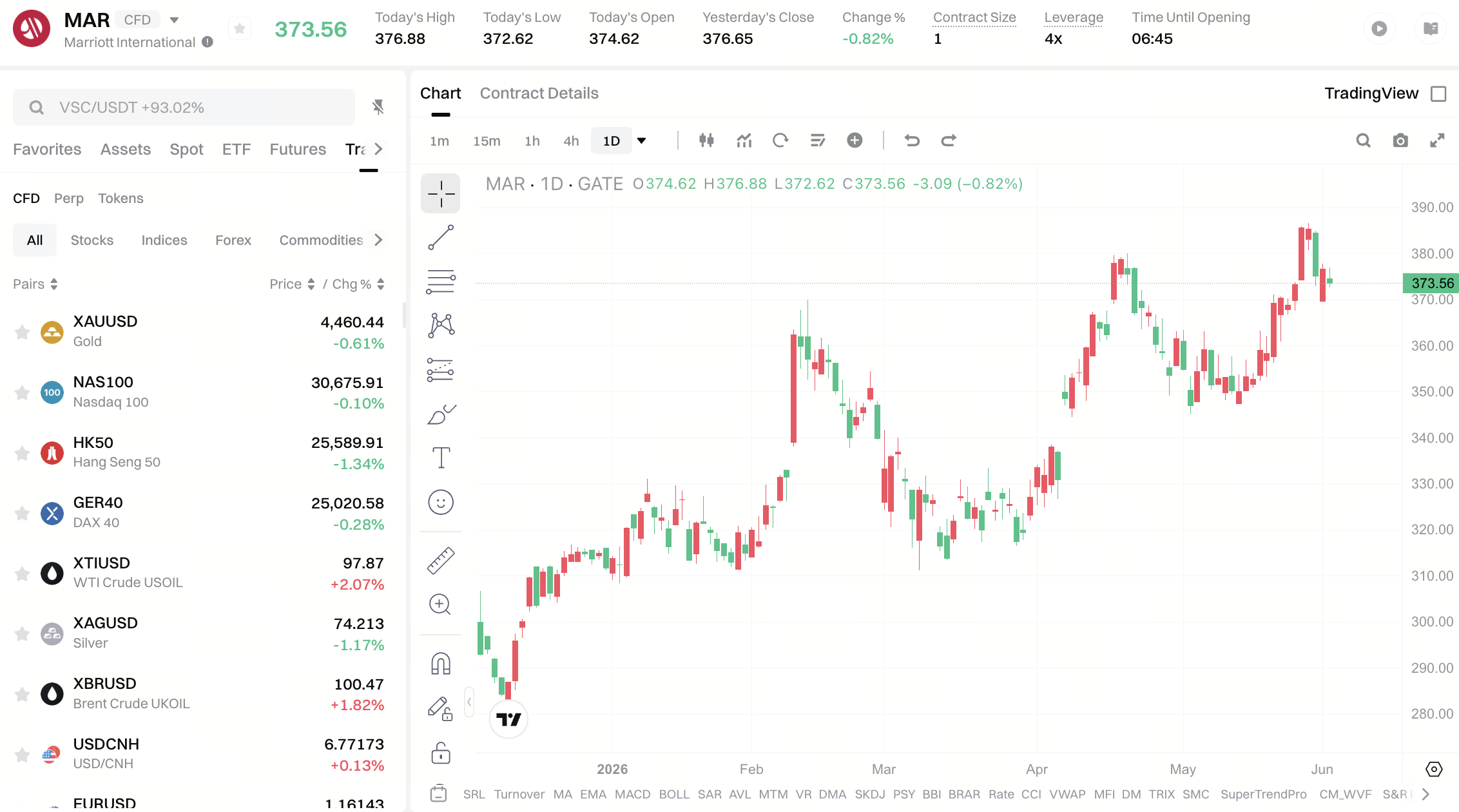
Taking Gate TradFi as an example, in addition to following the digital asset market, users can also track traditional financial assets such as stocks, ETFs, indices, and commodities within the same ecosystem. Some markets also offer Gate CFD products, providing more options for cross-market asset allocation and price observation.
Regardless of how investors choose to participate in the market, they should fully understand the product structure, trading rules, and regulatory requirements in their region.
Marriott International’s Strengths and Limitations
Marriott International’s greatest strengths come from its global brand system and asset-light business model. Through management contracts and brand licensing, Marriott can continue expanding its global business scale while keeping capital investment relatively low. At the same time, its multi-brand matrix helps the company cover different consumer tiers and increase market penetration.
The Marriott Bonvoy membership system further strengthens customer loyalty and creates long-term competitive advantages for the company. Its large membership network and global hotel footprint together form an important moat.
However, Marriott is still affected by cyclical fluctuations in the global travel market. Slower economic growth, lower international travel demand, or sudden public events may all affect hotel occupancy rates and the overall performance of the industry.
In addition, competition from online travel platforms, home-sharing platforms, and other international hotel groups continues to push the industry toward higher service quality and greater operational efficiency.
Conclusion
MAR (Marriott International) is one of the world’s largest hotel management groups. Its business model is built on hotel management, brand licensing, and membership ecosystems. Through an asset-light operating model, a global brand matrix, and the Marriott Bonvoy membership system, Marriott has built a global hotel network covering business travel, leisure travel, and extended-stay markets. In the modern travel industry chain, Marriott is not only a hotel brand operator, but also an important platform connecting consumers, hotel owners, and the global travel market.
FAQs
What kind of company is MAR?
MAR is the ticker symbol for Marriott International. Marriott International is one of the world’s largest hotel management groups, mainly engaged in hotel management, brand licensing, and membership ecosystem operations.
Does Marriott International own all of its hotels?
No. Most Marriott International hotels operate under an asset-light model. Hotel properties are usually owned by independent owners, while Marriott provides brand and management services.
What is Marriott Bonvoy?
Marriott Bonvoy is Marriott International’s global loyalty program. Members can earn points through hotel stays and redeem them for stays and related benefits.
What is the difference between Marriott and Hilton?
Marriott has a broader brand matrix and global hotel network, while Hilton places greater emphasis on its membership system and standardized brand operations.
Who are Marriott International’s main customers?
Marriott International mainly serves several groups, including business travelers, leisure travelers, extended-stay guests, and corporate clients.
What is Marriott International’s core competitive advantage?
Marriott International’s core competitive advantages come from its global brand system, asset-light business model, membership ecosystem, and worldwide hotel operating network.