In 2021, the company was officially renamed Meta Platforms, pivoting its strategic focus from traditional social networking to the "Metaverse + AI + Next-Generation Computing Platforms." This rebranding wasn't just a brand upgrade—it signaled an ambition to transform from an application-layer company into a provider of foundational technology platforms.
Over the past decade, Meta's business model gradually shifted from being "user-growth driven" to "advertising-efficiency driven." By leveraging data scale and AI algorithm optimization, its advertising system has become one of the most efficient digital ad engines globally.

Meta's current business structure consists of three core segments:
- Family of Apps, including Facebook, Instagram, WhatsApp, and Threads. These products form the world's largest social network ecosystem, covering content distribution, instant messaging, and the social media ecosystem.
- Advertising Business, Meta's primary revenue driver. The ad system relies on user behavior data, interest tags, and AI recommendation models to achieve precise targeting and dynamic optimization, enabling advertisers to achieve higher conversion rates at lower costs.
- Reality Labs, responsible for AR/VR hardware and metaverse technology R&D, including the Quest headset series and Ray-Ban Meta smart glasses. Although this segment remains unprofitable, it is viewed as a critical bet on the next computing platform entry point.
How Advertising, AI, and Reality Labs Drive Growth
Meta's growth engine is essentially a "data flywheel": more users → richer data → more accurate AI recommendations → longer user engagement → more ad impressions → higher revenue.
In this system, AI is the key accelerator. By optimizing content ranking and ad matching through machine learning models, Meta continuously improves ad click-through rates (CTR) and conversion rates (CVR).
In recent years, the company has further integrated generative AI into ad creation and delivery, allowing advertisers to automatically generate assets and run multi-variant tests, thereby boosting overall marketing efficiency.
Although Reality Labs is not yet profitable, its work in spatial computing, gesture interaction, and immersive content lays the technical groundwork for future ad formats (e.g., AR scene ads) and virtual social experiences.
AI has become the underlying infrastructure of the digital economy, and Meta must ensure it remains competitive in the next generation of computing platforms. That's why the company continues to invest heavily in data centers, GPU clusters, and distributed training systems.
At the infrastructure level, Meta is building massive AI computing clusters to support its recommendation systems, ad systems, and generative AI model training. These investments directly impact product experience and monetization capabilities.
Moreover, AI infrastructure improves the marginal efficiency of the ad system. For example, more precise user interest modeling can significantly reduce ad waste and improve advertiser ROI, strengthening platform competitiveness.
In the context of an accelerating global AI race, this "infrastructure-first" strategy allows Meta to create a closed loop between model capabilities and product deployment.
Meta is building an open-source AI ecosystem centered around Llama. The Llama model series emphasizes openness and deployability, allowing developers to flexibly use AI capabilities in various environments.
Meta AI, as the user-facing entry point, has been gradually embedded into Facebook, Instagram, WhatsApp, and Messenger, offering chat assistants, content generation, information retrieval, and personalized recommendations.
At the ecosystem level, Meta follows an "open-source model + platform integration" strategy, attracting global developers to participate in model optimization and application development by lowering the barrier to entry. This approach not only accelerates technology diffusion but also expands its ecosystem influence.
AI is also used for internal efficiency improvements, such as content moderation, ad delivery optimization, and user behavior prediction, reducing overall operational costs.
Meta's competitive edge can be understood from three dimensions.
First is scale advantage: its social products reach billions of users worldwide, creating powerful network effects and traffic moats.
Second is data and algorithm capabilities: years of accumulated user behavior data give its recommendation system unmatched precision, making it indispensable in the advertising industry.
Third is cross-platform integration: from social software to AI models to AR/VR hardware, Meta is building a full-stack technology platform.
Compared to other tech giants, Meta's uniqueness lies in its integrated structure of "consumer applications + AI infrastructure + hardware terminals," giving it stronger systemic competitiveness in the AI era.
Despite Meta's strong performance in its AI transformation, investors should consider the following risks.
- Cyclicality of the advertising business. During macroeconomic downturns, corporate ad budgets may shrink, impacting revenue growth.
- Rising AI and infrastructure costs may pressure profit margins in the near term.
- Reality Labs' long-term profitability uncertainty. This business is still in its early stages and lacks a stable business model.
- Regulatory risks remain a significant variable, including data privacy policies, antitrust reviews, and changes in content governance rules, all of which could affect its business model.
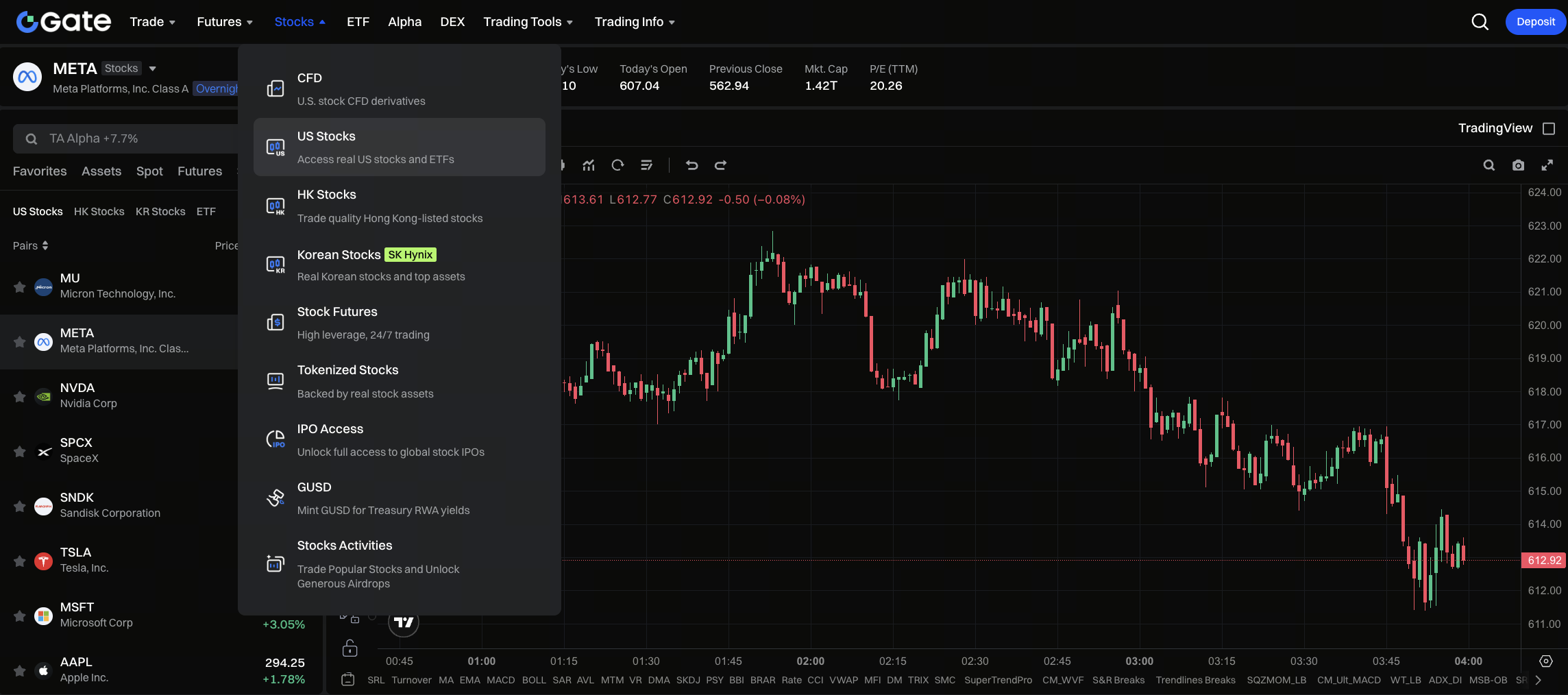
In recent years, the way global capital markets are accessed has undergone structural changes. Services like Gate's stock trading are blurring the lines between traditional securities accounts and crypto asset accounts. According to official information, users on the Gate platform can directly trade U.S. stocks—including popular tech stocks like Meta Platforms (META)—using USDT, without needing to open a separate overseas brokerage account, allowing participation in the price movements of global capital markets.
From a mechanism standpoint, Gate Stocks embeds stock trading into a digital asset account system. Users use USDT as the settlement medium to deposit funds, execute trades, and manage assets all within the same platform. This model effectively lowers the barrier to cross-border investing, allowing crypto users to access multi-market assets such as U.S., Hong Kong, and South Korean stocks while bypassing the complexity of forex conversion and account opening.
For investors looking at large-cap tech stocks like Meta, this new trading channel offers three key benefits:
- Improved capital efficiency—users don't need to move between multiple financial systems.
- More flexible trading hours—some platforms already support extended hours or even 24-hour trading.
- Unified asset allocation—users can manage both crypto and traditional stock assets in a single account.
This convergence is driving further "Crypto + TradFi" integration and accelerating the digital transformation of global investment infrastructure.
However, it's important to note that this trading model does not change the underlying risk profile of the stocks. Meta stock remains subject to macroeconomic conditions, advertising cycles, AI investment pace, and regulatory factors. Platforms like Gate offer optimized access, not a change in risk structure. Investors must still make decisions based on fundamentals and market cycles.
Looking ahead, Meta's strategic focus will center on AI-driven digital ecosystem transformation.
On one front, AI will further optimize the ad system, improving commercial efficiency. On another, generative AI will reshape content creation, shifting the platform from "content distribution" to "content generation + distribution."
Meanwhile, AR/VR and smart glasses have the potential to become the next computing entry point, reinventing social interaction and information access.
As Meta Platforms continues to invest heavily in AI and hardware, its long-term goal is evolving from a "social platform company" into an "AI + digital infrastructure + device ecosystem company."
If this transformation succeeds, Meta's business model will expand from a single reliance on advertising to a multi-layered revenue structure based on technology platforms and hardware ecosystems, unlocking significant long-term growth.
Summary
Meta Platforms is in the midst of a critical transition from a traditional social media giant to an AI-driven technology infrastructure company. Its core growth logic is upgrading from ad optimization to building a full-stack AI ecosystem. Powered by user scale, data capabilities, and AI infrastructure, Meta is creating a comprehensive technology system spanning content, compute, and hardware terminals—positioning it for long-term strategic value in the digital economy.
FAQs
Q1: What is Meta's main source of revenue?
It comes primarily from digital advertising, monetized through platforms like Facebook and Instagram.
Q2: What is the role of Llama?
Llama is Meta's open-source large language model, designed to fuel the AI ecosystem and enable developer applications.
Q3: Is Reality Labs profitable yet?
No, it is still in the investment phase, focused on AR/VR and smart hardware R&D.
Q4: Why is Meta investing so heavily in AI?
AI improves ad efficiency, optimizes content recommendations, and drives innovation in new product formats.
Q5: What is Meta's long-term growth logic?
A threefold ecosystem expansion combining AI, social networks, and smart hardware.