Metaplex (MPLX) Fundamentals and Ecosystem Positioning provides a comprehensive overview of Metaplex within Solana’s asset infrastructure. Metaplex Core, in particular, focuses on the foundational mechanisms for defining, extending, and governing asset objects.
When developers transform on-chain assets from “simple transferable units” into “objects with rules, permissions, and composable behaviors,” the distinctions between Core and traditional NFT/Token creation models directly affect issuance costs, scalability, and ongoing maintenance complexity.
This distinction also serves as the basis for comparing Metaplex to other Solana asset issuance frameworks.
Metaplex Core represents a standardized asset layer within the Solana ecosystem. Its primary goal isn’t to replace all Token Programs but to offer a unified object model for on-chain assets that require advanced behavioral expression.
Traditional fungible tokens emphasize balance tracking and transfer semantics, while early NFT approaches typically relied on “minting + metadata + external rules” to create a complete asset experience. Core consolidates these fragmented modules into extensible asset objects, so creation, configuration, and governance all occur within a single framework.
From an architectural perspective, Core functions more as an “asset protocol layer” than a single minting script. Developers define not only the unit to be held but also who can update the asset, when it can be frozen, and whether additional features can be added.
How Do Traditional NFT/Token Creation Methods Typically Work?
Traditional Token creation methods focus on “issue first, add capabilities later.” For fungible assets, this process usually involves creating a Mint, setting precision and supply, distributing to accounts, and using additional programs for complex permissions.
Traditional NFT approaches begin with basic minting, then use metadata accounts to describe the asset’s name, scarcity, and links to external resources. If more rules are needed, extra programs or application-layer constraints are often required.
This model is efficient for straightforward issuance, but when assets require dynamic permissions, composable behaviors, or continuous iteration, development teams can face challenges with “multi-program dependencies, scattered rules, and inconsistent upgrade paths.”
| Traditional Path Module |
Main Responsibility |
Common Limitations |
| Token Mint/Account |
Issuance, bookkeeping, transfer |
Limited behavioral semantics, complex logic requires external programs |
| Metadata Layer |
Describes asset information and display properties |
Limited rule expressiveness, dependent on external conventions |
| Custom Programs |
Manages permissions, freezing, burning, etc. |
High integration complexity, greater audit and upgrade costs |
The table above illustrates a typical scenario where “modules exist but are fragmented”: assets can be created, but business rules aren’t inherently unified, and later expansions often require new contracts and migration processes.
Core’s primary distinction is that it “defines asset object capabilities first, then executes issuance,” rather than creating the asset first and retrofitting rules. Through a plugin architecture, it embeds permissions, transfer restrictions, attribute extensions, and other features directly into the asset’s lifecycle.
Traditional approaches often place permission controls in separate programs or operational workflows, while Core allows composable rules to be declared at the asset level, making on-chain semantics around “who can update, which states are mutable, and when transfers are allowed” much more explicit.
From an engineering standpoint, Core reduces hidden assumptions in cross-program collaboration, lowering the risk of “front-end constraints diverging from on-chain rules.”
| Comparison Dimension |
Metaplex Core |
Traditional NFT/Token Creation |
| Asset Model |
Object-oriented, extensible, plugin-ready |
Accounting unit + external rules |
| Permission Governance |
Asset-native permissions and orchestratable policies |
Heavily reliant on external programs or offline processes |
| Lifecycle Management |
Supports state evolution and rule predefinition |
Supplemental rules and application-layer fallbacks post-issuance |
| Expansion Cost |
Standardized capability composition |
New requirements often require new programs and migrations |
| Development Consistency |
Unified source for rules and asset definitions |
Rules dispersed across multiple implementation layers |
This doesn’t render traditional models obsolete. For purely fungible settlements or scenarios with stable, rarely changing rules, traditional approaches remain simple, mature, and widely supported. Core is designed to address complex asset behaviors and long-term governance evolution.
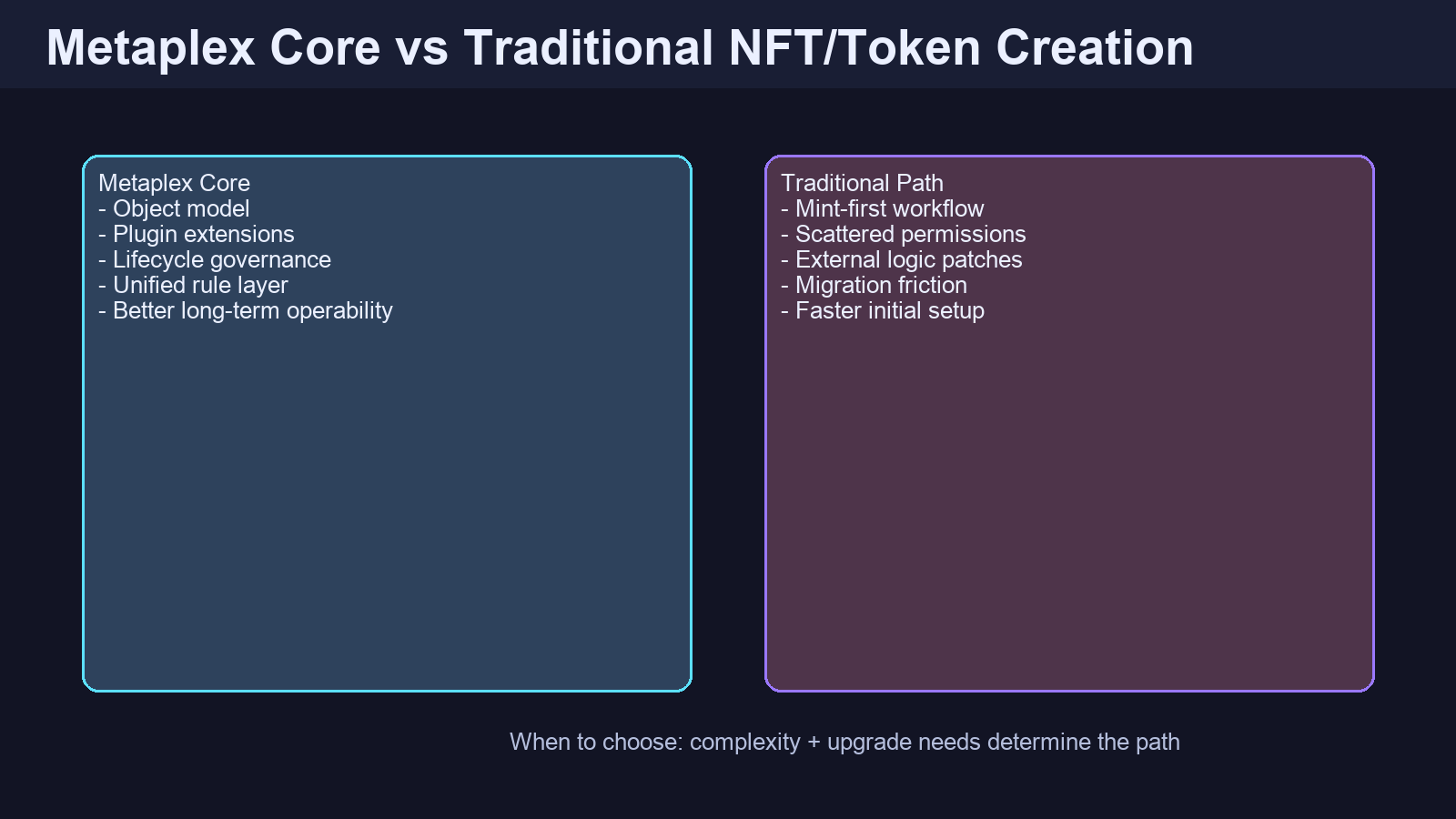
Comparison of Metaplex Core and traditional NFT/Token creation models in asset modeling, permission governance, and expansion cost.
What Are the Lifecycle and Permission Model Advantages of Core?
Core’s lifecycle advantage lies in the principle of “governance at creation”: key rules are bound at the moment of asset creation, with all future updates managed within the same object.
Traditional models often split permissions among minting rights, metadata updates, and application-layer controls, requiring operations teams to maintain multiple boundaries. Core centralizes key control surfaces, reducing governance risks from permission drift.
In real-world projects, this centralized model is ideal for assets that need to unlock features in phases—such as initially restricting transfers, then opening new permissions after community governance approval.
| Lifecycle Stage |
Core Approach |
Traditional Approach |
| Creation Stage |
Declare asset capabilities and permission rules simultaneously |
Mint first, then gradually add rules |
| Operation Stage |
Manage changes through standardized extensions |
Decentralized updates via multiple programs |
| Iteration Stage |
Evolve strategies via object model upgrades |
Often requires migrations or compatibility layers |
This centralized approach simplifies long-term maintenance: audit scopes are clearer, and state changes are easier to track.
Core’s benefits are most evident in “total engineering cost for complex requirements,” not in “lowest one-time minting cost.” For basic token issuance, traditional methods have fewer steps and abundant resources, making them quicker to adopt.
When projects require layered permissions, composable features, or ongoing iteration, Core’s unified model minimizes cross-program integration, stabilizing testing and audit boundaries.
On the tooling side, Core also makes it easier to map asset rules to SDKs and indexers, reducing the risk of inconsistent state semantics between front-end and back-end.
It’s important to note that Core doesn’t automatically lower all performance overhead. Its plugin and extensibility features increase expressiveness but require teams to clearly define the minimum necessary rules at the design stage to avoid unnecessary complexity.
Therefore, when evaluating Core, developers should focus on “total lifecycle cost,” not just the on-chain fee for a single minting transaction.
Core is best suited for three scenarios:
First, assets that require ongoing governance evolution, such as projects with changing permissions over time; second, applications that need to layer multiple behaviors onto the same asset; third, medium to large projects that want to use a standardized object model to reduce cross-team friction.
For projects needing only basic transfers and simple issuance, the traditional Token Program route may be more straightforward, especially when resources are limited or timelines are tight.
Limitations and risks must also be considered. Core’s richer model can lead to over-engineered rules if requirements aren’t properly abstracted.
Unclear governance processes can make plugins and permission configurations unnecessarily complex.
Moreover, any asset framework is constrained by the maturity of ecosystem tools, audit quality, and engineering discipline—Core cannot replace robust security practices.
Summary
Metaplex Core’s core value lies in transforming on-chain assets from “accounting units” into “governable, extensible, and evolvable objects.” Compared to traditional NFT/Token creation, Core prioritizes rule predefinition and object-native capabilities, making it ideal for complex business logic and long-term evolution.
Traditional models remain efficient and mature for simple issuance tasks, so the best approach is not to choose one over the other, but to match the solution to asset complexity, governance needs, and team capabilities.
FAQ
Will Metaplex Core Completely Replace Traditional SPL Token or NFT Creation Methods?
No. Traditional methods are still efficient and mature for basic issuance and simple transfer scenarios. Core mainly addresses complex asset rule expression and lifecycle governance, and the two approaches solve different problems.
What Is the Main Mechanism Difference Between Metaplex Core and the Traditional NFT Metadata Model?
The biggest difference is where rules are defined. Traditional models place behavioral rules in external programs or the application layer, while Core defines extensible capabilities and permission boundaries at the asset object creation stage, keeping rules and the asset itself unified.
What Types of Projects Should Prioritize Metaplex Core?
Projects that require ongoing permission iteration, want to layer features on the same asset, and need long-term governance traceability are best suited for Core. Lightweight projects focused on basic issuance can start with the traditional model.
Is Metaplex Core Always Cheaper or Faster?
Not always. Core’s strengths are in overall engineering efficiency and consistency for complex needs, not in minimizing one-time costs. For simple scenarios, traditional methods may be faster; for complex scenarios, Core often reduces future rework.
What Are the Most Important Criteria When Choosing Between Core and Traditional Models?
Key criteria include the complexity of asset rules, whether permissions will change dynamically, the team’s object modeling capability, and the frequency of future upgrades. If these factors are high, Core’s structured approach delivers greater benefits.