Why Real Estate Tokenization Needs New Data Infrastructure
In recent years, RWA (Real World Assets) has become a major focus in blockchain, with real estate widely seen as one of the most promising asset classes for tokenization. By leveraging blockchain technology, real estate can be divided into smaller units, boosting liquidity and lowering the barrier to entry for investors.
But tokenizing physical property is only the first step. For institutional investors, the real question is: How can we verify that the tokens actually represent real, existing assets? Can their value be continuously audited? Can relevant data be updated in real time? Without clear answers, even successfully tokenized assets will struggle to earn market trust. That's why the next frontier in real estate tokenization is shifting from putting assets on-chain to putting data on-chain.
What Is a NAV Oracle?
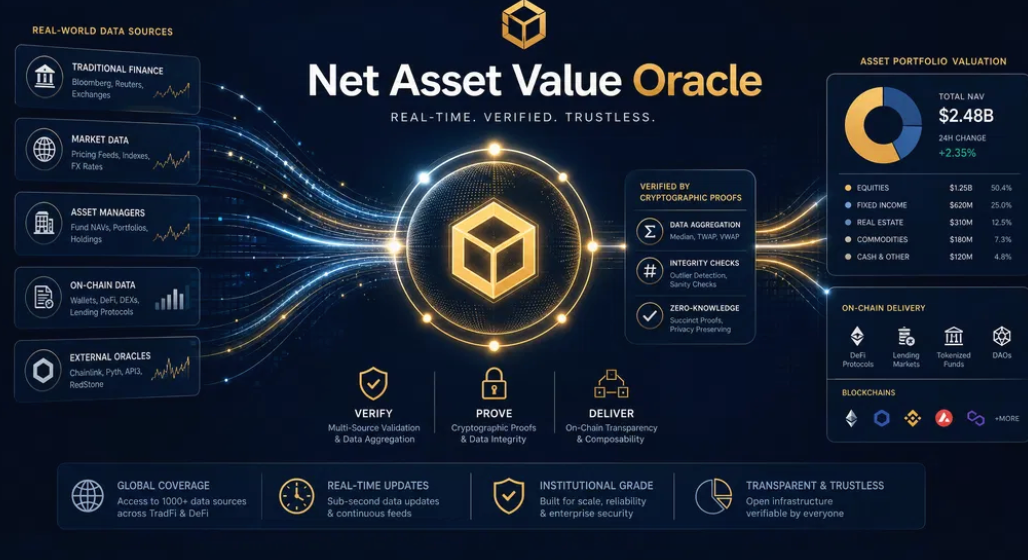
NAV Oracle stands for Net Asset Value Oracle. In traditional finance, NAV measures the actual value of a fund or portfolio. In blockchain, an Oracle is a data bridge that brings off-chain information on-chain. So a NAV Oracle is essentially a system designed to sync asset valuation data. Its job isn't to manage assets but to continuously collect, verify, and update asset-related information and relay it to the blockchain. For real estate, a NAV Oracle acts as the vital link between the physical world and on-chain finance.
What's Wrong with Traditional Real Estate Valuation?
Real estate is inherently a data-fragmented asset class. The complete profile of a single building is often scattered across property managers, insurers, banks, government agencies, and third-party appraisers. When investors want to assess an asset's true condition, they typically face a tedious process of gathering and verifying data from multiple sources. Beyond the time drain, these sources often have inconsistent update cycles, missing information, or verification challenges. That's why large real estate deals frequently require heavy spending on due diligence and audits. For an on-chain market that aims to be efficient, this legacy model is clearly inadequate.
How Does a NAV Oracle Work?
A NAV Oracle's core mission is to consolidate fragmented data from different systems into a single, verifiable source. When any real estate data changes—say, rental income is adjusted, a building undergoes maintenance, or asset value shifts—the system collects the relevant data, verifies it, and then pushes it to the blockchain through the Oracle mechanism.
In an ideal setup, investors no longer have to wait for periodic reports to stay informed. Instead, they can monitor asset status in near real time. This approach enables on-chain assets to operate with a live valuation system rather than relying on stale financial data from months ago.
How Do Digital Twins and NAV Oracles Relate?
Digital twin technology has recently made inroads into real estate. A digital twin is a complete digital replica of a physical building—not just its appearance, but also equipment conditions, energy efficiency, maintenance logs, operational metrics, and compliance records. When these datasets are updated continuously, they form a dynamic asset data system.
The NAV Oracle then transforms that raw data into a format usable by financial markets. In short: the digital twin supplies the data; the NAV Oracle verifies and synchronizes it. Together, they form the essential backbone for real estate tokenization.
Why Do Institutional Investors Care So Much About Data Credibility?
Large institutions base their investment decisions on verifiable data. If the source of asset information is opaque, even strong returns won't earn long-term trust—especially when real estate is turned into on-chain tokens, widening the gap between investors and the physical asset. In that context, transparency becomes even more critical than tokenization itself. That's why more and more RWA platforms are prioritizing data verification, asset monitoring, and real-time valuation over simply minting tokens. And it's a key reason the NAV Oracle has gained market traction.
What Does a NAV Oracle Mean for the RWA Market?
As blockchain finance evolves toward institutional-grade markets, demand for information quality keeps rising. The future RWA market may not just be about tokenizing assets—it's about building a complete on-chain asset management system. Under such a framework, asset data, valuations, operational metrics, and financial reports can all be continuously synced and updated. The NAV Oracle acts as the critical bridge that makes this system work. It transforms blockchain from a mere ownership ledger into a platform that carries a continuous stream of real-world asset information.
Summary
Real estate tokenization has moved beyond simply issuing tokens into a new phase: building trustworthy data infrastructure. The NAV Oracle emerged precisely to solve problems like fragmented asset data, slow valuation updates, and hard-to-verify information. By combining oracle technology with digital twin systems, the real estate market can create a more transparent, real-time, and reliable on-chain financial environment. As the RWA market grows, data credibility will likely be the deciding factor in whether asset tokenization can scale—and the NAV Oracle will play an increasingly central role in that journey.







