Real-world asset tokenization is rapidly emerging as a major trend in the blockchain industry. As more treasury bonds, real estate, private credit, and commodity assets enter the on-chain market, the industry's focus has shifted from "how to get assets on-chain" to "how to generate sustainable yields."
Early RWA projects primarily concentrated on token issuance and ownership mapping—but once these assets were issued on-chain, they often lacked further financial use cases. The real challenge for RWA ecosystem growth is enabling the cash flows from real-world assets to flow on-chain and spark new financial activity.
What Is Nest?
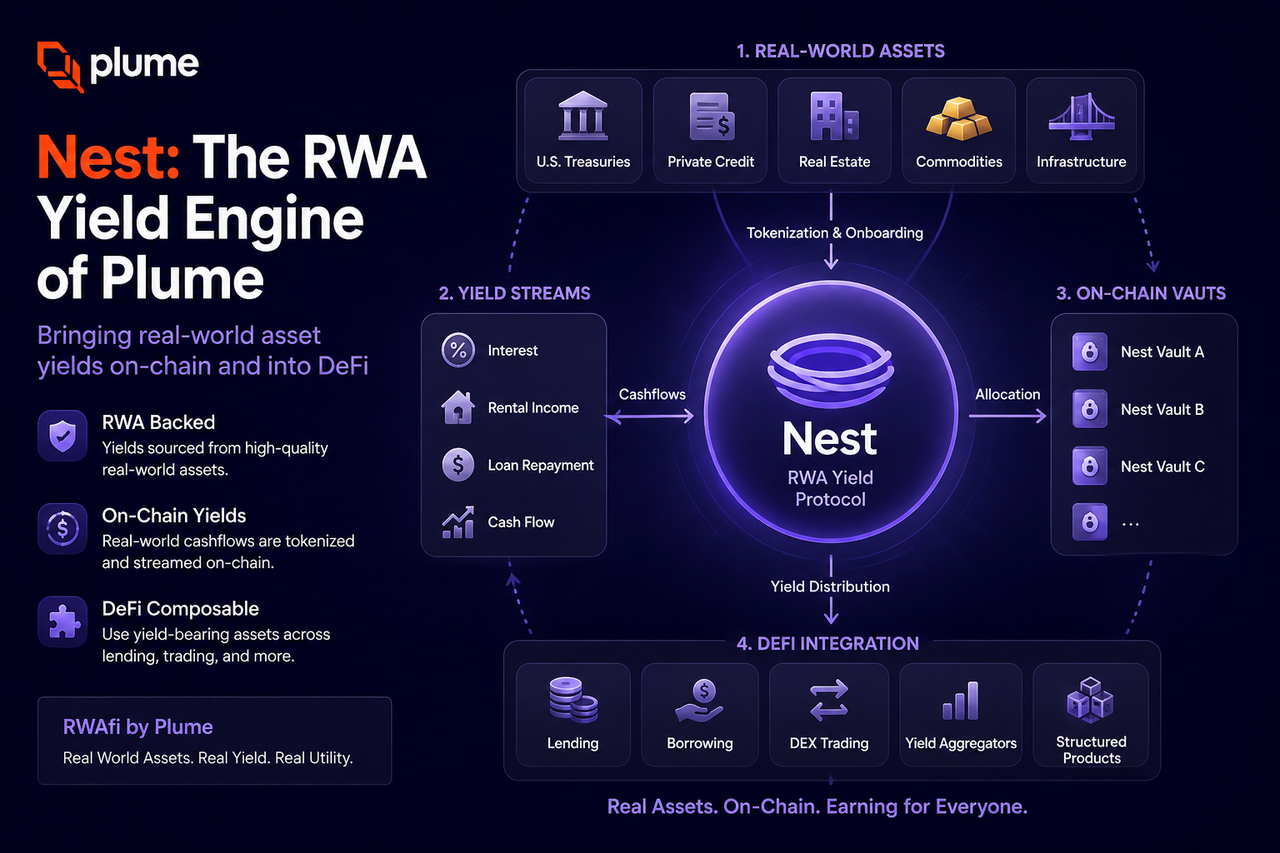
Nest is an on-chain protocol purpose-built for managing real-world asset yields. Built on Plume, Nest uses standardized yield product designs and smart contract management to bring cash flows from real-world assets into the blockchain financial market.
Nest does not create yields on its own. Instead, it sources yields from the economic activities of the underlying real-world assets—such as treasury interest, corporate loan interest, rental income from real estate, or infrastructure project revenue.
Nest's core value lies in converting these traditional income streams into programmable, tradable, and composable on-chain financial products.
How Does Nest Work?
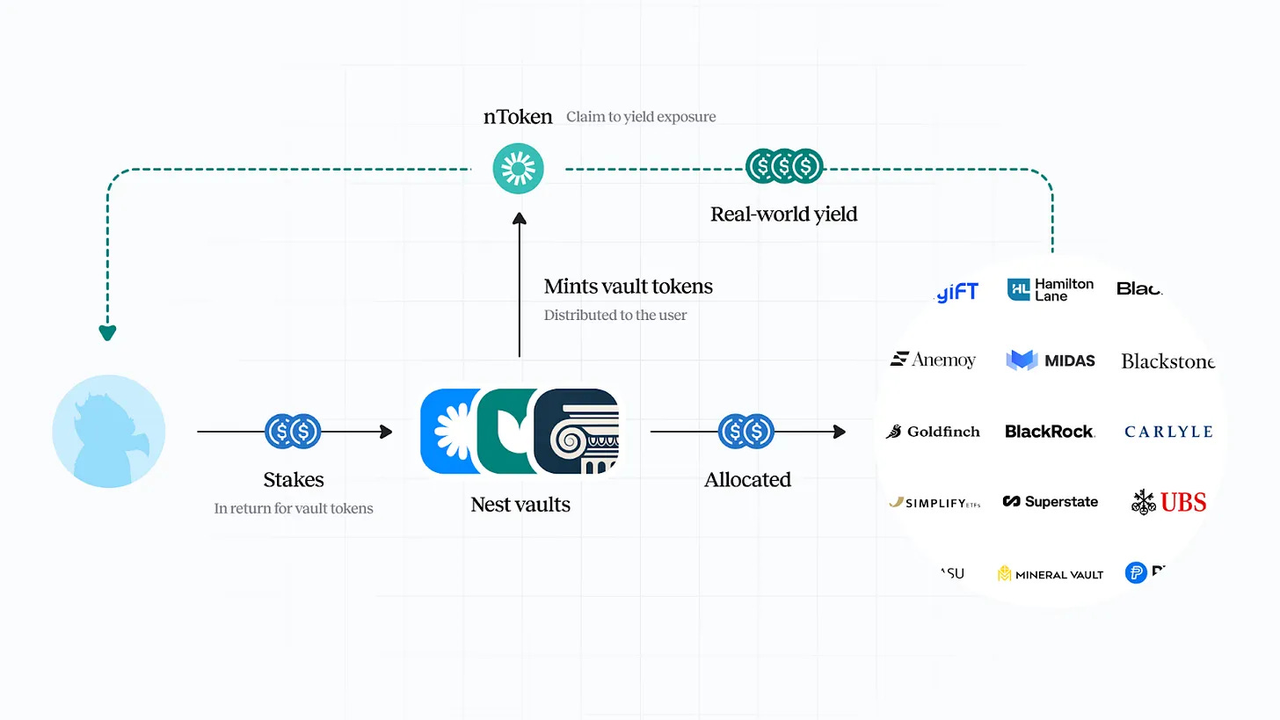
Nest operates through a multi-step process:
- Real-world assets are tokenized and enter the Plume network.
- Asset issuers connect their assets to the Nest yield market.
- Nest creates dedicated yield pools or yield products based on the asset type.
- As assets generate cash flows, yield data is synchronized on-chain.
- Smart contracts automatically compute and distribute yields according to predefined rules.
- Yields enter user accounts as on-chain assets and can then be used in other DeFi applications.
This completes a full loop that brings real-world asset yields into the on-chain financial market.
What Are Nest's Yield Sources?
Nest's yields come from the real-world assets themselves—not from incentive tokens issued by the protocol.
Common sources include:
Treasury Yields
Fixed interest income from short-term government bonds and sovereign bonds.
Private Credit Yields
Interest returns from corporate financing and lending.
Real Estate Yields
Rental income from commercial and residential properties.
Infrastructure Yields
Cash flows from energy, telecom, and public utility projects.
Commodity Finance Yields
Income from commodity trade and supply chain finance.
Nest maps these yields onto the blockchain using a standardized framework.
What Is Nest Vault?
The Vault is a core component of the Nest yield system.
Think of it as a dedicated fund pool that manages real-world asset yields. Once assets enter a Vault, their yields are aggregated and distributed based on preset rules.
Key functions of Vault include:
- Aggregates yields from diverse real-world assets
- Simplifies how users participate
- Automates yield settlement
- Boosts asset utilization efficiency
With the Vault mechanism, users don't need to manage the underlying assets directly—they still receive the corresponding yield rights.
How Does Nest Manage Risk?
Real-world assets come with a more complex risk profile than crypto assets. Nest addresses this with multiple layers of risk control:
Asset Screening
Only pre-audited real-world assets are allowed into the protocol.
Third-Party Custody
Real-world assets are typically held by independent custodians.
Ongoing Disclosure
Asset performance and yield data are updated regularly.
Smart Contract Automation
Reduces operational risks from manual processes.
Compliance Checks
Both assets and participants must meet regulatory standards.
Together, these measures boost the transparency and credibility of real-world asset yield products.
Nest vs. Traditional Fixed-Income Products
| Dimension |
Nest |
Traditional Fixed-Income |
| Yield Source |
Real-world asset cash flow |
Real-world asset cash flow |
| Management |
Smart contracts |
Financial institutions |
| Settlement |
On-chain, automated |
Manual or centralized systems |
| Composability |
Full DeFi integration |
Low |
| Liquidity |
On-chain market |
Traditional market |
| Transparency |
Verifiable on-chain |
Limited disclosure |
Nest doesn't change where yields come from—it changes how they flow and are managed within the financial system.
Nest's Role in the RWAfi Ecosystem
RWAfi aims to make real-world assets a core part of on-chain finance. But simply tokenizing assets isn't enough. Assets need liquidity, yield markets, and the ability to interoperate with other financial protocols.
That's exactly where Nest fits in.
By funneling real-world asset yields into DeFi, Nest enables these assets to participate in lending, liquidity management, yield aggregation, and asset allocation—driving true integration into the on-chain financial ecosystem.
Many RWA projects stop at tokenization. Nest goes further—focusing on how assets perform and generate yield after they're on-chain.
| Dimension |
Nest |
Traditional RWA Platforms |
| Core Goal |
Build a yield market |
Issue assets |
| Main Focus |
Yield liquidity |
Asset mapping |
| DeFi Integration |
Deep support |
Limited support |
| Financial Composability |
High |
Low |
| RWAfi Alignment |
Strong |
Weak |
This distinction makes Nest a critical piece of Plume's RWAfi strategy.
Summary
As the flagship RWA yield protocol in the Plume ecosystem, Nest connects real-world assets with on-chain yield markets. Through standardized yield management, Vault structures, and smart contract-driven distribution, Nest brings cash flows from treasuries, private credit, real estate, and more into the blockchain financial ecosystem.
Unlike traditional RWA platforms that focus on issuance, Nest emphasizes yield circulation and composability after assets are on-chain. It's a key part of the RWAfi architecture, turning static registered assets into dynamic financial assets and providing the infrastructure for real-world assets to participate in DeFi.
FAQs
Where does Nest's yield come from?
Nest's yield originates from the real-world assets themselves—including treasury interest, private credit returns, rental income, and infrastructure cash flows—not from protocol-created rewards.
What is the relationship between Nest and Plume?
Plume provides the infrastructure for tokenizing real-world assets, while Nest manages the yields those assets generate and brings them into DeFi. Together they form the RWAfi ecosystem.
What is Nest Vault?
Nest Vault is an on-chain fund pool that aggregates, settles, and distributes yields from real-world assets, making it easy for users to tap into the real-world asset yield market.
Is Nest a DeFi protocol?
Nest is a yield protocol that bridges real-world assets with the DeFi market. Its core function is to standardize real-world asset yields and weave them into the on-chain financial ecosystem.







