Pons (PONS) is a decentralized launch and trading interface on Robinhood Chain (Chain ID 4663) for fixed-supply tokens. The platform does not custody funds; each trade requires wallet approval. At launch, one transaction deploys a 1 billion-token supply and a WETH Uniswap V3 pool with locked liquidity—no bonding curve and no graduation pool migration.
Fixed supply and pool-at-launch respond to the common bonding-curve path where tokens trade on a curve first and liquidity migrates later. On Pons, users trade in the same Uniswap V3 pool from creation, and Graduation only marks whether paired WETH hit the default 4.2 ETH threshold—not a quality endorsement. Pool fees split at launch snapshot (Active factory commonly 70% creator / 30% protocol); protocol share may buy back and burn PONS, without a price guarantee. Verify identity via token, factory, and pool addresses—names and symbols can be spoofed.
From a digital-asset perspective, Pons compresses deployment, liquidity locking, launch protection, and fee splits into a verifiable on-chain flow useful when comparing launch mechanics across the Robinhood Chain ecosystem.

What Is Pons? How Does It Relate to Robinhood Chain?
Pons serves as a launch and trading interface on Robinhood Chain, connecting user wallets to on-chain contracts: token creation, buying and selling, and fee settlement all occur on-chain, and the interface itself does not hold assets. The underlying network is Robinhood Chain (Chain ID 4663), native asset is ETH, quote asset is WETH, and the underlying DEX is Uniswap V3.
| Item |
Detail |
| Network |
Robinhood Chain (Chain ID 4663) |
| Native asset |
ETH |
| Quote asset |
WETH |
| Underlying DEX |
Uniswap V3 |
| Active factory |
0xA5aAb3F0c6EeadF30Ef1D3Eb997108E976351feB (start block 8991118) |
The table summarizes the network and contract entry points Pons relies on. The Active factory applies current creator/protocol split rules from the specified start block; an earlier legacy factory retains historical split ratios—actual terms depend on the snapshot at launch. When verifying an asset, token contract address and pool address matter; names and symbols can be spoofed, so interface display alone cannot confirm identity. Users building a verification checklist should compare on-chain contracts and addresses carefully—treating a displayed ticker or symbol as identity is not enough for any project on Robinhood Chain.
How Does Token Launch Work on Pons? Is There a Bonding Curve?
Pons does not price tokens through a bonding curve and does not migrate liquidity after graduation. At creation, a single transaction deploys both the token and a WETH trading pool: fixed supply is 1,000,000,000 (1e9); pool fee is 1% (fee parameter 10000); launch fee is 0.0005 ETH. Liquidity locks automatically at creation, and trading occurs in that Uniswap V3 pool.
For the first 2 blocks after launch, Launch protection applies: only the creator may complete the initial buy in the launch block; during the protection window, each wallet may hold at most 5% of supply and buy up to 5.5%; sells and transfers are unrestricted. After the window closes, buy and holding limits lift. Protection shortens the early concentrated-buy window but does not remove information asymmetry or spoofed-asset risk.
From Create through tradability to Graduate when conditions are met, the full path can be traced step by step in Create → Trade → Graduate, checking both contract-side and interface-side behavior. That Create → Trade → Graduate process is the same for every project: users follow one deployment flow, then trade in the pool that those contracts and addresses define—without a separate bonding-curve building stage.
| Parameter |
Value / rule |
| Token supply |
1,000,000,000 (fixed) |
| Pool fee |
1% (10000) |
| Launch fee |
0.0005 ETH |
| Launch protection |
First 2 blocks; per-wallet holding ≤5%, buy ≤5.5% |
| Bonding curve |
None |
| Liquidity migration |
None |
The table summarizes key constraints under the pool-at-launch model. Compared with a curve-then-migrate path, price discovery begins immediately in a locked Uniswap V3 pool, and liquidity structure is fixed at launch.
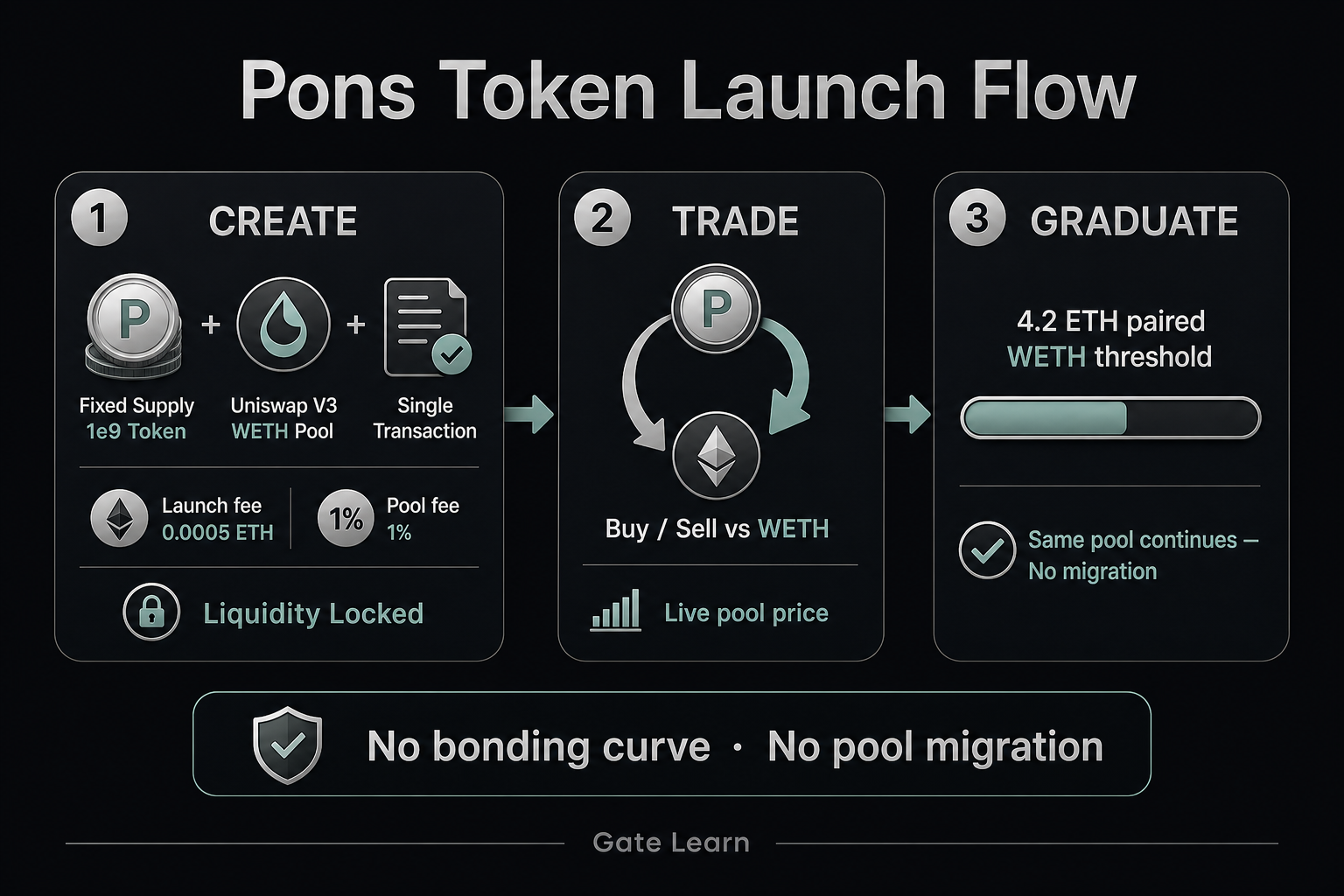 Figure 1. Pons launch path: Create deploys token and WETH pool, Trade occurs in the same pool, Graduate marks threshold without pool migration.
What Does Graduation Mean? Does Trading Move to a New Pool After Graduation?
Graduation means paired WETH in the locked liquidity pool reaches a set threshold. The default threshold is 4.2 ETH; once reached, the token status marks as graduated, but trading continues in the same Uniswap V3 pool—there is no new pool and no bonding-curve-style migration.
Graduation only describes whether pool WETH has hit the threshold; it is not a signal of project quality, compliance, or security. Non-graduated tokens trade in the same pool; graduation changes the status label and threshold progress, not the pool contract itself. A progress bar near 100% means paired principal is approaching the threshold—it does not alter pool fee, lock status, or quote-asset structure. For builders shipping a project on Pons, Graduation remains a liquidity-threshold label—not a marketing milestone.
When verifying Graduation, three items can be separated: whether the threshold was reached, whether trading remains in the same pool, and whether interface display matches the on-chain pool address. The first two follow from factory and pool state; the third is presentation-layer—spoofed interfaces may show incorrect progress or wrong tokens. Users evaluating a project should therefore re-check contracts and addresses after any status change, not rely on a ticker label alone.
What Role Does PONS Play? How Do Fees and Buyback-Burn Work?
PONS is the ecosystem native token; reference contract address is 0x39dBED3a2bd333467115dE45665cC57F813C4571. Pool fees from trading allocate per the split ratio snapshotted at launch: under the Active factory (from block 8991118), creator 70% and protocol 30%; under the legacy factory (from block 8600612), creator 90% and protocol 10%. Split ratios lock at launch and do not retroactively change for existing tokens when factory rules update. Users tracking a project’s fee process should confirm which factory contracts and locker addresses were bound at launch—not assume every ticker inherits the latest global rule.
A portion of protocol fees may buy PONS and send it to a burn address. Directionally, roughly 80% of protocol fees may fund buyback and roughly 20% operations; burn itself does not guarantee price appreciation. When reading burn-adjusted market cap, distinguish full-supply basis from circulating supply after burns. Fee split and buyback-burn further breaks down creator share, protocol share, and burn paths.
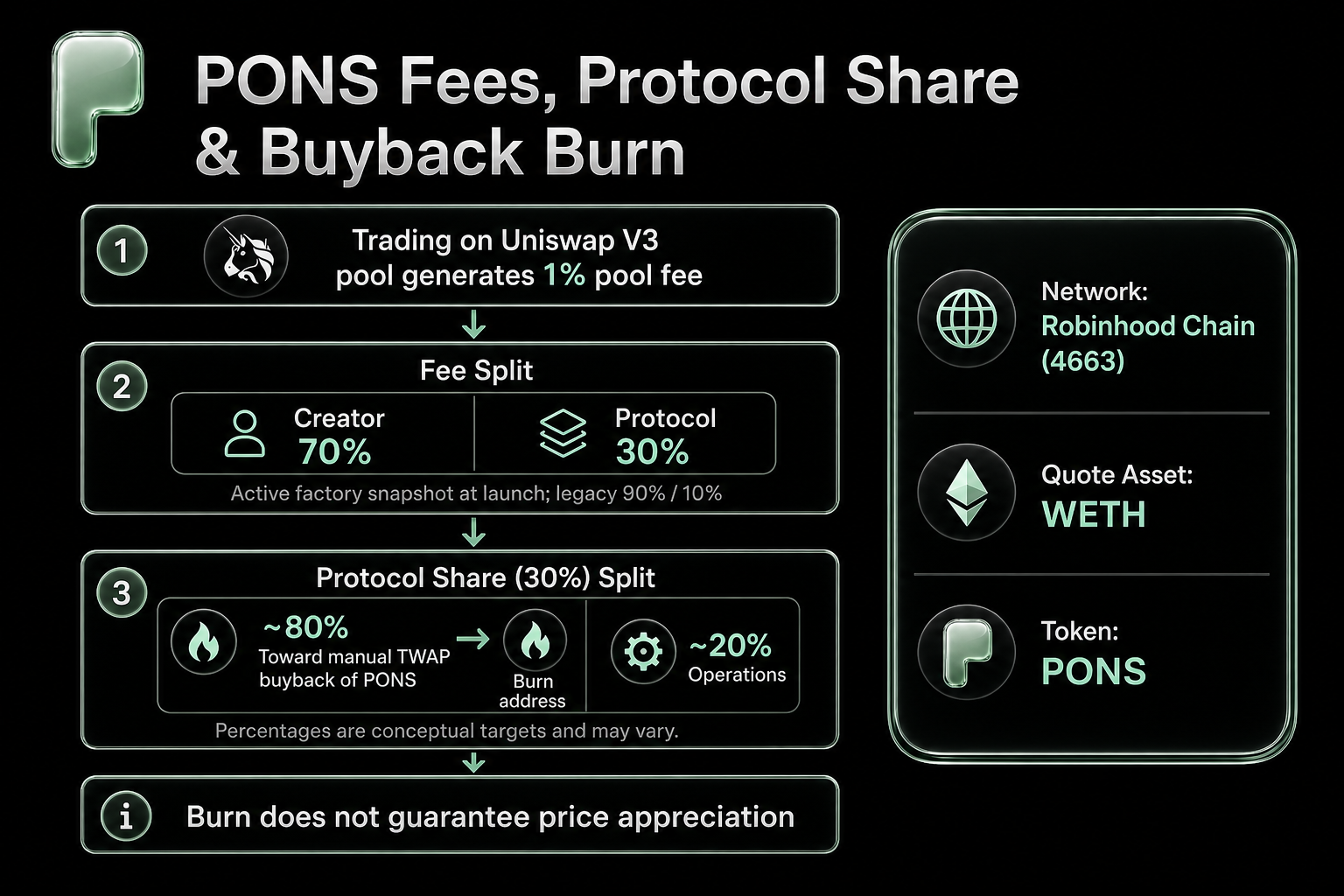 Figure 2. Pool fees split between creator and protocol; protocol share may buy back PONS and send to a burn address.
How Does Pons Differ From Bonding Curve Launchpads?
Bonding curve launchpads commonly follow: tokens trade on a curve first, then liquidity migrates to a DEX pool when conditions are met. Pons deploys a fixed-supply token and WETH Uniswap V3 pool at creation—no curve phase, no graduation migration. Pons vs bonding curve launchpad compares pool-at-launch versus curve-then-migrate across pricing, liquidity, and graduation meaning.
| Dimension |
Pons |
Typical bonding curve launchpad |
| Launch form |
Direct Uniswap V3 pool deployment |
Curve trading first |
| Supply |
Fixed 1e9 |
Often minted/released along curve |
| Graduation |
WETH threshold; same-pool trading continues |
Often includes liquidity migration |
| Quote asset |
WETH |
Varies by platform (e.g., native SOL) |
| Custody |
Non-custodial; wallet approves each trade |
Mostly non-custodial interfaces; implementations vary |
The comparison shows that both surface as launch plus trade, but when liquidity enters the DEX, whether graduation swaps pools, and how supply is determined change the on-chain paths and risk checks users must verify. Platforms such as pump.fun illustrate curve-then-migrate structure; thresholds and target DEX differ by platform and should not be extrapolated to all curve launchpads. Builders comparing paths for a project should map those differences before building go-to-market claims around any single launchpad.
What Are the Advantages and Risks of Launching or Trading on Pons?
Mechanism-level advantages include: launch enters a locked Uniswap V3 pool with transparent structure; no bonding curve or migration steps shortens the path; Launch protection limits concentrated early buying; fee splits snapshot at launch for verifiable rules; the platform does not custody funds—trades require wallet approval.
Structural limitations include: ecosystem dependence on Robinhood Chain and WETH quote depth; Graduation is a threshold label only and cannot replace independent review of contracts, liquidity, and issuers; protocol buyback and burn are not price commitments; launch parameters (fixed supply, pool fee, quote asset) follow platform conventions—creators cannot rewrite the same interface into a bonding-curve path. Building a risk process for users means checking contracts and addresses first, then reading ticker and status labels only as secondary display fields.
| Type |
Primary sources |
What to watch |
| Contract and factory risk |
Factory, pool, lock contracts |
Verify Active / legacy addresses and token contract |
| Information and spoofing risk |
Same-name symbols, phishing interfaces |
Rely on contract address and official entry points |
| Liquidity and slippage |
Thin pools, large trades |
Quotes, price impact, and slippage tolerance |
| Status misread |
Graduation / buyback-burn |
Threshold labels and burns are not quality or price guarantees |
Additional risks include information asymmetry on newly launched tokens and operational risks tied to network and cross-asset bridging. Before launching or trading, verify assets against official sources and on-chain addresses—do not treat status labels as safety guarantees. For users building or reviewing any project, the same process applies: confirm contracts and addresses, then treat ticker display as secondary.
Summary
Pons on Robinhood Chain provides a fixed-supply token launch and trading interface: creation deploys a token and WETH Uniswap V3 pool with no bonding curve and no pool migration; Graduation marks whether WETH reached the default 4.2 ETH threshold while trading stays in the same pool. PONS connects to fee splits and protocol buyback-burn, but burn does not guarantee price performance. Understanding pool-at-launch, launch protection, and fee snapshots supports objective comparison with other launch paths. Users comparing projects should keep the same verification process—contracts, addresses, and ticker display—across every launchpad style.
FAQ
What is Pons (PONS)?
Pons is a decentralized interface on Robinhood Chain for launching and trading tokens; it does not custody user funds, and each transaction requires wallet approval. PONS is the ecosystem native token; the product interface is often written as pons, while Pons refers to the product in narrative. Users verifying a project should still resolve identity via contracts and addresses, not the displayed ticker alone.
How are tokens launched on Pons? Is there a bonding curve?
Launch deploys a fixed-supply (1 billion) token and WETH Uniswap V3 pool in a single transaction with 1% pool fee and 0.0005 ETH launch fee; liquidity locks automatically. Pons does not use a bonding curve and does not migrate liquidity after graduation.
What does Graduation mean on Pons? Does trading move to another pool?
Graduation means paired WETH in the locked pool reaches the threshold (default 4.2 ETH). Trading continues in the same Uniswap V3 pool—no pool swap; graduation is not a quality or security signal.
What is PONS used for? Do fees buy back and burn?
PONS is the ecosystem native token. Pool fees split between creator and protocol per launch-time snapshot (Active factory commonly 70% / 30%). A portion of protocol fees may buy PONS and send to a burn address; burn does not guarantee price appreciation.
How does Pons differ from launchpads like pump.fun?
Typical bonding curve launchpads trade on a curve first, then migrate liquidity to a DEX. Pons deploys a Uniswap V3 pool at creation—no curve, no migration; Graduation marks a WETH threshold, not a pool-change event.
What risks apply when trading on Pons?
Risks include smart contract and factory risk, information asymmetry on new tokens, spoofed assets and phishing interfaces, liquidity and slippage, and network-related operational risk. Graduation and buyback-burn cannot substitute for independent verification and do not constitute return or price commitments. A careful process for users is to check contracts and addresses for each project before treating any ticker or status badge as definitive.