As the new energy vehicle industry shifts from electrification to intelligentization, the Software-Defined Vehicle is becoming a pivotal technological milestone. Vehicles are evolving from mere mechanical and battery assemblies into sustainable, upgradeable computing platforms, where software capabilities now determine both product lifecycle and profitability. This is a key reason Rivian remains a focal point for capital markets.
From an industry standpoint, Rivian is more than just an electric vehicle brand—it represents a systemic innovation path centered around electric platforms, cloud-based software, and coordinated energy ecosystems. Its product lineup, business model, and technology architecture are redefining traditional automotive manufacturing and offering new frameworks for future intelligent transportation and energy networks.
What Is Rivian Automotive (RIVN)? Company Background and History
 Image source: https://x.com/Rivian/status/2069486992946053393
Founded in the United States, Rivian Automotive is a technology-driven automaker specializing in electric vehicles and energy systems. The company initially entered the market with electric pickups and off-road SUVs, targeting North America's high-end outdoor and lifestyle segments.
Early funding rounds attracted strategic investors like Amazon and Ford. Amazon also placed a large-scale order for electric delivery vehicles (EDV), providing Rivian with stable commercial EV demand. Following its 2021 IPO, Rivian became a prominent player in the new energy vehicle sector.
Recently, Rivian has shifted its strategy from single-model sales to building platform and software capabilities. Through its R1 series, the upcoming R2 platform, and commercial vehicle business, Rivian has established a multi-tier product portfolio, while continually optimizing its cost structure to enhance gross margins and scalability.
Rivian’s Core Business Structure
Rivian’s business is divided into three main segments: passenger EVs, commercial EVs, and software and services.
For passenger vehicles, the R1T (electric pickup) and R1S (large SUV) are the core products, focusing on high performance, electric off-roading, and outdoor use—setting them apart from traditional urban EVs.
In commercial vehicles, Rivian collaborates closely with Amazon to develop an electric delivery platform, entering the logistics and last-mile delivery markets. This segment offers stable orders and significant long-term scalability.
On the software and services front, Rivian is developing an in-vehicle operating system, remote updates (OTA), fleet management tools, and energy management capabilities, transforming vehicles into endpoints that generate ongoing software revenue.
Growth Engines: R1, R2, Commercial EVs, and Software
The R1 series marks Rivian’s entry into the high-end market, leveraging premium pricing and brand positioning to establish early cash flow and validate technology.
The R2 platform is critical for scaling, targeting the mid-market to broaden user reach and stabilize sales structure, thereby supporting long-term profitability.
Commercial EVs provide stable order streams, especially in logistics and corporate fleet markets, with ongoing revenue from long-term contracts and fleet management solutions.
The software business spans the entire portfolio, including OTA updates, driver assistance, and energy management platforms, shifting the revenue model from one-time sales to lifecycle services.
Why Rivian Focuses on Software-Defined Vehicles (SDV)
Software-Defined Vehicle (SDV) signifies that a vehicle’s core capabilities are governed by software, not traditional mechanics.
Rivian’s centralized electronic architecture integrates vehicle controls, power systems, and user experience at the software level, enabling continuous performance and feature upgrades via remote updates.
This approach extends product lifecycles and enhances gross margins, while laying the foundation for subscription services and paid feature modules—such as advanced driver assistance, fleet management, or personalized options.
As competition intensifies in the new energy vehicle sector, software capability is increasingly critical for brand differentiation.
Rivian’s Approach to Autonomous Driving, AI, and the Energy Ecosystem
In autonomous driving, Rivian is developing proprietary driver assistance systems, merging camera and radar data to enhance perception, and refining models through ongoing data training.
In AI, Rivian applies machine learning to driving behavior analytics, energy consumption optimization, and predictive maintenance, further boosting vehicle efficiency.
In the energy ecosystem, Rivian has launched the Rivian Adventure Network fast charging system, and is exploring home energy management and storage integration—aiming to build a closed-loop “vehicle + energy + software” ecosystem.
Collaboration with Volkswagen Group also brings new resources for platform expansion and cost optimization.
Rivian vs. Tesla, Lucid, and Traditional Automakers
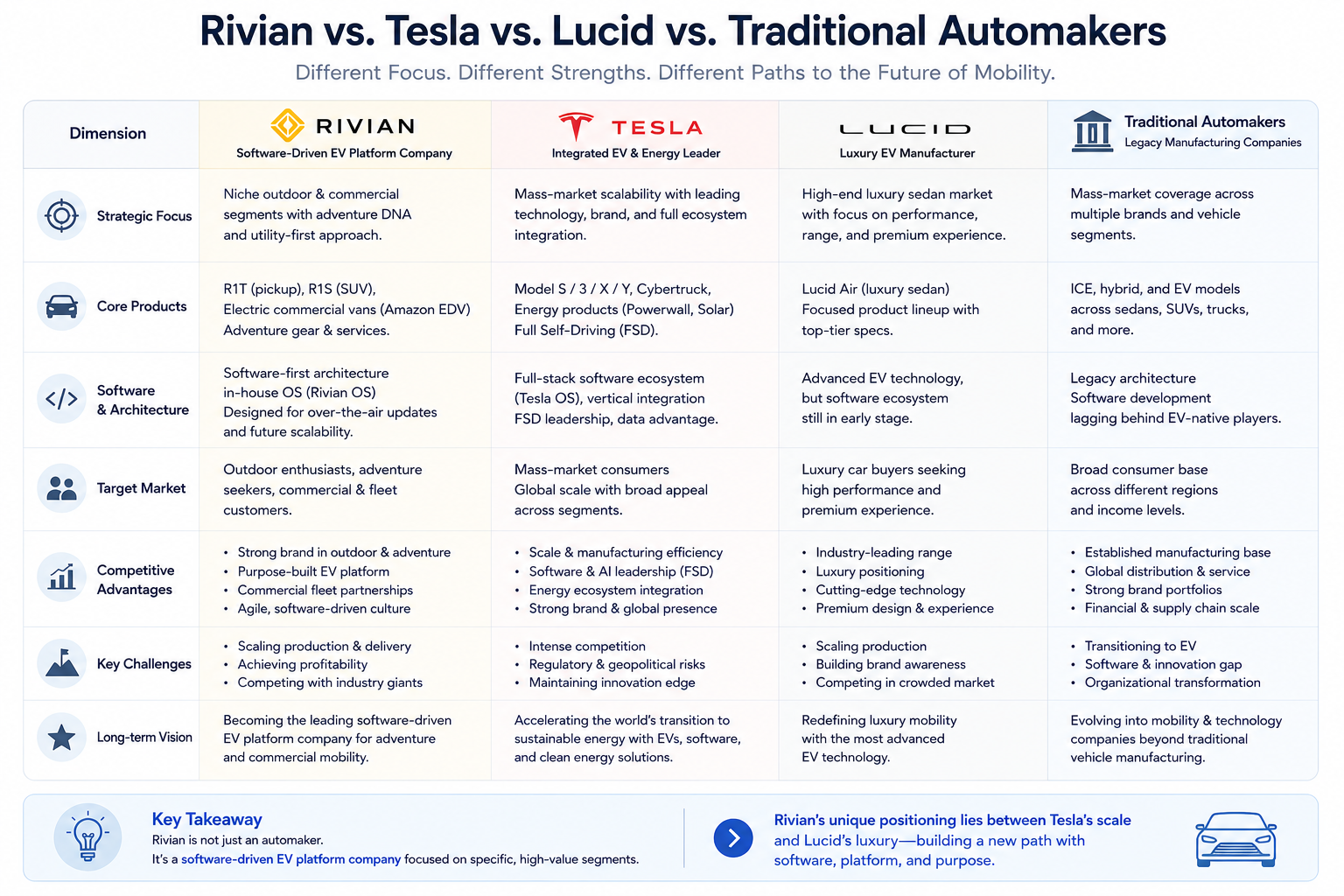
Rivian trails Tesla in scale and software ecosystem maturity, but focuses on niche outdoor and commercial markets.
Unlike Lucid Motors, Rivian does not solely target luxury sedans, instead prioritizing SUVs and pickups for greater practicality.
Compared to traditional automakers, Rivian’s key differentiation is its software-first architecture and platform design, rather than a production model based on single vehicle types.
Overall, Rivian is best described as a “software-driven EV platform company,” not a conventional car manufacturer.
Key Risks for RIVN Stock Investors
Rivian faces major risks including cost control, scalable delivery, and intensifying competition.
Ongoing price wars in the EV sector squeeze margins, and the success of the R2 platform will directly impact Rivian’s long-term financial structure.
Supply chain volatility, battery cost fluctuations, and macro interest rate changes also affect capital expenditures and financing capacity.
Software and autonomous driving remain in the investment phase, with stable profitability unlikely in the short term.
Rivian’s Future Direction and Long-Term Growth Potential
Rivian’s long-term growth centers on three main themes: scaling products, commercializing software, and expanding the energy ecosystem.
If the R2 platform scales successfully, Rivian will transition from a niche brand to the mainstream, transforming its sales structure.
Growing software service revenue will shift Rivian from a “car-selling company” to a “continuous service platform company.”
Expansion of energy and charging networks could create a closed-loop ecosystem, increasing user loyalty and strengthening long-term competitiveness.
As new energy vehicles advance toward intelligence and platformization, Rivian’s positioning offers strong growth flexibility.
Gate Stock Trading and Multi-Asset Allocation Perspective
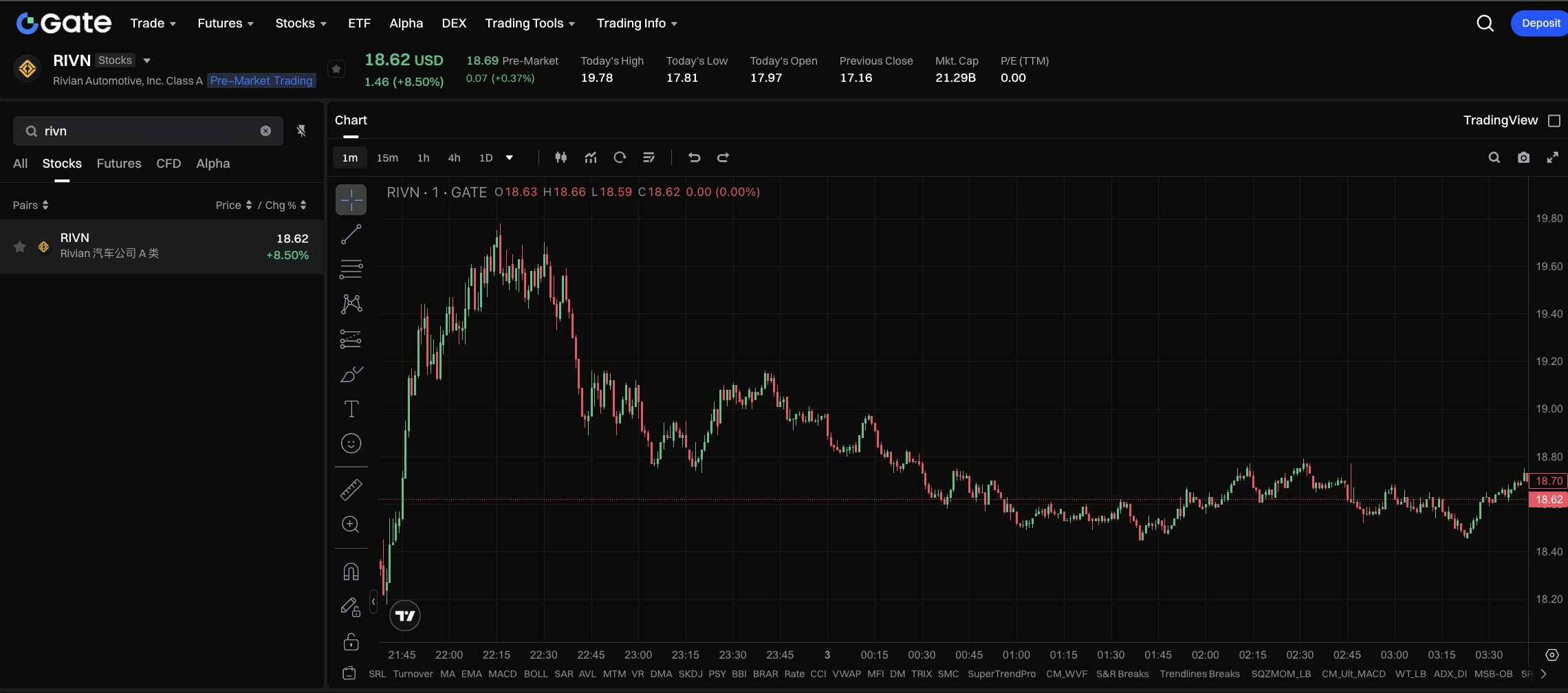
As trading platforms evolve toward multi-asset integration, Gate is expanding its offerings to include crypto assets, derivatives, and select features tied to traditional financial markets (availability varies by region and compliance). Users can manage multi-asset portfolios and risk within a single account.
For US stocks like RIVN, the mainstream method is direct ownership via brokers, while some comprehensive platforms offer price-linked or derivative exposure tools to supplement asset allocation and market hedging.
Ultimately, these platforms enhance cross-market liquidity and asset management efficiency, rather than fully replacing traditional brokerage systems.
Summary
Rivian Automotive (RIVN) is building next-generation intelligent mobility through a unified electric platform, software-defined vehicles, and energy ecosystem. Its core strength lies not only in EV manufacturing, but in long-term evolution driven by software and data.
FAQs
Q1: What models does Rivian mainly sell?
R1T electric pickup, R1S SUV, and upcoming R2 platform models.
Q2: What is Rivian’s main competitive advantage?
Software-defined vehicle architecture and niche positioning in outdoor and commercial segments.
Q3: Is Rivian profitable?
Rivian is still in the expansion and investment phase, and has not yet achieved stable profitability.
Q4: What is the biggest difference between Rivian and Tesla?
Tesla focuses on an all-encompassing platform and ecosystem, while Rivian targets niche markets and software architecture innovation.
Q5: Where does Rivian’s long-term potential originate?
From scaling the R2 platform, growing software revenue, and expanding the energy ecosystem.