Samsung Electronics’ significance extends beyond the smartphones and TVs consumers know best—it stems from its foundational role in the global tech supply chain. Whether in memory chips, display panels, or mobile devices, Samsung Electronics provides the core capabilities behind countless digital services and electronic products. As demand grows for AI, high-performance computing, and global digital infrastructure, the company’s position is drawing increasing attention from the market.
From an industrial structure standpoint, Samsung Electronics operates at three critical levels: semiconductors, consumer electronics, and terminal ecosystems. This vertical integration enables the company to both manufacture core components and deliver complete product systems to end users. Understanding Samsung Electronics, therefore, means grasping not just a consumer brand but the collaborative rhythm of the modern tech industry.
What Is Samsung Electronics
The evolution of Samsung Electronics mirrors the rise of South Korea’s modern tech sector. Initially focused on consumer electronics and home appliances, the company gradually expanded into semiconductors, display panels, and mobile communications, building a full value chain from basic components to finished products. This long-term commitment has allowed Samsung Electronics to shed its pure manufacturing image and enter the core of global technology competition.
In the 21st century, the tech industry shifted toward platforms and ecosystems. Many companies chose to specialize in software, platforms, or design, while Samsung Electronics doubled down on manufacturing and hardware integration. This strategy allows it to participate in multiple industry cycles simultaneously, reducing exposure to volatility in any single product line.
Globally, Samsung Electronics has long held a leading position in consumer electronics and memory chips. In certain niche markets, it acts as both product provider and industry chain participant—a dual identity that sets it apart from traditional tech brands.
At the same time, Samsung Electronics has become one of South Korea’s most iconic global companies, with its performance often seen as a barometer for the health of the global electronics industry.
How Samsung Electronics’ Core Business Structure Operates
To understand Samsung Electronics, it’s essential to recognize it is not a single-business company but a comprehensive system composed of multiple technology sectors.
Currently, Samsung Electronics’ business can be divided into two main areas: Device eXperience (DX), targeting end users, and Device Solutions (DS), serving industrial clients. The former focuses on the consumer market, while the latter caters to the supply chain and enterprise customers.
DX covers smartphones, consumer electronics, home appliances, and the terminal ecosystem—including the familiar Galaxy series, TVs, and home electronics.
DS encompasses underlying technology capabilities, including memory chips, wafer manufacturing, and display technology. Although less visible to end users, this segment has a profound impact on the global tech industry.
| Business Sector |
Main Products |
Revenue Logic |
Industry Role |
| Device eXperience (DX) |
Phones, TVs, Home Appliances |
End-user sales |
Consumer ecosystem |
| Device Solutions (DS) |
Chips, Memory, Foundry |
Technology supply |
Infrastructure |
| Display |
OLED, Display Panels |
Enterprise supply |
Terminal support |
This multi-sector structure means Samsung Electronics does not rely on a single blockbuster product for growth. Instead, it leverages synergies across sectors: terminal devices drive ecosystem building, while chip and display capabilities enhance product competitiveness. This closed-loop capability is a key differentiator.
Why Samsung Electronics Wields Major Influence in Semiconductors
The semiconductor business is widely regarded as Samsung Electronics’ most influential segment. Unlike typical electronics manufacturers, Samsung has long been involved in chip R&D, production, and supply chain development, with particular strength in memory chips. Modern data centers, cloud services, mobile devices, and AI infrastructure all depend heavily on high-performance memory.
In recent years, the surge in AI computing demand has refocused attention on the semiconductor industry. Model training, high-performance computing, and data processing require higher bandwidth, lower latency, and greater computing power, making memory technology a critical component.
Samsung Electronics also participates in wafer manufacturing and advanced process development, meaning it not only supplies chips but is also involved in production technology.
From an industry perspective, the global semiconductor ecosystem typically consists of design, manufacturing, and terminal applications. Samsung relies less on any single link, instead striving for a more complete technology capability system.
This is why many misunderstand Samsung Electronics: on the surface, it’s a phone brand; from an industry perspective, it’s a major semiconductor player.
As AI hardware demand continues to grow, the importance of semiconductor capabilities may increase further, and Samsung Electronics will remain at the center of this transformation.
How Samsung Electronics Builds Its Consumer Electronics and Technology Ecosystem
Samsung Electronics’ competitive strategy goes beyond launching new hardware; it builds long-term ecosystem synergies around devices, software, connectivity, and underlying technologies.
Traditional consumer electronics companies often rely on a single blockbuster product—like smartphones or PCs—but as the global hardware market matures, product-centric innovation alone is no longer enough. Large tech companies are shifting from product competition to ecosystem competition.
Samsung Electronics’ approach is to create a multi-device user network. Smartphones, tablets, TVs, displays, home appliances, and wearables form a unified experience, allowing users to stay within the same ecosystem across different scenarios.
This device synergy does not happen in isolation. Connectivity requires support from display technology, chips, networking, and software. That’s why Samsung Electronics not only produces terminal devices but also invests in underlying capabilities.
This model is a classic example of vertical integration. Compared to single-device brands, Samsung can more directly influence supply chain efficiency, product iteration speed, and long-term technology planning.
As smart devices enter the AI era, terminal ecosystems are becoming even more important. Future competition may hinge not on who has the most devices, but on who can create the most seamless collaboration between them.
Where Samsung Electronics, Apple, and TSMC Stand
Samsung Electronics, Apple, and TSMC are all core global tech companies, but their biggest differences lie not in product categories but in their industry levels. Apple leans toward terminal ecosystem operations, TSMC focuses on chip manufacturing infrastructure, and Samsung Electronics spans both terminal devices and underlying technology—a classic vertical integration model.
Many people lump these three companies together as “tech companies,” but their roles differ. Apple’s core goal is connecting users through hardware, software, and services. TSMC primarily serves enterprise clients, supporting the global chip industry with advanced manufacturing. Samsung Electronics aims to cover both technology supply and consumer markets.
This means that even when facing the same trend—like AI, mobile devices, or computing growth—their paths to benefit vary. Apple focuses on terminal applications, TSMC is driven by chip demand, and Samsung Electronics participates in both basic capability building and terminal product output.
| Dimension |
Samsung Electronics |
Apple |
TSMC |
| Core Positioning |
Vertically integrated tech company |
Consumer tech ecosystem platform |
Semiconductor manufacturing infrastructure |
| Core Customers |
Consumers + Enterprises |
Consumers |
Chip design companies |
| Main Revenue Sources |
Phones, Semiconductors, Displays, Consumer Electronics |
Hardware, Service ecosystem |
Wafer foundry |
| Produces chips? |
Yes |
Primarily designs |
Primarily manufactures |
| Owns terminal products? |
Yes |
Yes |
No |
| Has OS ecosystem? |
Partial |
Strong |
None |
| Relationship with AI |
Chips + devices dual participation |
AI application entry point |
Underpins AI computing power |
| Industry Position |
Spans infrastructure and terminals |
Close to user side |
Close to manufacturing side |
From an industry structure perspective, Apple is a digital consumption gateway, TSMC is a global chip factory, and Samsung Electronics sits between them, creating synergies by controlling core components, manufacturing, and terminal devices.
This model allows Samsung to connect multiple growth levers. For example, when the consumer market slows, infrastructure businesses can provide balance; when chip demand rises, the terminal ecosystem helps form an application closed loop.
However, cross-level operations also require higher capital investment, more complex resource allocation, and longer technology accumulation cycles. Understanding the differences between these three companies is essentially about understanding how the modern tech industry divides labor and collaborates across design, manufacturing, and terminals.
Asset Attributes of Samsung Electronics Stock
Samsung Electronics stock is generally classified as a tech stock, but its underlying asset attributes are more complex than those of typical tech companies.
First, Samsung Electronics has a clear global manufacturing profile. Its revenue is not tied to a single region but is influenced by global electronics demand.
Second, its business spans both consumer electronics and semiconductors, meaning it is affected by both consumer demand cycles and technology infrastructure cycles.
This distinguishes Samsung Electronics from internet platform companies. For instance, when consumer demand slows, terminal businesses may face pressure; when AI infrastructure demand grows, chips and related capabilities may perform differently. Its performance often reflects the combined effects of multiple industry cycles.
From an asset allocation standpoint, many investors view Samsung Electronics as a key proxy for the global electronics industry, South Korea’s tech sector, and the semiconductor space.
It’s important to note that understanding stock attributes does not mean predicting price movements. Stock prices are influenced by macro conditions, industry cycles, market sentiment, and company operations. Therefore, it’s better to understand Samsung Electronics from an industry structure perspective rather than short-term price fluctuations.
How to Buy Samsung Electronics Stock on Gate
As digital asset infrastructure strengthens global market connectivity, more users are seeking convenient ways to access global stocks. Through Gate’s stock trading feature, users can directly trade stocks like Samsung Electronics without needing a traditional overseas brokerage account.
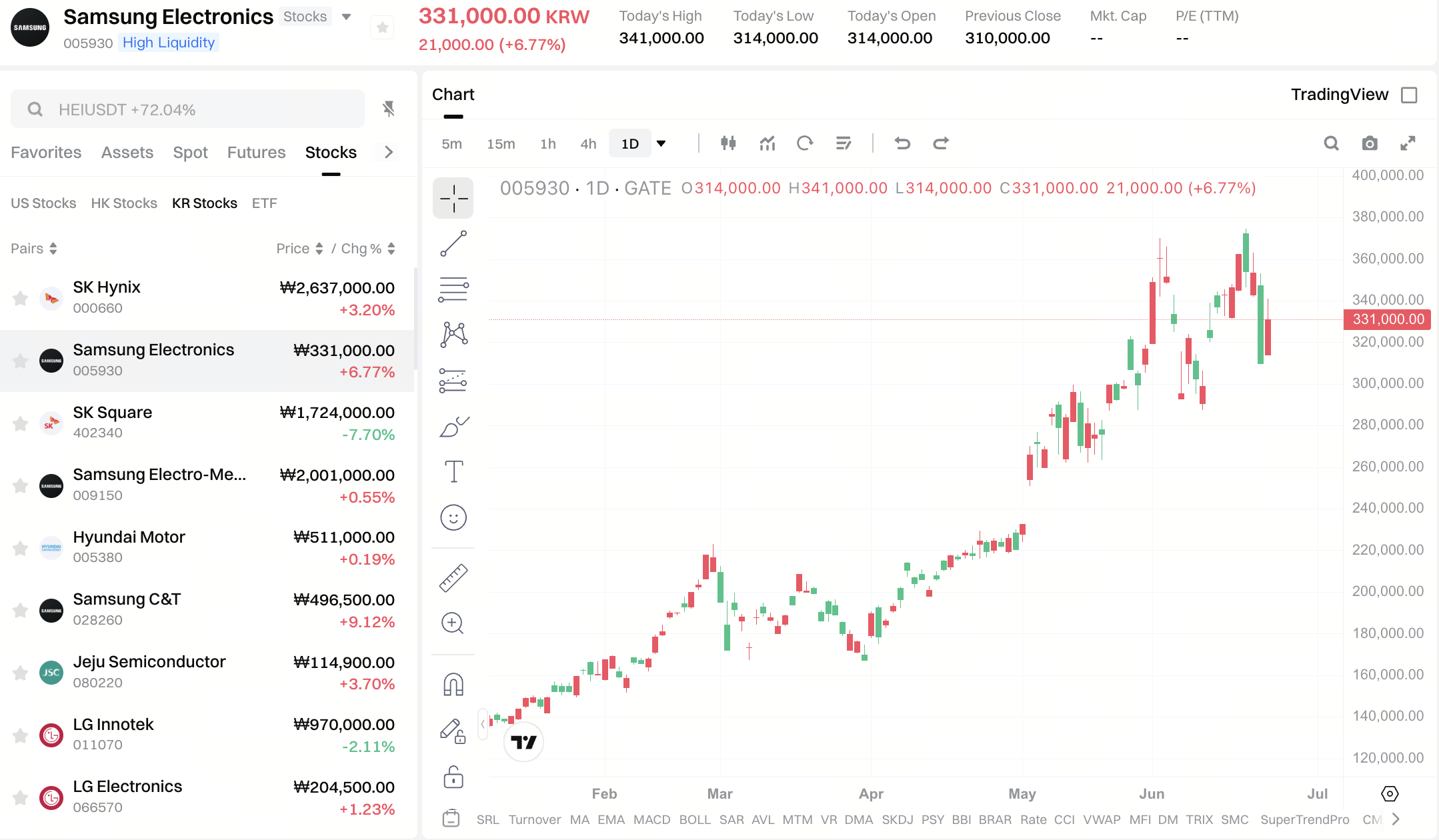
The process typically involves three steps.
Step 1: Download Gate, complete registration and identity verification. Once verified, users can access the stock trading portal and view supported products.
Step 2: Fund your account. The platform supports trading with USDT, eliminating the need to convert to USD first. After preparing assets, proceed to the next step.
Step 3: Search for Samsung Electronics in the stock section and execute your trade. You can buy, hold, or manage positions as needed. The platform supports fractional shares, so you don’t need to buy a full share.
From a product perspective, stock trading provides exposure to real stock assets and supports corporate actions like dividends and stock splits. The process is more like a digital stock access method than traditional cross-border account opening. It’s important to note that trading on Gate is a market participation activity, not a promise of returns, and does not replace personal risk assessment.
Samsung Electronics’ Long-Term Position in AI and the Global Tech Cycle
AI’s rapid development is reshaping the global tech industry, and Samsung Electronics’ position is evolving accordingly. In the past, tech growth came mostly from device upgrades and internet service expansion. In the future, growth may increasingly come from computing infrastructure, data capabilities, and smart device collaboration.
This shift is reconnecting the relationships among semiconductors, memory, displays, and terminal ecosystems.
Because Samsung Electronics has both chip and terminal capabilities, it can participate in multiple technology phases. For example, AI models require infrastructure support, while end users still interact through devices. This reconnects foundational capabilities with consumer-facing applications.
At the same time, global supply chain adjustments, regional tech competition, and next-generation computing demands will continue to drive industry evolution.
Over the long term, Samsung Electronics’ importance comes not from any single product but from its ability to participate in multiple key technology nodes. Understanding Samsung Electronics is essentially about understanding how future tech infrastructure will create synergies.
Summary
Samsung Electronics is a global tech company spanning semiconductors, consumer electronics, display technology, and terminal ecosystems. Its business structure ensures it participates not only in product markets but also in underlying technology development.
Unlike many tech companies that focus on a single area, Samsung Electronics has long used vertical integration to connect chips, devices, and ecosystems, giving it both manufacturing and consumer-facing capabilities. Understanding Samsung Electronics goes beyond knowing a phone brand or stock ticker—it’s about understanding how the global tech industry extends from foundational technology to end-user applications, forming a complete collaborative system.
FAQ
What does Samsung Electronics mainly do?
Samsung Electronics’ main businesses cover semiconductors, smartphones, display panels, consumer electronics, and technology infrastructure.
What is the relationship between Samsung Electronics and Samsung Group?
Samsung Electronics is a key part of Samsung Group and one of its most globally influential core companies.
Is Samsung Electronics a semiconductor company?
Yes, but not limited to semiconductors. It also covers consumer electronics and terminal ecosystems.
What is the difference between Samsung Electronics and Apple?
Apple focuses more on terminal ecosystem platforms, while Samsung Electronics participates in both terminal devices and underlying technology capabilities.
How can I buy Samsung Electronics stock on Gate?
After completing registration and identity verification, you can use USDT to go to the stock section, search for Samsung Electronics, and complete the trade.
Can I trade Samsung Electronics using USDT?
Yes, the platform supports trading stocks with USDT without needing to convert to USD.
Does Gate support fractional share trading?
Yes, the platform supports fractional shares, so you don’t need to buy a full share.