Unlike traditional PFP NFTs, the state of a Slonks NFT is not fixed. It continues to evolve as Merge, Void, and slop values change, making the entire ecosystem closer to an on-chain AI art experiment system.
Around Slonks’ core mechanics, on-chain model, dynamic supply structure, and differences from CryptoPunks, an experimental digital asset ecosystem has gradually taken shape, blending NFTs, AI Art, and on-chain game logic.
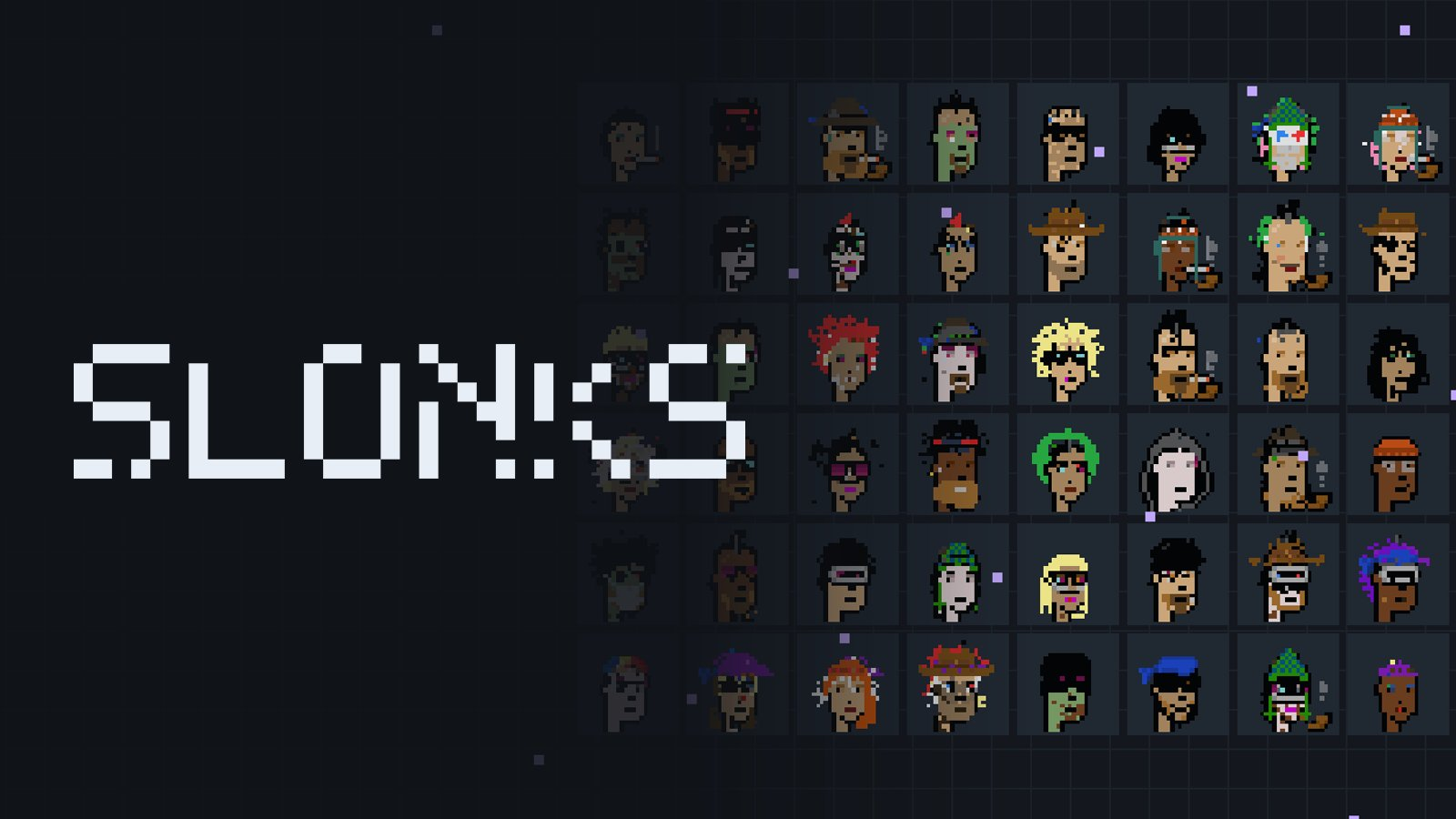
What Is Slonks NFT?
At the center of Slonks is an AI neural reconstruction mechanism that regenerates classic CryptoPunks images on-chain and builds a dynamic NFT ecosystem through Merge, Void, and SLOP mechanics.
Structurally, Slonks is not a traditional PFP NFT in the usual sense. It is an experimental digital asset system that combines AI art, on-chain generation, and NFT burn logic.
Traditional NFT collectible projects usually rely on fixed scarcity and the value of static images. Slonks, by contrast, allows the NFT itself to keep undergoing structural changes through Merge, Void, and shifts in slop values.
The whole ecosystem is built around AI image reconstruction, on-chain interaction mechanisms, changing NFT scarcity, and the SLOP token cycle. It also touches on questions related to NFT art experimentation and on-chain control.
How Slonks Reconstructs CryptoPunks Through AI
One of Slonks’ core mechanisms is the use of an on-chain AI neural model to regenerate and reconstruct CryptoPunks images at the pixel level.
In simple terms, Slonks does not merely copy CryptoPunks. Instead, it uses a neural network to “rebuild” the original Punk images, producing new NFT image outputs.
This AI Reconstruction mechanism preserves some of the original Punk traits, while also creating visible pixel deviations, color disturbances, and visual errors. As a result, each Slonk displays a different degree of image distortion.
Structurally, Slonks is closer to on-chain generative art than to an ordinary avatar NFT.
| Comparison Dimension |
Slonks NFT |
Traditional PFP NFT |
| Image generation method |
AI neural reconstruction |
Static asset combination |
| Image changes |
Can continue evolving |
Mostly fixed |
| Data logic |
on-chain computation |
Generated off chain |
| Scarcity |
Dynamically changing |
Fixed supply |
| Image error |
Contains slop deviation |
Usually no error |
This structure means the value of Slonks comes not only from the NFT itself, but also from the on-chain generation process and the AI reconstruction mechanism.
What Is the slop Value in Slonks?
slop is a core parameter in the Slonks ecosystem. It measures the degree of deviation between the AI reconstructed image and the original Punk.
In essence, slop can be understood as an “image error value.” The higher the value, the more obvious the visual deviation after AI reconstruction.
Slonks does not aim to perfectly restore CryptoPunks. Instead, it uses a neural model to generate varying degrees of distortion, which makes slop a key indicator of NFT scarcity and experimentation.
The slop value not only affects the collectible attributes of the NFT, but also influences how much SLOP token can be generated.
Mechanically, Merge actions change the slop value, while the Void mechanism releases a corresponding amount of SLOP based on slop. This means Slonks NFTs are not just visual assets; they also carry on-chain incentive and ecosystem evolution functions.
How Slonks’ on-chain Neural Model Works
The core of Slonks’ AI model lies in its on-chain neural reconstruction logic.
Traditional NFT projects usually generate images off chain, while Slonks combines the generation process and state changes with on-chain interactions. At its core, it relies on neural network image reconstruction, on-chain state updates, and NFT evolution mechanics.
After each Merge, the system recalculates the NFT image state and generates a new visual result.
This structure means the NFT is not a permanently static asset. Instead, it continues to change in response to on-chain behavior. The NFT image, slop value, and scarcity all keep evolving as ecosystem interactions unfold.
| Module |
Function |
| AI Reconstruction |
Generates reconstructed images |
| Merge Engine |
Merges NFTs |
| Void System |
Burns NFTs |
| Slop Calculation |
Calculates error values |
| Token Logic |
Generates SLOP |
Slonks can therefore be understood more as an on-chain NFT experiment system than simply a collection of avatar assets.
How the Merge Mechanism Changes Slonks NFTs
Merge is one of the most important mechanisms in Slonks. In essence, it strengthens one NFT by burning another.
Each Merge consumes one Slonk and upgrades the state level of the remaining NFT. This process not only changes the NFT image, but also recalculates the slop value.
Traditional NFTs usually rely on a fixed supply. Slonks’ Merge mechanism, however, causes the total number of NFTs to keep decreasing, so scarcity across the ecosystem changes continuously based on user behavior.
| Type of Change |
Impact |
| NFT quantity decreases |
Scarcity increases |
| Image is regenerated |
AI state changes |
| slop increases |
Potential SLOP release increases |
This NFT burn and upgrade logic also makes Slonks closer to an on-chain experimental art project.
How the Void Mechanism Generates SLOP Tokens
Void is the core mechanism in Slonks that converts NFTs into SLOP tokens.
Through Void, users can permanently burn an NFT and receive a corresponding amount of SLOP based on its slop value.
In other words, after Void, the NFT is broken down into an on-chain incentive asset. The NFT is no longer just a collectible; it can also be transformed into a resource within the ecosystem.
Mechanically, Void continuously reduces the number of NFTs while expanding SLOP circulation. This structure creates a direct link between Slonks NFTs and the token.
The fewer NFTs remain, the stronger the scarcity of the surviving NFTs becomes, while SLOP circulation within the ecosystem continues to increase. As a result, Slonks combines NFT burn logic with on-chain incentive logic.
Why Slonks Scarcity Changes Dynamically
Slonks’ scarcity is not fixed by design. It is constantly changed by Merge and Void actions.
Traditional NFT projects usually determine total supply at issuance. In Slonks, however, the NFT supply keeps decreasing, which means the entire ecosystem’s supply structure is always in motion.
This dynamic scarcity mainly comes from two mechanisms: Merge and Void. Merge reduces supply during NFT combination, while Void permanently burns NFTs when generating SLOP.
In essence, Slonks turns NFT scarcity from “static issuance” into an “on-chain dynamic game.” The number of NFTs, slop values, and on-chain interactions together determine the structure of the ecosystem.
This is also one of the main reasons it is viewed as an experimental NFT project.
Slonks vs CryptoPunks: How AI Reconstruction NFTs Differ From Classic PFPs
Although Slonks’ images are connected to CryptoPunks, the design logic of the two is completely different.
CryptoPunks places greater emphasis on the collectible value of a classic NFT, while Slonks focuses more on AI reconstruction, on-chain evolution, and dynamic scarcity.
| Comparison Dimension |
Slonks |
CryptoPunks |
| Image logic |
AI neural reconstruction |
Original pixel art |
| NFT state |
Changeable |
Fixed |
| Scarcity |
Dynamically changing |
Fixed total supply |
| Burn mechanism |
Includes Merge and Void |
None |
| Token mechanism |
Includes SLOP |
No native token |
| Artistic direction |
Experimental AI art |
Classic PFP collectible |
Structurally, CryptoPunks is more like a historical NFT asset, while Slonks leans more toward an on-chain art experiment.
As a result, users focus on different things in each project. CryptoPunks emphasizes historical status and collectible value, while Slonks places more weight on mechanical evolution and on-chain experimentation.
The Artistry, Experimentation, and Ecosystem Limits of Slonks
One of Slonks’ core values lies in its role as an on-chain AI art experiment.
Through neural reconstruction, Merge, and dynamic NFT evolution, Slonks breaks away from the static asset structure of traditional NFTs.
This experimental nature is mainly reflected in AI image changes, NFT state evolution, and a dynamic supply structure. The ecosystem does not pursue fixed scarcity. Instead, it continually reshapes NFT states through on-chain mechanisms.
But this structure also has limitations.
Because the ecosystem depends heavily on experimental mechanics, NFT pricing logic becomes more complex, collectible standards are not fixed, and the learning curve for users is noticeably higher than it is for traditional PFP NFTs.
Compared with traditional NFT projects, Slonks depends more on community recognition of on-chain experimental art and AI reconstruction mechanisms.
Conclusion
Slonks NFT is an experimental NFT project that combines AI neural reconstruction, on-chain generation, and dynamic NFT scarcity.
The entire ecosystem forms a continuously evolving NFT system around AI Reconstruction, Merge, Void, slop values, and the SLOP token.
Unlike traditional PFP NFTs, Slonks places greater emphasis on on-chain art experimentation, NFT state changes, and a dynamic supply structure. For that reason, Slonks is not only an NFT collectible project, but also an experimental digital asset ecosystem built around AI image generation and on-chain mechanisms.
FAQs
What Is Slonks NFT?
Slonks NFT is an on-chain NFT project generated through an AI neural reconstruction mechanism. Its images are connected to CryptoPunks, but it has its own independent on-chain evolution structure.
What Does the slop Value Do in Slonks?
slop measures the degree of deviation between the AI reconstructed image and the original Punk. It also affects NFT scarcity and the amount of SLOP token generated.
How Does the Merge Mechanism Work?
Merge consumes one Slonks NFT and strengthens the state of another NFT, while also regenerating the image and recalculating the slop value.
Why Does Void Generate SLOP?
Void permanently burns an NFT and releases a corresponding amount of SLOP tokens based on the slop value.
What Is the Difference Between Slonks and CryptoPunks?
CryptoPunks focuses more on classic NFT collectibility, while Slonks emphasizes AI reconstruction, on-chain evolution, and dynamic scarcity mechanics.
Is the SLOP Token a Meme Coin?
SLOP is closer to an on-chain incentive asset within the NFT ecosystem. Its core source is the Void mechanism, rather than the issuance logic of a traditional Meme Coin.