The semiconductor industry has long been considered a critical pillar of the tech sector. As a result, fluctuations in demand for AI chips, GPUs, servers, and data centers often directly impact semiconductor index movements. SOXS's price performance is also closely tied to the chip industry cycle.
Because SOXS is a high-volatility leveraged ETF, its performance is influenced not only by index direction but also by market sentiment, daily rebalancing, volatility, and short-term capital flows. SOXS is better suited as a short-term trading instrument rather than a long-term allocation asset.
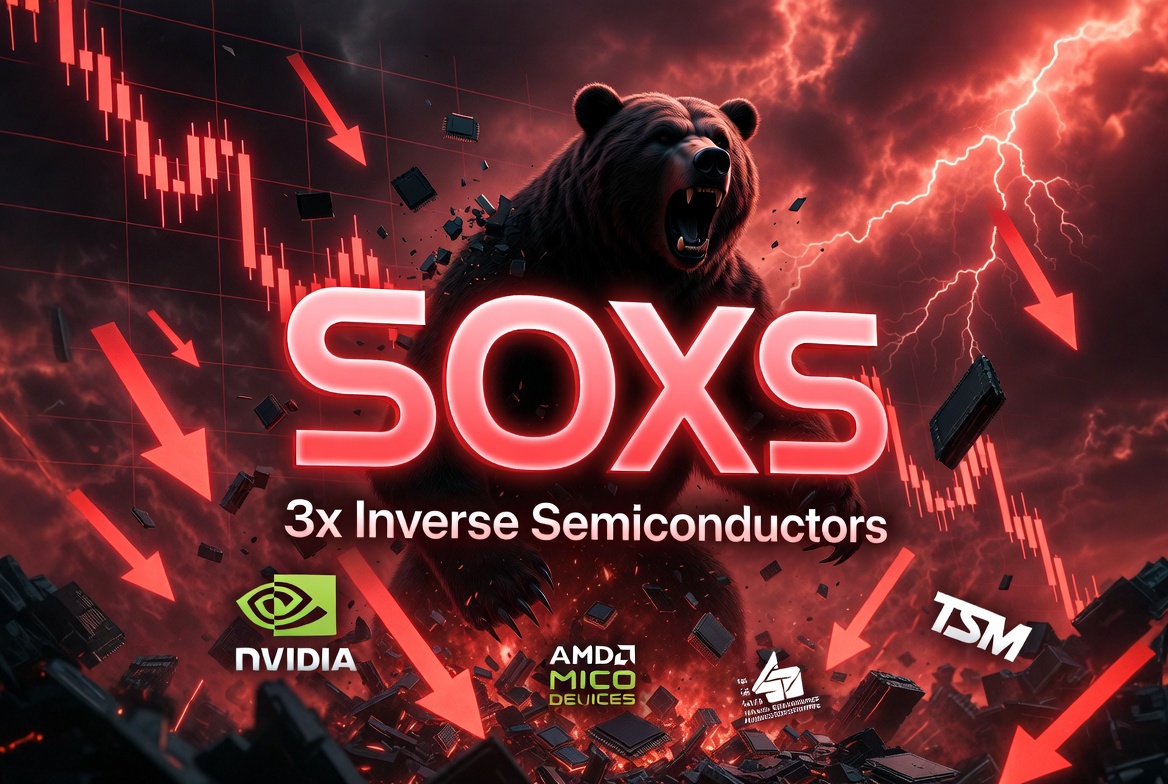
What Is SOXS (Triple Short Semiconductor ETF)
SOXS is designed to amplify daily returns during declines in the semiconductor index. It typically tracks a semiconductor-related index and targets a triple inverse daily return.
Structurally, SOXS does not directly short individual chip companies. Instead, it builds short exposure through swap contracts, futures, and other derivatives. When the semiconductor sector drops, SOXS theoretically rises.
Its core objective is to deliver three times the inverse daily return of the semiconductor index. So, if the index falls 1% in a day, SOXS may gain roughly 3%.
This structure means SOXS prioritizes short-term market volatility over long-term holding. Since daily returns are recalculated, the long-term net asset value may diverge from what users intuitively expect.
Why Does SOXS Move Inversely to the Semiconductor Index?
The inverse relationship stems from the ETF's short-return structure.
Semiconductor indices typically consist of major chip companies—including GPU, CPU, wafer manufacturing, and semiconductor equipment firms. Therefore, demand for AI chips, server markets, and tech cycles all affect index performance.
First, when the semiconductor sector declines, SOXS's inverse derivative structure generates returns simultaneously. The larger the index drop, the more pronounced SOXS's theoretical gain.
Then, the fund manager uses derivatives to maintain the target leverage ratio. Greater market changes lead to more frequent rebalancing.
Next, market panic can amplify capital flows. During a major tech pullback, SOXS trading volume often spikes.
Ultimately, SOXS's price exhibits a clear inverse correlation with the semiconductor index.
How Does SOXS's Triple Leverage Mechanism Work?
SOXS's triple leverage is a financial structure that magnifies the index's daily return.
First, the fund uses derivatives to create market exposure exceeding its net asset value. This leverage amplifies market swings.
When the semiconductor index falls, SOXS's inverse returns expand accordingly. The steeper the decline, the larger the theoretical gain.
The table below illustrates SOXS's theoretical return structure:
| Semiconductor Index Daily Change |
SOXS Theoretical Change |
| -1% |
3% |
| -2% |
6% |
| +1% |
-3% |
| +2% |
-6% |
This structure amplifies both returns and risks.
From a trading standpoint, SOXS is more appropriate for short-cycle, high-volatility markets than for long-term trend positions.
What Does SOXS's Daily Rebalancing Mechanism Mean?
Daily rebalancing continuously reshapes the ETF's long-term net asset value.
First, SOXS targets a "daily" triple inverse return—not a cumulative long-term return. So the fund must adjust its leverage every day.
After market close, the fund recalculates net assets and derivative positions. Greater index volatility increases rebalancing pressure.
In a choppy market, compounding deviation can occur. Even if the index remains flat over time, SOXS's net asset value may gradually erode.
This is known as volatility decay. In high-volatility environments, leveraged ETF net asset values often deviate from intuitive expectations.
Thus, SOXS suits short-term risk trading, not long-term asset allocation.
What Are the Differences Between SOXS and Regular Semiconductor ETFs?
The core differences lie in return direction and risk structure.
Regular semiconductor ETFs track the chip industry's long-term growth. Expansion in AI, servers, and semiconductors typically pushes them up.
SOXS, conversely, is an inverse leveraged ETF. When the semiconductor sector declines, SOXS delivers amplified returns.
The table below highlights the key distinctions:
| Type |
Regular Semiconductor ETF |
SOXS |
| Return Direction |
Positive |
Inverse |
| Leverage Structure |
None |
Triple |
| Risk Level |
Medium |
High |
| Primary Use |
Long-term allocation |
Short-term trading |
This structure means SOXS focuses on volatility trading and risk hedging.
Why Is SOXS's Risk Structure Higher Than Traditional ETFs?
SOXS carries higher risk due to the combination of leverage, inverse returns, and a highly volatile sector.
The semiconductor industry is inherently cyclical. The AI boom, chip inventory shifts, and global tech demand all drive volatility.
First, triple leverage magnifies market moves. Even a small index rise can cause significant SOXS losses.
Then, daily rebalancing may erode long-term net asset value. In high-frequency volatile markets, SOXS's NAV can gradually decline.
Next, market panic amplifies price swings. Rapid capital flows cause SOXS volatility to notably exceed regular ETFs.
This structure makes SOXS suitable only for short-term trading with high risk tolerance.
Application Scenarios for SOXS During Semiconductor Downturns
SOXS is typically used during chip pullbacks, high-volatility markets, and tech risk hedging.
Some traders hedge semiconductor stock risk with SOXS. When AI chip or GPU stocks drop sharply, SOXS can theoretically generate inverse returns.
Short-term volatility trading is another key use. During high-volatility tech phases, SOXS's price elasticity often increases significantly.
Institutional traders also use SOXS to manage market exposure. When the semiconductor sector enters a correction, SOXS trading volume typically surges.
Meanwhile, some multi-asset platforms now offer CFD products tied to US stock ETFs. Products like Gate CFD by Gate are expanding digital asset platforms' coverage of overseas ETFs and leveraged assets.
However, note that SOXS is already a high-volatility leveraged ETF. Combining it with CFD leverage further elevates overall risk.
SOXS, as a US market leveraged inverse ETF, can typically be traded on securities platforms that support US stocks. Traditionally, users access these ETFs through overseas securities accounts.
Recently, the China Securities Regulatory Commission reiterated that overseas institutions may not illegally offer account opening and trading services within China, and pushed for rectification of existing business. This has led some internet brokerage platforms to adjust their US stock offerings.
This shift has prompted many users to explore alternative channels for US stock ETFs. Beyond traditional accounts, some platforms now offer stock CFDs, ETF CFDs, or on-chain derivatives.
The CFD model does not involve direct holding of the actual ETF; instead, it tracks price movements via contracts. Some digital asset platforms have also begun expanding services related to US stock ETFs.
For instance, Gate CFD by Gate is gradually broadening digital asset platforms' coverage of overseas ETFs and global market assets. Users can now access derivatives of overseas ETFs like SOXS in addition to crypto assets.
Still, it's crucial to remember that leveraged ETFs already carry high volatility. Combining them with CFDs or additional leverage further amplifies market risk.
Summary
SOXS is a leveraged ETF that tracks a triple inverse daily return of the semiconductor index. It is primarily used for chip sector pullback trading, market risk hedging, and short-term volatility management.
Its core structure relies on inverse returns, leverage amplification, and daily rebalancing, making its risk profile higher than regular ETFs.
Given the semiconductor industry's inherent volatility, SOXS is better suited for short-cycle trading than long-term asset allocation.
FAQ
What is SOXS?
SOXS is a triple-leveraged inverse semiconductor ETF that aims to deliver three times the inverse daily return of the semiconductor index.
Why does SOXS rise when chip stocks fall?
SOXS uses financial derivatives to build a short position on the index. When the semiconductor index falls, SOXS theoretically rises.
What does SOXS's triple leverage mean?
Triple leverage means that if the semiconductor index drops 1% in a day, SOXS may theoretically gain about 3%.
Why is SOXS not suitable for long-term holding?
Daily rebalancing and compounding deviation can cause long-term net asset value erosion, especially in high-volatility environments.
What is the difference between SOXS and a regular semiconductor ETF?
A regular semiconductor ETF tracks long-term industry growth, while SOXS is a short-term inverse leveraged trading tool.