Leveraged inverse ETFs have long existed in the U.S. stock market. They are mainly used for short term trading, market hedging, and trading during highly volatile market conditions. Compared with traditional ETFs, SQQQ focuses more on short term price movements than on long term asset allocation.
Because the Nasdaq 100 Index has long been concentrated in technology stocks, SQQQ is usually closely tied to volatility in large technology companies, AI related stocks, and high growth sectors. When market risk appetite declines, SQQQ volatility often increases significantly.
What Is SQQQ, the Triple Inverse Nasdaq ETF?
From a product structure perspective, SQQQ is a leveraged inverse ETF. Its objective is not to track the Nasdaq Index over the long term, but to deliver three times the inverse performance of the Nasdaq 100 Index’s daily return.
SQQQ mainly tracks the Nasdaq 100 Index. This index typically includes large U.S. technology and growth companies, so its movements are often highly correlated with the technology sector.
Unlike traditional ETFs, SQQQ does not directly hold large amounts of technology stocks. Instead, it relies more on financial derivatives, swap agreements, and futures based structures to generate leveraged inverse returns.
One important feature of SQQQ is its “daily return target.” This means its long term performance may differ significantly from what investors might intuitively expect from a “three times short Nasdaq” product.
The table below shows some of SQQQ’s core features:
| Module |
Details |
| Product type |
Leveraged inverse ETF |
| Tracking target |
Nasdaq 100 |
| Leverage multiple |
Three times inverse |
| Return target |
Daily return |
| Core use |
Hedging and short term trading |
In essence, SQQQ is closer to a short term volatility tool than a long term investment product.
Why Does SQQQ Move Inversely to the Nasdaq Index?
The core reason SQQQ moves inversely to the Nasdaq Index is that the product uses derivatives to create an inverse return structure. When the Nasdaq falls, SQQQ is designed to generate inverse returns in theory.
First, SQQQ establishes short exposure to the index through financial contracts. The fund itself does not necessarily short stocks directly; instead, it obtains inverse returns through instruments such as swaps.
Then, when the Nasdaq 100 Index declines, the inverse return structure can push SQQQ’s price higher. The larger the index decline, the more pronounced SQQQ’s movement usually becomes.
Next, the leverage mechanism further amplifies both gains and risks. Three times leverage means daily price swings are magnified significantly.
Finally, SQQQ rebalances every day to realign with its target leverage ratio. As a result, SQQQ is better suited to short cycle trading strategies.
This structure means SQQQ is not simply a tool for “long term shorting of the Nasdaq.” During extended sideways or volatile markets, the product’s net asset value may gradually erode.
How Does SQQQ’s Three Times Leverage Mechanism Work?
SQQQ’s three times leverage mechanism essentially depends on financial derivatives and leveraged exposure management. The product aims to deliver three times the inverse daily return of the Nasdaq 100 Index.
For example, if the Nasdaq 100 Index falls by 1% in a single day, SQQQ would theoretically rise by about 3%. Conversely, if the index rises, SQQQ’s losses would also be magnified.
SQQQ’s leverage structure is not fixed. Because market movements vary from day to day, the fund needs to continuously adjust its positions and derivative exposure.
Structurally, the focus of leveraged ETFs is not long term holding, but capturing short term volatility. Their returns usually depend more on short cycle market conditions.
A key feature of leverage is that it magnifies both returns and risks. When the market direction is misjudged, changes in net asset value are usually much larger than those of ordinary ETFs.
SQQQ’s high volatility also means the product is more easily affected by market sentiment and short term trading capital.
What Does SQQQ’s Daily Rebalancing Mechanism Mean?
SQQQ’s daily rebalancing mechanism is a key part of how leveraged ETFs operate. Daily rebalancing means the product adjusts its leverage ratio every trading day.
First, the fund adjusts its positions based on the day’s market gains or losses. After the index moves, the original leverage ratio usually changes.
Then, SQQQ reallocates its derivative positions so the product can move back toward its target three times inverse structure.
Next, the effect of daily compounding gradually influences long term returns. When markets move repeatedly over time, the product’s long term performance may deviate from what investors intuitively expect.
Ultimately, the more pronounced the market swings, the greater the potential net asset value erosion. In sideways and choppy markets, leveraged ETFs often experience volatility drag.
The table below shows the potential impact of daily rebalancing:
| Market environment |
Possible SQQQ performance |
| One way decline |
Amplified gains |
| One way rise |
Amplified losses |
| Frequent fluctuations |
Net asset value erosion |
| High volatility market |
Clearly increased volatility |
The daily rebalancing mechanism is also one of the main reasons SQQQ is not suitable for long term holding.
How Is SQQQ Different from Ordinary ETFs?
The biggest difference between SQQQ and ordinary ETFs lies in their return objectives and product structures. Ordinary ETFs are usually used to track an index over the long term, while SQQQ is more of a short term leveraged trading tool.
Traditional ETFs often hold stocks directly. Products such as QQQ allocate capital to Nasdaq 100 Index constituents over the long term.
SQQQ, by contrast, mainly relies on derivatives and an inverse leverage structure. Its focus is to amplify short term market volatility, not to hold assets for the long run.
Ordinary ETFs usually have lower volatility and are more suitable for long term asset allocation. SQQQ carries significantly higher risk.
From a trading logic perspective, ordinary ETFs place more emphasis on long term market growth. SQQQ is usually used when traders expect market declines or want to trade short cycle volatility.
This difference means SQQQ and traditional ETFs differ clearly in risk management and holding period.
Why Is SQQQ Riskier Than Traditional ETFs?
The core reason SQQQ is riskier than traditional ETFs is that leverage, an inverse structure, and daily rebalancing all exist at the same time.
First, three times leverage amplifies market volatility. When the index rises in a single day, SQQQ’s losses increase accordingly.
Then, daily rebalancing can create compounding deviation. Over longer holding periods, net asset value performance may differ from market expectations.
Next, highly volatile markets increase net asset value erosion. When markets fluctuate back and forth, leveraged ETFs are more prone to value decay.
Finally, SQQQ itself is a high trading frequency product. Short term capital flows and market sentiment can further increase volatility.
From a risk structure perspective, SQQQ is closer to a trading instrument than a long term investment asset. The product is designed primarily for managing short term price volatility.
How SQQQ Is Used During Market Declines
SQQQ is mainly used during market declines, technology stock pullbacks, and high volatility trading periods.
Some traders use SQQQ to hedge technology stock risk. When the Nasdaq sector declines, SQQQ can theoretically generate inverse returns.
Short term trading is another important use case for SQQQ. When market volatility increases, the leveraged structure can usually enhance price sensitivity.
Some institutional traders also use SQQQ for risk management. During high volatility periods, leveraged inverse ETFs can help adjust portfolio risk exposure.
However, SQQQ is not suitable for long term holding. Daily rebalancing and volatility drag can gradually affect long term returns.
The logic behind using SQQQ is essentially built on “short cycle volatility trading” and “market risk hedging.”
As a U.S. listed ETF, SQQQ can usually be traded through brokerage platforms that support U.S. stock trading. Under the traditional model, users typically access the U.S. stock market through an overseas securities account.
Recently, the China Securities Regulatory Commission further emphasized that overseas institutions may not illegally provide account opening or trading services within China, while also setting a rectification period for existing business. As a result, some internet brokerage platforms have adjusted their U.S. stock related services.
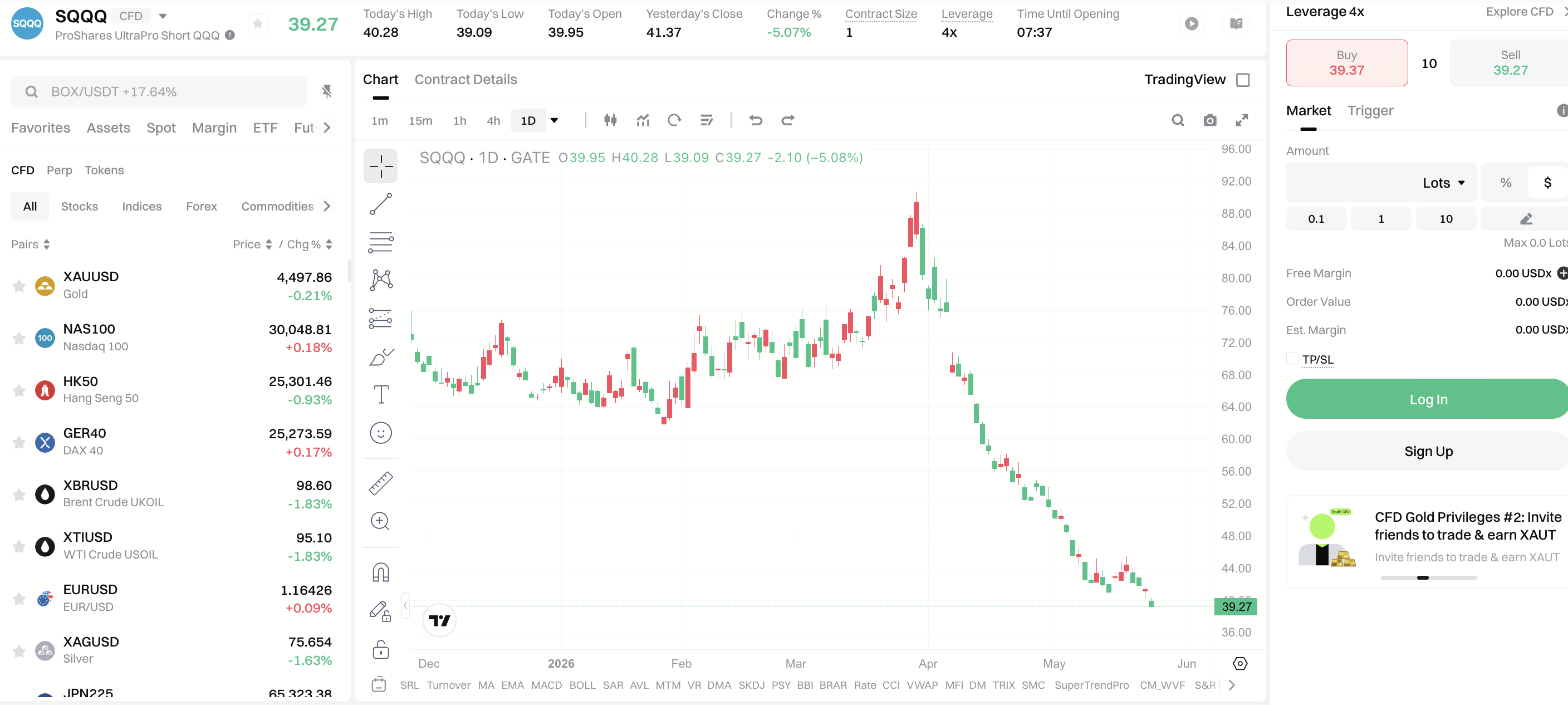
In addition to traditional stock accounts, some platforms have begun offering U.S. stock related CFD, or contract for difference, products. CFDs usually track ETF or stock prices through price contracts rather than direct ownership of the underlying assets.
At the same time, products such as Gate CFD offered by Gate are gradually expanding digital asset platforms’ coverage of overseas stock and ETF markets. In addition to crypto assets, some users also follow leveraged U.S. stock assets such as SQQQ through stock or ETF CFD products.
However, it is important to note that SQQQ is already a high volatility leveraged ETF. If it is combined with a leveraged CFD trading structure, the overall risk usually increases further.
Summary
SQQQ is a leveraged ETF that tracks three times the inverse daily return of the Nasdaq 100 Index. It is mainly used for trading market declines, hedging technology stock risk, and managing short term volatility.
Unlike ordinary ETFs, SQQQ relies more heavily on derivatives, leverage structures, and daily rebalancing, so its volatility and risk are usually much higher.
The core logic of SQQQ is not long term holding, but short cycle market volatility management. Daily compounding, leveraged amplification, and net asset value erosion are also key sources of risk for this product.
FAQs
What Is SQQQ?
SQQQ is a three times leveraged inverse ETF that aims to deliver three times the inverse daily return of the Nasdaq 100 Index.
Why Does SQQQ Move Inversely to the Nasdaq Index?
SQQQ uses financial derivatives to build an inverse return structure. As a result, when the Nasdaq 100 Index falls, SQQQ is theoretically designed to rise.
Why Is SQQQ Not Suitable for Long Term Holding?
SQQQ has a daily rebalancing and compounding deviation mechanism. In long term sideways markets, this can gradually erode its net asset value.
What Is the Difference Between SQQQ and QQQ?
QQQ is an ordinary Nasdaq ETF that mainly tracks the long term performance of the index. SQQQ is a three times leveraged inverse ETF that focuses more on short term volatility trading.
How Can You Buy SQQQ?
SQQQ can usually be traded through brokerage platforms that support U.S. stock trading. Some platforms also provide SQQQ related CFD or derivative products.