In the trend of exchanges issuing their own chains, native coins often double as both Gas and ecosystem incentives. Whitechain uses PoA consensus to cut energy use and boost throughput, while EVM compatibility lowers developer migration costs. SoulDrop links on-chain activity to WBT Holding levels on WhiteBIT, creating an "on-chain fees → holder rewards" feedback loop.
From a WhiteBIT Coin ecosystem perspective, understanding Whitechain's tech stack, cross-chain asset migration, and SoulDrop calculation rules is essential to tell apart "in-platform Holding discounts" from "on-chain native rewards." Both depend on WBT, but their triggers and distribution logic differ.
What Is Whitechain?
Whitechain is WhiteBIT's own blockchain network, serving as the core infrastructure for WBT's evolution from an exchange utility token to a chain-level native asset. It uses Proof-of-Authority (PoA) consensus—pre-authorized validators handle block production and transaction verification, no proof-of-work mining required—resulting in low energy use and high throughput.
Technically, Whitechain forks Go-Ethereum (Geth) and stays EVM-compatible, so it can run Ethereum-style smart contracts and reuse existing dev tools. WBT is the native base coin on Whitechain; every on-chain transaction's Gas is paid in WBT. At mainnet launch, some fund assets were burned on other networks (e.g., Tron) and then issued equally in Whitechain's genesis block, keeping total supply allocation unchanged.
| Technical Dimension |
Whitechain Feature |
| Consensus |
Proof-of-Authority (PoA) |
| Virtual Machine |
EVM Compatible (Geth Fork) |
| Native Gas |
WBT |
| Validator Model |
Authorized Entities Produce Blocks (No Public Mining) |
| Ecosystem Expansion |
WB Soul, SoulDrop, Smart Contract dApps |
Whitechain is positioned as the on-chain execution layer of the WhiteBIT ecosystem—complementing its centralized exchange products, not replacing the WhiteBIT account system.
How Does WBT Work as Gas on Whitechain?
WBT's Gas function on Whitechain is independent of its in-account benefits. When users send transactions or call contracts from a Whitechain wallet or linked address, they must pay WBT as network fees. These fees go into a network fee pool, with part flowing into the SoulDrop contract for later reward distribution.
The Gas mechanism follows typical PoA design: validators package transactions and collect Gas, with Gas prices tied to network load. Since WBT has a fixed supply and undergoes weekly buyback-and-burn, on-chain Gas consumption creates demand for WBT alongside in-exchange Holding use cases.
Users who only hold WBT on WhiteBIT without sending on-chain transactions still get Owning/Holding platform benefits. But they need a separate WBT balance on Whitechain to pay for Gas. In-platform balances and on-chain wallet balances connect via official deposit/withdrawal and cross-chain flows.
How Does Cross-Chain Migration Keep WBT Supply Constant?
WBT lives on three networks: Whitechain, Ethereum (ERC-20), and Tron (TRC-20). To prevent supply inflation from cross-chain moves, Whitechain uses a "burn on source chain, mint on target chain" mechanism. After users burn a set amount of WBT on Ethereum or Tron, they submit the burn transaction hash as proof, and Whitechain mints an equal amount of native WBT.
The key constraint: each new mint must match a burn on another network. WhiteBIT is the only issuance manager and cannot mint WBT on Whitechain without a corresponding burn proof. Every mint is traceable to its source-chain burn, keeping total supply consistent with the whitepaper. This is different from weekly buyback-and-burn—that reduces circulating supply, while cross-chain minting just moves tokens between networks.
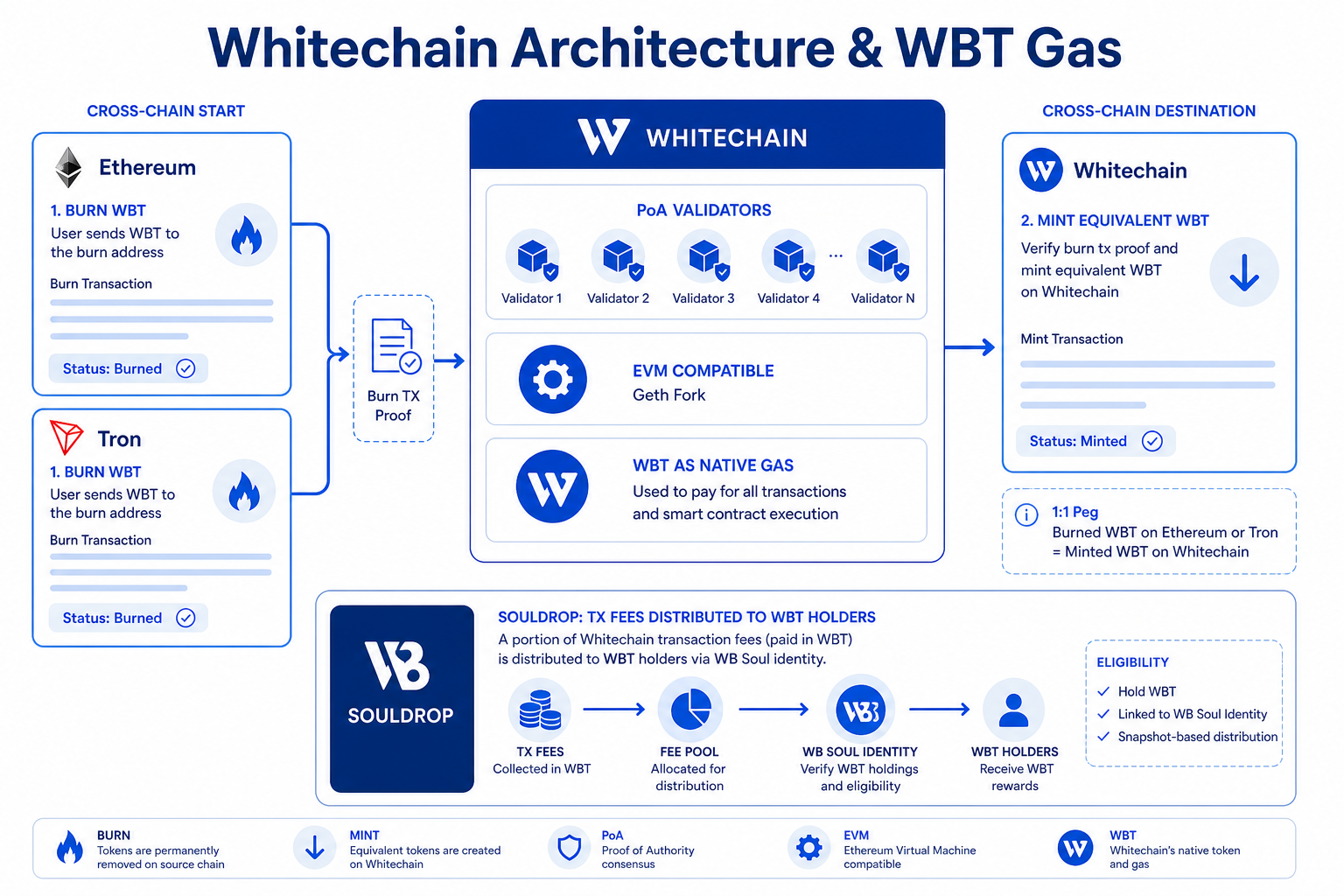 Figure 1. Whitechain: burn on Ethereum/Tron, mint on Whitechain; transaction fees flow to SoulDrop contract.
For cross-chain operations, always use the official bridge interface and contract addresses to avoid losing assets to unofficial contracts. After bridging, WBT on Whitechain can be used for Gas payments and SoulDrop interactions.
How Do WB Soul Identity System and SoulDrop Connect?
WB Soul is an on-chain identity system inspired by Soulbound Tokens (SBT). After users complete KYC and link a wallet to their WhiteBIT account, the platform can create a WB Soul as identity guarantor—representing identity on-chain without exposing personal data. Each WB Soul can bind one main wallet and up to 4 secondary addresses.
WB Soul Features sync platform account attributes to the on-chain identity, including mutable Soul Attributes (like WBT Holding amount) and immutable SoulBound Tokens (achievement badges). SoulDrop reward calculations depend on the Holding amount and level shown by the WB Soul. Users control whether to publicly disclose their Holding Amount on-chain via the WhiteBIT Soul page, which affects reward accuracy.
WB Soul is the entry point for SoulDrop. Users who haven't completed KYC or created a WB Soul can't claim on-chain rewards under SoulDrop rules—even if they already hold WBT Holding on the platform.
How Does the SoulDrop Reward Mechanism Work?
SoulDrop is a marketing reward distribution launched on Whitechain's mainnet, giving WBT rewards to WBT Holding users via the SoulDrop smart contract. Contract funds come from:
- WBT allocated from user participation funds (burned on Tron at mainnet launch and migrated to Whitechain)
- All Whitechain network transaction fees (collected into the SoulDrop contract and redistributed)
- Possible future official top-ups (announced separately)
Rewards use compound interest logic: every 30 days is a fixed period. The period reward percentage depends on the WBT Holding amount and level. Unclaimed rewards from the previous period are added to the next period's Holding principal. The longer you hold, the higher your final claimable reward. The WB Soul must have IsVerified = true (i.e., valid WhiteBIT KYC) to claim.
Users claim by calling the Claim function on the SoulDrop contract from their WB Soul-linked wallet. Accumulated rewards are recorded in the WithHolding variable. Even if Holding drops to zero, accumulated WithHolding can still be claimed (conditions apply). Users can also use the contract's Read functions—getSoulReward or calculateReward—to check pending or estimated rewards.
| SoulDrop Element |
Key Points |
| Prerequisites |
WB Soul + Valid KYC + WBT Holding |
| Contract Funds |
User fund allocation + on-chain transaction fees |
| Calculation Period |
30 days/period; compound interest included in Holding principal |
| Level Impact |
Holding Level determines period reward percentage |
| Claim Method |
Call Claim function from linked wallet |
SoulDrop and in-exchange fee discounts live in different benefit layers. SoulDrop is on-chain WBT reward distribution; the other is platform trading fee reduction.
What Are the Limitations and Risks of Whitechain and SoulDrop?
Whitechain uses PoA consensus, where validators are authorized entities—less decentralized than public PoS/PoW networks. Users need to understand the trust model and governance. Cross-chain burn/mint relies on correct burn proof verification; bridge or contract bugs could introduce asset risk.
SoulDrop rules involve multiple variables—Holding level, period compounding, KYC status—making calculations more complex than platform discounts. Reward rates change with Holding level and don't guarantee a fixed yield. WB Soul creation and address management go through WhiteBIT support, and the on-chain identity must stay in sync with platform account status.
Other risks include: smart contract bugs, Gas fee volatility, rule changes affecting reward distribution, and fake contracts or phishing interfaces. Always verify contract addresses through official tools like WB Explorer. This description is a mechanism-level analysis, not investment advice.
Summary
Whitechain is WhiteBIT's own PoA, EVM-compatible L1, with WBT as its native Gas coin. Cross-chain keeps total supply constant by burning on the source chain and minting on the target chain. SoulDrop distributes WBT from on-chain fees and fund pools to users who meet KYC and WB Soul conditions, using Holding level and 30-day periods with compound rewards. Understanding Gas payments, cross-chain migration, and SoulDrop claiming logic is essential for engaging with the Whitechain ecosystem and WBT's on-chain utility.
FAQ
What is Whitechain?
Whitechain is WhiteBIT's proprietary Layer 1 blockchain, using PoA consensus and EVM compatibility. WBT is its native Gas coin for paying on-chain transaction fees.
How is WBT Gas paid on Whitechain?
When you send transactions on Whitechain, you pay Gas in WBT. Part of the network fees flows into the SoulDrop contract to reward eligible WBT Holding users.
Does bridging to Whitechain increase total WBT supply?
No. Bridging requires burning an equal amount of WBT on Ethereum or Tron, then minting on Whitechain with the burn proof. Total supply allocation stays the same.
What is SoulDrop?
SoulDrop is a reward mechanism on Whitechain that uses smart contracts to give WBT rewards to WB Soul users who hold WBT and have completed KYC. Funds come from user fund allocations and on-chain transaction fees.
How do I claim SoulDrop rewards?
First, create a WB Soul and keep your KYC valid. Then call the Claim function on the SoulDrop contract from your linked wallet. Rewards compound over 30-day periods based on your Holding level. Use getSoulReward to check your accumulated amount.
How is SoulDrop different from Holding fee discounts?
Holding discounts reduce trading fees on the WhiteBIT platform. SoulDrop is on-chain WBT reward distribution on Whitechain. Both relate to WBT Holding but have separate fund pools, calculation rules, and claim methods.







