As on-chain analysis, address labeling, and transaction traceability become standard practice, privacy is evolving from a niche preference into a core requirement for payments, asset management, and cross-chain transfers. With stablecoins, wrapped assets, DEX trading, and payment tools migrating to public ledgers, users now face not just balance exposure but also long-term tracking of trading strategies, business relationships, and fund flows. Zano's significance lies in its effort to extend "default privacy" across the entire asset ecosystem, rather than limiting it to individual token transfers.
This article examines Zano from the perspectives of project background, underlying technology, hybrid PoW/PoS consensus, Confidential Assets, cross-chain and DEX applications, differences with Monero and Zcash, tokenomics, risk considerations, and the future roadmap. Leveraging the official roadmap and ecosystem updates through May 2026, readers can quickly assess whether Zano represents an extension of privacy coins or the emergence of a privacy asset network.
What Is Zano (ZANO)? Project Background and Development
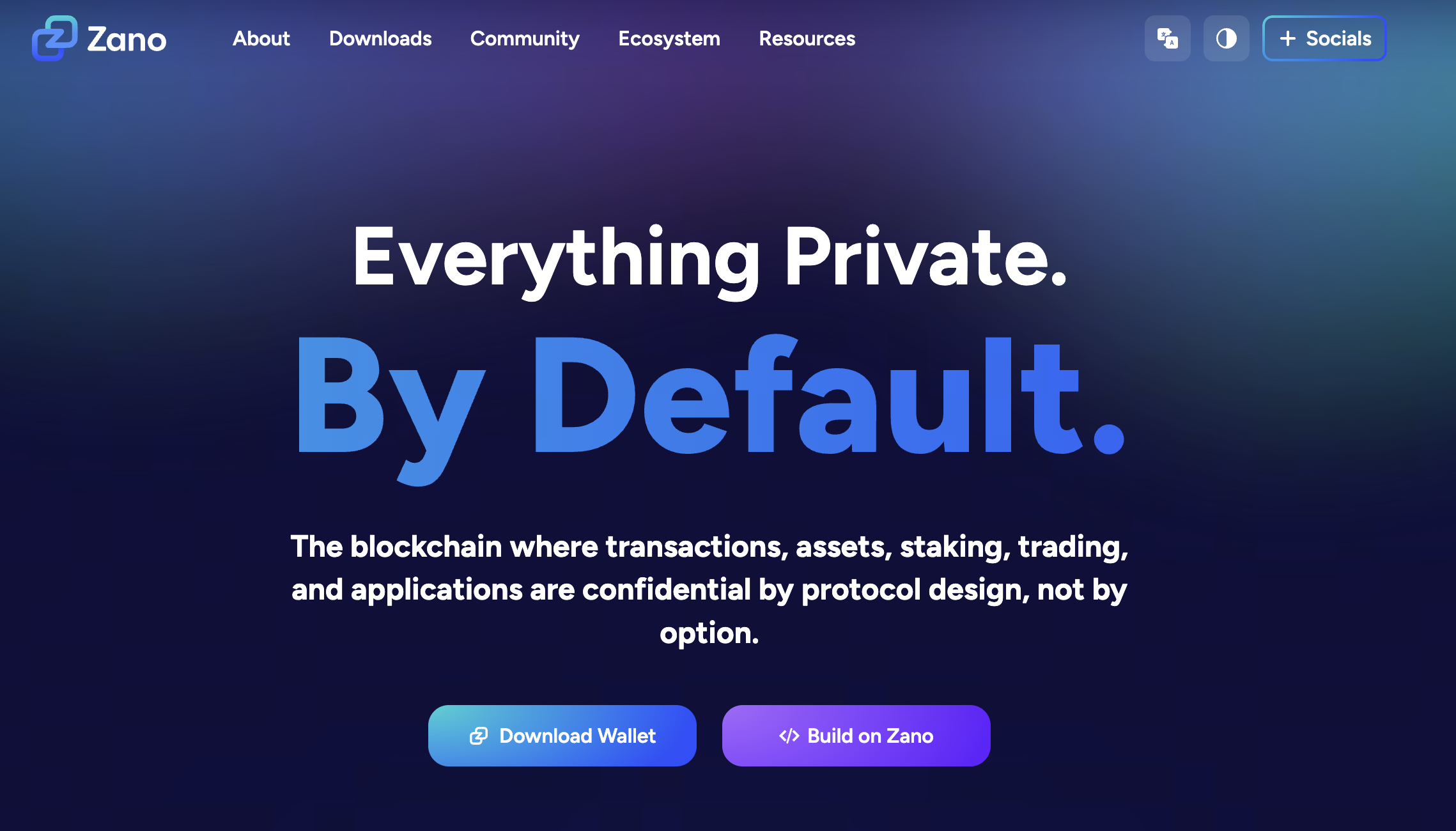
Zano is an open-source privacy blockchain launched in 2019, distinguished by its "default privacy" feature: all on-chain transactions automatically conceal critical data, eliminating the need for users to manually activate anonymity. According to official documentation, Zano's lead developer, Andrey Sabelnikov, contributed to the early CryptoNote reference implementation—a foundational technology for projects such as Monero.
Zano has consistently positioned itself beyond an "anonymous payment coin," evolving into a privacy asset platform. In 2024, the Zarcanum network upgrade introduced a private PoS mechanism supporting confidential amounts and brought Confidential Assets to mainnet. In 2025, the project advanced cross-chain wrapped assets, mobile wallets, wallet integration, and privacy-focused transaction infrastructure. The 2026 roadmap prioritizes Gateway Addresses, Hardfork 6, native ZANO cross-chain bridges, Lite Wallet, and further consensus enhancements.
Recent public updates highlight three strategic priorities for Zano: enhancing infrastructure integration, improving payment and wallet access points, and strengthening cross-chain liquidity for private assets. For instance, the March 2026 update announced Gateway Addresses on testnet; in April, Unstoppable Wallet launched initial iOS support for ZANO; and the January update reported ecosystem TVL exceeding $21 million. These milestones reflect Zano's transition from a "technology-centric privacy project" to a deployable privacy asset network.
Zano's Core Technical Architecture and Privacy Mechanisms
Zano’s technology is engineered to embed privacy as a protocol-level default, not a modular add-on. Officially, on-chain observers can only see that "a transaction occurred," without access to sender, receiver, amount, or even the asset type involved.
This privacy is achieved through several mechanisms:
- dv-CLSAG Ring Signatures: Conceal the true sender by mixing them within a group of potential signers.
- Stealth Addresses: Each incoming payment generates a one-time stealth address, preventing linkage of multiple receipts to a single public identity.
- Pedersen Commitments & Bulletproofs+: Validate transaction amounts without revealing values. In confidential asset scenarios, Zano further obscures the "asset type," unlike many solutions that only hide amounts but not token categories.
A unique feature is Auditable Wallets, allowing users to enable auditability for specific wallets while maintaining overall network privacy—addressing enterprise, financial verification, or compliance needs. Zano thus offers not just absolute anonymity but selective transparency atop default privacy.
How Zano's Hybrid PoW/PoS Consensus Works
Zano currently employs a hybrid PoW/PoS consensus model. The network alternates between PoW and PoS blocks, meaning attackers must control both hashrate and staking weight to reorganize the chain or double-spend—significantly raising the cost versus single-mechanism chains.
Key parameters: Zano's block time is approximately 1 minute, with a fixed block reward of 1 ZANO. Both miners and stakers can earn rewards; whoever finds a block receives it. This structure aims to balance security and sustainable incentives.
The Zarcanum upgrade is especially notable, introducing the first PoS mechanism that supports confidential amounts—so users can stake without publicly disclosing their balances, validator holdings, or reward paths. Zano also features no minimum staking threshold, no lock-up, and no slashing, lowering barriers for everyday users.
Zano’s consensus is not static. The 2026 roadmap targets a "Full PoS consensus upgrade" to further improve security and long-term structure. Currently, the mainnet uses hybrid PoW/PoS, but further evolution is planned.
Zano’s Confidential Assets and Privacy Asset Ecosystem
Confidential Assets are Zano’s standard for private assets, enabling anyone to issue confidential tokens on-chain. These inherit ZANO’s privacy protections—obscuring sender, receiver, amount, and asset type.
This positions Zano as a privacy asset issuance platform, not just an anonymous transfer network. Developers can issue private stablecoins, wrapped assets, membership credentials, or even NFT-like assets—while on-chain observers cannot easily determine asset holdings or transfer amounts.
A flagship example is fUSD, a private stablecoin on Zano, highlighted as a model in multiple 2025–2026 updates. Other ecosystem assets include BTCx, ETHx, SOLx, TONx, BCHx, and BNBx. Users can thus hold privacy-preserving versions of major assets without leaving Zano’s privacy layer.
Zano’s key advantage is a "shared anonymity set": as more asset types and transactions appear similar on-chain, the privacy pool strengthens. This enhances not just token diversity but the network’s overall privacy effect.
Zano in Cross-Chain, DEX, and Payment Scenarios
Zano’s main application scenarios are cross-chain asset wrapping, private trading, and privacy payments.
Cross-chain: Confidential Layer and Bridgeless enable bridging of BTC, ETH, SOL, DAI, BNB, and other public chain assets into Zano, converting them to confidential asset versions. This provides on-chain privacy without sacrificing original price exposure. The 2026 plan includes, post-Hardfork 6, bridging native ZANO and some Confidential Assets back to EVM, TON, and Solana for broader liquidity and DeFi use. Note: Once assets return to transparent chains, privacy is not retained.
Trading: Zano Trade uses Ionic Swaps for private peer-to-peer trading. Unlike public DEXs, where on-chain orders and strategies are exposed and MEV is prevalent, Zano integrates privacy semantics into trading to reduce external analysis risks.
Payments: Recent updates have accelerated. In March 2026, AEON Pay integration enabled ZANO payments via Telegram Mini App in merchant scenarios; Checkout by Bitcoin.com added support for merchant ZANO and confidential asset payments; and non-custodial donation tools like CoinDonor were integrated. Officially, fUSD is already used in some European retail and payment contexts. For privacy blockchains, such payment usability is a key validation of network value.
How Zano Differs from Monero, Zcash, and Other Privacy Coins
Among privacy coins, Monero and Zcash are Zano’s primary comparators.
Monero: Both focus on default privacy and strong anonymity. Zano, however, aims to be a privacy asset platform—supporting confidential asset issuance, private staking, on-chain private trading, alias systems, and auditable wallets. Monero’s strengths are brand recognition, longevity, and community maturity; Zano stands out for broader functionality, especially Confidential Assets and the privacy asset ecosystem.
Zcash: The main difference is default privacy and technical design. Zcash relies on zk-SNARKs for shielded addresses but also supports transparent addresses, resulting in many transparent transactions. Zano enforces default privacy, using ring signatures, stealth addresses, and commitments to hide key transaction data—and uniquely integrates asset type hiding into its framework.
In summary, Monero is "focused anonymous cash," Zcash is a "zero-knowledge privacy protocol," and Zano is building a "default privacy asset and transaction network." These are distinct product positions, not simply a matter of stronger or weaker privacy.
ZANO Tokenomics and Ecosystem Utility
ZANO is the native asset of the Zano network, used for trading fees, consensus rewards, and ecosystem functions. Key parameters: block time of 1 minute, fixed block reward of 1 ZANO, uncapped maximum supply, long-term inflation trending toward zero, a base transaction fee of 0.01 ZANO, and 100% of trading fees are burned.
Initial supply was approximately 17.5172 million ZANO, with a 3.6 million ZANO premine fund for development, marketing, partnerships, and early expenses. This supports long-term sustainability but raises questions about fund concentration and governance transparency.
Functionally, ZANO is more than a payment coin—it is also a staking asset, fee unit, base denomination for confidential assets, and a governance credential. The March 2026 update confirmed the on-chain voting system is live, allowing governance over wallet whitelisting for confidential assets.
Key Risks and Controversies When Using Zano
Regulatory risk: Privacy blockchains face higher compliance barriers, limiting listing on major centralized exchanges. Zano acknowledges that strong privacy in native ZANO raises integration hurdles, motivating the development of cross-chain transparent wrappers.
Infrastructure maturity: Core infrastructure such as Confidential Layer, Bridgeless, Gateway Addresses, and future Hardfork 6 are still evolving. Implementation bugs in bridges, wallets, mobile, or trading interfaces can impact user experience and fund safety. Some bridge infrastructure remains early-stage.
Liquidity and ecosystem depth: Zano’s user base, developer community, and market depth lag behind mainstream Layer 1s and leading privacy coins. This may limit trading depth, fiat on/off-ramp convenience, and third-party tool support for regular users.
Tokenomics debate: ZANO is not a capped-supply asset but uses a long-term, low-inflation model, with a historical premine fund. While this supports security and ongoing development, it may not appeal to investors seeking absolute scarcity.
Zano Ecosystem and Future Roadmap
The 2026 roadmap outlines a clear direction: Hardfork 6, Gateway Addresses, native ZANO cross-chain bridge, Lite Wallet, new mobile wallet architecture, Full PoS consensus upgrade, DEX integration research, P2P network privacy enhancements, and ecosystem incentive plans.
Gateway Addresses are a key milestone, introducing account-based address capabilities for exchanges, bridges, and service providers—crucial for integration efficiency. For external markets, mature engineering interfaces are as important as cryptographic strength for wallet, bridge, and trading support.
Cross-chain expansion is another focus. Historically, Zano was a "privacy endpoint"—bridging assets in for private use. With Hardfork 6, native ZANO and select confidential assets will be able to move to transparent chains, improving privacy-liquidity conversion.
Long-term, Zano aims to build a privacy financial layer—including private payments, stablecoins, wrapped assets, DEX, and selective audit tools—rather than a single anonymous coin. Success will depend on integration quality, developer adoption, and real-world usage over the next one to two years.
Summary
Zano’s core value lies not in being "just another privacy coin," but in expanding default privacy into a comprehensive asset and transaction system. It inherits the foundation of anonymous transfers and, through Confidential Assets, private staking, private trading, and cross-chain bridging, advances privacy from payment to asset and liquidity layers. As of May 2026, Gateway Addresses, Hardfork 6, wallet integration, and payment adoption are transitioning Zano from concept to product. For those focused on privacy infrastructure, private stablecoins, and confidential asset networks, Zano is a project to watch—though regulatory, liquidity, and early-stage infrastructure risks remain.
FAQs
Is Zano a privacy coin or a privacy blockchain?
Both. Zano is fundamentally a privacy-first blockchain, supporting not only native coin transfers but also asset issuance, staking, trading, and cross-chain functionality—making it a privacy blockchain rather than just a privacy coin.
Is privacy enabled by default on Zano?
Yes. Zano transactions hide amounts, addresses, and asset types by default; users do not need to manually activate anonymity.
What’s the main difference between Zano and Monero?
The key difference is scope. Monero focuses on anonymous cash, while Zano supports Confidential Assets, private DEX, private staking, and broader assetization.
How does Zano differ from Zcash?
Zcash relies on zk-SNARKs and supports both transparent and shielded addresses. Zano enforces default privacy and integrates asset type hiding and confidential asset issuance into a unified system.
After cross-chain transfers with Zano, is privacy preserved?
It depends. Assets bridged into Zano gain privacy on the Zano chain; however, ZANO or confidential assets bridged back to EVM, Solana, TON, or other transparent networks become visible on those chains.
Is ZANO supply fixed?
No. ZANO uses an uncapped issuance model, with long-term inflation approaching zero. All on-chain trading fees are burned, so high network usage can partially offset new issuance.
What are Zano’s most notable recent developments?
As of May 2026: preparations for Hardfork 6, Gateway Addresses on testnet, native ZANO cross-chain bridge plans, initial support from Unstoppable Wallet, and ongoing expansion of payment and merchant tools.