The rise of digital asset markets is introducing new challenges to the global financial system. Traditional banks boast mature payment and clearing networks but fall short in digital asset compatibility, cross-border settlement efficiency, and global open access. Meanwhile, while blockchain networks enable peer-to-peer value transfers, most protocols lack comprehensive banking capabilities, making it difficult to address more complex financial needs.
As a Deobank infrastructure network, WeFi aims to bridge the gap between traditional banking and decentralized finance. Its mission goes beyond supporting digital asset management to building a complete on-chain banking system that encompasses payments, custody, settlement, and financial service access.
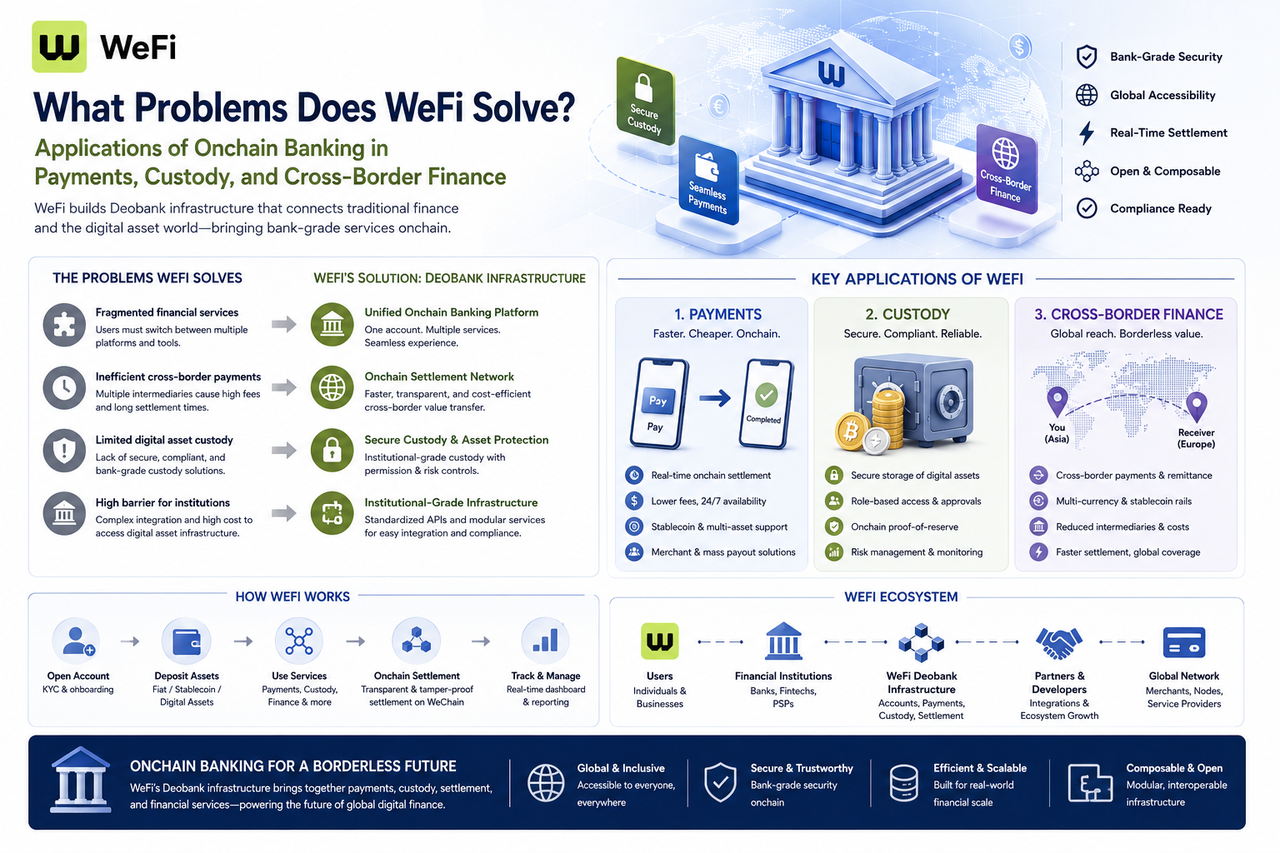
What Key Problems Does WeFi Solve?
WeFi targets several core issues that have long hindered digital finance.
First is the fragmentation of financial services. Users often find themselves switching between wallets, trading platforms, payment tools, and bank accounts.
Second is the inefficiency of cross-border fund flows. Traditional cross-border payments typically involve multiple financial institutions and clearing networks.
Additionally, weaknesses in digital asset custody, security management, and institutional access are constraining the digital finance ecosystem.
WeFi aims to lower these barriers through a unified Deobank infrastructure.
| Industry Problem |
WeFi Corresponding Solution Direction |
| Fragmented financial services |
Unified account system |
| Complex cross-border settlement |
On-chain payment network |
| Difficult digital asset management |
Custody and account services |
| High institutional access costs |
Standardized infrastructure |
| Fragmented user experience |
Integrated service platform |
How WeFi Enhances the Payment Experience
Payment is one of WeFi's most critical use cases.
Traditional payment systems rely on bank networks and payment institutions working together. While mature, cross-region payments often require multiple intermediaries.
WeFi leverages the blockchain as a value transfer layer, allowing payment data and asset settlement to be completed within a single unified system.
For digital asset users, this means greater transparency in fund flows and a reduction in the complexity inherent in traditional cross-border payments.
On-chain payment capability is a key differentiator for Deobank compared to traditional banks.
How WeFi Powers Cross-Border Financial Services
Cross-border finance is one of blockchain technology's most anticipated applications.
In the traditional model, an international remittance may pass through multiple banks and clearing houses, often taking a relatively long time to reach the final account.
WeFi uses an on-chain account system and a unified settlement network, enabling value transfers between different regions to be completed within the same infrastructure.
This approach does not aim to replace the existing financial system entirely but provides a new way to connect digital assets with global payments.
As stablecoin use grows, the importance of on-chain cross-border finance continues to rise.
WeFi's Role in Digital Asset Custody
Custody capabilities are a cornerstone of banking and a critical element of digital finance.
Many digital asset users need secure storage while retaining control over their funds.
WeFi's custody system balances account management, permission control, and asset security.
Beyond asset safekeeping, the custody system handles payment authorization, risk control, and account management.
Thus, custody capability is essential infrastructure for the Deobank network.
| Custody Need |
WeFi Capability |
| Asset preservation |
Unified account management |
| Permission control |
Multi-layered access management |
| Payment authorization |
Account-level operation permissions |
| Risk monitoring |
Security and compliance support |
| Financial service access |
Coordinated custody and payment |
How WeFi Helps Financial Institutions Enter the Digital Asset Ecosystem
WeFi provides infrastructure support not only for individual users but also for financial institutions and fintech companies.
For many institutions, building a digital asset management system in-house requires significant technical and compliance investment.
Through standardized interfaces and infrastructure services, WeFi lowers the barrier to entry, enabling institutions to enter the on-chain financial market more quickly.
This model mirrors traditional Banking-as-a-Service (BaaS) but extends its scope to the digital asset ecosystem.
Therefore, WeFi is more than a set of user-facing products—it is a financial infrastructure solution.
WeFi's Application in Stablecoin Finance
Stablecoins have become a cornerstone of digital finance.
As more payments and settlements are conducted via stablecoins, the demand for stablecoin accounts, payment tools, and management solutions continues to grow. WeFi integrates stablecoins into a unified account system, combining them with payment and custody capabilities for a seamless service flow.
This design helps transform stablecoins from simple trading instruments into foundational financial infrastructure.
For on-chain banking, stablecoins serve as a vital bridge between traditional currency systems and the digital asset world.
How Do WeFi's Solutions Differ from Those of Traditional Banks?
While both WeFi and traditional banks provide financial services, they target different problems.
Traditional banks primarily serve the fiat system, focusing on savings, loans, and payments.
WeFi is tailored for digital asset scenarios, emphasizing on-chain payments, digital asset management, and global open financial services. The two are not purely competitive; they operate in different financial environments.
As the digital asset market evolves, increasing synergies between the two models are expected.
| Comparison |
WeFi (Deobank) |
Traditional Bank |
| Target users |
Digital asset users |
Fiat currency users |
| Account system |
On-chain accounts |
Bank accounts |
| Payment method |
On-chain and digital payments |
Bank payment networks |
| Global access |
Highly open |
Regionally restricted |
| Asset type |
Digital assets and stablecoins |
Fiat assets |
What Future Applications Could On-Chain Banking Unlock?
As digital financial infrastructure matures, the use cases for on-chain banking continue to expand.
Beyond payments and custody, future on-chain banking may include digital identity, real-world asset (RWA) management, on-chain credit, and enterprise-level financial services.
For the Deobank network, value lies not only in current product features but also in its capacity to continuously extend into new service scenarios as digital financial infrastructure. This infrastructure nature is a key distinction between WeFi and many single-purpose protocols.
Summary
WeFi connects traditional finance with the digital asset ecosystem through its Deobank architecture, tackling fragmentation in financial services, inefficiency in cross-border payments, gaps in digital asset custody, and high institutional access costs.
By offering a unified account system, an on-chain payment network, digital asset custody services, and financial infrastructure capabilities, WeFi is pioneering the path for on-chain banking. As stablecoins and the digital asset market mature, the Deobank model is well-positioned to become a key component of the future digital financial system, providing new infrastructure choices for global payments, asset management, and cross-border finance.
FAQs
What key problems does WeFi solve?
WeFi addresses fragmentation in digital financial services, inefficiency in cross-border payments, difficulties in digital asset custody, and the high cost for institutions to access the digital asset ecosystem.
How is WeFi's on-chain bank different from traditional banks?
Traditional banks serve the fiat system, while WeFi focuses on digital asset management, on-chain payments, and global open financial services, leading to differences in underlying architecture and service models.
How does WeFi support cross-border payments?
WeFi uses blockchain networks and a unified settlement system to process fund transfers, reducing some intermediary steps in traditional cross-border payments and improving efficiency.
Why do digital assets need custody services?
Digital asset custody goes beyond asset storage—it includes permission control, payment authorization, risk management, and financial service access, making it an important part of digital finance infrastructure.
Is WeFi only for individual users?
No. In addition to individuals, WeFi provides infrastructure services for financial institutions and fintech companies to help them enter the digital asset ecosystem.
What role do stablecoins play in the WeFi ecosystem?
Stablecoins are integral to WeFi's payment, settlement, and digital financial services, serving as a critical bridge between traditional finance and the digital asset system.







