As the new energy vehicle industry moves into its mid-to-late competitive phase, differences based solely on battery range or motor performance are rapidly narrowing, shifting the industry’s competitive focus toward software capabilities. OTA upgrades, autonomous driving systems, data-driven optimization, and cloud-based collaborative architectures are becoming the key factors shaping product competitiveness and user experience, positioning SDV as the core direction for next-generation automotive architectures.
From an industry perspective, SDV not only transforms how vehicles are designed but also reshapes automakers’ business models. Cars are evolving from one-time product sales into “continuous software service platforms,” redefining the value of the vehicle lifecycle. Rivian exemplifies this trend, aiming to build lasting competitive advantages through a unified software platform and centralized computing architecture.
What Is a Software-Defined Vehicle (SDV)
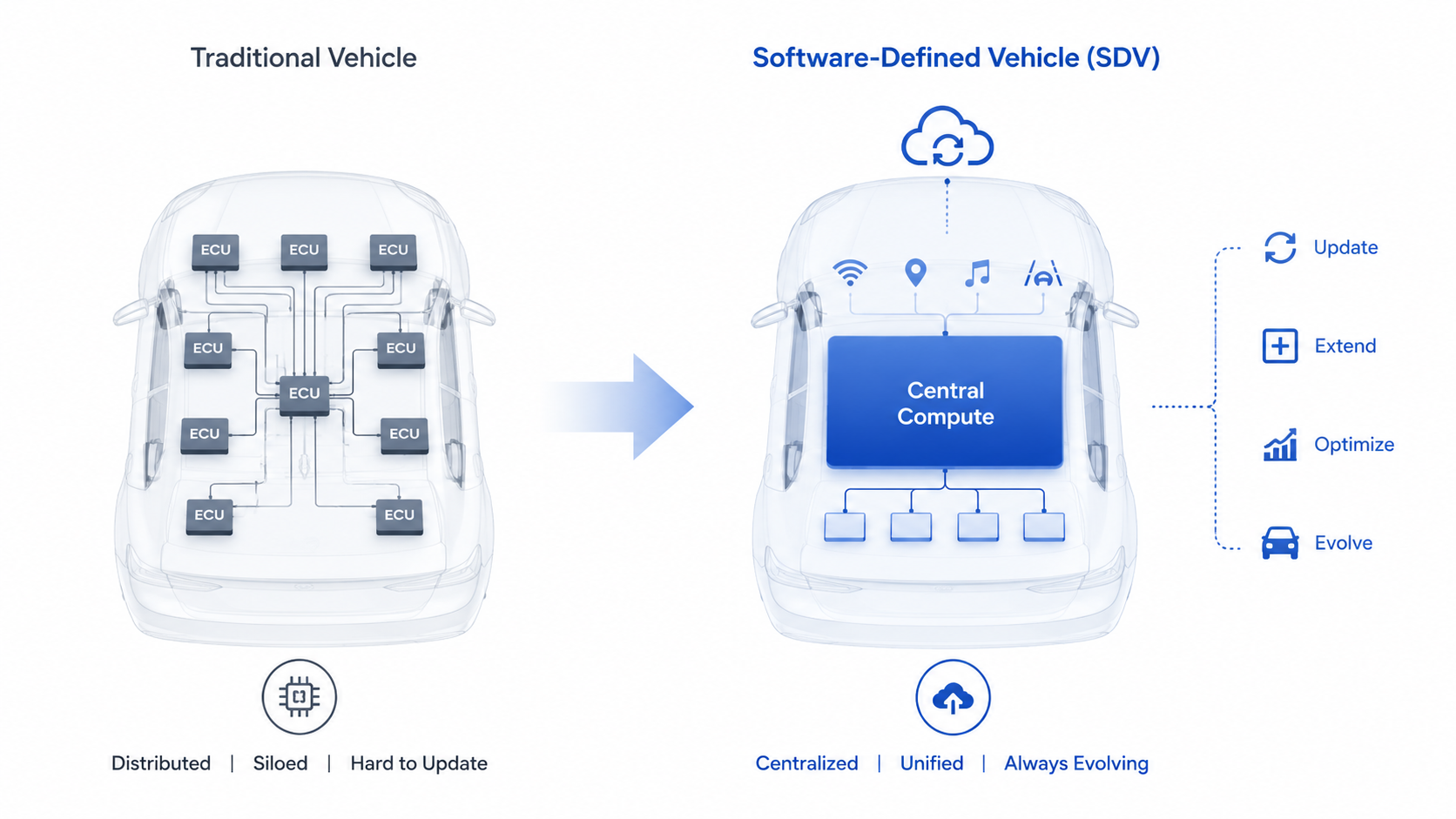
A Software-Defined Vehicle (SDV) is an automotive architecture where software systems serve as the core control logic. The fundamental concept is that vehicle functions are no longer bound to fixed hardware; instead, they are defined, updated, and expanded through software.
Traditionally, vehicle functions relied on multiple independent ECUs (Electronic Control Units), each operating in isolation—making upgrades complex and costly. By contrast, the SDV architecture integrates these functions into a unified software system via a centralized computing platform, enabling centralized control and dynamic updates.
With this architecture, vehicles shift from being “static products” to “dynamic systems” that continuously evolve through software updates. This allows vehicles to keep improving after delivery, supporting ongoing performance optimization, feature expansion, and even behavioral adjustments.
Key Features of Rivian’s Electronic and Electrical Architecture
Rivian’s electronic and electrical architecture is built on a Centralized Compute Architecture, aiming to reduce system fragmentation and enhance both software control and data processing efficiency. This approach consolidates previously distributed ECUs into a central computing unit that handles critical vehicle data and control logic, simplifying the internal network and reducing communication latency and system complexity.
Rivian also emphasizes modular software design, allowing various functions—such as powertrain control, infotainment, and driver assistance—to be updated independently while running on the same unified system, thus boosting scalability.
In its 2026 product iteration, Rivian further enhanced its onboard computing platform, enabling higher-frequency data processing and more sophisticated AI models—laying the groundwork for future autonomous driving upgrades.
How OTA Upgrades Continuously Enhance the Vehicle Experience
OTA (Over-the-Air) upgrades are a core capability of the SDV architecture, allowing software updates to be pushed to vehicles via the cloud for feature enhancements and performance improvements. Rivian’s OTA system covers not just infotainment, but also the battery management system, thermal management, power output logic, and driver assistance. This ensures vehicles can continuously gain new capabilities throughout their lifecycle, rather than becoming obsolete over time.
For example, OTA updates can optimize energy efficiency, improve acceleration response, enhance range, and introduce new driving modes or interface features.
This mechanism transforms vehicles from fixed assets into continuously evolving software platforms, enabling automakers to provide ongoing services post-sale and unlock new software subscription revenue streams.
Rivian’s Approach to Autonomous Driving Technology
Rivian pursues a “progressive software evolution” strategy for autonomous driving, rather than aiming for immediate full autonomy.
Its system leverages multi-sensor fusion (cameras, radar, and computational models) to build environmental awareness, with machine learning models continually refining driving behavior and path planning.
Currently, Rivian focuses on highway assist, lane keeping, adaptive cruise control, and complex road condition recognition, steadily advancing toward higher levels of autonomous capability.
Importantly, within the SDV architecture, autonomous driving is no longer a standalone module but a core function integrated into the overall software platform. This allows algorithms to be updated via OTA, eliminating the need for hardware changes.
As electrification becomes mainstream, the competitive edge in the automotive industry is shifting from hardware performance to software capability.
Metrics like battery range and acceleration are converging, while software determines a vehicle’s ability to continuously improve and deliver differentiated user experiences.
The software platform delivers value in three main areas:
- Continuous upgrade capability (OTA);
- Data-driven optimization (AI);
- Service-based business models (subscriptions and feature unlocks).
As a result, vehicles are evolving from manufactured products to “software-driven mobile computing platforms,” with SDV as the foundational architecture for this transformation.
How Rivian Differs from Tesla and Volkswagen in SDV
Like Tesla, Rivian employs centralized computing and OTA architecture, but its product strategy is more focused on outdoor and commercial EV scenarios rather than a fully autonomous ecosystem. Compared to Volkswagen Group, Rivian’s advantage lies in its “native software architecture,” while Volkswagen is primarily upgrading its electronic and electrical systems atop traditional architectures.
These differences produce distinct SDV development strategies: Rivian emphasizes “ground-up construction,” Tesla prioritizes “ecosystem closed-loop optimization,” and traditional automakers pursue “incremental transformation.”
Challenges Facing Software-Defined Vehicles
Despite the long-term benefits of SDV, several challenges remain:
- Increased system complexity raises reliability and safety concerns; while centralization boosts efficiency, it also introduces single-point-of-failure risks.
- Autonomous driving technology is still evolving rapidly, with algorithms not yet fully mature and functional boundaries requiring strict management.
Additional challenges include the cost of onboard computing power, integration with battery and energy systems, and heightened requirements for data privacy and regulatory compliance—all demanding higher standards for SDV architecture.
The Future of Rivian’s Software Strategy
Rivian’s software strategy will continue to advance along three main lines: further strengthening its unified computing platform for greater standardization and modularity of vehicle control systems (improving development efficiency and stability); accelerating autonomous driving capabilities through large-scale data training and AI optimization; and expanding its energy and service ecosystem, including charging networks, fleet management, and energy optimization platforms—positioning vehicles as integral nodes in the energy network.
Long term, Rivian aims to elevate its vehicles from “transportation tools” to “mobile intelligent terminals and energy nodes” through software innovation.
Summary
Rivian’s software-defined vehicle strategy is transforming vehicles from traditional mechanical products into continuously evolving intelligent computing platforms. The SDV architecture not only enhances functional scalability but also redefines value creation across the automotive industry. As electrification competition intensifies, software capability is emerging as the key variable determining the future competitiveness of automotive companies.