Traditional travel platforms have mainly relied on keyword searches and manual filtering to match accommodations, but AI is now transforming how users discover destinations, plan trips, and manage their stays. By understanding natural language requests, analyzing user preferences, and integrating massive amounts of travel data, AI enables Airbnb to offer more precise and personalized services.
From a long-term perspective, Airbnb's AI strategy is not just a technological upgrade, but a fundamental shift in platform competition. AI is poised to become the core infrastructure connecting travelers, hosts, and local services—helping Airbnb evolve from a booking platform into an intelligent travel gateway.
Why Is Airbnb Committed to AI?
Airbnb is a global home-sharing platform that connects property owners and travelers through digital technology, allowing users to book apartments, houses, villas, and unique accommodations. In recent years, with the rapid rise of Generative AI, Airbnb has accelerated its deployment of AI in search, customer service, recommendation systems, and travel services, aiming to further boost platform efficiency and unlock new growth opportunities.
For over a decade, competition in online travel has focused on inventory, pricing, and transaction efficiency. Hotel booking sites, online travel agencies, and home-sharing companies have all expanded supply and optimized user experience to win market share.
But AI is changing the rules of competition in travel. In the future, searching for accommodations may go beyond “city + date + room type”—users could simply describe their needs in natural language, such as: “I want a family-friendly place, a 10-minute walk from the beach, with a kitchen, and suitable for two weeks of remote work.”
AI can understand these complex needs and, by combining user history, destination data, and property attributes, deliver more accurate recommendations. For Airbnb, AI is not just about upgrading a single feature—it’s about transforming the business model. The platform aims to leverage its vast accommodation data, user behavior, and community feedback to build a smarter travel service ecosystem.
Search has always been at the heart of the Airbnb user experience.
Traditional accommodation searches rely on filters such as:
- Location
- Check-in date
- Price range
- Number of rooms
- Amenities
While effective, this approach often fails to capture users’ real intentions.
For example, someone searching for a place in Paris might actually want “a romantic spot for couples, near the arts district, with a local vibe.” Traditional search systems struggle to interpret these emotional and situational needs, but AI can match them through semantic understanding.
Generative AI’s strength lies in analyzing vast amounts of unstructured data, including:
- Property descriptions
- User reviews
- Images
- Location information
- Nearby amenities
With this data, AI can help users find accommodations that truly meet their expectations, and do so faster.
Airbnb is exploring how AI can enhance the search experience, shifting from “users actively searching for listings” to “the system understanding user needs and proactively recommending options.” This could reshape the travel industry, as competition may shift from inventory size to who best understands the user.
Platforms with massive user data have a natural edge in the AI era.
How Airbnb Uses AI to Improve Customer Service
Customer service is a critical operational function for major travel platforms. Because accommodation transactions involve hosts, travelers, payments, order changes, and unexpected issues, support needs are complex. Traditional human agents can solve problems, but are costly and can’t guarantee 24/7 real-time responses.
AI-powered customer service is becoming a key part of Airbnb’s operational strategy. With Large Language Models (LLMs), AI can handle many common issues, such as:
- How to change a reservation
- How to cancel a booking
- How to contact a host
- How to resolve check-in issues
Unlike simple bots, LLM-based AI assistants can understand context and generate natural, situation-specific replies. For example, if a user says, “My flight is delayed, I may not be able to check in tonight,” AI can both recognize the problem and offer solutions based on booking details.
For Airbnb, the value of AI customer service goes beyond cost savings—it’s about improving the user experience. Travel is time-sensitive, and users want quick help. AI can reduce wait times and boost service efficiency. In the future, AI support may evolve into a travel concierge that proactively updates users on itinerary changes and offers helpful suggestions.
How Large Language Models Enhance Travel Planning
Travel planning is another area where AI is transforming the industry. Traditionally, users had to search separately for:
- Hotels
- Attractions
- Restaurants
- Transportation
This process is time-consuming. Large Language Models can integrate diverse information to provide more complete travel plans. For example, a user might say: “I’m planning a 7-day trip to Japan, want to experience the local culture, avoid tourist traps, and have a couple-friendly itinerary.”
AI can generate:
- City recommendations
- Accommodation area suggestions
- Itinerary planning
- Activity ideas
Airbnb’s extensive lodging data and user reviews give it a strong foundation for building AI travel assistants. In the future, accommodation search may be just one part of the decision process, with AI serving as the entry point that connects lodging, transportation, dining, and experiences.
This is a key reason Airbnb is doubling down on AI. If the platform becomes the first stop for trip planning, its commercial value can expand far beyond accommodation bookings.
How AI Helps Hosts Improve Operations
Another major focus for Airbnb is using AI to help hosts run their businesses more efficiently. For many individual hosts, managing short-term rentals involves a lot of work:
- Optimizing property descriptions
- Adjusting prices
- Responding to guest inquiries
- Managing reviews
- Handling check-ins
AI can automate some of these tasks. For example:
AI-Optimized Property Descriptions
Descriptions directly impact click-through rates. AI can help hosts write more compelling listings based on market trends and user search habits.
AI-Powered Dynamic Pricing
Accommodation prices fluctuate with season, holidays, local events, and market demand. AI can analyze historical data and market trends to suggest pricing adjustments.
AI-Driven Automated Communication
Hosts often answer the same questions repeatedly. AI assistants can handle routine inquiries, boosting operational efficiency. These tools lower the barrier for hosting, encouraging more users to join Airbnb. For the platform, more efficient hosts mean higher supply quality and stronger competitiveness.
How Airbnb Stands Apart from Booking and Google in AI Travel
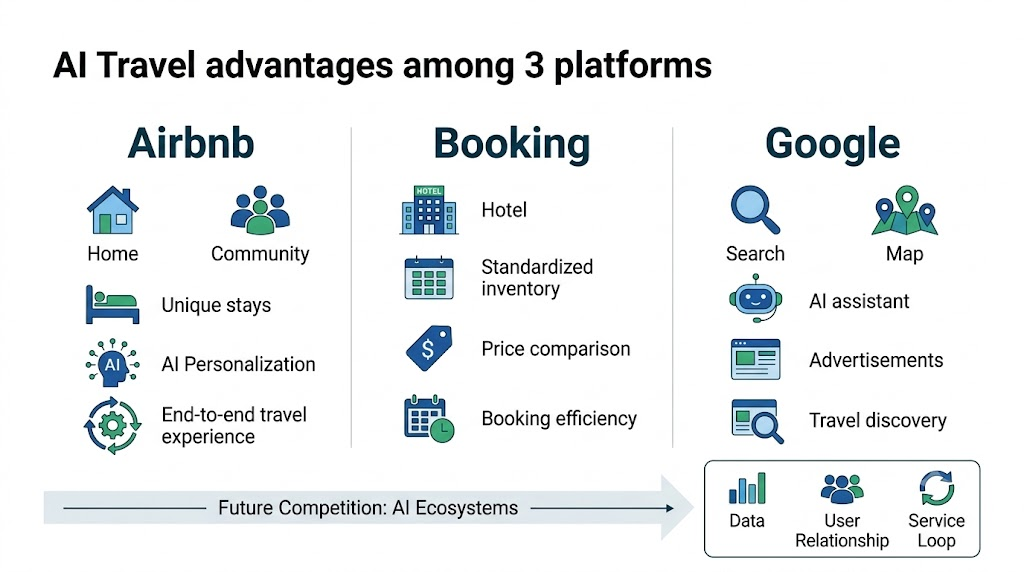
AI is now a key battleground in travel, with each company bringing unique strengths.
Compared to Booking Holdings, Airbnb emphasizes community, experience, and personalized travel. Booking has a vast hotel inventory and excels in standardized lodging, while Airbnb’s edge comes from its non-standard listings and engaged user community.
Compared to Google, Airbnb’s strength is vertical travel data. Google’s search, maps, and ad ecosystem help users discover information, but Airbnb is closer to actual bookings and real travel needs.
In the future, competition may be less about individual platforms and more about competing AI ecosystems. Platforms with richer data, stronger user relationships, and a more complete service loop may gain the upper hand in the AI era.
AI offers huge opportunities for travel, but challenges remain.
Data Privacy
AI needs large volumes of user data for training and optimization, including:
- Search history
- Travel preferences
- Spending habits
Protecting user privacy is a must for platforms.
AI Recommendation Accuracy
Travel choices are highly personal. If AI suggestions don’t match user expectations, trust can erode. For example, a listing may look great in photos but disappoint in reality—AI recommendation engines must factor in real reviews to reduce risk.
Technical Costs
Large-scale AI requires ongoing investment in computing and R&D. Balancing tech spending with business returns is a long-term challenge.
Intensifying Competition
With AI becoming mainstream, more companies are entering smart travel. Airbnb will face competition from hotel groups, OTAs, and tech firms.
The Future of Airbnb’s AI Strategy
Looking ahead, Airbnb’s AI strategy may focus on several key areas:
- Building a native AI search experience—users may find accommodations through chat, not just filters.
- Developing smart travel assistants—AI could guide users from planning to execution.
- Increasing automation—AI can help hosts manage listings and help Airbnb optimize operations.
- Integrating more local services—by combining lodging, experiences, and destination services, Airbnb could create a more complete travel ecosystem.
In the long run, AI’s value for Airbnb is not just about efficiency—it’s about redefining what a travel platform can be.
Summary
Airbnb is using AI to transform itself from a home-sharing platform into an intelligent travel ecosystem. AI search helps users find the right accommodations, smart customer service boosts efficiency, Large Language Models power personalized planning, and AI tools help hosts lower operating costs.
Compared to traditional travel platforms, Airbnb’s edge lies in its global network, community data, and user experience. As AI matures, competition in travel may shift from scale to smart services.
However, AI strategies must overcome hurdles like privacy, costs, accuracy, and competition. Whether Airbnb can leverage AI for new growth will be a decisive factor in its long-term value.