As global tourism trends shift, cruises have evolved from a niche luxury travel product into a mainstream leisure choice for families, young travelers, and the middle- to upper-income segment. Today’s large cruise ships not only provide transportation—they create a holistic consumer ecosystem that includes accommodations, dining, entertainment, shopping, and shore excursions, enabling cruise lines to diversify their revenue streams.
The driving force behind the growth of the cruise economy isn’t just a rise in passenger numbers—it's the ongoing evolution of the business model. Carnival, for example, leverages a multi-brand portfolio, large-scale operations, digital management, and fleet optimization to boost the profitability of each vessel and accelerate the industry’s transformation from a “transportation business” to a comprehensive vacation platform.
What Is the Cruise Economy?
The cruise economy is a comprehensive industry model built around large cruise ships, integrating travel, lodging, dining, entertainment, destination spending, and commercial services.
Unlike traditional tourism, cruises offer a “one-stop experience.” Once on board, the ship itself becomes a mobile resort, providing accommodations, meals, entertainment, and multi-destination access.
Modern cruise ships typically feature:
- Capacity for thousands of guests
- A variety of dining options
- Entertainment venues
- Retail shopping areas
- Fitness, leisure, and recreation facilities
This model allows cruise lines to earn not only from ticket sales but also from guests’ onboard spending throughout the voyage. From an industry chain perspective, the cruise economy spans multiple sectors:
Cruise operators handle fleet development, itinerary planning, customer management, and brand marketing; port cities benefit from visitor spending; and industries like shipbuilding, fuel, food supply, and maintenance all profit from cruise sector growth. In recent years, global tourism has shifted from traditional sightseeing to experiential travel, making cruises—thanks to their high experiential value—one of the fastest-growing segments.
How Does Carnival Succeed with a Multi-Brand Strategy?
One of Carnival Corporation’s core strengths is its multi-brand strategy, which targets a wide range of consumer segments. Unlike single-brand cruise companies, Carnival uses its diverse brands to position itself across the mass market, premium, and luxury segments simultaneously. Its main brands include:
Carnival Cruise Line
The company’s largest brand, Carnival Cruise Line targets the mass leisure market, emphasizing entertainment, family travel, and strong value.
Princess Cruises
Princess Cruises is positioned for the premium market, focusing on destination immersion, cultural experiences, and high-quality service.
Cunard
Cunard stands for classic luxury, highlighting heritage, refined service, and a traditional cruise experience.
Holland America Line
This brand appeals primarily to mature travelers, offering long voyages, cultural exploration, and premium service.
Costa Cruises
Costa Cruises is focused on the European market, blending Mediterranean cultural influences.
With its multi-brand portfolio, Carnival tailors products to specific market needs. For example, young families may choose Carnival Cruise Line, while luxury seekers might opt for Cunard. This approach mirrors large hotel groups, expanding market reach through brand segmentation while leveraging shared supply chains, technology platforms, and operational expertise.
Where Do Cruise Companies Make Their Money?
Many assume cruise lines rely mainly on ticket sales, but today’s cruise companies have developed a much more diversified profit structure.
Ticket Sales Are Foundational
Cruise fares typically include accommodations, basic meals, and some entertainment—making them the core revenue source.
Carnival adjusts pricing dynamically based on:
- Itinerary popularity
- Travel season
- Booking lead time
- Cabin category
Onboard Spending Drives Profitability
Onboard spending is a critical profit engine for cruise lines.
Key categories include:
- Specialty dining
- Beverage services
- Entertainment activities
- Internet packages
- Spa services
- Retail shopping
Since guests often spend several days to a week or more onboard, cruise companies have ample opportunity to increase ancillary revenue.
Shore Excursion Revenue
When ships dock, guests typically participate in local tours, cultural experiences, and special activities.
Some major cruise lines have even developed private destinations, allowing them to control the guest experience and further enhance revenue.
Why Do Cruises Benefit from Economies of Scale?
The cruise industry is defined by economies of scale, giving large operators a significant competitive edge.
Large ships lower per-guest operating costs. A single vessel can carry thousands of passengers, but crew and infrastructure costs don’t rise proportionally—so as scale increases, unit costs decrease.
Large companies also have stronger purchasing power. Each year, Carnival procures vast quantities of:
- Food
- Fuel
- Ship equipment
- Service resources
This buying power drives down supply chain costs. Large fleets also enable better resource utilization. Operators can redeploy ships seasonally—for example, adding Caribbean itineraries in winter and shifting to Europe in summer—maximizing fleet efficiency throughout the year.
Additionally, major cruise lines have greater brand influence. Since cruises are a high-value purchase, consumers tend to prefer established brands with proven track records.
How Does Carnival Maximize Ship Utilization and Profitability?
For cruise lines, ships are the most valuable assets—optimizing their utilization is key to profitability. Carnival drives efficiency through several strategies:
Optimized Itinerary Deployment
The company adjusts fleet assignments based on market demand, allocating more ships to high-demand regions.
The Caribbean remains the world’s most mature cruise market, while Europe and Asia offer new growth opportunities.
Maximizing Guest Spend
Rather than simply raising ticket prices, increasing onboard spending delivers higher margins.
To this end, Carnival continues to expand:
- Premium dining
- Entertainment options
- Digital services
- Personalized travel experiences
Fleet Modernization
New-generation ships typically offer:
- Greater energy efficiency
- Lower maintenance costs
- Enhanced entertainment facilities
While newbuilds require significant investment, they deliver long-term operational benefits.
Data-Driven Operations
Digital technologies enable Carnival to analyze guest behavior and optimize:
- Pricing strategies
- Service recommendations
- Itinerary planning
- Resource allocation
In recent years, Carnival has focused on cost optimization and revenue growth. Its latest financial reports show strong booking demand and a steady recovery in cruise operations.
How Does Carnival Compare to Royal Caribbean and Norwegian Cruise Line?
The global cruise industry is dominated by Carnival, Royal Caribbean, and Norwegian Cruise Line.
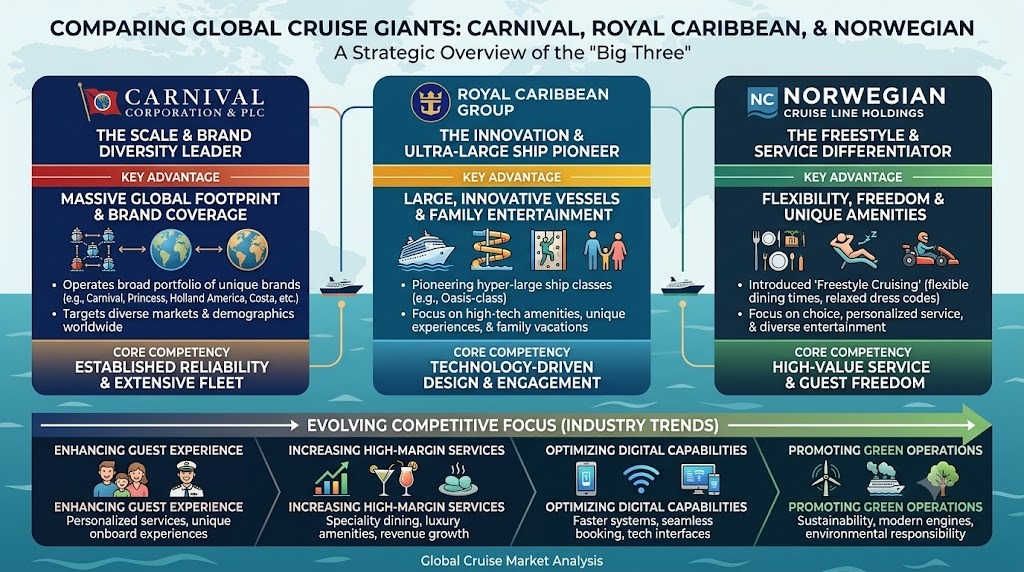
Carnival’s core strengths are scale and brand breadth.
Royal Caribbean Group focuses on innovative mega-ships, family entertainment, and cutting-edge technology to attract guests.
Norwegian Cruise Line Holdings differentiates itself through a “freestyle” experience, offering flexible dining and a relaxed vacation style.
Competition among the three is shifting from simply growing fleet size to:
- Enhancing the guest experience
- Expanding high-margin services
- Optimizing digital capabilities
- Advancing green operations
Carnival excels in broad market coverage, Royal Caribbean leads in innovation, and Norwegian emphasizes service differentiation.
What Challenges Does the Cruise Industry Face?
Despite continued growth, the cruise industry faces several challenges.
Fuel Cost Pressures
Cruising is energy-intensive, and rising fuel prices directly impact operating margins.
Stricter Environmental Regulations
Global carbon emission standards are tightening, requiring cruise lines to invest heavily in sustainability.
This includes:
- Clean-energy vessels
- Energy-saving technologies
- Waste management systems
Macroeconomic Factors
Cruising is a discretionary expense. During economic downturns, consumers may curtail high-value travel.
Intensified Competition
As major cruise lines expand, maintaining brand differentiation is an ongoing challenge.
What Are the Global Trends Shaping the Cruise Industry?
The cruise economy is expected to keep growing, driven by several key trends:
Future competition will focus on the overall guest experience—not just destinations.
Cruise lines must enhance their offerings with entertainment, dining, themed events, and unique services.
Premiumization
Travelers are willing to pay more for unique experiences, and the luxury cruise market still has room to grow.
Deepening Use of AI and Digitalization
Artificial intelligence, big data, and smart systems will help cruise lines optimize:
- Guest service
- Itinerary planning
- Operations management
Green Technology and Industry Upgrades
Environmental requirements will accelerate adoption of more efficient energy solutions.
Expanding Asian Market Potential
As Asian tourism spending rises, the region is poised to become a major growth driver for the cruise industry.
Conclusion
The cruise economy’s sustained growth is rooted in its ability to meet the demand for experiential travel and generate greater commercial value through an integrated consumption model.
Carnival Corporation, as a global industry leader, has built strong competitive advantages through multi-brand operations, large-scale fleet management, and digital transformation.
Looking ahead, the cruise industry will be propelled by rising travel demand, technology innovation, and sustainability. However, energy costs, environmental regulations, and economic cycles will continue to shape long-term corporate performance.
For Carnival, future success will hinge not just on fleet size, but on improving the profitability of each ship and consistently enhancing the guest experience.