As competition in the retail sector shifts from expansion to efficiency, AI has emerged as a crucial tool for large retailers to strengthen their operational capabilities. For Walmart, with its global store network and complex supply chain, AI not only helps reduce operational costs but also enables more accurate consumer demand forecasting, optimizes product flow, and enhances the integration of online and offline customer experiences.
Why Walmart Has Made AI a Core Strategic Focus
Historically, Walmart gained its competitive edge through large-scale procurement, low-price strategies, and a global supply chain. However, with the rapid rise of e-commerce, retail competition has shifted from "owning more stores" to "meeting consumer needs faster and more precisely." In this new landscape, AI has become a cornerstone of Walmart’s digital transformation.
In recent years, Walmart has significantly increased its investment in AI, data analytics, and automation, advancing AI adoption through in-house R&D, a robust partner ecosystem, and cloud infrastructure. The company’s objective is not just to deploy chatbots or isolated smart tools, but to embed AI throughout the entire business process, including procurement, inventory, logistics, sales, and customer service.
As a global retailer, Walmart generates vast amounts of sales, inventory, and consumer behavior data daily, providing a rich foundation for training AI models. Analyzing this data enables Walmart to better identify market trends and drive greater efficiency across its retail operations.
How AI Enhances Inventory Management and Demand Forecasting
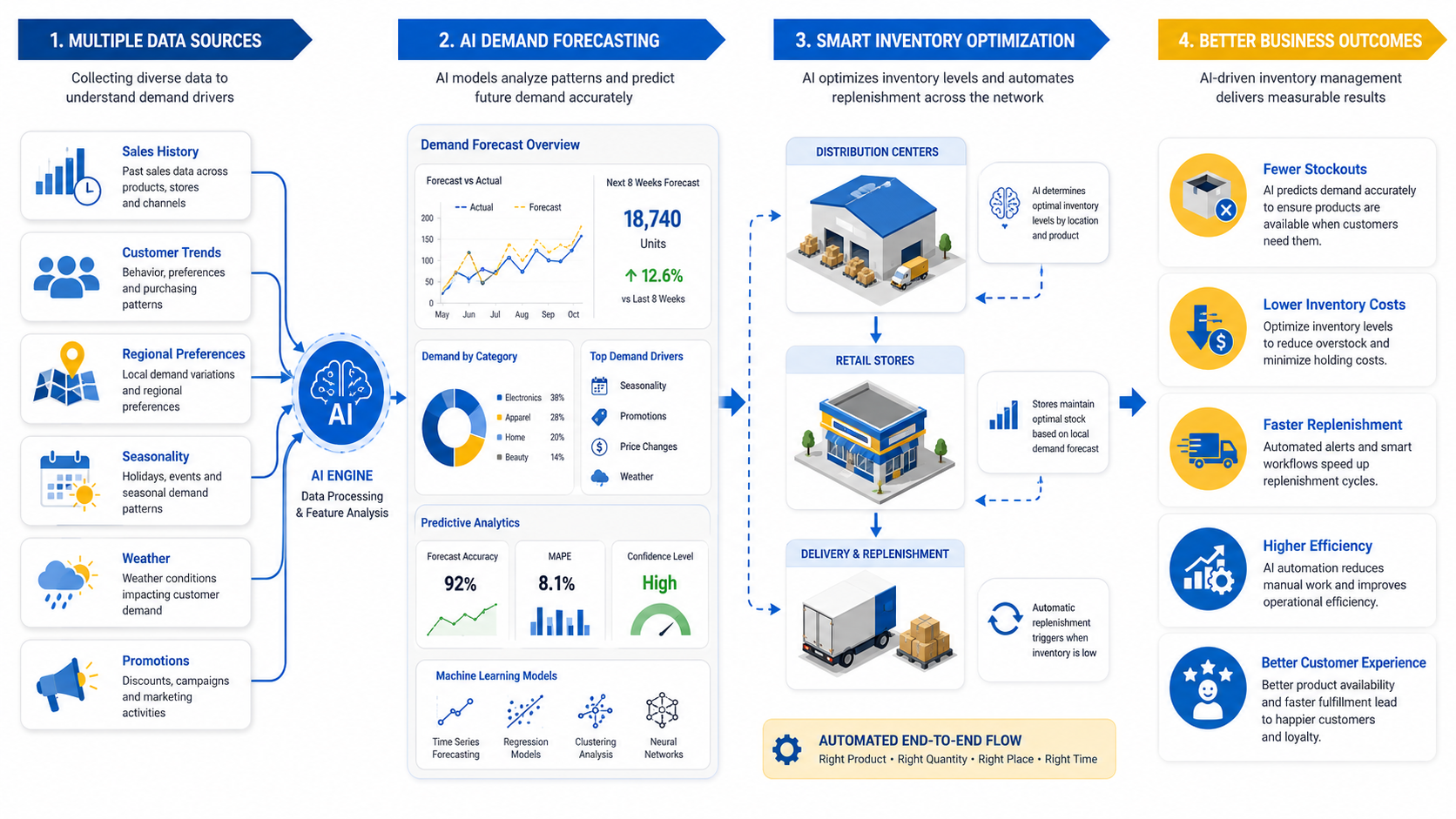
Inventory management remains one of the most critical operational elements in retail. Excess inventory drives up storage costs, while shortages risk losing customers. Accurately forecasting consumer demand is a persistent challenge for major retailers. Walmart is leveraging AI to sharpen its demand forecasting capabilities. While traditional inventory management relies on historical sales data and human expertise, AI systems analyze a broader array of variables, including purchasing trends, regional consumption patterns, seasonality, weather, and market events.
For example, during holiday shopping seasons, consumer demand can vary widely by region. AI systems leverage real-time data to predict which products will see increased demand, enabling Walmart to proactively adjust inventory allocation. This approach reduces out-of-stock situations and minimizes unnecessary inventory buildup. AI also streamlines the restocking process by analyzing sales velocity and inventory levels, automatically alerting the supply chain team to replenish stock and enhancing store efficiency.
Improved inventory forecasting is pivotal to Walmart’s low-price model. More efficient inventory management reduces waste and allows Walmart to pass cost savings on to customers.
How Walmart Uses AI to Optimize Its Supply Chain
The supply chain is a core competitive advantage for Walmart, and AI is now central to boosting supply chain efficiency. Managing a global retail supply chain involves suppliers, distribution centers, transportation networks, and stores—any inefficiency can impact the customer experience. AI enables Walmart to manage its entire supply chain with greater intelligence.
In supplier management, AI analyzes product performance, optimizes purchasing plans, and forecasts market demand. For logistics, AI determines optimal delivery routes based on order volume, transportation paths, and inventory locations.
Walmart also uses data analytics to improve supply chain transparency. Real-time tracking of product movement allows the company to quickly identify issues such as shipping delays, inventory discrepancies, or demand shifts.
Compared to traditional, manually coordinated supply chains, AI-powered systems process data faster and automate decision-making, significantly improving operational stability for Walmart’s global network.
How Automated Fulfillment Centers Drive Efficiency
Beyond AI software systems, automation technology is a key pillar of Walmart’s smart retail strategy. In recent years, Walmart has built automated fulfillment centers, deploying robotics, intelligent sorting equipment, and automated warehousing to enhance logistics capacity.
Traditional fulfillment centers depend heavily on manual labor for sorting, handling, and packaging. Automation handles repetitive tasks at scale, accelerating order processing. AI systems coordinate robotic operations and dynamically adjust warehouse workflows based on order requirements.
Automated fulfillment centers reduce labor costs and improve delivery accuracy. As e-commerce order volumes surge, automation enables Walmart to fulfill orders faster and meet growing consumer expectations for rapid delivery.
In an omnichannel retail model, fulfillment efficiency directly shapes the customer experience. The tighter the integration between stores, e-commerce, and logistics, the stronger the competitive advantage.
AI is also reshaping the consumer experience. For online shopping, Walmart employs AI to optimize product recommendations, delivering more personalized displays based on search history, purchase records, and browsing behavior. While traditional e-commerce relied on keyword searches, AI better understands consumer intent—even when users don’t know exact product names, AI can match needs to relevant products.
Generative AI is advancing intelligent shopping assistants, enabling consumers to interact with AI in natural language for product searches, price comparisons, and purchase advice.
In customer service, AI handles common inquiries and improves response times. Tasks like order tracking, returns, and product information can be managed by intelligent systems, streamlining the support process.
This evolution is changing how retailers and consumers interact—AI is now a key touchpoint in the customer experience, not just a back-end tool.
Walmart vs. Amazon: Different Paths in AI Retail
Walmart and Amazon are both investing heavily in AI, but with different priorities.
Amazon’s AI strategy is built on e-commerce, cloud computing, and data services. As a leading e-commerce platform, Amazon possesses vast online consumer data and provides AI infrastructure through Amazon Web Services.
By contrast, Walmart’s AI advantage stems from its physical retail network and supply chain. Its extensive store footprint serves as both sales channels and data sources.
Amazon focuses on enhancing the online shopping experience, recommendation algorithms, and cloud capabilities, while Walmart prioritizes using AI to boost physical retail efficiency and integrate online and offline operations.
The two companies represent distinct AI retail strategies: Amazon expands through digital platforms, while Walmart modernizes traditional retail infrastructure with AI.
Challenges in AI-Driven Retail
Despite new opportunities, AI-driven retail faces several challenges:
-
AI systems require large volumes of high-quality data. Retailers must ensure data accuracy, security, and compliance with privacy standards.
-
AI and automation demand significant investment. Building smart warehouses, upgrading IT systems, and developing AI applications all require long-term capital. Large enterprises must balance short-term costs with long-term returns.
-
AI may reshape retail employment. As automation rises, some repetitive roles may diminish, while demand grows for technical and operational talent.
Additionally, retail competition is intense, and AI is not exclusive to Walmart. Rivals like Amazon, Costco, and Target are also accelerating digital transformation, so ongoing innovation is vital for Walmart to maintain its lead.
The Future of Walmart’s AI Strategy
Looking ahead, Walmart’s AI strategy is likely to advance in three directions:
-
Driving full-scale retail intelligence. AI will further penetrate core functions like inventory, logistics, procurement, and store management, automating the retail ecosystem.
-
Expanding generative AI applications. As large-scale models mature, AI shopping assistants, smart customer service, and personalized recommendations will redefine consumer interactions.
-
Building a data-driven retail ecosystem. With vast consumer and transaction data, Walmart can use AI to unlock value in advertising, brand services, and business analytics.
Long term, AI is poised to be more than a cost-saving tool—it will serve as the technological bedrock for Walmart to redefine retail.
Conclusion
Walmart’s commitment to AI reflects the global retail sector’s digital transformation.
By leveraging AI for inventory forecasting, supply chain optimization, automated fulfillment, and smart shopping experiences, Walmart is evolving from a traditional retailer into a data-driven, intelligent retail platform.
Going forward, retail competition will hinge not just on price or store count, but on how effectively companies use data and technology to drive efficiency. For Walmart, AI will be the backbone connecting supply chain, consumers, and the broader business ecosystem, shaping its future growth trajectory.