As blockchain technology steadily enters the gaming industry, a growing number of projects are exploring digital asset ownership and decentralized economic models. World of Dypians stands out as a representative example, leveraging NFTs, WOD tokens, and on-chain governance to build a new gaming ecosystem. It serves as a key case study for understanding Web3 gaming paradigms.
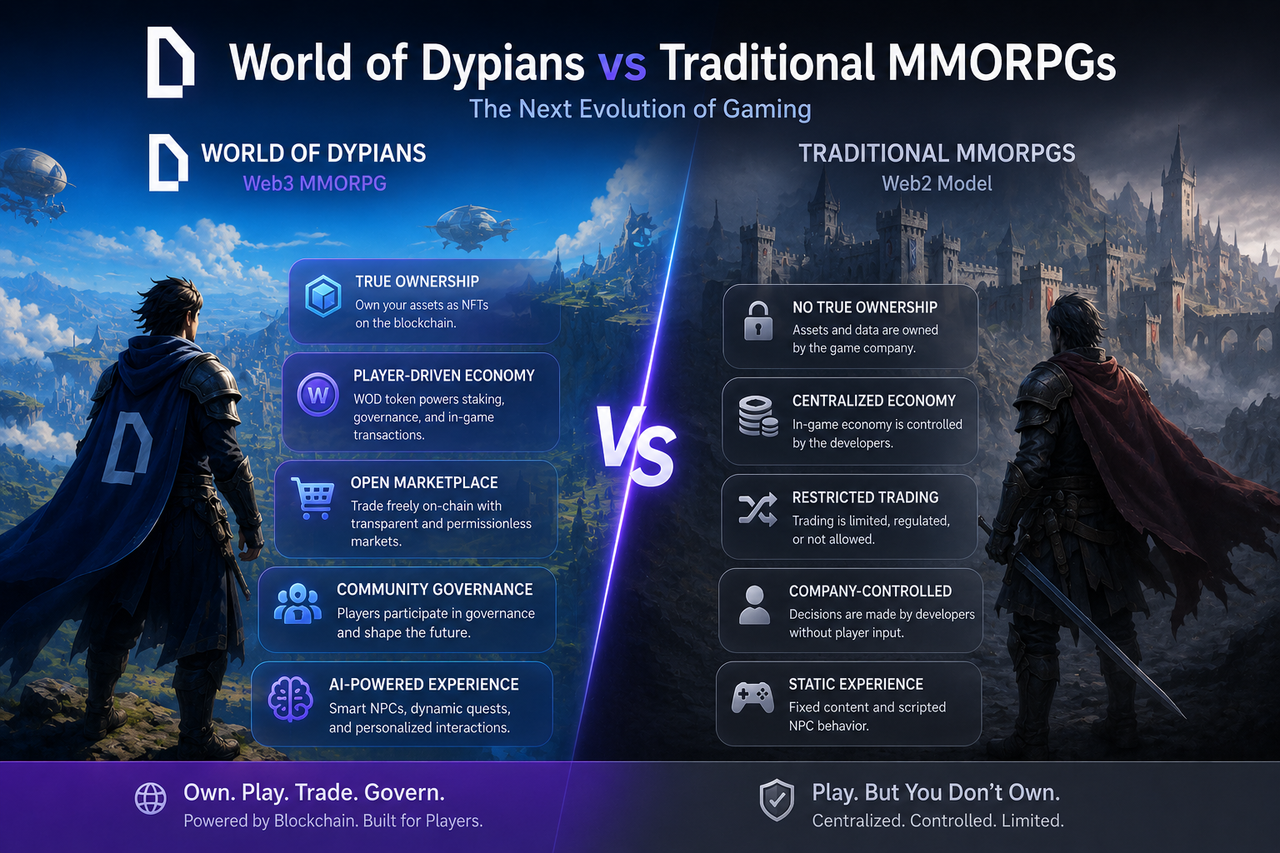
What Is World of Dypians?
World of Dypians (WOD) is a Web3 gaming ecosystem that fuses MMORPG, NFTs, AI, and metaverse infrastructure.
It preserves the core elements of traditional MMORPGs—open-world exploration, character progression, and quest systems—while integrating blockchain technology so that in-game assets exist as NFTs owned by players.
Through WOD tokens, World of Dypians connects the in-game economy, governance framework, and incentive mechanisms into a unified on-chain economic network.
What Is a Traditional MMORPG?
MMORPG stands for Massively Multiplayer Online Role-Playing Game.
Traditional MMORPGs are typically operated by centralized game companies. Players create characters, complete quests, and engage in combat to earn equipment and resources.
While players can accumulate substantial in-game wealth, those assets are stored on the game company's servers, with ownership and ultimate control remaining with the platform.
How Does Digital Asset Ownership Differ?
Digital asset ownership is the most fundamental distinction between World of Dypians and traditional MMORPGs.
In traditional MMORPGs, player items, currencies, and character data reside on centralized servers. If an account is banned, a server shuts down, or rules change, players have little to no control over their assets.
World of Dypians uses blockchain to record asset ownership. Equipment, land, and collectibles as NFTs are stored in players' wallets and managed entirely by them.
This shift transforms digital assets from mere "usage rights" into true "ownership."
How Do the Game Economic Systems Differ?
The economy of a traditional MMORPG is designed and tuned by the development team.
Operators can adjust drop rates, item stats, currency supply, and market rules to maintain balance.
World of Dypians' economy, however, is built on WOD tokens and on-chain assets. Economic activity extends beyond the game itself into NFT marketplaces and the broader on-chain ecosystem.
As a result, Web3 game economies are more open and highly composable.
How Do NFTs Differ from Traditional In-Game Items?
Both NFTs and traditional in-game items serve as player assets, but their underlying nature is fundamentally different.
Traditional items are locked to a specific server and game; the platform retains ultimate ownership.
NFTs are minted on the blockchain, offering uniqueness and verifiability. Players can store them in wallets and freely transfer or trade them according to the project's rules.
Technically, NFTs give digital assets an existence independent of any game server.
How Do Player Trading Mechanisms Differ?
Traditional MMORPGs often restrict player-to-player trading.
Some allow market trading, but the rules, fees, and asset circulation scope are controlled by the operator.
World of Dypians provides an open trading environment through its NFT Marketplace. Eligible assets can circulate freely, with every transaction recorded on the blockchain.
This design increases asset liquidity and enhances transaction transparency.
Governance is a defining feature of Web3 games.
In traditional MMORPGs, updates, events, and rule changes are decided solely by the development team.
World of Dypians introduces WOD token-based governance. Token holders can propose and vote on changes, influencing the ecosystem's direction.
While the core team still handles development, community involvement is far greater than in traditional setups.
How Does AI Differ in Gaming Experience?
AI is a standout feature of World of Dypians.
In traditional MMORPGs, most NPCs and quests run on fixed scripts, resulting in a predictable experience.
World of Dypians uses AI to deliver more dynamic interactions, including intelligent NPCs, personalized guidance, and content recommendations.
AI not only boosts immersion but also lowers the learning curve for Web3 newcomers.
World of Dypians vs Traditional MMORPGs
| Comparison Dimension |
World of Dypians |
Traditional MMORPG |
| Game Type |
Web3 MMORPG |
MMORPG |
| Asset Ownership |
Player holds NFTs |
Platform controls |
| Asset Storage |
Blockchain wallet |
Game server |
| Trading Method |
On-chain marketplace |
Platform-restricted trading |
| Game Economy |
Token-based economy |
Centralized economy |
| Governance Model |
Community governance |
Official-led |
| NFT Support |
Supported |
Not supported |
| AI System |
Integrated AI modules |
Mostly fixed scripts |
| Metaverse Scalability |
Strong |
Limited |
Summary
Though World of Dypians and traditional MMORPGs share similar gameplay, their core differences lie in digital asset ownership and ecosystem logic. Traditional MMORPGs emphasize centralized control, while World of Dypians uses blockchain to grant players greater asset sovereignty and participatory rights.
Together, NFTs, WOD tokens, community governance, and AI define World of Dypians' Web3 identity. This model not only transforms how game assets are managed but also pushes the gaming industry toward a more open, composable digital economy.
FAQs
What is the biggest difference between World of Dypians and traditional MMORPGs?
The biggest difference is digital asset ownership. World of Dypians uses NFTs and blockchain to let players truly own their assets, while traditional MMORPG assets are controlled by the game operator.
Is World of Dypians an MMORPG?
Yes, World of Dypians is an MMORPG. It includes core MMORPG elements—open-world exploration, character progression, quests, and multiplayer interaction—while adding Web3 technology.
Why do Web3 games use NFTs?
NFTs provide uniqueness and verifiability for digital assets. They allow players to own and manage items like equipment, land, and collectibles within the ecosystem.
What role does the WOD token play?
WOD is World of Dypians' core token, used for payments, ecosystem incentives, governance voting, staking, and certain in-game functions. It serves as the key medium connecting the entire ecosystem.
Can traditional MMORPGs provide true asset ownership?
No. Most assets in traditional MMORPGs fall under the platform's control. Players have usage rights, but ultimate ownership rests with the operator.
Why is AI a key part of World of Dypians?
AI enhances NPC interactions, optimizes quest systems, and helps newcomers understand Web3 features. Unlike fixed scripts, AI delivers more flexible and personalized experiences.