XRP Breaks $3 Triggering Liquidation Imbalance Ahead of July 17 Bull-Bear Showdown

Last Updated 2026-04-03 20:54:48
Reading Time: 1m
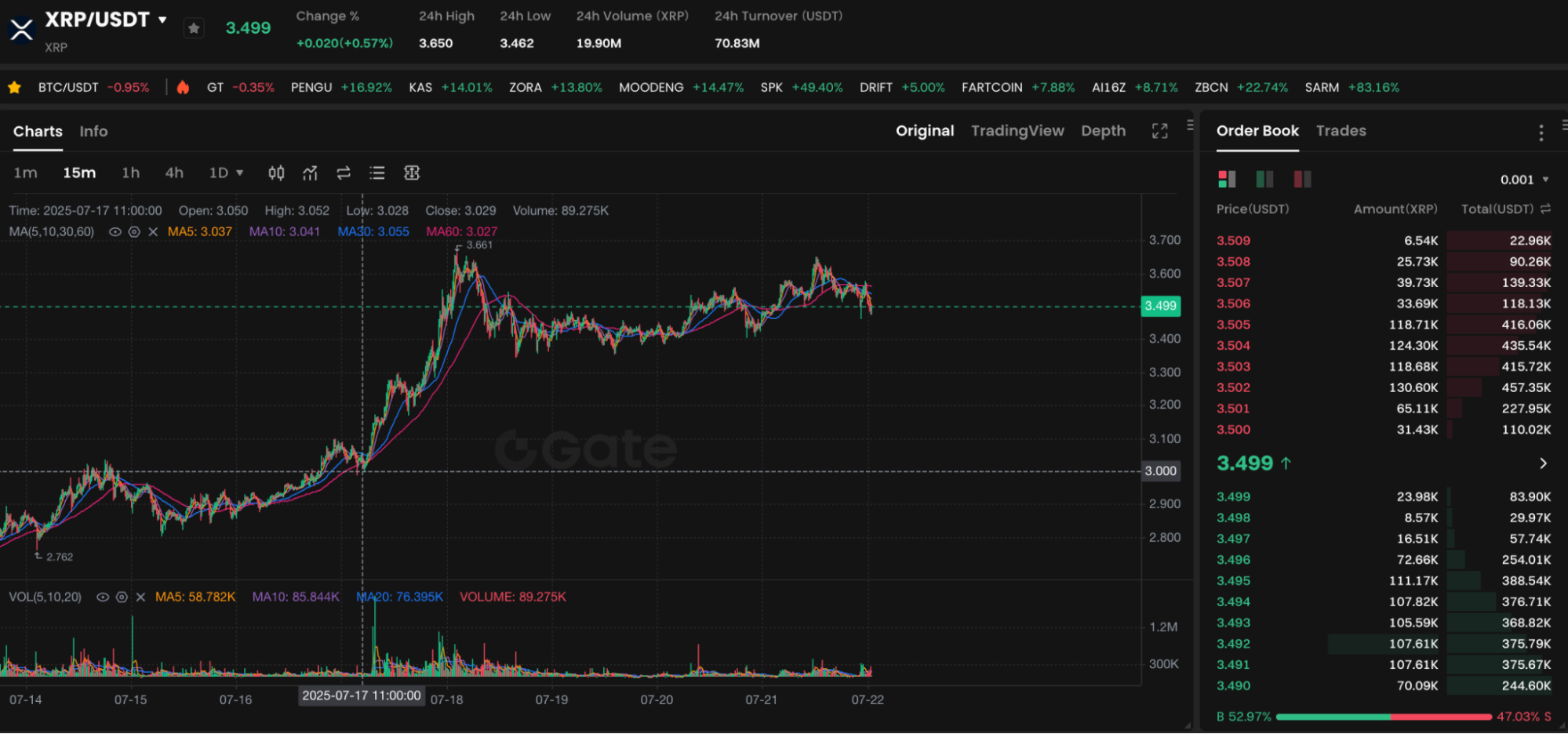
On July 17, 2025, XRP’s price briefly surged above $3, causing sharp market volatility. Liquidations of short positions greatly outpaced those of long positions, with the net difference totaling $18.89 million. This concentrated liquidation event highlighted heightened market risk.


Image source: https://www.gate.com/trade/XRP_USDT

The market experienced an abrupt, yet not entirely unexpected, breakout in XRP. For a significant period, XRP traded within a tight range of $2.60 to $2.90, with market sentiment generally cautious. Then, during the early hours of July 17 (Asia time), the price spiked to $3.08. It rapidly dropped back to the $2.90 zone, reflecting severe volatility.

Data from TradingView and CoinGlass show this sudden surge triggered an unprecedented liquidation event. On the derivatives market, XRP’s liquidation activity was highly disproportionate that day:

  • Total short liquidations: $28.93 million
  • Total long liquidations: $10.04 million
  • Net liquidation imbalance: $18.89 million—evidence that a wave of short positions was wiped out amid the price rally

Analysts believe many traders misjudged XRP’s ability to break through the $3 barrier and went short. Some exchanges offered leverage as high as 50x, significantly increasing risk exposure.

This event contributed to a broader market-wide shakeout. According to CoinGlass’s aggregated data:

  • Total market-wide liquidations reached approximately $560 million
  • More than 140,000 accounts were liquidated
  • XRP registered the third-highest liquidation volume among cryptocurrencies, trailing only BTC and ETH

Why Did XRP Experience This Sudden Volatility?

  1. Fear of Missing Out (FOMO) at the critical $3 psychological level: The $3 mark is a major psychological threshold for XRP. Breaking it triggers automatic buy orders and stop-losses from short sellers.
  2. Technical Breakout Driven by Bulls: Long traders may have leveraged a period of thin liquidity to drive a rapid price spike, forcing shorts to liquidate.
  3. Heightened Optimism Around SEC Developments: Even without concrete news, rising speculation about favorable outcomes in Ripple’s legal battle with the SEC further intensified market sentiment.

Investor Strategies for Sudden Liquidation Events

  • Avoid blindly betting on direction: When prices approach key round numbers, bulls and bears clash, making false breakouts or market whipsaws more likely.
  • Manage leverage prudently: Avoid using leverage exceeding 5x, particularly in highly volatile conditions.
  • Keep positions flexible. Use tiered stop-loss and take-profit strategies to allow for adjustments as conditions change.
  • Watch on-chain data and market sentiment. Surges in open interest or significant futures premiums often signal elevated risk.

Summary

The $18.89 million liquidation imbalance sparked by XRP’s breakout above $3 is more than just a dramatic number. It underscores the crypto market’s intense speculation, fragile sentiment, and concentration risks. Everyday investors should focus on interpreting these market signals rather than simply guessing price direction.

Author: Max
Disclaimer
* The information is not intended to be and does not constitute financial advice or any other recommendation of any sort offered or endorsed by Gate.
* This article may not be reproduced, transmitted or copied without referencing Gate. Contravention is an infringement of Copyright Act and may be subject to legal action.

Related Articles

AI-Native Settlement Layers: How United Stables Is Building the Next Financial Rail
Beginner

AI-Native Settlement Layers: How United Stables Is Building the Next Financial Rail

Stablecoins were originally designed as dollar substitutes within exchanges, primarily used for asset pricing and trade settlement. As on-chain financial ecosystems have matured, their role has expanded beyond simple payments to include collateral assets, cross-chain liquidity mediums, and unified settlement units. In particular, as AI systems and automated agents begin to participate directly in economic activity, demand has risen sharply for programmable value units capable of instant settlement. This shift is pushing stablecoins toward the role of foundational financial infrastructure.
2026-03-25 03:16:17
The ve(3,3) Flywheel Explained: How AERO Tokenomics Powers Aerodrome’s DeFi Economy
Beginner

The ve(3,3) Flywheel Explained: How AERO Tokenomics Powers Aerodrome’s DeFi Economy

In the competition for DeFi liquidity, high-inflation mining alone is no longer enough to build lasting advantages. Aerodrome applies the ve(3,3) economic model to redesign token emissions, voting mechanisms, and revenue distribution, creating a liquidity flywheel centered on governance and cash flow. This article examines AERO tokenomics, the veAERO locking mechanism, and protocol revenue models to explain how Aerodrome builds a sustainable DeFi economic system.
2026-03-25 06:41:58
How Does PAXG Work? In-Depth Overview of the Physical Gold Tokenization Mechanism
Beginner

How Does PAXG Work? In-Depth Overview of the Physical Gold Tokenization Mechanism

PAXG (Pax Gold) is a tokenized asset backed by physical gold, issued by the fintech company Paxos and traded on the Ethereum blockchain as an ERC-20 token. The core concept is to tokenize physical gold on-chain, with each PAXG token representing ownership of a certain amount of gold. This structure enables investors to hold and trade gold in the form of a digital asset.
2026-03-24 19:12:51
Aerodrome Tokenomics: How ve(3,3) Powers Base's Most Profitable DEX
Beginner

Aerodrome Tokenomics: How ve(3,3) Powers Base's Most Profitable DEX

AERO is the native token of Aerodrome Finance, a core decentralized exchange and liquidity protocol in the Base ecosystem. It is primarily used for liquidity incentives and ecosystem operations. veAERO is a governance NFT that users receive by locking AERO, representing both voting power and the right to share protocol revenue. Through a dual track structure of AERO as a utility token and veAERO as a governance credential, Aerodrome separates liquidity usage value from long term governance power, allowing participants to act as liquidity providers, governance decision makers, and revenue sharers within the same system.
2026-03-25 06:40:31
How is the price of PAXG determined? Pegging mechanism, trading depth, and influencing factors
Beginner

How is the price of PAXG determined? Pegging mechanism, trading depth, and influencing factors

PAXG (Pax Gold) is a tokenized asset backed by physical gold reserves, launched by fintech firm Paxos and issued as an ERC-20 token on the Ethereum blockchain. The core concept is to digitally represent real-world gold assets, allowing investors to hold and trade gold via the blockchain network. Because each PAXG token corresponds to a specific quantity of physical gold, its price is theoretically expected to closely track the global gold market.
2026-03-24 19:11:40
Hybrid Collateral Stablecoins: Inside United Stables' Stability and Yield Architecture
Beginner

Hybrid Collateral Stablecoins: Inside United Stables' Stability and Yield Architecture

In the early stages of the crypto market, traditional stablecoins mainly relied on single-reserve or single-collateral models. Their primary focus was price stability and payment convenience, which allowed them to become foundational tools for on-chain trading and capital flows. As the market has entered a more mature financial phase, however, this structure has begun to reveal limitations, including high concentration risk and the difficulty of balancing liquidity with yield. These constraints have driven the evolution toward multi-layer collateral and portfolio-based designs, such as the dual-layer hybrid collateral architecture proposed by United Stables, which seeks to redefine the underlying logic of stable assets.
2026-03-25 03:17:39