Stocks have long been one of the most important asset classes in global financial markets. Historically, investors have primarily traded stocks through brokerage accounts, with execution, clearing, and custody all managed by traditional finance infrastructure. With the rise of blockchain technology, stock assets are now entering the on-chain world in tokenized form, creating a new model of asset circulation.
xStocks is a representative framework in the tokenized stock ecosystem. Its primary goal is to establish a mapping between real stocks and on-chain tokens, enabling stock assets to circulate on blockchain networks. Meanwhile, traditional brokerages remain the dominant channel for global stock investing. While both systems cater to stock investment needs, they differ significantly in asset structure, market operation, and user experience.
What Is xStocks
xStocks is a tokenized stock system that converts real stocks into on-chain digital assets. Through a combination of asset custody, legal frameworks, and blockchain issuance, real stocks can be transformed into tokenized assets that users can hold and transfer on-chain. Instead of maintaining stock records in a traditional securities account, users hold corresponding stock tokens in a digital wallet.
At its core, xStocks is a key application of real-world asset tokenization. Its purpose is not to create new stocks but to digitize existing stock assets, integrating them into the blockchain ecosystem and unlocking programmability and on-chain liquidity.
What Is a Traditional Brokerage
A traditional brokerage is an intermediary that connects investors with securities markets. Investors open securities accounts with brokerages to buy and sell stocks on exchanges. After a trade, stock holdings are recorded in the brokerage's system and the central securities depository—not in a wallet under the investor's control.
Over decades, traditional brokerages have built a mature market infrastructure. Exchanges, central clearing houses, custodian banks, and regulators form a complete securities ecosystem, offering investors asset protection, transparency, and dispute resolution.
How Do Asset Holding Methods Differ?
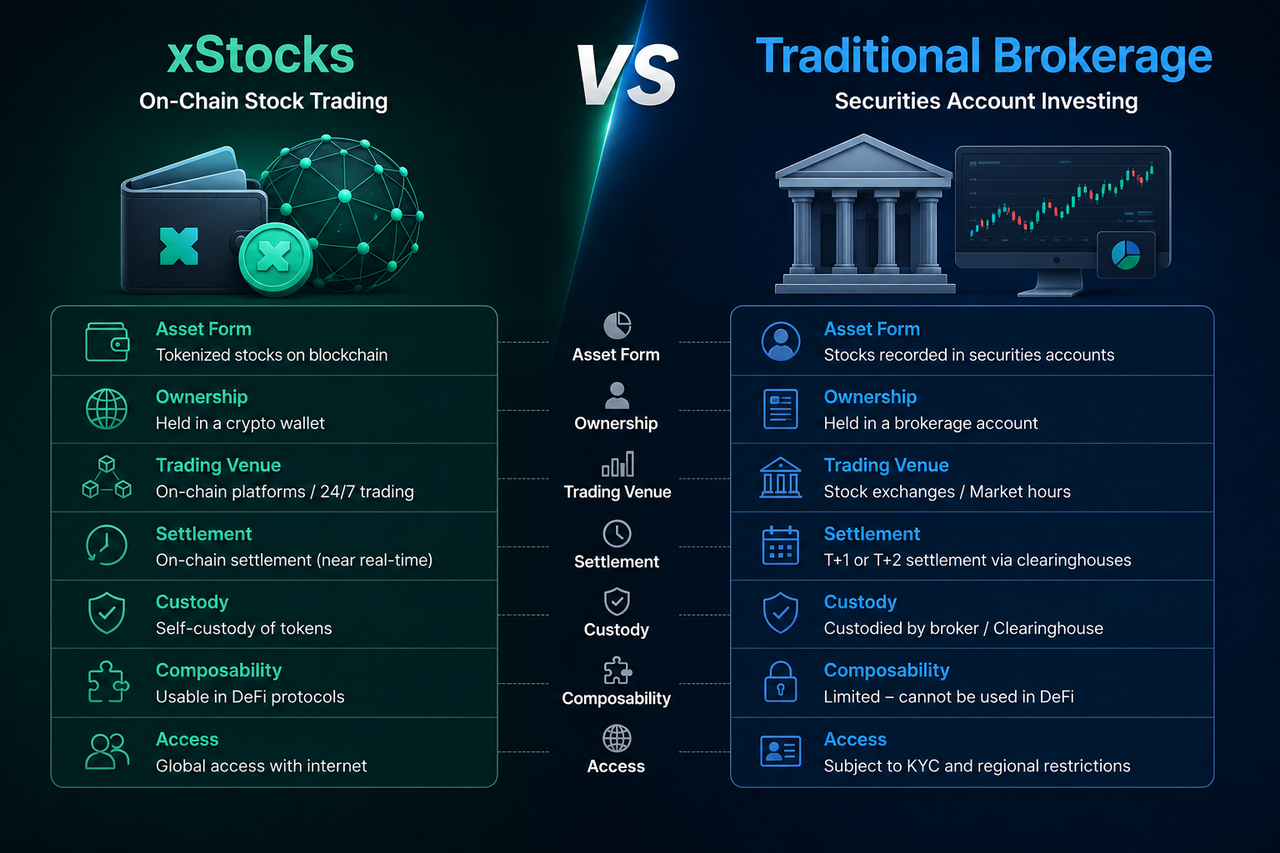
The most intuitive difference between xStocks and traditional brokerages is how assets are held.
In traditional markets, investors hold stocks via securities accounts managed by brokerages and depositories. This means investors rely on financial institutions to safeguard their assets.
With xStocks, stocks are represented as blockchain tokens. Users control token ownership directly through a digital wallet, giving them full management of on-chain assets. This shift from an account-based system to a wallet-based system is a critical distinction.
In essence, investors operate under two different asset management paradigms: one rooted in account records, the other based on private key control on the blockchain.
How Do Trading Mechanisms Differ?
Traditional brokerages execute trades on regulated stock exchanges. Buy and sell orders are matched in a centralized order book, with the exchange handling price discovery and trade execution. Market hours are limited to the exchange's operating schedule.
xStocks trades occur on platforms or on-chain markets that support tokenized stocks. Asset transfers are settled directly on the blockchain, with transaction records written to the distributed ledger. While different platforms may impose their own trading schedules, on-chain assets inherently offer greater flexibility.
From a technical standpoint, traditional brokerages depend on centralized trading infrastructure, whereas xStocks aligns more closely with the operating model of digital asset markets.
How Do Settlement Processes Differ?
Settlement is one of the most pronounced differences between the two systems.
Traditional securities markets use a multi-tiered clearing process. After a trade, the central clearing house confirms the transaction, net positions, and facilitates delivery—a process that typically involves a settlement cycle.
With xStocks, asset transfer and settlement happen nearly simultaneously on the blockchain. When a transaction is executed, token ownership is updated instantly on the ledger, dramatically reducing the time between trade and settlement.
This capability gives on-chain stocks near-real-time settlement, a major reason tokenized securities are gaining attention.
How Do Custody Models Differ?
Custody models determine how asset security is structured.
In traditional brokerages, stock assets are held by a combination of the brokerage, custodian bank, and central securities depository. Investors have beneficial ownership but no direct control over the underlying records.
In the xStocks model, the underlying stocks remain custodied by a professional institution, but the on-chain tokens are self-custodied by users. Investors manage assets through a digital wallet without needing to rely on a brokerage account for day-to-day operations.
Thus, traditional brokerages emphasize institutional custody, while xStocks introduces a hybrid model: institutional custody for the underlying assets combined with user self-custody of the tokenized representation.
How Do Market Access Methods Differ?
Access to markets is another key differentiator.
Traditional brokerages require account opening, identity verification, and compliance checks based on the investor's jurisdiction. Eligibility criteria vary across countries, creating different barriers for global investors.
xStocks aims to improve asset accessibility. By leveraging blockchain networks, stock assets can reach a global digital asset ecosystem in tokenized form. That said, specific products must still comply with local regulations, so access may vary by region.
In theory, tokenized stocks can lower the cost of cross-border participation, but in practice, regulatory frameworks remain a constraint.
How Do Investor Protection Mechanisms Differ?
Traditional securities markets have developed robust investor protection frameworks over the years. Regulators, exchanges, and brokerages share responsibilities for disclosure, risk management, and dispute resolution.
The tokenized securities market, including xStocks, is still evolving. Different projects vary in their asset disclosure, proof-of-reserves, and investor rights design. As a result, investors need to pay closer attention to product structure, custody arrangements, and compliance framework.
Looking ahead, the maturity of investor protection will be a key factor in the long-term growth of tokenized stock markets.
Core Differences: xStocks vs Traditional Brokerages
| Dimension |
xStocks |
Traditional Brokerages |
| Asset Form |
On-chain tokens |
Stock account records |
| Holding Method |
Digital wallet |
Securities account |
| Trading Environment |
On-chain platforms or digital asset markets |
Stock exchanges |
| Settlement Mechanism |
Blockchain settlement |
Central clearing system |
| Custody Model |
Stock custody + self-custodied tokens |
Managed by brokerages and custodians |
| Composability |
Can integrate with on-chain applications |
Typically cannot integrate directly |
| Asset Transfer |
On-chain transfers |
Depends on brokerage system |
| Market Infrastructure |
Blockchain network |
Traditional financial system |
Conclusion
Both xStocks and traditional brokerages offer investors exposure to stock markets, but they are built on fundamentally different infrastructure. Traditional brokerages rely on securities accounts, exchanges, and central clearing systems, while xStocks uses asset custody, legal structures, and blockchain networks to create a digital representation of stocks.
In terms of evolution, traditional brokerages represent the established securities market, while xStocks embodies the trend of tokenizing real-world assets. These two models are not simple substitutes—they are two distinct ways of circulating stock assets, shaped by different technological frameworks and market demands.
FAQs
Do xStocks and traditional brokerages give you exposure to the same stock?
xStocks typically represents real stocks through tokens, while traditional brokerages directly hold stock positions in your name. Both are linked to the same underlying asset, but the holding method and legal structure may differ.
Does xStocks require a securities account?
Holding xStocks generally relies on a digital wallet, not a traditional securities account. However, some products may still require identity verification and compliance procedures.
Why do traditional brokerages take longer to settle trades?
Traditional securities markets involve several steps—trade confirmation, central clearing, and securities delivery—which take time. This process helps maintain market stability and integrity.
Are the risks of xStocks the same as those of traditional brokerages?
Both are subject to market price fluctuations, but they differ in custody models, technical architecture, regulatory frameworks, and liquidity sources. They should not be considered identical investment products.