Over the past few years, Ethereum has used its smart contract advantage to build a mature DeFi market ahead of other networks, including lending, DEX, stablecoin, and derivatives ecosystems. Bitcoin, despite being the largest crypto asset by market size, has long lacked a complete on-chain financial system.
With the development of Stacks, sBTC, and Bitcoin Layer2 technology, BTCFi has begun growing quickly, and Zest Protocol is gradually becoming one of the important protocols in the Bitcoin-native lending market. The differences between Zest Protocol and Aave essentially reflect how Bitcoin DeFi and Ethereum DeFi differ in technical architecture, asset models, and market goals.
A Brief Outlook at Aave and Zest Protocol
As one of the leading lending protocols in the Ethereum DeFi ecosystem, Aave was first built on the Ethereum network and gradually expanded to multiple EVM-compatible chains. Aave’s core functions allow users to deposit crypto assets to earn interest, collateralize assets to borrow stablecoins, participate in flash loans, and use multichain liquidity markets. Aave supports a wide range of EVM assets, including ETH, USDC, DAI, and WBTC, and its liquidity scale has long ranked among the top in the DeFi market.
As a lending protocol in the Bitcoin DeFi, or BTCFi, ecosystem, Zest Protocol mainly runs on the Stacks network. In terms of direction, Zest Protocol focuses more on a Bitcoin-native financial system, aiming to let BTC participate in on-chain lending and liquidity markets. Its core areas include BTC-collateralized lending, sBTC liquidity markets, Bitcoin Layer2 financial protocols, BTCFi yield assets, and native BTC lending structures.
What Is the Difference Between Bitcoin DeFi and Ethereum DeFi?
Ethereum has supported smart contracts since its creation, so DeFi applications can be built directly on its mainnet.
Bitcoin, by contrast, places greater emphasis on security and decentralization. Its mainnet functionality is more conservative, which is why it long lacked complex financial applications.
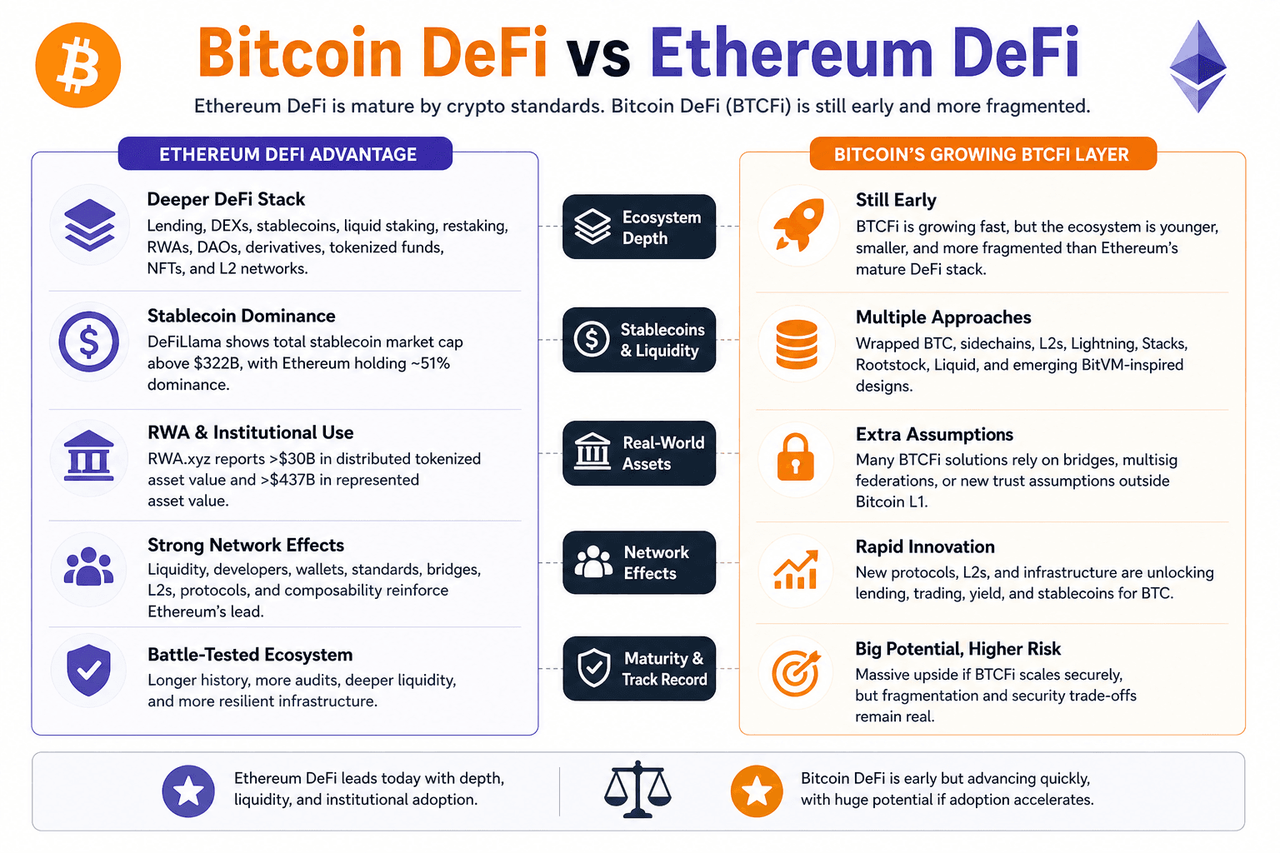
This has led the two ecosystems down different development paths:
| Comparison Dimension |
Bitcoin DeFi, or BTCFi |
Ethereum DeFi |
| Core Asset |
BTC |
ETH |
| Smart Contract Capability |
Layer2 expansion |
Native support |
| DeFi Development Timeline |
Later-stage development |
More mature |
| Main Goal |
Financialization of BTC |
General on-chain finance |
| Risk Preference |
Greater emphasis on security |
Greater emphasis on application innovation |
Ethereum DeFi is more oriented toward rapid innovation and diverse financial products, while BTCFi places greater emphasis on secure expansion of native Bitcoin assets and long-term value management.
How Do the Lending Mechanisms of Zest Protocol and Aave Differ?
Although both use an overcollateralized lending model, their underlying operating logic differs clearly.
Aave runs in an EVM smart contract environment, with a more mature lending market structure and support for many asset pools. Zest Protocol, by contrast, relies more on Bitcoin Layer2 and BTC-pegged asset structures.
The differences between their lending models mainly appear in the following areas:
| Comparison Dimension |
Zest Protocol |
Aave |
| Core Assets |
BTC, sBTC |
ETH, USDC |
| Underlying Network |
Stacks + Bitcoin |
Ethereum |
| Smart Contract Environment |
Bitcoin Layer2 |
EVM |
| Asset Expansion Method |
BTC-pegged assets |
Native ERC-20 |
| Market Maturity |
Early-stage BTCFi |
Mature DeFi |
For Aave, the lending market already has mature liquidity and a large user base. Zest Protocol, meanwhile, is still in the stage of building Bitcoin-native financial infrastructure.
Why Does BTCFi Rely More on Layer2?
The Bitcoin mainnet itself does not support complex smart contracts, so BTCFi must rely on Layer2 networks to expand its functionality.
Stacks serves a role similar to a smart contract execution layer for Bitcoin, while sBTC is responsible for bringing BTC into a programmable financial environment.
In Zest Protocol:
-
BTC enters the lending market through sBTC
-
Stacks executes the lending logic
-
Smart contracts manage collateral ratios and liquidations
-
BTCFi liquidity pools provide funding support
By comparison, Ethereum DeFi protocols can run their core financial logic without requiring an additional Layer2.
As a result, Bitcoin DeFi places greater emphasis on “secure expansion,” while Ethereum DeFi focuses more on “application efficiency.”
Why Is There a Gap in Liquidity Scale Between Public Chains?
Ethereum DeFi has been developing for many years, so it has a more mature capital market.
Aave’s pool size, stablecoin liquidity, and level of institutional participation are usually much higher than those of current BTCFi protocols.
BTCFi, meanwhile, is still an early-stage market. Its main challenges include:
-
Bitcoin Layer2 infrastructure is not yet mature
-
Native BTC liquidity is limited
-
The scale of programmable assets remains small
-
User habits still lean toward long-term BTC holding
That said, BTCFi’s advantage is that it is backed by the world’s largest crypto asset category.
Why Does Zest Protocol Emphasize Bitcoin-Native Finance?
The core logic of Ethereum DeFi is to build open on-chain financial markets.
BTCFi, however, places more emphasis on long-term value management for native Bitcoin assets.
For many BTC holders, the key concerns are:
-
How to obtain liquidity without selling BTC
-
How to maintain long-term BTC exposure
-
How to reduce cross-chain custody risk
-
How to participate in financial markets that are closer to Bitcoin-native structures
For this reason, Zest Protocol focuses more on:
-
BTC-collateralized lending
-
Native BTC liquidity
-
Non-custodial financial structures
-
Bitcoin Layer2 infrastructure
This is also one of the important differences between BTCFi and traditional Ethereum DeFi.
Conclusion
Zest Protocol and Aave are both decentralized lending protocols, but they represent different directions for Bitcoin DeFi and Ethereum DeFi.
Aave is built on the mature Ethereum smart contract ecosystem, with deep liquidity and a well-developed capital market. Zest Protocol focuses more on Bitcoin-native lending structures and aims to expand BTC’s financial capabilities through Stacks and sBTC.
The difference between the two essentially reflects the different roles Bitcoin and Ethereum play in blockchain finance. Ethereum places greater emphasis on open financial innovation, while Bitcoin places greater emphasis on security and store-of-value properties.
FAQs
What Is the Biggest Difference Between Zest Protocol and Aave?
The biggest difference between Zest Protocol and Aave is their underlying ecosystem. Zest Protocol is built for Bitcoin DeFi, or BTCFi, while Aave belongs to the Ethereum DeFi ecosystem.
Does Zest Protocol Use Overcollateralized Lending?
Yes. Similar to Aave, Zest Protocol also uses an overcollateralized lending model.
Why Does Bitcoin DeFi Rely More on Layer2?
Because the Bitcoin mainnet itself does not support complex smart contracts, BTCFi needs Layer2 networks to expand its financial functions.
What Is the Difference Between sBTC and WBTC?
sBTC is more focused on the Bitcoin-native Layer2 ecosystem, while WBTC is mainly used in Ethereum DeFi.
Why Is BTCFi Starting to Gain Attention?
Because more market participants want to improve BTC’s capital efficiency and enable Bitcoin to participate in on-chain financial activity.
Is Zest Protocol a Bitcoin Layer2 Protocol?
Strictly speaking, Zest Protocol is a BTCFi application protocol that runs within the Bitcoin Layer2, Stacks, ecosystem.