
Futures
Access hundreds of perpetual contracts
CFD
Gold
One platform for global traditional assets
Options
Hot
Trade European-style vanilla options
Unified Account
Maximize your capital efficiency
Demo Trading
Introduction to Futures Trading
Learn the basics of futures trading
Futures Events
Join events to earn rewards
Demo Trading
Use virtual funds to practice risk-free trading
Launch
CandyDrop
Collect candies to earn airdrops
Launchpool
Quick staking, earn potential new tokens
HODLer Airdrop
Hold GT and get massive airdrops for free
Pre-IPOs
Unlock full access to global stock IPOs
Alpha Points
Trade on-chain assets and earn airdrops
Futures Points
Earn futures points and claim airdrop rewards


Promotions
AI
Gate AI
Your all-in-one conversational AI partner
Gate AI Bot
Use Gate AI directly in your social App
GateClaw
Gate Blue Lobster, ready to go
Gate for AI Agent
AI infrastructure, Gate MCP, Skills, and CLI
Gate Skills Hub
10K+ Skills
From office tasks to trading, the all-in-one skill hub makes AI even more useful.
GateRouter
Smartly choose from 40+ AI models, with 0% extra fees


Is Taiwan opening up Bitcoin ETFs? Financial Supervisory Commission: Will provide an explanation by the end of June
Author: Max, Crypto City
Bitcoin ETF review enters deep waters; Financial Supervisory Commission promises to reveal the truth by the end of June
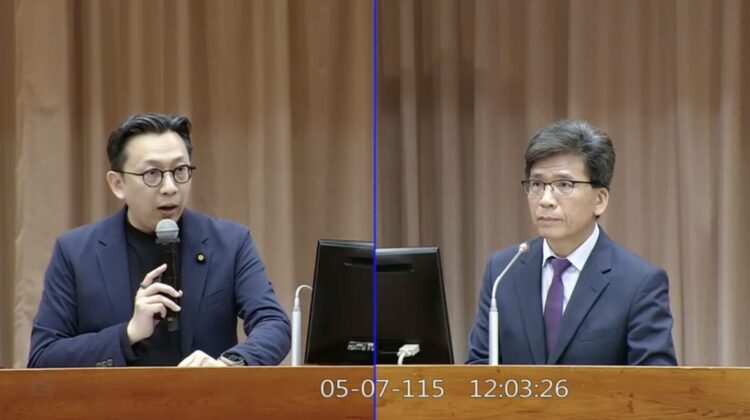
The Legislative Yuan Finance Committee held a meeting on May 7, 2026, to conduct intense questioning on virtual asset regulation and digital financial development. Kuomintang legislator Ge Rujun was the first to raise concerns, pointing out that global digital assets are rapidly converging in Taiwan, and the push for Bitcoin ETFs has become an irreversible trend.
Ge Rujun mentioned that recently, international financial giants like Morgan Stanley have joined the competition for Bitcoin spot ETFs, indicating that traditional finance’s embrace of digital assets is becoming increasingly formalized. He further revealed that he has forwarded a research report titled “Bitcoin as a Reserve Asset,” drafted by staff of U.S. Senate members, to the Financial Supervisory Commission. The report details the pros and cons of including Bitcoin in national reserves and offers legal recommendations.
FSC Chair Peng Jinlong responded that he has read the report and understands the multiple advantages of viewing Bitcoin as a reserve asset. Regarding the market’s most concerned issue—the progress of opening Bitcoin ETFs—Peng Jinlong admitted that the securities association submits an implementation report and analysis every six months, which has already been delivered to the FSC and is under intensive internal discussion.
In response to Ge Rujun’s follow-up question about a clear policy timetable, Peng Jinlong promised to conduct rolling reviews every six months, with the goal of providing an explanation to the public on the feasibility and discussion results of Bitcoin ETFs before the end of June 2026.
Ge Rujun emphasized that countries worldwide are competing for the position of digital asset management centers. If Taiwan can establish a complete legal framework early, it will help attract global capital and prevent the continuous outflow of funds interested in such products.
RWA Tokenization Opens New Asset Management Frontiers, Bonds and Gold as Pioneers
Besides ETFs, the tokenization of real-world assets (RWA) became another major focus of the questioning. Legislators from the Democratic Progressive Party, Zhong Jiapin and Ge Rujun, both expressed high concern.
Ge Rujun cited the latest developments from the U.S. Depository Trust & Clearing Corporation (DTCC), stating that the organization has obtained approval from the U.S. Securities and Exchange Commission (SEC) to fully tokenize assets worth up to $114 trillion. This groundbreaking move, which shocks the global financial market, is seen as a significant milestone in pushing asset values toward digitalization. Zhong Jiapin, from the perspective of “century trusts” and “asset inheritance,” asked how the FSC can utilize asset tokenization to retain Taiwan’s private wealth and attract overseas assets back.
Peng Jinlong pointed out that the FSC is actively promoting the Asia-Pacific asset management center, with RWA being an important future application scenario. Currently, the initial plan is to adopt a trial approach, prioritizing the tokenization of “bonds” and “gold.” He explained that these two assets were chosen first because they are easier to value. Compared to funds with complex account structures, bonds and U.S. Treasuries are less difficult to tokenize in the early stages.
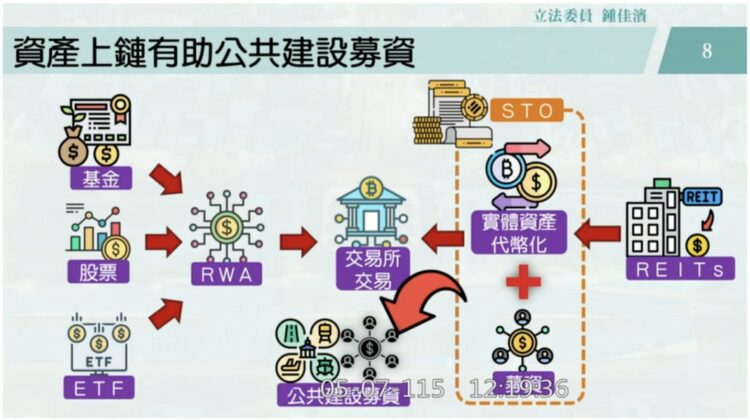
Zhong Jiapin then suggested that bills and real estate investment trusts (REITs) should also be included in the scope of RWA, believing this would enrich tokenization content and facilitate public infrastructure funding. Peng Jinlong was open to this idea, stating that the spirit of RWA is that any asset can be tokenized. In the future, they will refer to international trends and gradually expand the scope, including REITs in the development blueprint.
Image source: Legislative Yuan Finance Committee | Democratic Progressive Party legislator Zhong Jiapin immediately suggested including bills and REITs in the scope of RWA
Learning from Japan and the U.S. Stablecoin Regulatory Frameworks to Promote Virtual Assets Linked to Fiat Currency
Regarding the connection between virtual assets and the real financial system, Ge Rujun shared Japan’s successful experience in digital finance. He pointed out that Japan adopts a decentralized regulatory model, where experienced financial institutions are responsible for underwriting and issuing virtual assets, and trust banks hold 1:1 fiat currency reserves to issue stablecoins. These are then circulated and traded by regulated Virtual Asset Service Providers (VASPs), ensuring the legal listing and settlement of stablecoins on platforms. Ge Rujun believes this win-win model allows traditional banks and startups to share profits, serving as an important reference for Taiwan when drafting subsidiary laws related to VASPs.
Additionally, Ge Rujun mentioned the progress of the U.S. CLARITY Act, especially regarding the controversy over whether stablecoins can generate yields. The U.S. has proposed a compromise: passive fixed interest may be limited, but if users engage in specific active activities and rewards, there is room for compliance.
Peng Jinlong responded that the FSC is closely monitoring international regulatory developments, including new regulations expected to be announced in June and July.
Regarding the enforcement direction for the NT dollar stablecoin, the FSC plans to strengthen communication with industry players to ensure that high-potential VASPs are included in the issuance system during the formulation and enforcement of the special law, connecting virtual and physical currencies and preventing Taiwan from falling behind in international competition.
VASP Special Law Draft Sparks Attention: Balancing Regulatory Risks and Innovation
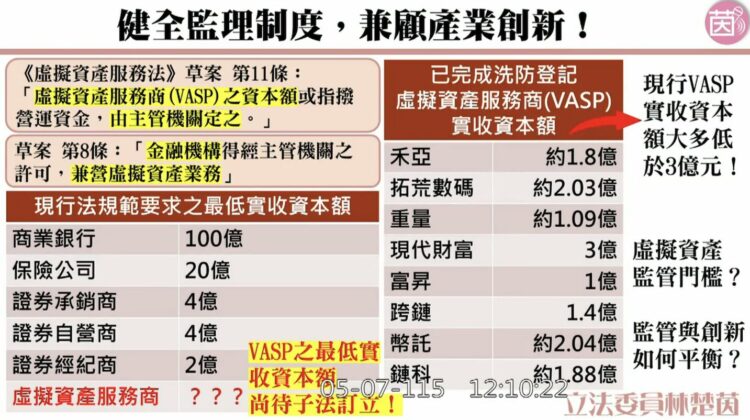
Democratic Progressive Party legislator Lin Chuyin focused on the upcoming draft of the “Virtual Asset Service Law.” She pointed out that Taiwan’s domestic VASP operators have shrunk from a peak of 26 to the current 8, indicating that small startups are gradually exiting the market.
Image source: Legislative Yuan Finance Committee | Democratic Progressive Party legislator Lin Chuyin worries that if the future law’s capital requirements are too high or compliance costs increase significantly, the market will face a situation where “small fish cannot compete with big whales.”
Lin Chuyin expressed concern that if the capital threshold set by the future law is too high or compliance costs are significantly increased, only large traditional financial institutions will be able to survive, leading to a market dominated by “big whales.” She cited data showing that the EU’s asset requirement for low-risk operators is about NT$1.84 million, Hong Kong’s ranges from NT$20 million to NT$40 million, and the U.S. is around NT$15 million. She urged the FSC to consider industry diversity while regulating.
In response to legislators’ concerns about the survival space for startups, Peng Jinlong explained that the future regulatory framework will adhere to a risk-based approach (Risk-Based Capital, RBC). He emphasized that capital requirements are meant to protect traders and investors, with higher risks requiring higher capital buffers.
Peng Jinlong promised that when drafting enforcement rules, the FSC will refer to international standards for actual capital requirements and ensure transparency in the rules. He believes that market competition is free, and capable operators will survive under regulations. The policy will not provide long-term protection for specific players; the goal is to establish a fair and internationally competitive digital financial environment.
The three legislators finally urged the FSC to rigorously supervise while leveraging Taiwan’s status as a tech giant, turning the virtual asset industry into a new engine for Taiwan’s financial progress.